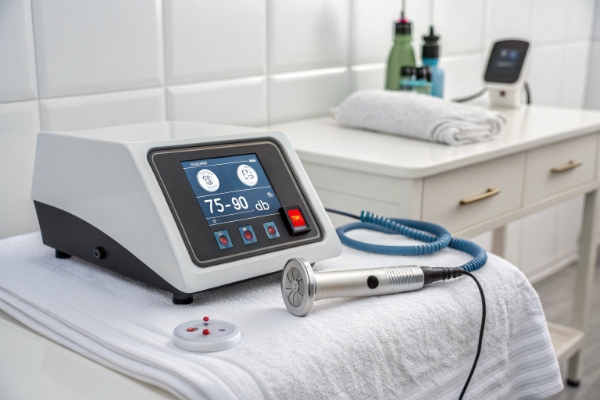
As the manufacturer, I often receive questions about whether shockwave therapy devices are “too loud” for clinical use. Our testing confirms that while the acoustic impulse is distinct, the sound exposure remains within recognized occupational safety limits when operated as directed.
Shockwave therapy machines typically produce impulse noise between 75 dB and 90 dB, depending on model type, frequency, and energy setting. Radial pneumatic devices tend toward the upper range (85–90 dB), while focused electromagnetic systems usually operate closer to 75–85 dB.
Understanding these sound levels helps clinics design comfortable, compliant workspaces in line with occupational noise exposure guidelines 1.
How does machine noise affect client comfort and staff environment in clinics?
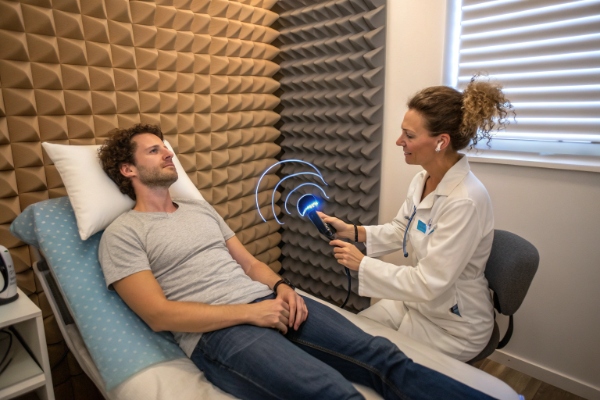
The “crack” sound of a shockwave pulse is short and rhythmic. Patients often describe it as similar to tapping or drumming. Though transient, repeated exposure can create mild discomfort or distraction, particularly in quiet treatment environments, especially when considering sound-pressure perception principles 2.
Noise affects both patient relaxation and staff fatigue. While short-term sessions rarely cause auditory harm, repeated exposure near 85–90 dB may justify protective measures or acoustic mitigation in high-volume clinics, consistent with recommended hearing protection practices 3.
Impact overview
- Patient comfort: Higher frequencies (20–25 Hz) can seem louder and more startling.
- Practitioner fatigue: Operators standing close to the handpiece experience cumulative daily noise load.
- Acoustic reflection: Rooms with hard floors or walls amplify perceived loudness per basic room acoustics behavior 4.
Table 1 — Noise perception in clinical operation
| Setting factor | Noise effect | Mitigation |
|---|---|---|
| Small enclosed room | Reverberation ↑ | Install acoustic panels |
| Multiple devices in same room | Overlap ↑ | Use scheduling separation |
| High-frequency protocols | Pulse count ↑ | Offer ear protection |
| Sensitive patients | Stress ↑ | Allow familiarization phase |
What is the typical noise range (dB) during operation for radial vs focused machines?
Different technologies generate noise in distinct ways. Pneumatic (radial) systems expel compressed air against an internal projectile, while focused systems use electromagnetic or piezoelectric drivers—quieter but sharper in tone.
Typical radial shockwave systems measure 85–90 dB at 1 m distance at maximum energy; focused systems average 75–85 dB. Environmental reflections and machine enclosure design can shift readings by ±3 dB.
These metrics align with A-weighted decibel measurement 5 used across medical device acoustics.
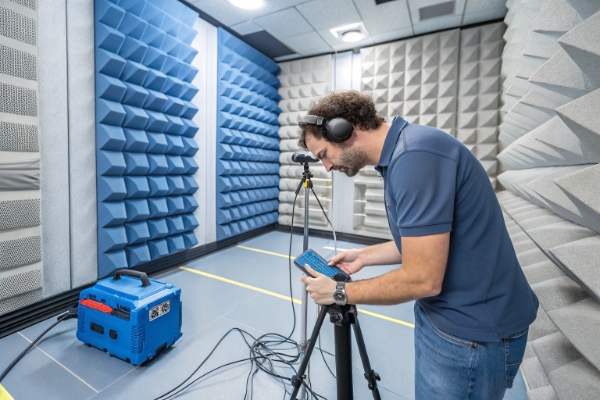
Table 2 — Measured noise levels by technology type
| Device type | Mechanism | Typical noise (dB A) | Measurement distance |
|---|---|---|---|
| Radial pneumatic | Air-propelled projectile | 85–90 | 1 m |
| Electromagnetic focused | Coil-driven acoustic pulse | 78–85 | 1 m |
| Piezoelectric focused | Crystal array impulse | 75–82 | 1 m |
| Portable/home models | Low-pressure variants | 70–80 | 1 m |
How should buyers request noise-level measurements or supplier documentation?
Noise testing for shockwave devices is not universally standardized, but reputable manufacturers perform ISO 3744/3746 acoustic pressure measurements or equivalent under controlled lab conditions, which are based on international acoustic testing standards 6.
Buyers should request third-party or in-house acoustic test reports specifying sound pressure level (SPL in dB A), measurement method, and test distance. Supplier responses should include raw data or certification references for verification.

Table 3 — Buyer checklist for verifying noise documentation
| Requirement | Why it matters | Expected data |
|---|---|---|
| Measurement standard | Confirms repeatable method | ISO 3744 / IEC 61672 |
| Energy/frequency condition | Noise scales with energy | Report test parameters |
| Distance from source | Critical for comparison | Usually 1 m |
| Peak vs. equivalent SPL | Impulse vs. continuous | Both values if available |
| Environment description | Room acoustics influence results | Anechoic or clinical room |
Are there industry guidelines on acceptable noise levels for therapy devices?
While no ESWT-specific EU or ISO standard limits noise output, general medical-electrical safety standards reference acceptable sound exposure indirectly.
Most clinics follow occupational noise directives recommending ≤ 85 dB A daily exposure for staff and ≤ 90 dB A peak at patient position. Manufacturers align with IEC 60601-1 ergonomic clauses, which require risk assessment of acoustic discomfort.
These include the EU’s Directive 2003/10/EC on worker noise exposure 7, OSHA’s hearing conservation rules 8, WHO’s environmental noise guidelines 9, and clinical best-practice recommendations from ISMST and physiotherapy associations.

Conclusion
Shockwave therapy machines emit 75–90 dB of impulse noise depending on technology and energy level. This sound is safe under regulated exposure but can affect comfort and concentration.
Clinics should assess acoustic layout, verify supplier test data, and consider basic hearing protection for high-frequency, high-volume operation, consistent with globally recognized noise risk-management practices 10.
Footnotes
1. OSHA guidance on occupational noise exposure limits. ↩︎
2. Overview of sound-pressure physics affecting human perception. ↩︎
3. NIOSH recommendations for preventing hearing damage from workplace noise. ↩︎
4. Introduction to room acoustics and noise reflections. ↩︎
5. Technical explanation of A-weighted decibels used in noise testing. ↩︎
6. ISO 3744 airborne noise measurement standard. ↩︎
7. EU directive regulating occupational noise exposure. ↩︎
8. OSHA rules defining noise exposure and safety thresholds. ↩︎
9. WHO guidelines for environmental and occupational noise. ↩︎
10. HSE UK best-practice guidance on workplace noise control. ↩︎

 English
  Español de México
  Deutsch
  Français
  العربية
  Русский