Every month, our export team sees at least two or three shipments stuck at U.S. ports. The frustration is real. Your customers wait. Storage fees pile up. Revenue stalls. FDA holds 1 on shockwave therapy machines 2 have become a growing pain point for importers sourcing from China.
To handle FDA holds effectively, importers must verify manufacturer FDA registration, confirm 510(k) clearance status, prepare complete documentation before shipment, and respond promptly to FDA notices with accurate evidence. Working closely with your Chinese supplier and engaging regulatory experts significantly reduces hold duration and prevents future detentions.
This guide walks you through the exact steps to prevent holds, respond to FDA actions, verify clearance status, and manage physical examinations. Let us dive in.
What documentation do I need to prepare to avoid FDA holds on my shockwave therapy machines?
Our shipping department has learned this lesson the hard way. One missing document can delay your shipment for weeks. The FDA's PREDICT system 3 scans every entry, regardless of value, and flags inconsistencies instantly.
To avoid FDA holds, you need complete documentation including commercial invoices, bills of lading, FDA registration numbers, device listing codes, 510(k) clearance letters, ISO 13485 certificates, labeling documentation, and a Declaration of Conformity. Every detail must match FDA database records exactly.

Core Documentation Checklist
Before your shockwave therapy machine leaves our warehouse, we verify every piece of paper. Missing or incorrect documentation is the number one reason for FDA holds.
| Document Type | Purpose | Who Provides It |
|---|---|---|
| Commercial Invoice | Product details, value, and transaction record | Manufacturer/Exporter |
| Bill of Lading | Shipping and cargo details | Freight forwarder |
| FDA Registration Number | Proves manufacturer is registered | Manufacturer |
| Device Listing (LST) Code | Confirms device is listed with FDA | Manufacturer |
| 510(k) Clearance Letter | Proves premarket clearance | Manufacturer |
| ISO 13485 Certificate | Quality management system proof | Third-party certifier |
| Declaration of Conformity | Compliance statement | Manufacturer |
| Labeling Documentation | Product labels and instructions | Manufacturer |
Why Accuracy Matters More Than Completeness
Having all documents is not enough. The FDA cross-references your entry transmission against their CDRH database 4. If your invoice says "Model A" but the 510(k) clearance covers "Model A-1," you have a problem.
When we prepare export documents, our team double-checks every model number, every registration code, and every manufacturer name. A single typo can trigger a detention notice.
Pre-Shipment Verification Steps
Before booking freight, smart importers take these steps:
- Request current FDA registration confirmation from your supplier
- Verify the 510(k) number on FDA's public database
- Confirm the device classification matches your intended use
- Check that all labeling meets FDA requirements
- Ensure the manufacturer's name and address match FDA records
Our quality team maintains a pre-shipment checklist specifically for FDA-regulated markets. This practice has reduced our clients' hold rates significantly.
Common Documentation Mistakes
Many importers make these errors:
- Using outdated FDA registration numbers
- Listing the wrong product code
- Providing NMPA approval documents 5 instead of FDA clearance
- Omitting Affirmation of Compliance codes 6
- Confusing "FDA Registered" with "FDA Cleared"
These mistakes seem small but cause major delays. Prevention is always cheaper than resolution.
How do I respond to an FDA Notice of Action if my imported beauty equipment is detained?
When our clients receive that dreaded FDA notice, panic often sets in. I understand the stress. Your inventory is stuck, customers are waiting, and every day costs money. But a strategic response can resolve most detentions.
When you receive an FDA Notice of Action, immediately identify the specific violation cited, gather supporting documentation from your manufacturer, submit a written response within the specified timeframe (usually 10-20 days), and request re-examination if the hold resulted from documentation errors. Fast, accurate responses are critical.

Understanding the Three Types of FDA Actions
The FDA uses different enforcement levels. Your response strategy depends on which one you face.
| Action Type | What It Means | Resolution Difficulty | Typical Timeframe |
|---|---|---|---|
| Detention | Temporary hold pending inspection or testing | Moderate | 2-4 weeks |
| Import Alert | Company flagged for repeated violations | High | 3-6 months |
| Refusal | Product deemed non-compliant, must export or destroy | Very High | 90 days max |
Step-by-Step Response Process
When a detention notice arrives, follow this sequence:
First, read the notice carefully. Identify the exact violation code and description. specific violation code 7 The FDA provides specific reasons—do not guess.
Second, contact your Chinese manufacturer immediately. At our facility, we keep compliance files ready for exactly these situations. Your supplier should provide:
- Current FDA registration confirmation
- Original 510(k) clearance documentation
- Manufacturing records for the specific shipment
- Any additional technical data requested
Third, prepare your written response. Be factual and concise. Include only relevant documents. The FDA reviewer handles hundreds of cases—make yours easy to process.
What to Include in Your Response
Your response package should contain:
- A cover letter addressing each violation point
- Corrected or clarified documentation
- Evidence that the product meets FDA requirements
- Any third-party test reports if requested
- A clear request for re-examination or release
Working with Your Customs Broker
A good customs broker is invaluable during FDA holds. They understand the system, know the local FDA office contacts, and can expedite communication. When we ship to the U.S., we always recommend our clients use brokers experienced with medical device imports.
Timeline Management
Time is critical. The FDA gives deadlines. Missing them can escalate detention to refusal. Mark every deadline on your calendar. Submit responses early when possible.
Our experience shows that well-prepared responses resolve most detentions within two to three weeks. Poor responses can extend holds for months.
Can my Chinese manufacturer help me verify the FDA 510(k) status of my private-label devices?
This question comes up in almost every conversation with new clients. They want private-label shockwave therapy machines but worry about FDA compliance. The answer depends on your manufacturer's regulatory knowledge and transparency.
Your Chinese manufacturer can help verify 510(k) status by providing clearance letters, predicate device information, and registration numbers. However, you must independently verify this information on FDA's public database. Manufacturers should share all regulatory documentation openly—if they hesitate, consider it a warning sign.

What "FDA Registered" vs. "FDA Cleared" Really Means
This distinction trips up many importers. They are not the same thing.
| Term | Meaning | Sufficient for Import? |
|---|---|---|
| FDA Registered | Manufacturer has registered their facility | No |
| FDA Listed | Device is listed in FDA database | No |
| FDA Cleared (510(k)) | Device has premarket clearance | Yes |
| FDA Approved (PMA) | Device has premarket approval | Yes |
Registration and listing are administrative requirements. Clearance or approval means the FDA has reviewed the device for safety and effectiveness. Only cleared or approved devices can legally enter the U.S. market.
How to Verify 510(k) Status Independently
Never rely solely on your manufacturer's claims. Verify independently:
- Visit FDA's 510(k) Premarket Notification Database 8
- Search by manufacturer name or product code
- Confirm the clearance covers your specific device model
- Check that "Indications for Use" match your intended application
- Download the clearance letter for your records
When our clients ask about 510(k) status, we provide the clearance number and direct them to FDA's database. Transparency builds trust.
The Private-Label Complication
Private-labeling adds complexity. If you put your brand on a device, you may need your own 510(k) submission. This depends on:
- Whether you are the "specification developer"
- The extent of labeling changes
- Any modifications to the device
Some manufacturers have clearances that cover private-label versions. Others do not. Clarify this before signing any agreement.
Questions to Ask Your Manufacturer
Before committing to a supplier, ask:
- What is the exact 510(k) number for this device?
- Does the clearance cover private-label distribution?
- What are the cleared "Indications for Use"?
- When was the clearance obtained?
- Have there been any FDA enforcement actions?
A reputable manufacturer answers these questions quickly and completely. Evasive answers signal potential problems.
The NMPA vs. FDA Gap
Chinese manufacturers often have NMPA (China's FDA equivalent) approval. They assume this transfers to U.S. requirements. It does not. CE marking for Europe does not transfer either. FDA requires separate, specific clearance.
At our facility, we maintain FDA clearances independent of our NMPA registrations. This costs more but enables compliant export to the United States.
What steps should I take if my shockwave therapy machine shipment is flagged for an FDA physical examination?
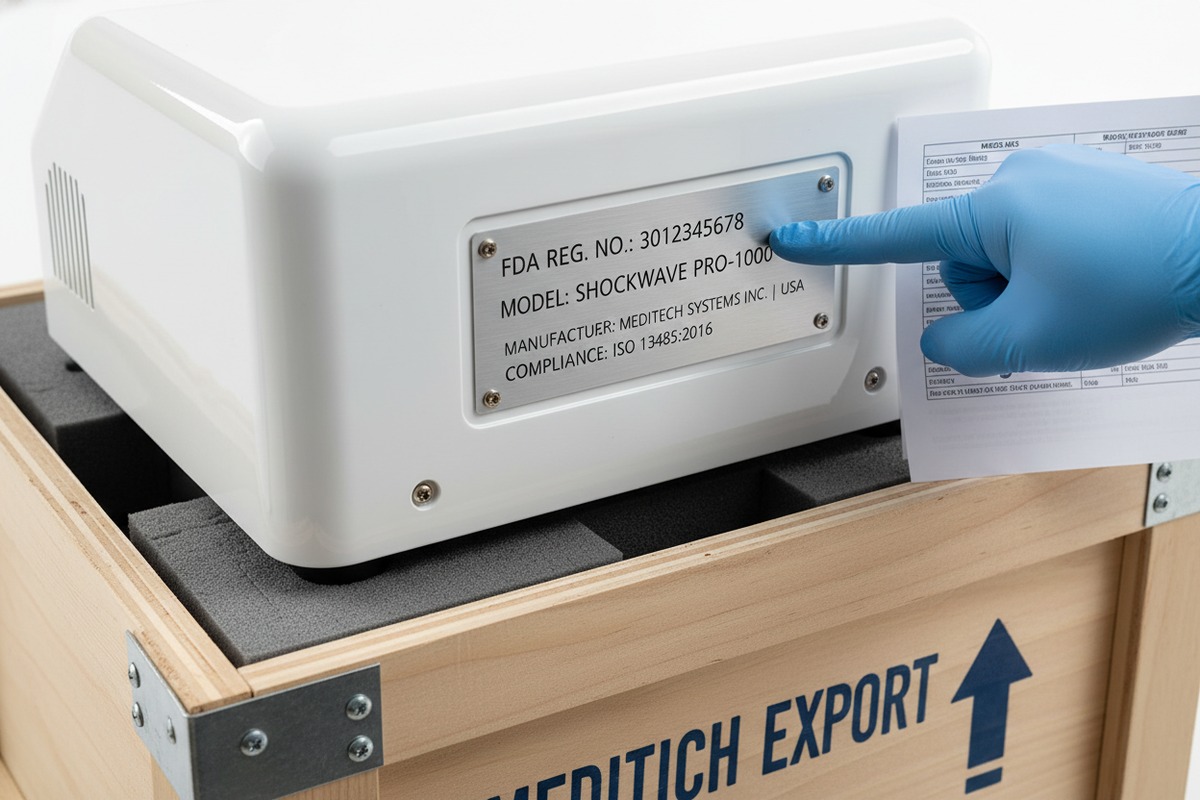
Physical examinations add stress and delay. The FDA wants to see the actual product, not just documents. Our export team has guided many shipments through this process. Preparation and cooperation make the difference.
If your shipment faces FDA physical examination, do not interfere with the inspection process. Ensure all labeling on the actual product matches documentation. Provide any additional information the FDA requests promptly. Work with your customs broker to facilitate access. Most physical exams conclude within days if the product is compliant.
What Happens During Physical Examination
The FDA may examine your shipment at the port or have it moved to an examination facility. They check:
- Product labeling accuracy
- Physical condition of devices
- Consistency with declared specifications
- Compliance with safety requirements
Inspectors compare what they see to what your documents claim. Discrepancies trigger further action.
Before the Examination
You cannot predict every physical exam, but you can prepare:
- Ensure all product labels are accurate and legible
- Verify model numbers on devices match documentation
- Check that packaging is intact and professional
- Confirm instruction manuals are included and compliant
- Keep additional documentation readily available
At our production facility, we photograph every shipment before sealing containers. This creates a record of product condition at departure.
During the Examination
Cooperation is essential. Do not argue with inspectors or provide misleading information. If they ask questions, answer honestly. Your customs broker can serve as your representative at the examination site.
Key points during examination:
- Respond to requests within 24 hours when possible
- Provide clear, direct answers
- Offer additional documentation if it helps clarify concerns
- Do not attempt to modify products after examination begins
Common Physical Examination Triggers
Understanding why examinations happen helps prevent them:
| Trigger | Description | Prevention Strategy |
|---|---|---|
| Random Selection | Routine sampling | None—accept as cost of importing |
| Previous Violations | History of non-compliance | Maintain clean compliance record |
| Documentation Flags | Inconsistencies in paperwork | Perfect documentation accuracy |
| Import Alert Status | Manufacturer on alert list | Source from compliant manufacturers |
| New Importer | First-time importers face more scrutiny | Build track record gradually |
After the Examination
If your products pass, they will be released. If problems emerge, you will receive a notice detailing the issues. Your response options depend on the specific findings.
Products that fail examination may be:
- Released with conditions
- Detained pending further documentation
- Refused entry entirely
Our quality control team designs packaging and labeling specifically to pass physical inspections. This includes clear model numbers, proper warnings, and FDA-compliant labeling formats.
Working with Your Manufacturer Post-Examination
After any FDA examination, communicate results to your manufacturer. If issues were found, require corrective action. Document everything. Future shipments should incorporate lessons learned.
When our clients report examination findings, we treat them as quality improvement opportunities. Continuous improvement reduces future risks.
Conclusion
FDA holds are manageable when you prepare properly and respond strategically. Complete documentation, verified clearances, cooperative responses, and quality manufacturing practices keep your shockwave therapy machine imports flowing smoothly.
Footnotes
1. Explains the reasons and process for FDA detentions on imported products. ↩︎
2. Provides official FDA classification for shockwave therapy devices. ↩︎
3. Official FDA page describing the PREDICT system for import screening. ↩︎
4. Lists various medical device databases maintained by FDA’s CDRH. ↩︎
5. Provides an overview of medical device regulations by China’s NMPA. ↩︎
6. Official FDA resource explaining Affirmation of Compliance codes for imports. ↩︎
7. Explains FDA Notice of Action and the importance of identifying violation codes. ↩︎
8. Provides access to the official FDA database for 510(k) premarket notifications. ↩︎

 English
  Español de México
  Deutsch
  Français
  العربية
  Русский