

Our production floor handles dozens of shockwave therapy units 1 each month. Yet the question we hear most from overseas buyers isn’t about price or lead time. It’s about FDA clearance. Many importers have been burned by suppliers waving fake documents FDA 510(k) Premarket Notification Database 2. This problem costs clinics thousands in fines and puts patient safety at risk.
To verify a supplier’s FDA 510(k) for shockwave therapy machines, search the official FDA 510(k) Premarket Notification Database using the clearance number, applicant name, or device product code. Cross-check the manufacturer name, model number, and indications for use against your supplier’s claims to confirm authenticity.
This guide walks you through every step. You’ll learn how to search FDA databases, confirm manufacturer ownership, validate coverage for private-label machines, and protect your brand from liability. Let’s dive in.
How do I search the FDA database to verify my supplier's 510(k) clearance number?
When we ship devices to US distributors, the first document they request is always the 510(k) clearance letter. But receiving a PDF isn't enough. Smart buyers verify that letter against official FDA records. Without this step, you risk importing a machine that was never cleared—or one whose clearance has been revoked.
Search the FDA's 510(k) Premarket Notification Database at accessdata.fda.gov. Enter the 510(k) number (e.g., K231234), device name, or applicant name. Cleared devices display the decision date, applicant, device classification, and product code. No match means no clearance—walk away from that supplier.
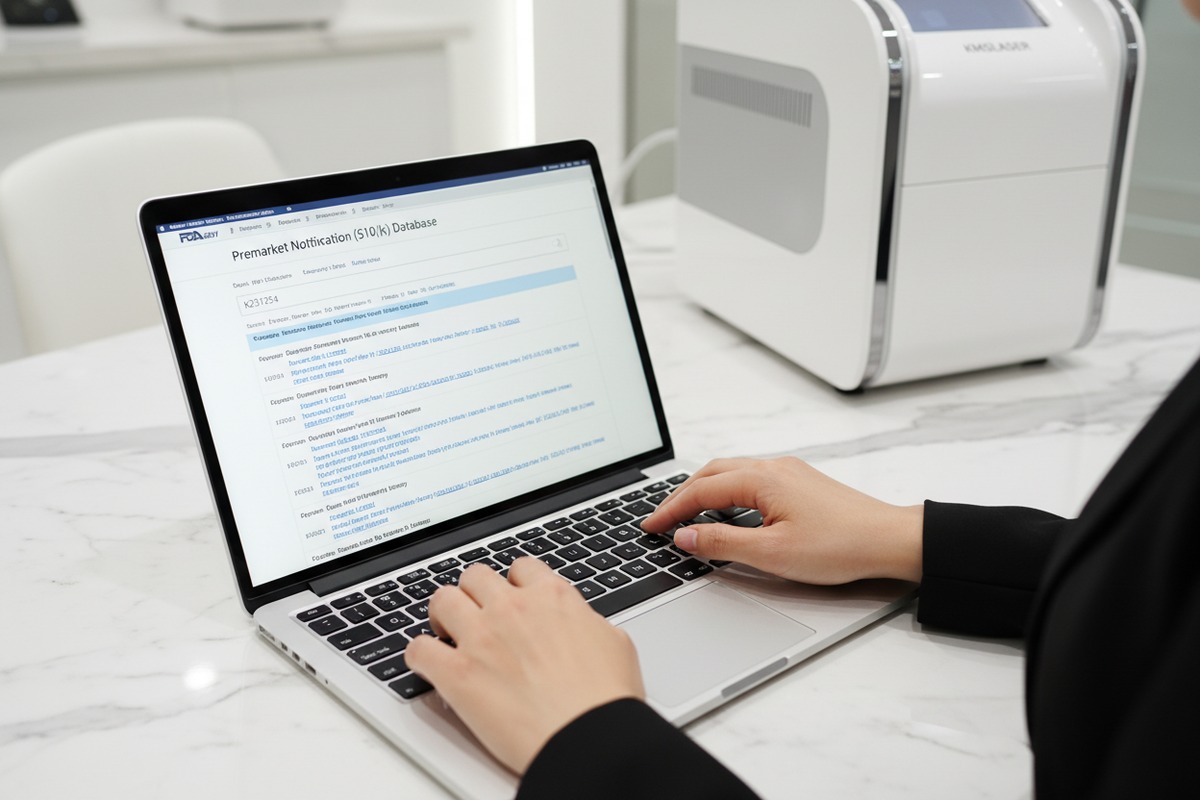
Step-by-Step Database Navigation
The FDA maintains a free, public database. Here's how to use it:
- Go to FDA 510(k) Premarket Notification Database.
- Click "Simple Search" for quick lookups or "Advanced Search" for filters.
- Enter the 510(k) number your supplier provided. It follows a format like K followed by six digits.
- If you don't have the number, search by applicant name or device trade name.
- For shockwave therapy machines, use product codes "LUH" (Extracorporeal Shock Wave Pain Therapy System) or "INS" (Shockwave Lithotripter). device product code 3
What the Search Results Show
A valid clearance shows several key details:
| Field | What It Tells You |
|---|---|
| 510(k) Number | Unique identifier for the cleared device |
| Applicant | Legal name of the company that received clearance |
| Device Name | Trade name or generic name of the device |
| Product Code | FDA classification code (LUH or INS for shockwave) |
| Decision Date | When FDA cleared the device |
| Decision | Should say "Substantially Equivalent 4" (SE) |
If the decision says "Not Substantially Equivalent" or the record doesn't exist, the device lacks clearance.
Download the Summary and Clearance Letter
After finding the record, click on the 510(k) number. This opens a detail page. Look for links to:
- 510(k) Summary: A public document describing the device, intended use, and predicate comparison.
- Clearance Letter: Official FDA decision letter confirming substantial equivalence.
- Indications for Use: Specific conditions the device may treat.
Download these documents. Compare them against what your supplier provided. Any discrepancy—different model numbers, altered dates, or missing pages—signals a red flag.
Common Search Mistakes to Avoid
Buyers often mistype the 510(k) number or confuse "registered" with "cleared." FDA registration means a company listed itself with the FDA. Clearance means a specific device passed 510(k) review. These are different things. A registered company can sell many uncleared devices. Always search for the device, not just the company.
How can I confirm that the 510(k) registration actually belongs to my Chinese manufacturer?
Our engineering team once reviewed a competitor's shockwave device. The supplier claimed FDA clearance. The 510(k) number was real—but it belonged to a German company, not the Chinese factory. This bait-and-switch happens more than you'd expect. Verifying ownership protects you from importing counterfeit or unauthorized devices.
Confirm ownership by matching the applicant name on the FDA 510(k) record with your supplier's legal company name. Check if your Chinese manufacturer is the clearance holder, a licensed subsidiary, or an OEM partner with written authorization from the actual clearance holder. Request legal documentation proving the relationship.
Three Scenarios You'll Encounter
Not every supplier lies. But relationships between clearance holders and manufacturers can be complex. Here are the three main scenarios:
| Scenario | What It Means | What to Request |
|---|---|---|
| Direct Holder | Chinese manufacturer holds the 510(k) in their name | Verify company name matches FDA record exactly |
| Licensed OEM | Clearance held by US/EU company; Chinese factory manufactures under license | Obtain written license agreement and authorization letter |
| Private Label | Your brand will appear on a device cleared under another name | Confirm original clearance covers your configuration; request 510(k) amendment or contract |
How to Verify the Applicant Name
The FDA database lists the "Applicant" for each clearance. This is the legal entity responsible for the device. Steps to verify:
- Find the applicant name in the FDA record.
- Ask your supplier for their official business license (in Chinese and English).
- Compare the legal entity name character by character.
- Check for common tricks: slight spelling changes, "Ltd" vs "LLC," or subsidiary names.
If names don't match, your supplier isn't the clearance holder. They may still legally sell the device—but only with proper authorization.
Request an Authorization Letter
When a Chinese manufacturer sells devices under another company's 510(k), they need written permission. This letter should:
- State the clearance holder's name and 510(k) number
- Name your supplier as an authorized manufacturer or distributor
- Specify which models are covered
- Include signatures and dates
Without this letter, your supplier may be selling counterfeit goods. We've seen cases where factories produce identical-looking machines without any legal agreement. Your customs clearance—and your patients—depend on this document.
Cross-Check FDA Establishment Registration
Beyond 510(k), FDA requires device manufacturers to register their facilities. Use the FDA Establishment Registration Database 5:
- Search for your supplier's facility address or name.
- Verify they appear as a "Manufacturer" or "Contract Manufacturer."
- Check the registration is current (annual renewal required).
A company can hold 510(k) clearance but fail to maintain registration. Both are necessary for legal import.
What specific details should I look for to ensure the 510(k) covers my private-label shockwave machine?
We customize shockwave machines for dozens of brands each year. Every private-label project raises the same question: does the original 510(k) cover our modified configuration? The answer isn't always yes. Missing details in clearance coverage can leave your brand exposed to FDA enforcement—and liability lawsuits.
Review the 510(k) summary's "Indications for Use" and "Device Description" sections. Verify that your exact model, treatment parameters, accessories, and software version fall within the cleared specifications. Any deviation—different energy levels, new applicators, or changed software—may require a supplemental 510(k) or new submission.
Critical Fields in the 510(k) Summary
The 510(k) summary contains technical specifications. Your private-label machine must match these specifications:
| Document Section | What to Verify |
|---|---|
| Indications for Use 6 | Approved conditions (e.g., plantar fasciitis, tendonitis, musculoskeletal pain) |
| Device Description | Physical specifications, energy output range, frequency settings |
| Accessories | Cleared applicators, handpieces, or probes |
| Software Version | Specific versions mentioned; updates may need separate clearance |
| Predicate Device 7 | The legally marketed device FDA used for comparison |
Indications for Use: Your Legal Boundaries
The Indications for Use (IFU) define what conditions the device may legally treat. Shockwave machines often receive clearance for:
- Chronic plantar fasciitis
- Lateral epicondylitis (tennis elbow)
- General musculoskeletal pain
If you market your machine for conditions not listed—like erectile dysfunction or cellulite reduction—you're selling an uncleared device for that use. FDA can seize products and issue warning letters. We always advise customers to match marketing claims to cleared indications exactly.
Accessories and Applicators Matter
Many shockwave systems use interchangeable applicators. The 510(k) may cover only specific accessories. Questions to ask:
- Which handpiece models are listed in the clearance?
- Are aftermarket or third-party applicators covered?
- Does adding a new probe require a supplemental submission?
In our experience, suppliers sometimes include non-cleared applicators with their systems. These accessories may function well, but using them means operating outside FDA clearance.
Software Version Compliance
Modern shockwave machines run embedded software. FDA tracks software versions in 510(k) clearances. If your supplier updated the firmware after clearance, the new version may not be covered. Ask for:
- Software version number matching the cleared version
- Documentation of any software changes since clearance
- Evidence that updates followed FDA's software guidance
Minor updates (bug fixes) may fall under original clearance. Major changes (new treatment protocols, altered energy algorithms) typically require a new 510(k).
Private-Label Specifics
When you private-label a device, your brand appears on the product. But the 510(k) remains under the original applicant's name. This creates obligations:
- You must have a written contract with the clearance holder.
- Marketing materials must stay within cleared indications.
- Any modifications you request may need supplemental clearance.
- Your labeling must reference the original 510(k) number.
We help our private-label partners navigate this process. Documentation protects both parties.
How do I protect my brand from liability if a supplier's FDA documentation is outdated or fake?
Three years ago, a US distributor faced a $50,000 fine. Their shockwave supplier had provided a legitimate-looking clearance letter. But the clearance had been revoked after a recall. The distributor never verified. This mistake cost them money, reputation, and customer trust. We've helped partners avoid similar disasters through rigorous due diligence.
Protect your brand by independently verifying all FDA documents through official databases, obtaining written warranties from suppliers regarding clearance validity, maintaining detailed compliance records, and including indemnification clauses in purchase contracts. Conduct annual re-verification and subscribe to FDA recall alerts for your device categories.
Build a Verification Checklist
Don't rely on supplier-provided documents alone. Create a systematic verification process:
| Verification Step | How to Complete | Frequency |
|---|---|---|
| 510(k) Database Search | Search FDA database for current clearance status | Before first order; annually |
| Establishment Registration Check | Confirm supplier's facility is FDA-registered | Before first order; annually |
| MAUDE Database Review | Search for adverse events, recalls, or warnings | Before first order; quarterly |
| Clearance Letter Comparison | Match supplier documents to FDA downloads | Every order |
| Authorization Letter Audit | Verify OEM agreements are current | Annually |
Search the MAUDE Database for Problems
The FDA Manufacturer and User Facility Device Experience (MAUDE) database 8 tracks adverse events. Search for your supplier's devices:
- Go to FDA MAUDE Database.
- Search by device name, manufacturer, or product code.
- Review reports of malfunctions, injuries, or deaths.
- Check for patterns—recurring issues signal quality problems.
A few isolated reports may be normal. Dozens of similar complaints suggest systemic failures.
Contract Protections You Need
Legal agreements shift risk back to negligent suppliers. Include these clauses:
- Warranty of Clearance: Supplier warrants device holds valid 510(k) clearance.
- Indemnification: Supplier agrees to cover losses from clearance misrepresentation.
- Document Retention: Supplier must maintain clearance documentation for inspection.
- Notification Requirement: Supplier must inform you of any clearance changes or recalls within 48 hours.
Our contracts with US partners always include these provisions. They protect both sides.
Subscribe to FDA Alerts
FDA publishes recalls, safety alerts, and warning letters. Set up monitoring:
- Subscribe to FDA MedWatch safety alerts 9
- Follow FDA Device Recalls RSS feed
- Set Google Alerts for your device category and supplier names
When a recall affects your supplier, you'll know immediately—not months later when customers complain.
Maintain Compliance Records
Keep copies of everything:
- Original 510(k) summaries and clearance letters
- Database search screenshots with dates
- Supplier correspondence regarding clearance
- Authorization letters and contracts
If FDA or a plaintiff's attorney comes calling, these records prove your due diligence. They may be the difference between a warning and a lawsuit.
When to Walk Away
Some red flags demand immediate action:
- Supplier refuses to provide 510(k) number
- Clearance number doesn't appear in FDA database
- Applicant name doesn't match supplier's company
- Multiple adverse event reports in MAUDE
- Supplier claims "FDA approved" instead of "510(k) cleared"
Walking away costs less than defending a lawsuit or facing FDA seizure. We've declined partnerships when documentation didn't check out. Reputation matters more than any single sale.
Conclusion
Verifying a supplier's FDA 510(k) clearance protects your business and your patients. Search official FDA databases, confirm manufacturer authorization, validate coverage details, and implement ongoing monitoring. Due diligence today prevents costly liability tomorrow.
Footnotes
1. Federal Register notice classifying extracorporeal shock wave devices for chronic wounds. ↩︎
2. Official FDA database for searching 510(k) premarket notifications. ↩︎
3. Replaced HTTP 404 with current FDA guidance on medical device classification product codes. ↩︎
4. FDA’s official page defining and explaining substantial equivalence in 510(k) submissions. ↩︎
5. Official FDA database for searching establishment registrations and device listings. ↩︎
6. FDA’s explanation of Indications for Use in determining if a product is a medical device. ↩︎
7. FDA’s official page explaining the role of predicate devices in 510(k) submissions. ↩︎
8. Official FDA database for searching adverse event reports related to medical devices. ↩︎
9. Official FDA program for safety information and reporting adverse events for medical products. ↩︎

 English
  Español de México
  Deutsch
  Français
  العربية
  Русский