

Every week, our export team receives urgent calls from US distributors who discovered their imported shockwave devices lack proper FDA documentation. The consequences hit hard—seized shipments, legal threats, and damaged business reputations. This nightmare scenario plays out more often than you’d think.
US distributors sourcing shockwave therapy machines must obtain FDA 510(k) clearance letters, verify manufacturer establishment registration and device listing through FDA databases, ensure Quality System Regulation compliance under 21 CFR Part 820, and confirm proper labeling per 21 CFR Part 801 to achieve full regulatory compliance.
Understanding these documents isn’t optional—it’s essential for protecting your business. Let’s break down exactly what you need and how to verify it.
What specific FDA 510(k) clearance documents should I request from my shockwave therapy machine supplier?
When our quality assurance team prepares export documentation for US-bound shipments, we've learned that many distributors don't know what paperwork to request. This knowledge gap creates serious compliance risks that can shut down entire distribution operations.
Request the FDA 510(k) clearance letter showing the clearance number (format K######), predicate device information, cleared indications for use, and the Summary of Safety and Effectiveness. Also obtain the device's product code, classification regulation number, and any special controls documentation required for Class II devices.
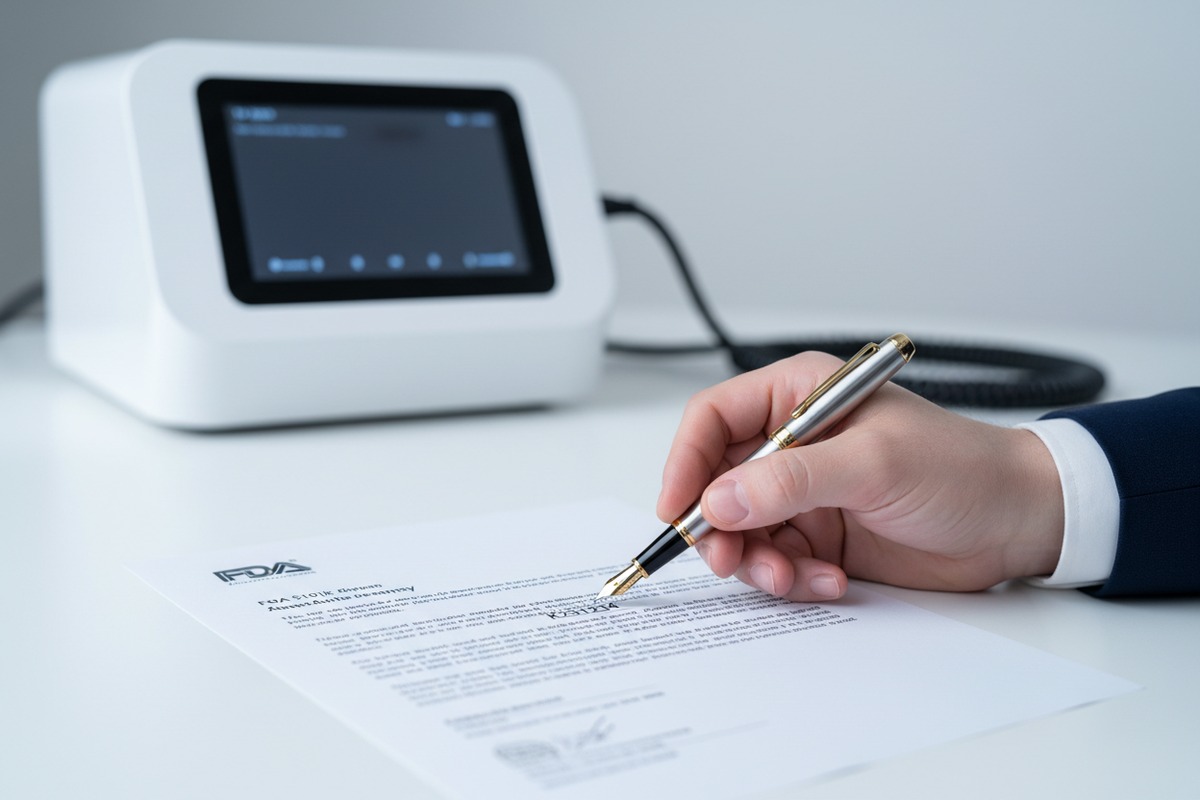
Understanding the 510(k) Clearance Letter
The 510(k) clearance letter is your primary proof of FDA authorization. FDA 510(k) clearance letter 1 This document confirms the FDA has reviewed the device and found it substantially equivalent to a legally marketed predicate device. Without this letter, you cannot legally market the device in the United States for medical purposes.
The clearance letter contains critical information you must verify. The clearance number follows a specific format—the letter K followed by six digits. For example, K240954 represents a 2024 clearance. Cross-reference this number on the FDA's 510(k) database 2 at accessdata.fda.gov to confirm authenticity.
Key Documents to Request From Your Supplier
| Document | Purpose | What to Check |
|---|---|---|
| 510(k) Clearance Letter | Proves FDA authorization | Clearance number, date, device name |
| Summary of Safety and Effectiveness 3 | Details testing results | Indications, contraindications |
| Predicate Device Information 4 | Shows substantial equivalence | Predicate 510(k) number |
| Declaration of Conformity | Confirms standards compliance | IEC 60601-2-36 reference |
| Labeling Samples | Verifies compliant claims | Prescription device statement |
Verifying Indications for Use
The cleared indications determine exactly how you can market and sell the device. Shockwave therapy machines receive clearance for specific applications. Some are cleared for musculoskeletal pain relief. Others target wound care or circulation improvement. Marketing beyond these cleared uses creates serious legal exposure.
Our engineering team always emphasizes this point to export customers. A device cleared for tissue activation therapy cannot be promoted for lithotripsy applications. That would require separate FDA approval—typically a PMA rather than 510(k).
Red Flags That Signal Problems
Watch for suppliers who provide only "FDA registration" certificates without 510(k) clearance. Registration under 21 CFR Part 807 simply means the establishment is registered with FDA. It does not mean the device has undergone premarket review. This distinction catches many first-time importers off guard.
Another warning sign is missing or incomplete predicate device information. Legitimate 510(k) clearances always reference a predicate. If your supplier cannot provide this information, investigate further before placing orders.
How can I verify that my manufacturer's FDA registration and device listing are currently valid?
During production planning at our facility, we maintain constant awareness of regulatory status for all US-destined equipment. We've seen how quickly outdated registrations can derail entire shipments and damage distributor relationships.
Verify manufacturer registration and device listing through FDA's online databases: check establishment registration at FDA's Registration and Listing database, confirm the device listing number matches your specific product, verify annual registration renewal status, and ensure the listed owner/operator information matches your supplier's documentation.

Using FDA's Online Verification Tools
The FDA provides free, publicly accessible databases for verification. The Establishment Registration and Device Listing database 5 lets you search by company name, registration number, or device listing number. This should be your first stop when evaluating any new supplier.
Enter the manufacturer's name exactly as it appears on their documentation. Slight variations in company names—such as "Inc." versus "Incorporated"—can affect search results. If you cannot find the company, ask your supplier for the exact registered name.
What to Look for in Registration Records
| Registration Element | Where to Find It | Why It Matters |
|---|---|---|
| Registration Number | FDA database search | Confirms active registration |
| Owner/Operator Name | Registration record | Must match supplier documents |
| Registration Status | Annual update indicator | Expired status = non-compliant |
| Device Listing Number | Linked to registration | Ties specific products to facility |
| US Agent 6 Information | Required for foreign firms | Your point of FDA contact |
Annual Registration Requirements
FDA registration requires annual renewal. Registrations must be updated between October 1 and December 31 each year. A registration showing last year's date may still be valid if checked before renewal deadlines. However, expired registrations from previous years indicate non-compliance.
Foreign manufacturers must designate a US agent. This agent serves as FDA's point of contact for the foreign establishment. Verify that your supplier has named a US agent and that this information appears in their registration record.
Cross-Referencing Device Listings
Device listings connect specific products to registered establishments. Each listed device receives a unique listing number. This number should appear on the device labeling and correspond to the manufacturer's registration.
When our compliance team reviews export documentation, we verify that the device listing matches the actual product specifications. A listing for a "radial pressure wave therapy device" doesn't cover a "focused shockwave lithotripter"—these are different product classifications.
Practical Verification Steps
Start by obtaining the manufacturer's FDA registration number directly from them. Access the FDA database and search for this number. Compare every detail—company name, address, registration status—against the documents provided. Any discrepancy requires explanation.
Next, search for the specific device listing. Confirm the product code matches what FDA has assigned to shockwave therapy devices. Common product codes include ILY for therapeutic massagers and LHP for lithotripters. The wrong product code suggests classification problems.
Which compliance certifications are required for me to private label these shockwave devices in the US?
Our OEM and ODM services involve extensive private labeling work for US brand owners. Through years of supporting these projects, we've developed deep expertise in the certification requirements that many distributors initially overlook.
Private labeling shockwave devices requires: maintaining your own FDA establishment registration as a specification developer or relabeler, ensuring the original 510(k) covers your intended marketing claims, compliance with Quality System Regulation 21 CFR Part 820, proper labeling per 21 CFR Part 801 including prescription device requirements, and potentially filing a new 510(k) if significant changes occur.

Your Registration Obligations as a Private Labeler
When you private label a medical device, you take on specific FDA obligations. Even though you don't manufacture the device, you must register your establishment with FDA. Your registration type depends on your activities—typically as a "specification developer" or "relabeler/repackager."
This registration requirement surprises many distributors. They assume the original manufacturer's registration covers everything. It doesn't. FDA holds both parties responsible for compliance. Your registration demonstrates your commitment to regulatory requirements.
Quality System Regulation Compliance
Private labelers must comply with applicable portions of 21 CFR Part 820 7—the Quality System Regulation. This doesn't mean you need a full manufacturing quality system. However, you must address requirements relevant to your activities.
| QSR Requirement | Applies to Private Labelers | Key Activities |
|---|---|---|
| Design Controls | If modifying specifications | Document changes |
| Purchasing Controls | Yes | Supplier qualification |
| Device Labeling | Yes | Label accuracy verification |
| Complaint Handling | Yes | Track customer issues |
| Medical Device Reporting | Yes | Report adverse events |
Labeling Requirements Under 21 CFR Part 801
Labeling compliance becomes your direct responsibility as a private labeler. 21 CFR Part 801 8 Your labels must include all required elements. For prescription devices—which most shockwave therapy machines are—labels must bear the statement: "Caution: Federal law restricts this device to sale by or on the order of a physician."
Additional labeling requirements include adequate directions for use, appropriate warnings, and truthful claims that don't exceed the cleared indications. Every claim on your labels and marketing materials must align with the original 510(k) clearance.
When You Need a New 510(k)
Certain changes to a cleared device require a new 510(k) submission. If your private labeling involves modifications beyond simple rebranding, you may trigger this requirement. Changes that typically require new clearance include:
- Modifications to intended use or indications
- Significant changes to device specifications
- New technological features not covered by original clearance
- Different energy output parameters
Our R&D team frequently advises customers on this topic. Simple logo changes and repackaging generally don't require new clearances. Adding new treatment protocols or modifying the user interface might.
Documentation You Must Maintain
Build a compliance file for each private-labeled product. This file should contain copies of the original 510(k) clearance, evidence of the manufacturer's quality system, your labeling specifications, and records of your supplier qualification activities. FDA inspectors may request these documents during establishment inspections.
Contract Manufacturing Agreements
Formalize your relationship with the original manufacturer through a quality agreement. This contract should specify responsibilities for quality system compliance, adverse event reporting, and regulatory submissions. Clear documentation protects both parties and demonstrates due diligence to FDA.
What are the legal risks to my distribution business if my imported machines lack proper FDA documentation?
When we counsel prospective export partners, we don't sugarcoat the compliance stakes. The consequences of importing non-compliant devices extend far beyond simple fines. They can fundamentally threaten your business existence.
Distributing shockwave machines without proper FDA documentation exposes your business to: FDA warning letters and import alerts, seizure and detention of products at ports, civil penalties up to $15,000 per violation, criminal prosecution for repeat or willful violations, product liability lawsuits from injured patients, and permanent damage to your business reputation.

FDA Enforcement Actions
FDA maintains multiple enforcement mechanisms against non-compliant distributors. Warning letters publicly document violations and require corrective action responses. Import alerts block future shipments from specific manufacturers or products. These alerts remain active until you demonstrate corrective measures.
More severe violations trigger stronger responses. FDA can pursue injunctions that halt all your distribution activities. Criminal prosecution remains possible for willful violations or cases involving fraud. The agency takes medical device compliance seriously.
Financial Consequences Table
| Violation Type | Potential Penalty | Additional Impacts |
|---|---|---|
| Misbranded Device | Up to $15,000 per violation | Product seizure |
| Uncleared Device Marketing | Civil and criminal penalties | Import alert |
| False 510(k) Claims | Criminal prosecution possible | Business shutdown |
| QSR Non-compliance | Warning letter minimum | Ongoing FDA scrutiny |
| MDR Reporting Failures | Per-incident penalties | Loss of market access |
Product Liability Exposure
Beyond FDA enforcement, civil liability creates massive risk. If a patient suffers injury from your device, you face potential lawsuits. Without proper FDA clearance, you lose important legal defenses. Plaintiffs' attorneys target distributors who cut compliance corners.
Product liability insurance may not cover claims arising from regulatory violations. Review your policy carefully. Many insurers exclude coverage for devices lacking required FDA authorizations. This leaves you personally exposed to judgments that can reach millions of dollars.
Business Reputation Damage
FDA warning letters 9 and enforcement actions become public records. Competitors and customers can easily find this information. Healthcare facilities increasingly conduct vendor due diligence. A compliance history showing violations makes winning new business nearly impossible.
Our business development team has witnessed this scenario repeatedly. Distributors who try to save money by skipping compliance steps ultimately lose far more. The short-term savings never justify the long-term business destruction.
Downstream Customer Impact
Your compliance failures affect everyone in your supply chain. Healthcare providers using non-compliant devices face their own regulatory and liability risks. When they discover problems, they don't just stop ordering—they share their experiences with peers. Word spreads quickly in medical device markets.
Clinicians who unknowingly use uncleared devices may face professional licensing consequences. Their patients may have grounds for malpractice claims. These downstream impacts circle back to you through lawsuits, reputation damage, and lost business relationships.
Criminal Prosecution Scenarios
FDA reserves criminal enforcement for serious cases. Willful violations, fraud, and repeat offenses can result in criminal charges. Penalties include fines and imprisonment. Corporate officers and owners face personal criminal liability—not just the business entity.
Recent enforcement trends show increased FDA attention to imported medical devices. The agency partners with US Customs and Border Protection to identify suspicious shipments. Attempting to import devices without proper documentation increasingly triggers investigation.
Conclusion
Proper FDA documentation isn't just regulatory paperwork—it's the foundation of a sustainable US distribution business. Request complete 510(k) clearance packages, verify registrations through official databases, understand your private labeling obligations, and recognize that compliance shortcuts create existential business risks.
Footnotes
1. Official FDA overview of the 510(k) premarket notification process. ↩︎
2. Provides direct access to the FDA’s searchable database for 510(k) clearances. ↩︎
3. Explains the components of a 510(k) submission, including the Summary of Safety and Effectiveness. ↩︎
4. Provides FDA guidance on selecting and using predicate devices for 510(k) submissions. ↩︎
5. Offers direct access to the FDA’s database for verifying establishment registration and device listings. ↩︎
6. The FDA’s official page detailing the requirements and responsibilities of U.S. Agents for foreign establishments. ↩︎
7. Provides the official text of the FDA’s Quality System Regulation. ↩︎
8. Contains the official FDA regulations for medical device labeling. ↩︎
9. Provides official information and a public archive of FDA warning letters. ↩︎

 English
  Español de México
  Deutsch
  Français
  العربية
  Русский