From our position on the production side, we often see buyers uncertain about whether shockwave therapy machines must follow the EU’s updated Packaging and Packaging Waste Regulation when entering the EU market.
Yes, shockwave therapy machines must comply with the EU Packaging and Packaging Waste Regulation because all packaging placed on the EU market—regardless of product category—falls under Extended Producer Responsibility (EPR), recycling requirements, and harmonized labeling unless specifically exempted for sterility or product-integrity reasons.
Understanding these rules upfront prevents customs issues, delayed clearance, and unexpected compliance costs for importers.
When you plan ahead, packaging compliance becomes a predictable part of your supply chain instead of a regulatory surprise.
What packaging standards are required for environmental compliance?
Coming from a manufacturer’s perspective, we frequently work with EU distributors who rely on us to design packaging that meets recyclability, marking, and documentation obligations under the latest EU rules.
Packaging for shockwave therapy machines must follow EU requirements for material recyclability, harmonized labels, accurate material identification, EPR registration, and proper reporting—even if some medical-device packaging is exempt from recycled-content or recyclability targets for safety reasons.

The EU’s Packaging and Packaging Waste Regulation (PPWR) applies broadly to packaging placed on the market, as described in the official PPWR proposal summary 1.
1. Recyclability requirements
Most packaging sold in the EU must be recyclable by design. The criteria for recyclability reference the principles defined in EU circular-economy packaging guidelines 2.
2. Recycled-content requirements
Future mandatory recycled-content thresholds follow targets outlined in EU plastic packaging policy documents 3.
3. Harmonized labeling
Label formats, material IDs, and disposal marking rules correlate with EU harmonized packaging labeling standards 4.
4. Packaging minimization
Minimization requirements, including empty-space ratios, are referenced in EU packaging waste prevention principles 5.
Packaging standards table
| Requirement Type | Description | Applies to Shockwave Packaging? |
|---|---|---|
| Recyclability | Must be recyclable by design | Yes (unless sterility exempt) |
| Recycled content | Mandatory % for plastics | Partially (exempt if sterility) |
| Labeling | Harmonized recycling marks | Yes |
| EPR registration | Country-level responsibility | Yes |
| Packaging minimization | Avoid excessive packaging | Yes |
Are medical and aesthetic devices subject to the same packaging rules?
Medical and aesthetic devices follow the same EU packaging framework, but sterile or contamination-sensitive medical packaging may be exempt from certain recyclability and recycled-content obligations, whereas aesthetic devices must follow full packaging requirements without exemptions.
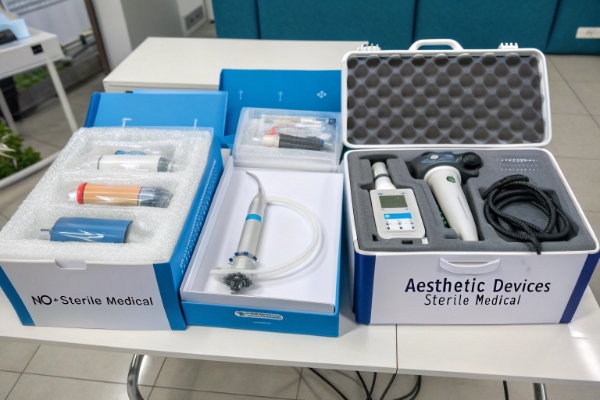
Packaging treatment for medical-related goods follows definitions from EU medical packaging regulatory interpretations 6.
Medical-device packaging categories
EU law distinguishes between:
- Sterile barrier packaging
- Non-sterile medical electronics (shockwave machines)
- Aesthetic or wellness devices
Shockwave therapy machines fall under non-sterile medical electronics, therefore subject to EPR and recyclability rules.
Comparison table
| Device Type | Sterility Requirement | Recyclability Exemptions | Full EPR Obligations? |
|---|---|---|---|
| Shockwave therapy machine | Non-sterile | No | Yes |
| Surgical tools (sterile) | Sterile packaging | Yes | Yes |
| Beauty/aesthetic devices | Non-sterile | No | Yes |
What documentation should suppliers provide for packaging compliance?
Since we prepare compliance files for many EU clients, we know buyers often struggle to identify what packaging documents are legally required.
Suppliers commonly reference EU packaging conformity requirements 7 when preparing documentation.

Required documents include:
-
EPR Registration Certificate
EPR obligations follow national requirements often accessed through EU EPR compliance guidance 8. -
Packaging Material Composition List
-
Recyclability Assessment
-
Conformity Statement for Packaging
-
Labeling Verification Sheet
Documentation table
| Document Type | Purpose | Needed? |
|---|---|---|
| EPR registration proof | Confirms compliance in target market country | Yes |
| Material composition list | Provides recyclability transparency | Yes |
| Recyclability declaration | Confirms compliance or exemption | Yes |
| Labeling sheet | Verifies correct marks | Yes |
| Packaging conformity statement | Required for audits and inspections | Yes |
How should buyers handle packaging responsibility in cross-border trade?
Buyers should clearly define who holds EPR responsibility, verify the supplier’s EPR registrations, and ensure packaging documentation is assigned to either the importer or manufacturer depending on who places the product on the EU market.
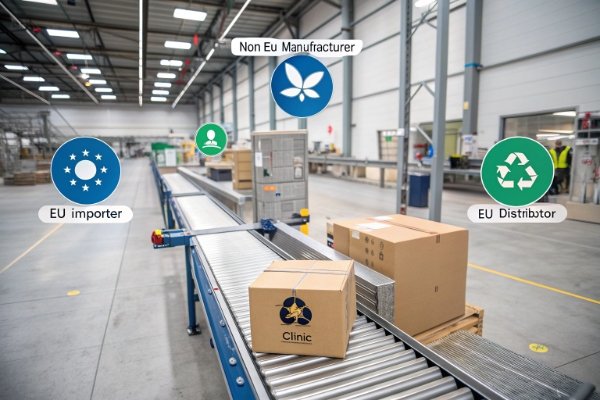
EPR responsibilities are determined by rules described in EU producer responsibility criteria 9.
Key principles for cross-border compliance
- EPR responsibility lies with the entity placing the product on the EU market
- Importer responsibility if buying from a non-EU manufacturer
- Freight forwarders do not carry EPR
- Platforms enforce EPR but do not replace importer duties
Additional market-access expectations are summarized in EU cross-border packaging compliance guidance 10.
Cross-border responsibility table
| Scenario | Responsible Party for EPR | Notes |
|---|---|---|
| Non-EU manufacturer with EU entity | Manufacturer | Must register in local markets |
| Non-EU manufacturer without EU entity | Importer | Most common scenario |
| Distributor selling within EU | Distributor or producer | Depends on contract |
| Agent or freight forwarder used | Not responsible | No EPR burden |
Conclusion
Shockwave therapy machines must comply with the EU Packaging and Packaging Waste Regulation, including EPR, recyclability, labeling, and documentation requirements. Medical exemptions are limited and do not apply to non-sterile medical electronics, making compliance essential for smooth market access and long-term sustainability.
Footnotes
1. EU PPWR proposal overview. ↩︎
2. EU circular economy packaging guidance. ↩︎
3. EU plastics strategy summary. ↩︎
4. Harmonized packaging labeling rules. ↩︎
5. EU waste prevention principles. ↩︎
6. Medical device packaging regulatory context. ↩︎
7. Official packaging conformity rules. ↩︎
8. EU EPR system guidance. ↩︎
9. EU producer responsibility criteria. ↩︎
10. EU market-access compliance reference. ↩︎

 English
  Español de México
  Deutsch
  Français
  العربية
  Русский