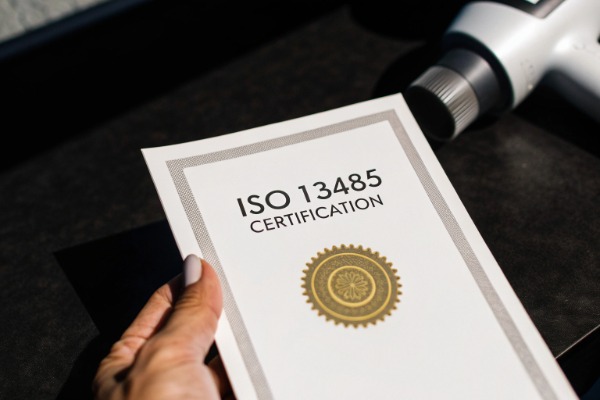
At KMSLASER, we see buyers struggle with compliance daily. You want safe equipment, but navigating regulatory standards is often confusing and frustrating. We understand that ensuring patient safety and business continuity is your top priority.
navigating regulatory standards 1
ISO 13485 is not universally mandatory by law for every manufacturer, but it is effectively required for FDA clearance, CE marking, and hospital procurement. Without it, suppliers cannot demonstrate the quality management systems necessary to ensure consistent safety, efficacy, and regulatory compliance for medical devices.
Let’s break down exactly why this standard matters for your business and how it impacts your supply chain.
How Does ISO 13485 Certification Impact the Quality of Shockwave Therapy Machines?
When our engineers calibrate shockwave outputs, precision is non-negotiable. Inconsistent energy levels can harm patients, damaging your clinic’s reputation instantly. We know that rigorous process control is the only way to guarantee performance.
Certification ensures that a manufacturer follows a rigorous Quality Management System (QMS) specific to medical devices. It impacts quality by mandating strict controls over design, production, and risk management, ensuring every shockwave machine delivers consistent, safe energy output and meets international performance standards.

The Connection Between QMS and Device Performance
ISO 13485 is far more than a piece of paper; it is the operational backbone of any serious medical device manufacturer. For shockwave therapy machines, which utilize high-energy acoustic waves to treat musculoskeletal conditions, the margin for error is incredibly slim. A deviation in the pneumatic pressure or electromagnetic pulse generation can turn a therapeutic device into a harmful one.
The impact on quality is visible in three specific areas:
1. Design Control and Validation
Before a machine even reaches the assembly line, ISO 13485 requires a "Design History File" (DHF). This means we must prove that the device was designed to meet clinical needs. We have to validate that the shockwave output (energy density, frequency, and focal point) matches the theoretical specifications. Without this standard, a supplier might skip the expensive validation phase, selling you a machine that hasn’t been stress-tested for real-world clinical use.
2. Consistency in Manufacturing
Imagine buying 50 units, but finding that 10 of them have weaker pressure output than the others. This happens when suppliers lack "Process Control." ISO 13485 mandates that every step of assembly is documented and repeatable. It ensures that the materials used—from the metal in the projectile to the silicone in the applicator—are identical in every batch.
3. Risk Management (ISO 14971 Integration)
Quality isn’t just about the machine working; it’s about the machine not failing dangerously. ISO 13485 integrates with ISO 14971 (Risk Management). This forces manufacturers to analyze potential failure modes. For example, what happens if the cooling system fails during a long treatment session? A certified manufacturer has already engineered a fail-safe to shut the machine down, whereas a non-certified supplier might not have considered the risk of the handpiece overheating and burning a patient.
Comparison: General Manufacturing vs. ISO 13485 Manufacturing
| Feature | General ISO 9001 Manufacturer | ISO 13485 Medical Device Manufacturer |
|---|---|---|
| Focus | Customer satisfaction and general improvement. | Patient safety and regulatory compliance. |
| Risk Management | Optional or business-focused. | Mandatory integration with ISO 14971. |
| Traceability | General batch tracking. | Full traceability of every component to the raw material. |
| Design Changes | Flexible and easy to change. | Strict "Change Control" procedures required. |
| Documentation | Basic records. | Comprehensive Device Master Record (DMR). |
Can I Trust a Supplier Without ISO 13485 Certification?
We often hear horror stories of "factory direct" deals gone wrong. Trusting a supplier without proven systems is a gamble with your capital. We believe you deserve a partner who values long-term reliability over short-term profits.
Trusting a non-certified supplier is highly risky for medical devices. While they may offer lower prices, the lack of ISO 13485 suggests they miss critical traceability and quality assurance processes, often indicating they are merely repackagers rather than genuine OEMs committed to long-term safety.

The "Repackager" Trap
In the beauty and medical equipment industry, especially in manufacturing hubs, there is a significant difference between a true Original Equipment Manufacturer (OEM) and a trading company or "repackager." A supplier lacking ISO 13485 certification is a massive red flag that they may not actually manufacture the goods they sell.
Why Certification Equals Trust
When we undergo our annual ISO audits, an independent third-party auditor spends days inspecting our facility. They interview our staff, check our calibration tools, and review our complaint handling logs. A supplier without this certification has no external oversight. You are essentially taking their word that they inspect the goods.
The Hidden Costs of Low-Cost Suppliers
You might find a shockwave machine for 20% less from a non-certified vendor. However, without the Quality Management System (QMS) mandated by ISO 13485, you lose:
- Traceability: If a specific component (like a capacitor) fails in one machine, a certified supplier can trace exactly which other machines have that same batch of capacitors and issue a targeted recall. A non-certified supplier likely cannot do this, forcing you to recall everything or risk lawsuits.
- Post-Market Surveillance: ISO 13485 requires us to actively monitor how our devices perform in the market. If a pattern of faults emerges, we are required to investigate and fix the root cause. Non-certified suppliers often view a sale as the end of the relationship. If the machine breaks in six months, they may claim it is "user error" because they have no formal process for investigating technical complaints.
Evaluating Supplier Credibility
| Supplier Type | ISO 13485 Status | Trust Level | Typical Outcome |
|---|---|---|---|
| True OEM | Certified (Scope: Design & Manufacture) | High | Consistent quality, spare parts availability, regulatory support. |
| Assembler | Certified (Scope: Assembly only) | Medium | Good assembly, but may lack design control or deep engineering knowledge. |
| Trading Company | Not Certified / Fake Cert | Low | Inconsistent quality, no technical support, high risk of customs seizure. |
What Risks Do I Face if My Supplier Lacks ISO 13485 Certification?
Our logistics team frequently helps clients who previously faced customs seizures. Ignoring certification creates a chain reaction of costly business failures. We aim to protect your investment by ensuring all documentation meets strict border requirements.
You face significant risks including customs seizure, legal liability for patient injuries, and rejection by hospitals or insurers. Without ISO 13485, you lack the documentation required for FDA or MDR compliance, leaving you with unsellable inventory and no recourse against manufacturing defects.

The Regulatory Domino Effect
The risks of buying from a non-certified supplier extend far beyond the machine simply breaking down. The primary danger lies in the regulatory and legal exposure you accept as the importer. In many jurisdictions, the importer is treated as the "manufacturer" for legal purposes if the original factory is overseas.
Therapeutic Goods Administration 2
1. Customs and Import Blockades
Customs officials in the US and Europe are increasingly vigilant. If you are importing devices labeled for medical use (like Shockwave Therapy), customs may request the manufacturer’s quality certification. If your supplier cannot provide a valid ISO 13485 certificate that matches the product, your shipment can be detained. We have seen competitors’ clients lose entire containers because they could not prove the factory met GMP (Good Manufacturing Practice) standards.
2. Inability to Register Products (FDA & MDR)
If you plan to sell to hospitals or serious clinics, you need FDA 510(k) clearance in the US or CE certification under the MDR in Europe.
- USA: While the FDA has its own Quality System Regulation (QSR), it is harmonized with ISO 13485. You cannot submit a 510(k) application without extensive manufacturing data that only an ISO 13485 system generates.
- Europe: Under the new Medical Device Regulation (MDR), it is virtually impossible to get a CE mark without the manufacturer holding a valid ISO 13485 certificate from a Notified Body.
3. Liability and Insurance Rejection
If a patient is injured by a shockwave machine (e.g., burns or tissue damage), the first thing your liability insurance provider will ask for is the device’s compliance file. If you purchased from a non-certified factory, you have no proof of "Due Diligence." Your insurance may refuse to cover the claim, leaving your company personally liable for damages.
Risk Impact Matrix
| Risk Category | Scenario | Consequence |
|---|---|---|
| Financial | Shipment detained at customs due to lack of quality docs. | Total loss of inventory cost + storage fees. |
| Legal | Patient injury lawsuit. | Full liability falls on you; insurance denies claim. |
| Commercial | Hospital requests compliance file for purchase. | Sale lost; reputation damaged as "unprofessional." |
| Operational | High failure rate of devices. | Support team overwhelmed; profit margin destroyed by shipping returns. |
How Do I Verify if My Supplier is Genuinely ISO 13485 Certified?
We openly share our audit reports because transparency builds partnerships. However, many suppliers send fake or expired certificates to unsuspecting buyers. We want you to have the tools to spot a forgery before you wire any money.
Medical Device Single Audit Program 3
Verify certification by requesting the full certificate and checking the scope to ensure it covers shockwave therapy manufacturing. Validate the registrar’s accreditation through the IAF database, demand recent audit reports, and cross-reference with their FDA or CE documentation to confirm authenticity.

The "Photoshop" Certificate Epidemic
In the digital age, forging a PDF certificate is alarmingly easy. As a buyer, you must be a detective. A common trick we see is a trading company using a certificate belonging to a completely different factory, or modifying an expired certificate to look current.
21 CFR Part 820 5
Step-by-Step Verification Process
To protect your business, do not just accept a PDF file at face value. Follow this rigorous verification protocol:
IAF CertSearch 6
1. Check the "Scope" of Registration
This is the most critical step. A supplier might be ISO 13485 certified, but for what?
- Bad Scope: "Sales of beauty equipment." This means they are just a trader. They do not manufacture anything.
- Good Scope: "Design, Development, Manufacture, and Service of Shockwave Therapy Devices." This confirms they control the entire process.
If the scope is vague or lists products unrelated to shockwave therapy (like "surgical masks"), the certificate is irrelevant to your purchase.
2. Verify the Registrar (Notified Body)
Look at the logo of the certification body (e.g., TUV, SGS, BSI, Intertek). Go to that registrar’s official website. Most major registrars have an online database where you can enter the certificate number to check its validity. If the certificate number returns "No Record Found," you are dealing with a fake.
3. The IAF Database Check
The International Accreditation Forum (IAF) maintains a global database (IAF CertSearch). While not every single valid certificate is always listed immediately, it is a powerful tool. If the registrar is not accredited by an IAF member, the certificate holds very little weight internationally.
4. Cross-Reference with Product Markings
Ask the supplier for a photo of the back label (nameplate) of the machine. The manufacturer name on the label MUST match the company name on the ISO 13485 certificate exactly. If the label says "Guangzhou Tech Co." but the certificate says "Shanghai Manufacturing Ltd," the supplier is outsourcing production, and you have no control over quality.
Checklist for Supplier Verification
- Request the full PDF certificate (not just a screenshot).
- Read the Scope: Does it explicitly mention "Manufacture"?
- Check the Expiry Date: Is it still valid?
- Verify the Address: Does the address on the certificate match the factory address on Alibaba/Website?
- Online Validation: Check the certificate number on the Registrar’s website.
- Audit Report: Ask for the "Executive Summary" of their last audit report (redacted is fine). A real manufacturer will have this; a trader will not.
Is ISO 13485 Legally Required for Importing Shockwave Machines?
Exporting to the US and Europe requires us to maintain strict documentation. Understanding regional laws prevents your shipment from being blocked at the border. We stay updated on these regulations so our partners never face compliance surprises.
Medical Device Regulation (MDR) 7
While ISO 13485 itself is a voluntary standard, it is the practical method to satisfy legal mandates like the US FDA’s QSR and the EU’s MDR. Customs authorities and notified bodies treat it as the benchmark for proving your device meets essential legal safety requirements.

The Nuance of "Voluntary" vs. "Mandatory"
Technically, no law says "You must have ISO 13485." However, the laws do say you must have a Quality Management System. ISO 13485 is the globally accepted way to prove you have one. It is the "de facto" standard.
ISO 14971 (Risk Management) 9
United States: FDA 21 CFR Part 820
In the US, medical devices are regulated by the FDA. Manufacturers must comply with the Quality System Regulation (QSR), found in 21 CFR Part 820.
- The Reality: The FDA is currently harmonizing its QSR with ISO 13485 (the "QMSR" rule). This means that for all intents and purposes, ISO 13485 is becoming the US law.
- Importing: If you import a Class II device (which many shockwave machines are), the FDA expects the manufacturer to follow these rules. If the FDA inspects the foreign facility and finds no ISO-equivalent system, they will issue a warning letter and block imports.
Europe: The Medical Device Regulation (MDR)
Europe has moved from the MDD (Directive) to the MDR (Regulation), which is much stricter.
- The Reality: To sell a medical shockwave device in the EU, you need a CE mark. To get a CE mark for anything other than the lowest risk class, you need a Notified Body to audit the manufacturer. Notified Bodies conduct these audits almost exclusively based on ISO 13485 standards.
- Conclusion: You cannot get a medical CE mark for a shockwave machine without ISO 13485 compliance.
Other Regions (Canada, Australia, etc.)
- Canada: The Medical Device Single Audit Program (MDSAP) is mandatory for selling in Canada. MDSAP is built directly upon ISO 13485.
- Australia: The TGA (Therapeutic Goods Administration) accepts ISO 13485 certificates as evidence of conformity for many device classes.
Summary of Regional Requirements
| Region | Regulation | Role of ISO 13485 |
|---|---|---|
| USA | FDA 21 CFR Part 820 | Harmonized standard; essential for 510(k) data. |
| Europe | EU MDR 2017/745 | Prerequisite for CE Marking audits by Notified Bodies. |
| Canada | Health Canada | Mandatory via MDSAP (Medical Device Single Audit Program). |
| Global | WHO / General Import | Often required by customs to prove "Good Manufacturing Practice." |
Conclusion
ISO 13485 isn’t just paperwork; it’s your shield against liability and your passport to global markets. Don’t compromise—ensure your supplier is certified to protect your business and your patients.
Design History File 10
Footnotes
- Links to the official ISO 13485 standard page, the primary subject of the article. ↩︎
- Links to the Australian regulatory authority mentioned in the regional section. ↩︎
- Official resource explaining the MDSAP requirement for Canadian market access. ↩︎
- Explains the role of Notified Bodies in EU certification. ↩︎
- Links to the official text of the US Quality System Regulation cited. ↩︎
- Direct link to the global database tool recommended for verifying certificates. ↩︎
- Official European Commission page detailing the MDR framework discussed. ↩︎
- Provides official FDA information on the 510(k) clearance process mentioned. ↩︎
- Direct link to the specific risk management standard cited in the text. ↩︎
- Official FDA guidance explaining the Design History File requirement for medical devices. ↩︎

 English
  Español de México
  Deutsch
  Français
  العربية
  Русский