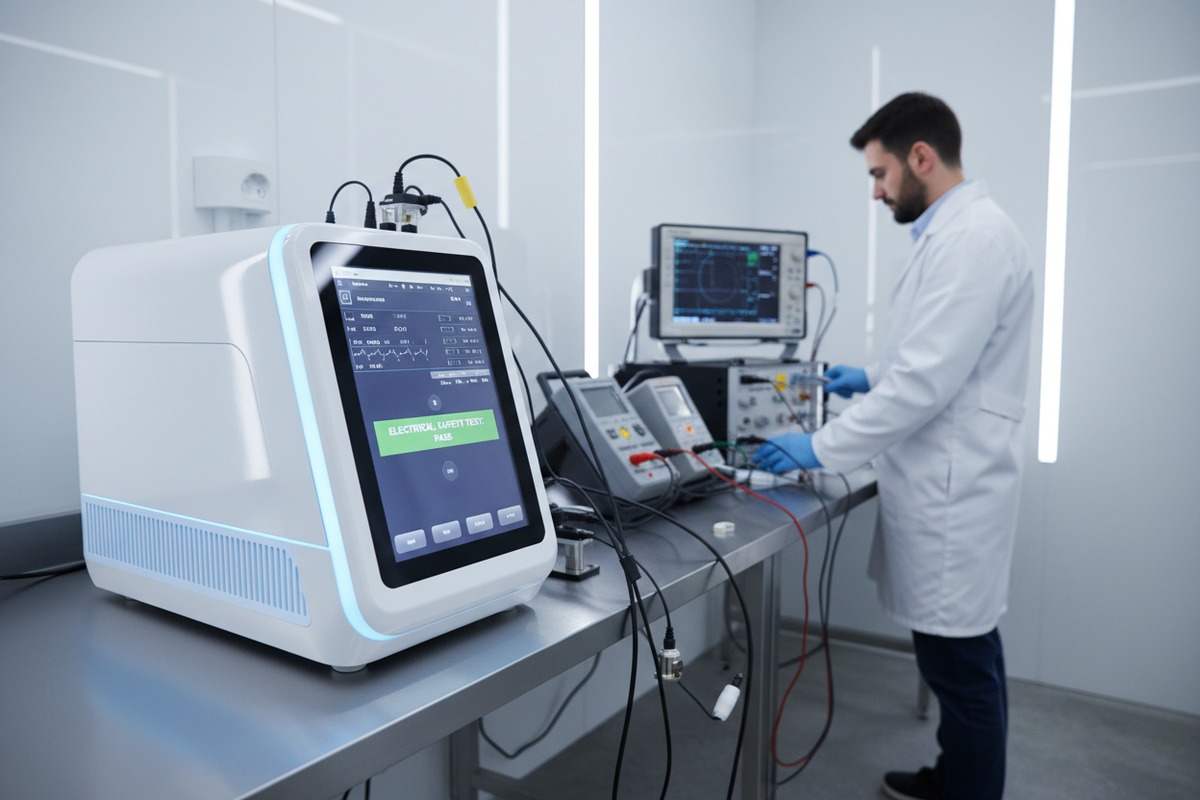
Every week, our export team fields calls from panicked importers whose shockwave machines are stuck at US customs. The shipment looked perfect—until border agents asked for lab testing documentation that simply didn’t exist. These delays cost thousands in storage fees and lost sales opportunities.
Yes, imported shockwave therapy machines require independent lab testing and certification for most regulated markets. In the US, these devices are classified as FDA Class II medical devices, requiring 510(k) clearance, electrical safety testing per IEC 60601-1, and electromagnetic compatibility verification before legal market entry.
Understanding certification requirements before placing your order can save months of delays and protect your business from serious legal exposure. Let me walk you through exactly what you need to know.
How do I know which safety certifications are mandatory for importing shockwave therapy machines into the US?
Navigating US import regulations feels overwhelming at first. When our quality team prepares export documentation for American buyers, we've learned that certification requirements depend heavily on how the FDA classifies your specific device.
For US imports, mandatory certifications include FDA 510(k) clearance, establishment registration, device listing, and compliance with IEC 60601-1 electrical safety standards. Without these, US Customs and Border Protection will hold or reject your shockwave therapy equipment at the port of entry.

Understanding FDA Device Classification
The FDA classifies shockwave therapy machines as Class II medical devices 1 under product code LNV or similar categories. This classification triggers "special controls" requirements that go beyond basic registration.
Class II devices need 510(k) premarket notification 2, which demonstrates your device is substantially equivalent to a legally marketed predicate device. This process typically takes three to six months when documentation is complete.
Core Testing Standards You Cannot Skip
Our engineering department ensures every unit meets these fundamental standards before export:
| Testing Standard | What It Covers | Testing Laboratory Requirement |
|---|---|---|
| IEC 60601-1 | Electrical safety, leakage current, insulation | NRTL-accredited lab (UL, ETL, CSA) |
| IEC 60601-1-2 | Electromagnetic compatibility (EMC) | NRTL-accredited lab |
| ISO 10993 | Biocompatibility for patient-contact parts | ISO 17025 accredited lab |
| ISO 13485 | Quality management system | Accredited certification body |
The FDA accepts testing from Nationally Recognized Testing Laboratories 3 (NRTLs) like UL, Intertek (ETL), and CSA. When we ship to the US, our buyers always request NRTL test reports specifically because customs officers recognize these credentials instantly.
Registration Steps That Trip Up First-Time Importers
Many importers assume the manufacturer handles everything. That's partially true, but US regulations place responsibilities on both parties.
Foreign manufacturers must register their establishment with the FDA 4. The US importer must also register as the initial distributor. Both parties must list the specific device. Annual registration renewal is required—missing this deadline means your products become illegal overnight.
The FDA's FURLS database 5 tracks all registrations publicly. Your competitors can verify your compliance status with a simple search. More importantly, customs agents check this database before releasing shipments.
State-Level Requirements Add Another Layer
Beyond federal FDA requirements, some states impose additional registration. California, for example, requires separate device registration through the California Department of Public Health. Florida has similar requirements for certain device categories.
When our US buyers operate in multiple states, we always recommend they consult with a regulatory affairs specialist familiar with state-specific rules. The federal 510(k) alone doesn't guarantee nationwide market access.
Can my Chinese OEM partner provide the independent lab testing reports I need for my private-label brand?
This question comes up in almost every initial conversation with new buyers. When we develop private-label programs, testing documentation ownership becomes a critical negotiation point that many first-time importers overlook.
Reputable Chinese OEM partners can provide independent lab testing reports, but you must verify the reports are issued to your company or include rights-transfer documentation. Some suppliers share reports belonging to other buyers, which creates serious legal liability for your brand.

What Testing Documentation Should Your OEM Provide?
Our standard practice involves providing comprehensive technical files to every private-label buyer. Here's what legitimate documentation looks like:
| Document Type | What to Verify | Red Flags |
|---|---|---|
| Test Report | Your company name as applicant or authorized party | Reports listing another brand name |
| Certificate | Scope matches your exact model numbers | Generic certificates covering "similar devices" |
| Lab Accreditation | NRTL, IECEE CB, or ISO 17025 status | Labs you cannot verify in public databases |
| Declaration of Conformity | Dated within regulatory validity period | Missing signatures or outdated declarations |
When testing reports list a different company as the applicant, you're essentially borrowing someone else's compliance. If that original company discontinues their registration or modifies their device, your regulatory status could collapse without warning.
Negotiating Testing Rights in Your OEM Agreement
At our facility, we structure OEM contracts to address testing documentation explicitly. Buyers who plan long-term market presence should negotiate for:
First, request testing conducted in your company's name. This costs more initially because the OEM cannot amortize testing costs across multiple buyers. However, you own the documentation permanently.
Second, if using shared testing, get written authorization from the certificate holder. This authorization should specify your model numbers, markets, and duration of rights.
Third, include audit rights in your contract. We welcome buyer inspections of our technical files because transparency builds trust. Suppliers who resist documentation audits often have something to hide.
The Hidden Risk of "Certificate Sharing"
Some suppliers offer suspiciously low prices by sharing single test reports across dozens of private-label buyers. This practice seems economical until problems emerge.
I've seen situations where the original certificate holder made product modifications that invalidated the shared reports. Every buyer using those reports suddenly found themselves selling non-compliant products. Customs rejections, product recalls, and legal exposure followed.
Your brand reputation depends on documentation that cannot be invalidated by another company's decisions. The extra investment in dedicated testing protects your independence.
Verifying Your Supplier's Testing Claims
Before finalizing any OEM agreement, take these verification steps:
Request the actual test report PDF, not just the certificate. Test reports contain detailed methodology, pass/fail results, and testing laboratory information. Certificates summarize conclusions but lack verification details.
Cross-reference the testing laboratory against official databases. For US NRTL labs, check OSHA's NRTL database 6. For IECEE CB scheme reports, use the IECEE certificate search tool. For ISO 17025 labs, verify through the relevant national accreditation body.
Contact the testing laboratory directly to confirm the report's authenticity. Legitimate labs maintain databases and will verify reports they issued. Counterfeit reports exist in this industry—verification protects your investment.
What are the legal risks to my business if my imported shockwave equipment lacks third-party lab validation?
Cutting corners on certification might seem like a cost-saving strategy. Our sales team has watched buyers make this calculation, import uncertified equipment, and then face consequences that dwarf any initial savings.
Importing shockwave machines without third-party lab validation exposes your business to customs seizure, FDA warning letters, mandatory recalls, civil penalties up to $15,000 per violation, and product liability lawsuits. Criminal prosecution is possible for repeat or willful violations.

Immediate Customs Consequences
US Customs and Border Protection works closely with the FDA on medical device imports. When your shipment arrives without proper documentation, several outcomes are possible:
Detention means your products sit in a bonded warehouse while you scramble to produce missing documents. Storage fees accumulate daily. If you cannot demonstrate compliance within a specified period, the goods face refusal.
Refusal means the FDA formally rejects entry. You must either export the goods to another country or destroy them under customs supervision. Either option costs money with zero revenue recovery.
In severe cases involving suspected fraud or repeat violations, customs can seize products outright. Seizure transfers ownership to the government—you lose everything.
FDA Enforcement Escalation
Beyond customs, the FDA maintains independent enforcement authority. The enforcement ladder escalates based on violation severity and your response:
| Enforcement Action | Trigger Conditions | Business Impact |
|---|---|---|
| Warning Letter | Documentation gaps, labeling violations | Public record, 15-day response required |
| Import Alert | Repeated violations, unresponsive companies | Automatic detention of future shipments |
| Consent Decree | Serious violations, failed corrective actions | Court-supervised compliance, massive costs |
| Criminal Prosecution | Willful violations, injury/death, fraud | Personal liability for executives, prison |
Warning letters become public record immediately. Your customers, competitors, and future business partners can find them through simple FDA database searches. The reputational damage often exceeds the direct compliance costs.
Import alerts create presumptive detention for all your future shipments. Breaking out of an import alert requires demonstrating systemic corrections—a process that can take years.
Product Liability Exposure
Certification serves as evidence that you exercised reasonable care in selecting safe products. Without this evidence, product liability claims 7 become much harder to defend.
When patients suffer injuries from shockwave therapy equipment, their attorneys examine the entire supply chain. Did the importer verify safety testing? Did they check laboratory credentials? Did they maintain technical documentation?
Answers of "no" to these questions suggest negligence. Negligence findings dramatically increase damage awards. Punitive damages—intended to punish reckless behavior—become much more likely.
Insurance complications follow. Product liability insurers may deny claims if you knowingly imported uncertified devices. Policy exclusions for "illegal products" or "regulatory violations" are common. You might face millions in liability with no coverage.
State Attorney General Actions
Beyond federal enforcement, state attorneys general pursue consumer protection cases against companies selling non-compliant medical devices. California, New York, and Texas are particularly active in this area.
State actions often result in consent judgments requiring refunds to all state purchasers, payment of investigation costs, and ongoing reporting requirements. Multi-state coordinated actions multiply these exposures.
Downstream Customer Consequences
Your salon and clinic customers face their own regulatory exposure when using uncertified equipment. Professional licensing boards can sanction practitioners using non-compliant devices. Insurance coverage for treatments performed with uncertified equipment may be void.
When your customers discover their liability exposure, they don't quietly accept it. Chargebacks, contract cancellations, and lawsuits against you as their supplier follow. Business relationships built over years collapse overnight.
How can I verify that my supplier's shockwave machines meet the performance and durability standards my salon clients expect?
Beyond regulatory compliance, your downstream customers expect equipment that actually works. Our product development team has identified key performance indicators that separate professional-grade equipment from cheap imports flooding online marketplaces.
Verify supplier performance claims by requesting third-party test reports for energy output consistency, applicator durability testing, clinical efficacy data, and warranty terms with spare parts pricing. Reputable manufacturers welcome technical due diligence because it demonstrates buyer seriousness.

Critical Performance Specifications to Verify
Not all shockwave machines deliver equivalent therapeutic outcomes. The technology divide between focused and radial shockwave systems creates significant performance differences that affect clinical results.
| Specification | Professional Grade | Budget Import | Why It Matters |
|---|---|---|---|
| Energy Output | 0.01-0.5 mJ/mm² (focused) | Often unverified | Determines treatment depth and efficacy |
| Frequency Range | 1-22 Hz adjustable | Limited settings | Treatment customization for conditions |
| Applicator Lifespan | 2-5 million shots | 500K-1M shots | Long-term cost of ownership |
| Compressor Type | Oil-free, medical-grade | Standard industrial | Reliability and maintenance needs |
Request specific test data for energy output measurements. Reputable manufacturers test energy consistency across the entire claimed range. Cheap imports often advertise peak numbers that actual clinical use never achieves.
Durability Testing Documentation
Applicators represent the primary wear component in shockwave systems. Replacement costs significantly affect total ownership economics.
When we develop new applicator designs, our engineers conduct accelerated life testing that simulates years of clinical use in weeks. Test reports document shot counts, energy degradation curves, and failure modes.
Ask your potential supplier for applicator life testing data. If they cannot provide it, they likely haven't conducted proper durability validation. Their lifespan claims become marketing guesses rather than engineering facts.
The Spare Parts Pricing Strategy
Here's an insight from years of manufacturing experience: request a complete spare parts price list before committing to any supplier.
Some manufacturers sell equipment cheaply while charging astronomical prices for consumables and replacement parts. The initial purchase seems economical until your first applicator wears out. Suddenly, you're paying 40% of the original machine cost for a replacement part.
Legitimate manufacturers provide transparent spare parts pricing upfront. At our facility, we share complete parts catalogs with pricing during the quotation phase. This transparency helps buyers calculate true five-year ownership costs.
Clinical Efficacy Evidence
Your salon clients ultimately care whether treatments produce results for their patients. Marketing claims about pain relief percentages or treatment success rates need supporting evidence.
Request clinical study summaries or references. These don't need to be your supplier's proprietary studies—published literature on the technology platform demonstrates the treatment approach works. However, your specific device should match the specifications used in successful clinical applications.
Pre-Purchase Verification Checklist
Before finalizing any supplier relationship, complete this verification process:
Request a demonstration unit for hands-on evaluation. Operating the actual equipment reveals interface quality, build construction, and real-world usability that photographs and specifications cannot communicate.
Ask for references from existing buyers in your target market. Contact these references directly to discuss their experience with product quality, delivery reliability, and after-sales support.
Verify manufacturing facility certifications. ISO 13485 certification 9 indicates quality management system compliance. Factory audit reports from previous buyers provide additional verification.
Review warranty terms carefully. Coverage duration, what's included versus excluded, and claims process procedures all affect your risk exposure. Warranties that require shipping equipment back to China for repair often provide little practical value.
Conclusion
Certification requirements for imported shockwave therapy machines are non-negotiable for US market entry. Invest in proper documentation upfront, verify your supplier's testing credentials thoroughly, and protect your business from the substantial legal risks of non-compliance.
Footnotes
1. Explains FDA Class II device classification and regulatory requirements. ↩︎
2. Details the FDA 510(k) submission process and substantial equivalence. ↩︎
3. Official OSHA page explaining the NRTL program and its purpose. ↩︎
4. Explains FDA requirements for medical device establishment registration. ↩︎
5. Provides information on the FDA’s Unified Registration and Listing Systems (FURLS). ↩︎
6. Direct link to OSHA’s official database of Nationally Recognized Testing Laboratories. ↩︎
7. Explains product liability claims specifically for defective medical devices. ↩︎
8. Official FDA page explaining warning letters and their public nature. ↩︎
9. Explains ISO 13485 standard for medical device quality management systems. ↩︎

 English
  Español de México
  Deutsch
  Français
  العربية
  Русский