

Every week, our quality control team receives inquiries from distributors who purchased shockwave machines elsewhere—only to discover their devices lack proper certifications for US import CE marking authenticity 1. The frustration is real. Delayed shipments, customs holds, and compliance failures cost buyers thousands of dollars and months of wasted time.
To verify international safety standards when sourcing shockwave therapy machines, you must confirm FDA clearance status, validate CE marking authenticity, request complete IEC 60601 test reports, verify ISO 13485 QMS certification, review device-specific standards compliance, and audit the manufacturer’s documentation trail for accuracy and completeness.
This guide walks you through each verification step IEC 60601 test reports 2. We will cover the specific certifications required, how to audit factory quality control, what technical documentation proves compliance, and how to evaluate long-term device performance. Let us begin with the regulatory requirements for US importers.
Which specific safety certifications must I verify before importing shockwave therapy machines into the US?
Our export team has processed hundreds of shipments to US distributors over the years ISO 13485 QMS certification 3. The single biggest mistake we see? Buyers assume a CE mark alone qualifies a device for the American market. It does not. The US has its own regulatory pathway, and missing documentation means your shipment sits at customs.
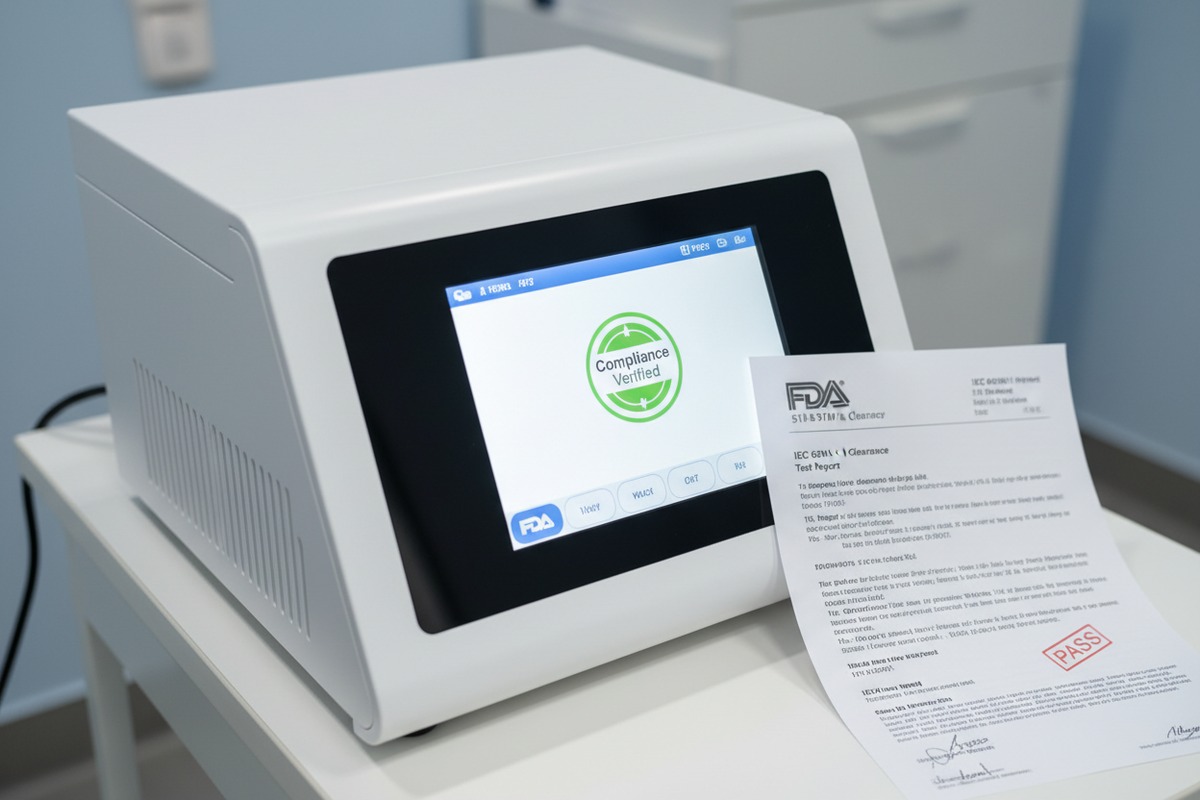
Before importing shockwave therapy machines into the US, you must verify FDA 510(k) clearance or appropriate device listing, confirm the device classification matches your intended use, validate IEC 60601-1 electrical safety compliance, check IEC 60601-1-2 EMC test reports, and ensure ISO 13485 quality management certification is current and covers the specific device model.
Understanding the FDA Pathway
The FDA classifies shockwave therapy devices based on intended use and risk level. Most musculoskeletal shockwave devices fall under Class II, requiring 510(k) premarket notification. This means the manufacturer must demonstrate the device is substantially equivalent to a legally marketed predicate device.
You can verify FDA clearance status 4 directly through the FDA's CDRH database. Search by manufacturer name, device name, or 510(k) number. The database shows clearance date, device classification, and intended use. Cross-reference this information with what your supplier claims.
The IEC Standards Framework
Six core standards form the compliance foundation for shockwave devices. Each addresses specific safety aspects.
| Standard | Coverage Area | Key Tests |
|---|---|---|
| IEC 60601-1 | Basic electrical safety | Leakage current, dielectric strength, grounding |
| IEC 60601-1-2 | Electromagnetic compatibility | Emissions, immunity, ESD, surge protection |
| IEC 60601-2-36 | Focused shockwave devices | Acoustic safety, control validation |
| IEC 63045:2020 | Non-focused devices | Pressure wave parameters, labeling |
| IEC 62304 | Software lifecycle | Validation, change control, traceability |
| ISO 10993 | Biocompatibility | Material safety for patient contact |
When requesting documentation, ask for the full test reports—not summary certificates. A legitimate report includes edition numbers, amendment status, test setup photographs, and detailed pass/fail results for each test parameter.
Focused vs. Non-Focused Device Standards
This distinction matters greatly. Focused extracorporeal shockwave therapy (fESWT) devices concentrate acoustic energy at a precise focal point. These devices measure energy flux density in mJ/mm², typically ranging from 0.03 to 0.60 mJ/mm². They must comply with IEC 60601-2-36.
Radial pressure wave devices spread energy more broadly. They measure output in bar, usually 1 to 4 bar. Since 2020, these devices fall under IEC 63045:2020—a newer standard with different testing requirements.
Verify which type you are sourcing. Request documentation confirming compliance with the correct standard. A radial device tested only under IEC 60601-2-36 may not meet current regulatory expectations.
Red Flags in Certification Claims
Watch for these warning signs when reviewing supplier documentation:
- Certificates without test report backing
- Missing edition numbers or amendment references
- Undated reports or expired certifications
- Generic certificates not listing specific device models
- Claims of FDA "approval" when only 510(k) clearance exists
- CE marks without notified body numbers for Class IIa or higher devices
Our engineering team always cross-references certificate details against issuing laboratory databases. You should do the same.
How can I confirm my supplier's factory actually follows the quality control protocols they promise?
During factory tours, I have seen beautiful quality control posters on walls—and completely different practices on production floors. Documentation alone tells only part of the story. Real verification requires deeper investigation into how manufacturers actually operate day-to-day.
To confirm a supplier's factory follows promised quality control protocols, conduct on-site audits with unannounced production line observation, request ISO 13485 audit reports from accredited registrars, review complaint handling records and corrective action documentation, verify calibration certificates for testing equipment, and examine traceability systems linking components to finished devices.

The ISO 13485 Verification Process
ISO 13485 certification indicates a manufacturer maintains documented processes for design, production, testing, and complaint handling. However, not all certifications carry equal weight.
First, confirm the certification comes from an accredited registrar—not a self-declared or unaccredited body. Check the registrar against IAF (International Accreditation Forum 6) member databases.
Second, verify the certification scope. A manufacturer may hold ISO 13485 for one product line but not another. Request the certificate and confirm your specific device model falls within the stated scope.
Third, ask for the most recent surveillance audit report summary. ISO 13485 requires annual surveillance audits. If a manufacturer cannot provide evidence of recent audits, their certification may be invalid or their processes may have degraded.
What to Observe During Factory Visits
If possible, conduct an on-site audit. Our production facility welcomes customer visits because transparent operations build trust. Here is what to examine:
| Audit Area | What to Check | Red Flags |
|---|---|---|
| Incoming inspection | Component testing records, rejection rates | No incoming inspection station visible |
| Production line | Work instructions at each station, cleanliness | Operators working without documented procedures |
| Calibration | Equipment calibration stickers, certificates | Expired calibration dates, missing stickers |
| Testing area | Test protocols, pass/fail documentation | Missing test records, informal testing |
| Traceability | Serial number tracking, component lot records | Unable to trace components to finished units |
| Complaint handling | CAPA records, trend analysis | No documented complaint process |
Document Traceability Systems
Robust traceability means the manufacturer can track every component in your device back to its source. This matters for two reasons: quality investigations and regulatory compliance.
Ask the manufacturer to demonstrate their traceability system. Provide a device serial number and request documentation showing:
- Component lot numbers used in that specific unit
- Production date and operator records
- Test results for that unit
- Any rework or deviation documentation
If the manufacturer cannot produce this information, their quality system has gaps.
Third-Party Audit Options
When on-site visits are impractical, consider hiring a third-party inspection company. Firms like SGS, Bureau Veritas, and TÜV offer factory audit services in China. They can verify QMS implementation, inspect production processes, and report findings independently.
Our facility has hosted numerous third-party audits at customer request. Manufacturers who resist third-party inspection often have something to hide.
What technical documentation should I request to prove my custom-branded machines meet international standards?
When our OEM customers request private-label devices, we provide comprehensive technical files. Why? Because your brand name goes on that device. If something fails compliance verification, your brand suffers—not ours. The right documentation protects both parties.
For custom-branded shockwave machines, request complete technical documentation including the Design History File, full IEC test reports with setup photographs, risk management file per ISO 14971, software validation evidence per IEC 62304, biocompatibility test reports per ISO 10993, and the Declaration of Conformity listing all applicable standards and directives.

The Complete Technical File
A technical file contains all evidence demonstrating regulatory compliance. For medical devices, this documentation must be maintained throughout the product lifecycle. Here is what your supplier should provide:
Design History File Contents
The Design History File 7 (DHF) documents the entire design and development process. It should include:
- Design input requirements
- Design output specifications
- Design verification records
- Design validation evidence
- Design transfer documentation
- Risk management throughout design
This file proves the device was designed systematically, not haphazardly. Missing DHF elements suggest shortcuts in the development process.
Test Report Requirements
Test reports must be complete and detailed. Summary certificates are insufficient. For each applicable standard, request:
| Document Type | Must Include | Verification Method |
|---|---|---|
| IEC 60601-1 report | Edition, amendments, all clause results | Check against current standard requirements |
| IEC 60601-1-2 report | Test levels, setup photos, pass/fail | Verify lab accreditation (ISO 17025) |
| CB Certificate | IECEE member body stamp, scope | Verify on IECEE certificate database |
| Device-specific report | IEC 60601-2-36 or IEC 63045 | Confirm correct standard for device type |
| Software validation | IEC 62304 traceability matrix | Review code change documentation |
| Biocompatibility | ISO 10993 test series | Check testing lab accreditation |
Risk Management Documentation
ISO 14971 requires manufacturers to maintain a risk management file throughout the product lifecycle. This file should contain:
- Hazard identification analysis
- Risk estimation for each hazard
- Risk control measures implemented
- Verification that controls work
- Residual risk evaluation
- Risk-benefit analysis
The risk file connects identified hazards to specific design controls and test evidence. If a manufacturer claims a safety feature exists, the risk file should document how that feature was verified.
Software Documentation Specifics
Modern shockwave devices rely heavily on software for control and safety functions. IEC 62304 governs software lifecycle management 8. Request:
- Software classification (Class A, B, or C based on risk)
- Requirements traceability matrix
- Verification and validation protocols
- Change control procedures
- Software version history
For custom-branded devices, confirm the software can be configured with your branding without affecting validated safety functions.
Declaration of Conformity
The Declaration of Conformity (DoC) is a legal document stating the device meets all applicable requirements. It should list:
- All applicable directives or regulations
- All harmonized standards applied
- Notified body number (if required)
- Authorized representative information
- Dated signature from authorized person
Keep this document with your import records. It proves due diligence in supplier selection.
How do I evaluate the long-term safety and performance stability of a shockwave machine during the sourcing process?
Our R&D team tests prototypes extensively before production release. But even rigorous internal testing cannot replicate years of clinical use. Evaluating long-term performance requires examining multiple evidence sources—clinical data, post-market surveillance, component quality, and service infrastructure.
To evaluate long-term safety and performance stability during sourcing, review clinical trial data and systematic reviews for the device type, request post-market surveillance reports and adverse event summaries, examine component quality specifications and supplier qualification records, assess the manufacturer's service infrastructure including spare parts availability and technical support capabilities, and verify software update policies and procedures.
Clinical Evidence Review
Standards compliance ensures electrical safety and biocompatibility—but not clinical effectiveness. A fully compliant device may still perform poorly in clinical settings. Separate verification is needed.
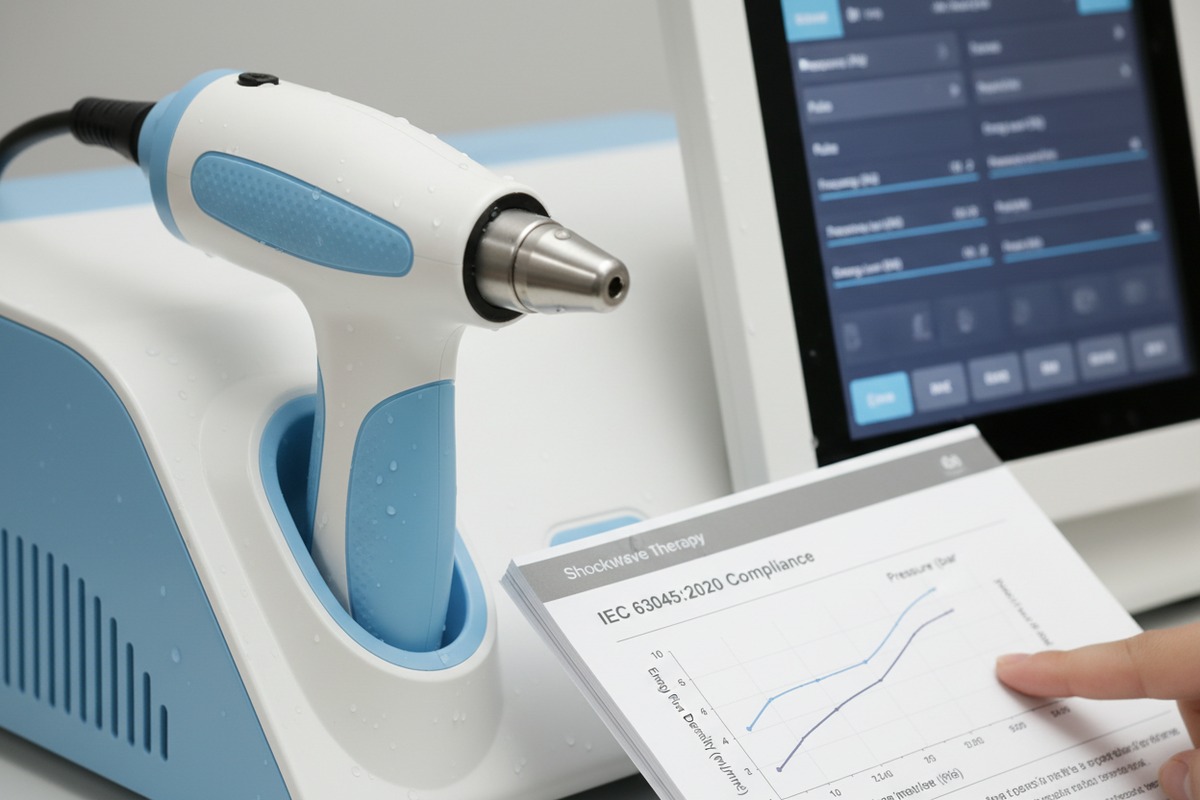
For shockwave therapy devices, substantial clinical literature exists. Systematic reviews indicate ESWT is generally safe with no serious adverse events reported in major randomized controlled trials. Typical treatment parameters include:
- Focused EFD: 0.03–0.60 mJ/mm²
- Radial pressure: 1–4 bar
- Pulses per session: 1000–4000
- Frequency: 1–15 Hz
- Optimal protocol: Three sessions at weekly intervals with 2000 impulses
Request clinical data specific to the device model you are sourcing. If the device is new, ask what clinical validation was performed during development.
Post-Market Surveillance Data
Manufacturers should track device performance after market release. This includes adverse event reports, customer complaints, and performance trends.
Ask your supplier for:
- Summary of complaints received in the past 12 months
- Corrective and preventive action (CAPA) trends
- Field safety corrective actions issued
- FDA MedWatch reports (if applicable)
Newer devices with limited market history carry higher uncertainty. Consider whether sufficient real-world data exists to evaluate long-term reliability.
Component Quality Assessment
Device longevity depends on component quality. Critical components in shockwave machines include:
| Component | Quality Indicators | Lifespan Factors |
|---|---|---|
| Shockwave generator | Brand, rated cycles | Usage intensity, maintenance |
| Handpiece | Material grade, seal quality | Treatment frequency, cleaning |
| Compressor (radial) | Brand, rated pressure | Duty cycle, ambient conditions |
| Control electronics | Component grade, thermal design | Environmental conditions |
| Display/interface | Brand, resolution | Usage patterns |
Request component specifications and supplier qualification records. Premium components from established brands typically offer better longevity than generic alternatives.
Service Infrastructure Evaluation
Long-term device operation requires ongoing support. Evaluate:
- Spare parts availability and lead times
- Technical support responsiveness
- Service documentation quality
- Training resources for operators
- Software update policies
- End-of-life policy and timeline
Our service team maintains spare parts inventory for all current and recent models. We provide remote diagnostics and technical support via multiple channels. Ask your supplier to describe their support infrastructure in detail.
Software Update Considerations
Connected devices require software maintenance. Ask about:
- How software updates are delivered
- Whether updates affect regulatory status
- Change control procedures for updates
- Cybersecurity update policies
For devices handling patient data, verify compliance with applicable privacy regulations like HIPAA in the US 9 or GDPR in Europe.
Conclusion
Verifying international safety standards requires systematic effort across certifications, factory audits, technical documentation, and performance evaluation. Take shortcuts, and you risk costly compliance failures. Invest time in thorough verification, and you build a foundation for successful, safe device distribution.
Footnotes
1. Guidance on CE marking requirements and verification for medical devices. ↩︎
2. Overview of the IEC 60601 series of standards for medical electrical equipment. ↩︎
3. Official information from BSI on ISO 13485 for medical device quality management systems. ↩︎
4. Official FDA information on 510(k) clearances for medical devices. ↩︎
5. Official FDA portal for medical devices, including links to relevant databases. ↩︎
6. Official website of the International Accreditation Forum (IAF). ↩︎
7. Replaced 404 link with a Wikipedia article providing a comprehensive overview of Design History Files. ↩︎
8. Explains IEC 62304 standard for medical device software lifecycle processes. ↩︎
9. Official U.S. Department of Health & Human Services (HHS) information on HIPAA. ↩︎

 English
  Español de México
  Deutsch
  Français
  العربية
  Русский