
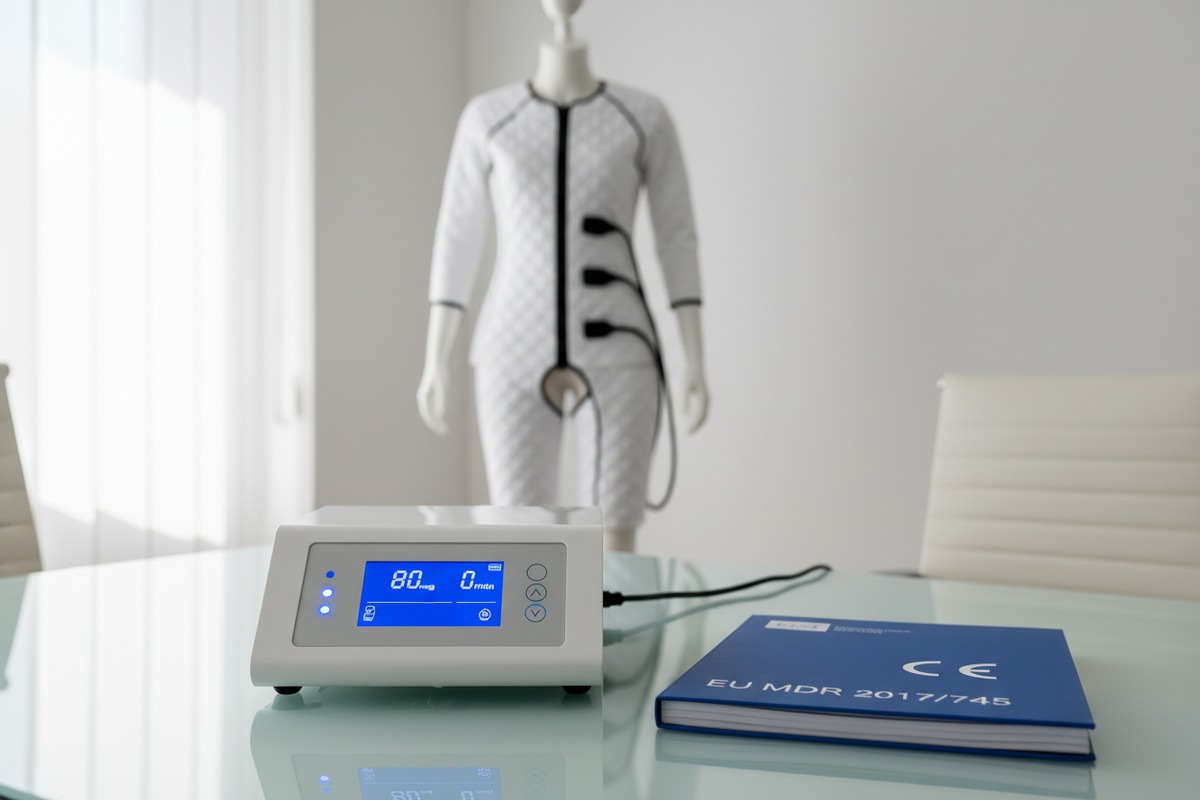
When our engineering team began redesigning our pressotherapy machines for the European market in 2021, we quickly realized the regulatory landscape had fundamentally changed. Many buyers now face confusion about what compliance truly means—and the cost of getting it wrong can devastate a brand.
EU MDR compliance significantly impacts pressotherapy machine purchasing by requiring CE marking through Notified Body assessment for Class IIa/IIb devices, demanding rigorous technical documentation, clinical evaluation reports, post-market surveillance systems, and UDI registration. Buyers must verify MDR-specific certifications rather than relying on legacy CE marks, which increases costs but ensures device safety and market legality.
The sections below break down exactly how to verify your supplier’s compliance, understand the risks of non-compliant imports, navigate private labeling under MDR, and prepare your documentation for smooth customs clearance.
How do I verify if my Chinese manufacturer's pressotherapy machines are truly EU MDR compliant?
Over the years, our sales team has received countless inquiries from buyers who purchased equipment with a CE mark—only to discover later that the certification was invalid under MDR. This happens more often than you might think, and the consequences can be severe.
To verify true MDR compliance, request the manufacturer’s EU Declaration of Conformity referencing Regulation 2017/745 (not the old MDD), confirm the Notified Body certificate number matches the device model, check the NB’s designation in the NANDO database, verify UDI registration in EUDAMED, and request technical documentation including the Clinical Evaluation Report.

Understanding the Difference Between MDD and MDR Certification
Many Chinese manufacturers still display CE marks based on the old Medical Device Directive (93/42/EEC) 2. However, the Medical Device Regulation (EU) 2017/745 3 has been fully applicable since May 26, 2021. Devices certified only under MDD may no longer be legally sold in the EU market depending on their transition status.
When reviewing a supplier's documentation, look for explicit references to "Regulation (EU) 2017/745" on the Declaration of Conformity. The document should clearly state the device classification (typically Class IIa or IIb for pressotherapy machines with dynamic compression) and include the Notified Body's four-digit identification number.
Key Documents to Request From Your Supplier
| Document | Purpose | Red Flags |
|---|---|---|
| EU Declaration of Conformity | Proves MDR compliance claim | References MDD instead of MDR |
| Notified Body Certificate | Confirms third-party assessment | Expired date or mismatched model numbers |
| Technical Documentation Summary | Shows compliance depth | Vague or incomplete information |
| UDI Registration Proof | Demonstrates EUDAMED entry | No UDI assigned to the device |
| ISO 13485 Certificate | Quality management verification | Not specific to medical devices |
Verifying Notified Body Legitimacy
The NANDO database 4 (New Approach Notified and Designated Organisations) allows you to verify whether a Notified Body is legitimately designated for MDR assessments. Simply enter the four-digit number from the CE mark and confirm the NB is authorized to assess medical devices under Regulation 2017/745.
Questions to Ask Your Manufacturer
When we work with international distributors, we always recommend asking these specific questions:
- Can you provide the full technical documentation package prepared according to MDR Annex II and III?
- Who is your Person Responsible for Regulatory Compliance (PRRC) 5?
- What is your post-market surveillance system structure?
- Is your device registered in EUDAMED with a valid UDI?
- Which Notified Body conducted your conformity assessment?
A legitimate manufacturer will answer these questions confidently and provide supporting documentation. Hesitation or vague responses should raise immediate concerns about compliance authenticity.
What are the risks to my brand if I import pressotherapy equipment without proper MDR certification?
In our experience supporting distributors across Europe, we have seen brands suffer devastating setbacks when their equipment fails compliance checks. The financial and reputational damage goes far beyond the initial purchase price.
Importing non-MDR-compliant pressotherapy equipment exposes your brand to market withdrawal orders, product recalls, significant financial penalties, legal liability for patient harm, customs seizures, damage to professional reputation, and loss of distributor relationships. Under MDR, importers share vigilance obligations and can be held jointly liable with manufacturers for non-compliance.

Regulatory Enforcement Actions
EU competent authorities have broad powers to enforce MDR compliance. If your pressotherapy devices are found non-compliant, authorities can:
- Prohibit or restrict market availability
- Order immediate product withdrawal
- Issue mandatory recalls
- Impose financial penalties
- Publicize non-compliance findings
Financial Impact Analysis
The true cost of non-compliance extends far beyond regulatory fines. Consider the complete financial picture:
| Cost Category | Potential Impact |
|---|---|
| Product Recalls | €50,000 – €500,000+ depending on scale |
| Legal Fees | €20,000 – €200,000 for defense |
| Customer Refunds | Full purchase price plus shipping |
| Lost Revenue | Months of market absence |
| Brand Rehabilitation | Marketing costs to restore trust |
| Insurance Premium Increases | 20-50% increase in coverage costs |
Liability Shifting Under MDR
The MDR introduces the concept of "economic operators 8" with shared responsibilities. As an importer, you are not merely a passive buyer—you become part of the compliance chain. According to Article 13 of MDR, importers must verify that manufacturers have fulfilled their obligations, including conformity assessment, technical documentation, and CE marking.
If a non-EU manufacturer disappears or becomes uncooperative, the importer may become the primary target for regulatory action. The Authorized Representative can also be held jointly liable with the manufacturer, creating additional pressure on all parties in the supply chain.
Reputational Damage
Medical spas and clinics increasingly demand MDR-compliant equipment for post-operative lymphatic drainage treatments. If your brand becomes associated with non-compliant devices, you risk:
- Loss of key accounts with compliance-conscious clinics
- Negative reviews and industry word-of-mouth
- Exclusion from professional trade shows
- Damage to relationships with distributors
When our distributors ask about compliance shortcuts, we remind them that reputation takes years to build but only one compliance scandal to destroy.
Post-Market Obligations for Importers
Even after successful import, MDR compliance requires ongoing vigilance. Importers must:
- Maintain complaint handling systems
- Forward incident reports to manufacturers immediately
- Keep copies of Declarations of Conformity for 10 years
- Cooperate with competent authority investigations
- Report serious risks or suspected falsification
Can I still customize and private label pressotherapy machines under the new EU MDR regulations?
Private labeling has been a cornerstone of our business model for over a decade. When MDR came into force, many of our distributors worried that their OEM arrangements would become impossible. The reality is more nuanced—customization is still possible, but with significantly increased responsibilities.
Yes, you can still customize and private label pressotherapy machines under EU MDR, but the private labeler (OBL) assumes full manufacturer responsibilities. This means you must maintain complete technical documentation, implement ISO 13485-compliant QMS, appoint a PRRC, conduct clinical evaluations, manage post-market surveillance, and ensure your OEM supplier agrees to Notified Body audits.

The Shift From MDD to MDR for Private Labelers
Under the old Medical Device Directive, Own Brand Labelers (OBLs) could often rely on simplified technical files provided by Original Equipment Manufacturers (OEMs). This approach is no longer acceptable under MDR. The regulation treats private labelers as full legal manufacturers with all corresponding obligations.
When you put your brand name on a pressotherapy device, you are declaring to EU authorities that you take complete responsibility for its safety and performance throughout its lifecycle. This is a fundamental change from previous practice.
Requirements for Private Label Manufacturers
| Requirement | OBL Responsibility | OEM Support Needed |
|---|---|---|
| Technical Documentation | Compile and maintain per Annex II/III | Provide design and manufacturing data |
| Quality Management System | ISO 13485 certification required | QMS must align with OBL system |
| Clinical Evaluation Report | OBL must review and approve | Provide clinical data and studies |
| Post-Market Surveillance | OBL manages complaint handling | Report issues to OBL immediately |
| UDI Registration | OBL registers in EUDAMED | Provide device specifications |
| PRRC Appointment | OBL must have qualified person | N/A |
| Notified Body Audits | OBL is audited; OEM may be included | Agree to audit participation |
Contractual Considerations
Your agreement with a Chinese OEM manufacturer must clearly define responsibilities under MDR. Essential contractual elements include:
- Data Access: The OEM must provide complete technical documentation, test reports, and validation data for your review
- Audit Rights: Your agreement must allow Notified Body access to the OEM's facilities
- Change Notification: The OEM must inform you of any design or manufacturing changes
- Complaint Handling: Clear protocols for forwarding customer complaints
- Liability Allocation: Define responsibility sharing for compliance failures
The Person Responsible for Regulatory Compliance (PRRC)
MDR Article 15 requires manufacturers to have a Person Responsible for Regulatory Compliance permanently available. For private label companies, this person must:
- Hold relevant qualifications (law, medicine, pharmacy, engineering, or equivalent)
- Have at least one year of professional experience with medical device regulations
- Oversee technical documentation conformity
- Manage post-market surveillance and vigilance reporting
Small and micro enterprises may have a PRRC available externally rather than as an employee, but the person must be continuously accessible.
Cost Implications of Private Labeling Under MDR
Many distributors underestimate the investment required for MDR-compliant private labeling. Beyond product costs, budget for:
- QMS implementation and ISO 13485 certification
- PRRC salary or consulting fees
- Clinical evaluation expertise
- Post-market surveillance systems
- UDI registration and EUDAMED fees
- Notified Body assessment fees
- Regulatory consulting support
Our observation from working with distributors is that compliant private labeling costs have increased 20-50% compared to pre-MDR arrangements. However, this investment protects your brand and ensures market access.
How will MDR compliance documentation impact my logistics and customs clearance process in Europe?
Our logistics team has learned through years of shipping to European ports that documentation errors cause the most frustrating delays. With MDR adding new requirements, proper preparation becomes even more critical for smooth customs clearance.
MDR compliance documentation significantly impacts EU customs clearance by requiring proof of CE marking under Regulation 2017/745, EU Declaration of Conformity, evidence of Notified Body certification for Class IIa/IIb devices, UDI registration confirmation, and importer identification on labeling. While documents need not be submitted automatically, customs may request them for inspection, causing delays if unavailable.
Documentation Requirements at EU Borders
Customs authorities verify that medical devices meet EU regulatory requirements before allowing market entry. For pressotherapy machines, this means having the following documentation readily accessible:
| Document | Status | Notes |
|---|---|---|
| EU Declaration of Conformity | Mandatory | Must reference MDR 2017/745 |
| Notified Body Certificate | Required for Class IIa/IIb | Must be valid and match product |
| Technical Documentation Summary | Available on request | May be requested during inspection |
| Commercial Invoice | Mandatory | Include tariff classification |
| Packing List | Mandatory | Itemize all products and accessories |
| Transport Document (CMR/Bill of Lading) | Mandatory | Depends on transport mode |
| Certificate of Origin | Often required | May affect duty rates |
The Role of Importer Identification
Under MDR Article 13(3), importers must indicate their name, registered trade name, and address on the device, packaging, or accompanying document. This requirement applies to all medical devices entering the EU market from non-EU manufacturers.
The importer's details ensure traceability and allow competent authorities to contact the responsible EU-based party. Without proper importer identification, customs may delay or refuse clearance.
Tariff Classification for Pressotherapy Equipment
Correct tariff classification is essential for customs clearance and determines applicable duty rates. Pressotherapy machines typically fall under customs codes related to electro-medical equipment. Misclassification can result in:
- Additional duties and back-payments
- Clearance delays while authorities investigate
- Penalties for incorrect declarations
- Audit triggers for future shipments
Work with an experienced customs broker familiar with medical devices to ensure accurate classification.
Pre-Clearance Preparation Steps
To minimize customs delays, we recommend our distributors follow these preparation steps:
- Verify all documentation before shipping: Ensure DoC and certificates match the exact products in the shipment
- Provide your customs agent with complete files: Include all compliance documentation, not just commercial papers
- Confirm importer labeling requirements are met: Labels must show EU importer details before first market placement
- Prepare for potential inspections: Have technical documentation summaries available electronically
- Check UDI registration status: EUDAMED registration should be complete before shipment
Handling Customs Authority Requests
If customs authorities request compliance documentation, response time is critical. Documents must be provided immediately upon request. Delays are the responsibility of the importer and can result in:
- Storage fees at customs facilities
- Demurrage charges for delayed containers
- Loss of customer orders due to delivery failures
- Increased scrutiny on future shipments
Ensure your freight forwarder or customs agent has access to all required documentation before goods arrive at EU ports.
EUDAMED Registration and Customs
While EUDAMED registration is not checked automatically at customs, competent authorities may verify device registration during market surveillance activities. Having your device properly registered demonstrates compliance readiness and simplifies any post-clearance inquiries.
Both manufacturers and importers must register in EUDAMED. The database stores information on device registrations, certificates, and economic operators, creating a comprehensive record that authorities can access.
Conclusion
EU MDR compliance 9 has fundamentally changed how pressotherapy machines must be purchased, imported, and sold in Europe. By verifying your manufacturer's MDR certification, understanding your liability as an importer, properly structuring private label arrangements, and preparing thorough customs documentation, you protect your brand while ensuring patient safety across the EU market.
## Footnotes

<span id="footnote-1">
1. BSI, an authoritative certification body, provides an overview of ISO 13485 for Quality Management Systems in the medical device industry. <a href="#ref-1" class="footnote-backref">↩︎</a>
</span>

<span id="footnote-2">
2. Official source for the repealed Medical Device Directive, providing historical context. <a href="#ref-2" class="footnote-backref">↩︎</a>
</span>

<span id="footnote-3">
3. Direct link to the official consolidated text of the Medical Device Regulation (EU) 2017/745. <a href="#ref-3" class="footnote-backref">↩︎</a>
</span>

<span id="footnote-4">
4. This is the official European Commission's NANDO database, which lists Notified Bodies for medical devices. <a href="#ref-4" class="footnote-backref">↩︎</a>
</span>

<span id="footnote-5">
5. Provides an overview of the PRRC role and requirements under MDR Article 15. <a href="#ref-5" class="footnote-backref">↩︎</a>
</span>

<span id="footnote-6">
6. Explains the role and necessity of Notified Body assessment in the EU MDR conformity process. <a href="#ref-6" class="footnote-backref">↩︎</a>
</span>

<span id="footnote-7">
7. Provides a comprehensive guide to CE marking requirements for medical devices under EU MDR. <a href="#ref-7" class="footnote-backref">↩︎</a>
</span>

<span id="footnote-8">
8. Defines economic operators under MDR and their shared compliance obligations in the supply chain. <a href="#ref-8" class="footnote-backref">↩︎</a>
</span>

<span id="footnote-9">
9. Official explanation of EU MDR compliance and its requirements for medical devices. <a href="#ref-9" class="footnote-backref">↩︎</a>
</span>

 English
 Español de México
 Deutsch
 Français
 العربية
 Русский
