

Every week, our export team receives inquiries from US buyers who have been burned by shockwave machines that looked great online but failed customs inspection. The frustration is real. Thousands of dollars lost. Months of waiting wasted. And the worst part? These problems are completely avoidable with the right knowledge.
To identify US market shockwave therapy machines when sourcing from China, verify FDA 510(k) clearance for Class II devices, request official documentation including device listing numbers, check the FDA database independently, and ensure technical specifications match cleared indications. CE marking alone is insufficient for US import.
This guide walks you through every step of the verification process. You will learn exactly what documents to demand, which red flags to watch for, and how to protect your investment from costly compliance failures.
How do I verify that a Chinese shockwave therapy machine meets US regulatory and safety standards?
When our quality team prepares export documentation for US-bound shipments, we follow a strict checklist that many overseas buyers overlook. The regulatory landscape is complex. One missing document can mean your machine sits in a customs warehouse indefinitely.
To verify US regulatory compliance, request the FDA 510(k) clearance letter with a valid K-number, confirm the manufacturer's FDA establishment registration, verify device listing in the FDA database, and ensure labeling matches cleared indications. "FDA registered" is not the same as FDA cleared—only 510(k) clearance authorizes market entry.
Understanding FDA Device Classifications
The FDA classifies medical devices into three categories based on risk level. This classification determines what documentation you need.
Class I devices carry the lowest risk. Radial shockwave machines sometimes fall here. They need basic registration and labeling compliance but no 510(k) clearance.
Class II devices 1 require 510(k) clearance. Most therapeutic shockwave machines fall into this category. The manufacturer must prove "substantial equivalence" to a legally marketed device.
Class III devices pose the highest risk. Early focused ESWT machines required Premarket Approval (PMA) 2. The Orthospec system, for example, received PMA P040026 for plantar fasciitis treatment.
| Device Class | Risk Level | FDA Requirement | Common Shockwave Types |
|---|---|---|---|
| Class I | Low | Registration, GMP, Labeling | Some radial devices |
| Class II | Moderate | 510(k) Clearance | Most therapeutic ESWT |
| Class III | High | PMA or IDE | High-energy focused units |
Essential Verification Documents
Before placing any order, demand these documents from your Chinese supplier:
The 510(k) clearance letter confirms FDA authorization. It contains a K-number you can verify independently.
The device listing number shows the specific product is registered. Cross-check this in the FDA database.
Establishment registration proves the factory is registered with FDA. It also confirms they have a US agent.
Quality System Regulation (QSR) 3 certification under 21 CFR 820 demonstrates manufacturing compliance. ISO 13485 certification 4 supports this but does not replace it.
How to Use FDA Databases for Independent Verification
Never rely solely on supplier-provided documents. The FDA maintains searchable databases for verification.
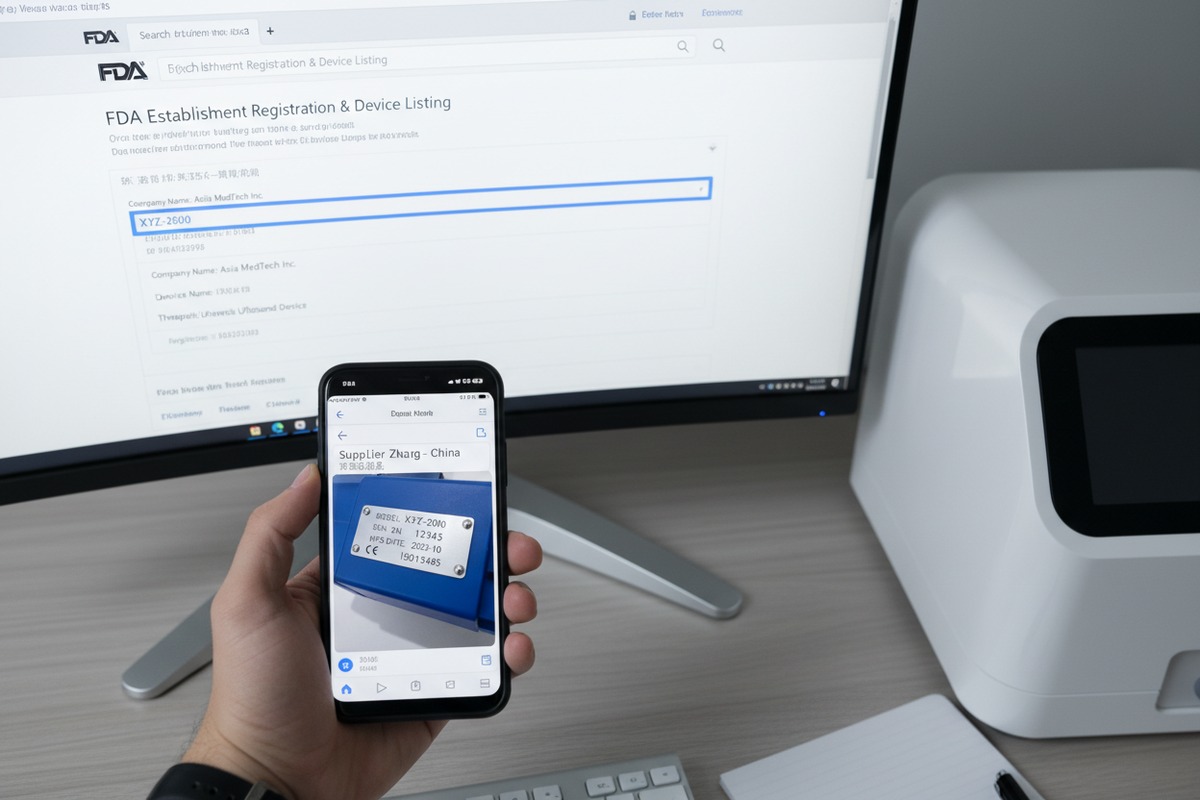
Visit the FDA 510(k) Premarket Notification database. Enter the K-number from the clearance letter. The results should match exactly.
Check the FDA Establishment Registration database. Search by facility name or registration number.
Review the cleared indications carefully. A machine cleared for musculoskeletal pain cannot be marketed for wound healing. Mismatched claims indicate compliance problems.
| Verification Step | FDA Database | What to Check |
|---|---|---|
| 510(k) Clearance | 510(k) Database | K-number, device name, indications |
| Factory Registration | Establishment Registration | Registration status, US agent |
| Device Listing | Device Listing Database | Product code, device class |
What quality control measures should I look for to ensure the shockwave machine's performance is stable?
Our production floor runs continuous testing protocols that would surprise many buyers. Performance stability is not automatic. It requires systematic quality control at every manufacturing stage. Without proper QC, even well-designed machines fail within months.
Look for manufacturers with documented quality management systems including ISO 13485 certification, in-process testing records, final inspection protocols, and third-party calibration reports. Request energy flux density (EFD) measurement data, handpiece durability testing results, and electromagnetic compatibility (EMC) certification under IEC 60601 standards.

Critical Technical Specifications to Verify
Performance stability starts with proper specifications. Understand what numbers matter.
Energy Flux Density (EFD) 6 measures therapeutic output. It should remain consistent across the machine's lifespan. Ask for calibration data showing EFD variance.
Focal mapping shows where energy concentrates. Focused machines need precise focal zones. Poor mapping means unpredictable treatment results.
Handpiece lifespan affects long-term costs. Quality handpieces deliver 1-5 million pulses before replacement. Cheap units fail at 100,000 pulses.
Radial vs. Focused Technology Considerations
The two main shockwave types require different quality benchmarks.
Radial shockwave technology uses pneumatic pressure to create ballistic waves. These waves spread outward from the applicator tip. Penetration depth reaches about 3-4 centimeters. The technology is simpler and more durable.
Focused shockwave technology concentrates energy at a specific depth. It penetrates up to 12 centimeters. The precision requires more sophisticated manufacturing. Quality control must be more rigorous.
| Specification | Radial Type | Focused Type |
|---|---|---|
| Penetration Depth | 3-4 cm | Up to 12 cm |
| Energy Concentration | Diffuse | Precise focal point |
| Manufacturing Complexity | Lower | Higher |
| QC Requirements | Standard | Rigorous |
| Typical FDA Class | Class I/II | Class II/III |
Quality Management System Requirements
A robust quality management system prevents defects before they happen.
ISO 13485 certification is the baseline. It demonstrates systematic quality control. But certification alone is not enough. Ask for audit reports and corrective action records.
Design verification records show the product was tested against specifications. Request these documents for the exact model you are purchasing.
Production testing records document in-process inspections. Each unit should have traceable test results.
Final inspection protocols ensure consistency before shipping. Ask what parameters are tested and what acceptance criteria apply.
Testing Standards for US Market Compliance
Several IEC standards apply to shockwave devices.
IEC 60601-1 7 covers general safety and essential performance. Every medical electrical device must comply.
IEC 60601-1-2 addresses electromagnetic compatibility. Shockwave machines must not interfere with other equipment and must resist interference.
IEC 62304 governs medical device software. If your machine has digital controls, this standard applies.
ISO 14971 requires documented risk management. The manufacturer should have a complete risk analysis file.
Can I customize the design and private label these shockwave machines to fit my US brand identity?
When clients visit our facility in Guangzhou, they often arrive with specific branding requirements. Our design team has learned that US market expectations differ significantly from other regions. The good news is that comprehensive customization is absolutely achievable with the right manufacturing partner.
Yes, reputable Chinese manufacturers offer extensive OEM and ODM services including custom housing colors, logo placement, software interface localization, and branded packaging. However, ensure that any modifications do not alter FDA-cleared specifications, as design changes may require new regulatory submissions.

Understanding OEM vs. ODM Services
These terms describe different levels of customization.
OEM (Original Equipment Manufacturing) applies your brand to an existing product. The machine design stays the same. You customize colors, logos, packaging, and documentation.
ODM (Original Design Manufacturing) involves deeper collaboration. You can modify features, change specifications, or develop entirely new configurations. This requires more time and investment.
| Service Type | Customization Level | Timeline | Minimum Order | FDA Implications |
|---|---|---|---|---|
| OEM Basic | Logo, colors, packaging | 2-4 weeks | 10-50 units | Usually none |
| OEM Advanced | UI, documentation, accessories | 4-8 weeks | 50-100 units | Labeling review needed |
| ODM | Specifications, features, design | 3-6 months | 100+ units | May require new 510(k) |
Software Localization Requirements
US practitioners expect intuitive interfaces. Proper localization goes beyond translation.
Language must be clear English with correct medical terminology. Automated translation often fails. Request native English review of all text.
Treatment protocols should align with US clinical practices. Pre-set programs save practitioner time. Ensure protocols match common US treatment approaches.
Units of measurement must use US conventions where appropriate. Some practitioners prefer imperial measurements for certain parameters.
Data handling must comply with US standards. If the machine stores patient information, HIPAA considerations apply. Discuss data security features with your supplier.
Branding Without Compromising Compliance
Customization has limits when FDA clearance is involved.
The device name on labeling must match the 510(k) clearance. You can add your brand name, but the cleared device name must remain.
Indications for use cannot expand beyond cleared claims. Your marketing materials must stay within approved uses.
Technical specifications cannot change without regulatory review. If you want different energy levels or frequencies, consult a regulatory expert first.
Working with Manufacturers on Custom Projects
Successful customization requires clear communication.
Provide detailed specifications in writing. Include dimensional drawings for logo placement. Specify exact color codes.
Request samples before production. Physical prototypes reveal problems that digital mockups miss.
Establish approval processes. Define who signs off on designs and at what stages.
Plan for longer lead times. Custom projects take more time than standard orders. Build this into your purchasing timeline.
How do I manage the door-to-door logistics and pre-shipment inspections to avoid damaged equipment?
Our logistics team coordinates shipments across six continents. The journey from Guangzhou to a US clinic involves many potential failure points. Proper logistics management prevents the heartbreak of receiving damaged equipment after months of waiting.
Implement mandatory third-party pre-shipment inspections, specify shock-resistant packaging with adequate cushioning, require detailed photo documentation before sealing, use freight forwarders experienced with medical equipment, and secure appropriate marine cargo insurance covering full replacement value.

Pre-Shipment Inspection Protocols
Third-party inspections provide objective verification.
Visual inspection confirms no cosmetic damage. Inspectors photograph the machine from multiple angles.
Functional testing verifies the machine operates correctly. All modes should be tested before shipping.
Documentation review ensures all papers are included. Missing certificates cause customs delays.
Packaging inspection confirms adequate protection. Inspectors check cushioning, box integrity, and moisture protection.
| Inspection Element | What Inspectors Check | Why It Matters |
|---|---|---|
| Appearance | Scratches, dents, color accuracy | Customer satisfaction |
| Function | All modes, displays, handpieces | Operational readiness |
| Documentation | Certificates, manuals, warranties | Customs clearance |
| Packaging | Cushioning, sealing, labels | Transit protection |
| Quantity | Unit count, accessories | Order accuracy |
Packaging Requirements for Safe Transit
Shockwave machines are precision instruments. They need proper protection.
Inner packaging should include custom foam inserts. Generic packing materials allow movement during transit. Movement causes damage.
Outer packaging requires double-wall corrugated boxes at minimum. Triple-wall is better for heavy units.
Moisture protection prevents condensation damage. Include desiccant packets inside the packaging.
Shock indicators reveal rough handling. These small devices change color when the package experiences excessive impact.
Freight Forwarding Considerations
Choose freight partners with medical device experience.
Air freight is faster but more expensive. It suits urgent orders or high-value units. Transit time is typically 5-10 days.
Sea freight costs less for larger shipments. Plan for 25-35 days transit time. Containers should be temperature controlled.
Customs brokerage services help navigate import requirements. Experienced brokers know FDA documentation requirements. They prevent costly delays.
Insurance and Risk Mitigation
Proper insurance protects your investment.
Marine cargo insurance should cover full replacement value. Standard carrier liability is often insufficient.
Document everything before shipping. Photographs create evidence for claims.
Understand Incoterms 8. DDP (Delivered Duty Paid) transfers risk to the seller until delivery. EXW (Ex Works) makes you responsible from the factory door.
Managing US Import Requirements
FDA registration requires a US agent. Your supplier must register their establishment and list their devices.
Prior notice may be required for certain medical devices. Your customs broker can advise on specific requirements.
Import alerts can affect shipments from certain suppliers or products. Check FDA import refusal reports before selecting a supplier.
Tariffs and duties vary by product classification. Calculate these costs before finalizing pricing. Recent trade policy changes may affect rates.
Conclusion
Sourcing US-compliant shockwave therapy machines from China requires diligence across regulatory verification, quality control assessment, customization planning, and logistics management. The effort protects your investment and your reputation with downstream customers.
Footnotes
1. Provides official information on FDA medical device classifications. ↩︎
2. Explains the FDA’s most stringent premarket review process for medical devices. ↩︎
3. Describes the FDA’s requirements for quality management systems for medical devices. ↩︎
4. Details the international standard for quality management systems in medical devices. ↩︎
5. Replaced with the current official FDA page for 510(k) clearances. ↩︎
6. Defines a key parameter for shockwave therapy device performance. ↩︎
7. Provides information on the international standard for medical electrical equipment safety. ↩︎
8. Replaced with the official International Chamber of Commerce (ICC) page for Incoterms rules. ↩︎

 English
  Español de México
  Deutsch
  Français
  العربية
  Русский