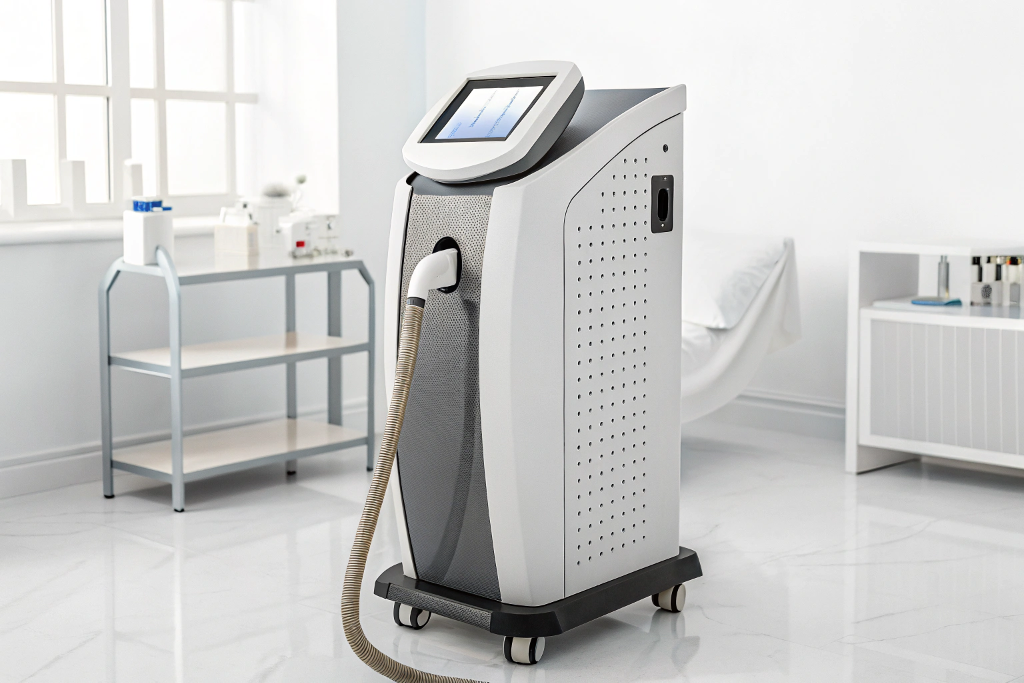
When I started sourcing beauty machines from Chinese suppliers, I was overwhelmed by the range of technologies and models. It was difficult to understand the difference between diode lasers, IPL, and other systems.
Chinese hair removal device manufacturers predominantly use diode laser technology 1, particularly the 808 nm wavelength, often combined with 755 nm and 1064 nm for broader treatment applications.
If you’re considering sourcing these devices or launching your own OEM line, here’s everything you need to know about the technology, effectiveness, and quality standards of laser hair removal machines from China.
What are the pros and cons of diode lasers vs IPL?
When I first compared diode lasers with IPL systems, I didn’t know which one would meet client expectations better. Then I saw how customers responded differently to the treatments.
Diode lasers offer more precise and effective permanent hair removal 2 with fewer side effects than IPL, especially on coarse or dark hair. However, IPL systems 3 are cheaper and more versatile for multiple skin treatments.

Key Differences Between Diode Lasers and IPL
| Feature | Diode Laser | IPL |
|---|---|---|
| Light source | Focused single wavelength | Broad-spectrum pulsed light |
| Target precision | High (melanin in hair follicle) | Moderate (can affect skin too) |
| Pain level | Lower with good cooling | Often more painful |
| Effectiveness | High on all hair colors | Moderate, less on light hair |
| Safety | Safer on darker skin tones | Riskier on dark skin tones |
| Treatment depth | Deeper penetration | Shallower penetration |
Chinese OEMs tend to prioritize diode lasers because they are purpose-built for hair removal. IPL systems, although cheaper to build, are more general-purpose. That’s why most Chinese factories now offer diode as their flagship system.
Which wavelength suits different skin and hair types best?
One of my clients was sourcing machines for a multi-ethnic market. She kept asking which wavelength works for light hair, and which is safer on dark skin. I had to break it down clearly.
The 755 nm wavelength 4 targets light and fine hair; 808 nm is best for average skin and hair types; 1064 nm is safest for darker skin due to its deeper penetration and lower melanin absorption.

Wavelength Suitability Table
| Wavelength (nm) | Best For | Skin Types | Hair Types | Penetration Depth |
|---|---|---|---|---|
| 755 | Fair skin, light hair | I–III | Thin, light | Shallow |
| 808 | Normal skin, dark hair | I–V | Medium-coarse | Medium |
| 1064 | Dark skin, deep follicles | IV–VI | Coarse, thick | Deep |
Many Chinese suppliers offer devices with all three wavelengths in a single handpiece. This makes it easy for clinics to treat all clients safely and effectively without needing separate machines.
Can triple-wavelength devices treat all skin tones safely?
I remember the first time I tried selling single-wavelength machines. The feedback from clients with darker-skinned customers was clear: they needed more flexibility.
Yes, triple-wavelength diode laser devices 5 (755 nm + 808 nm + 1064 nm) can safely treat all skin tones by combining multiple light depths and melanin absorption levels in one treatment session.
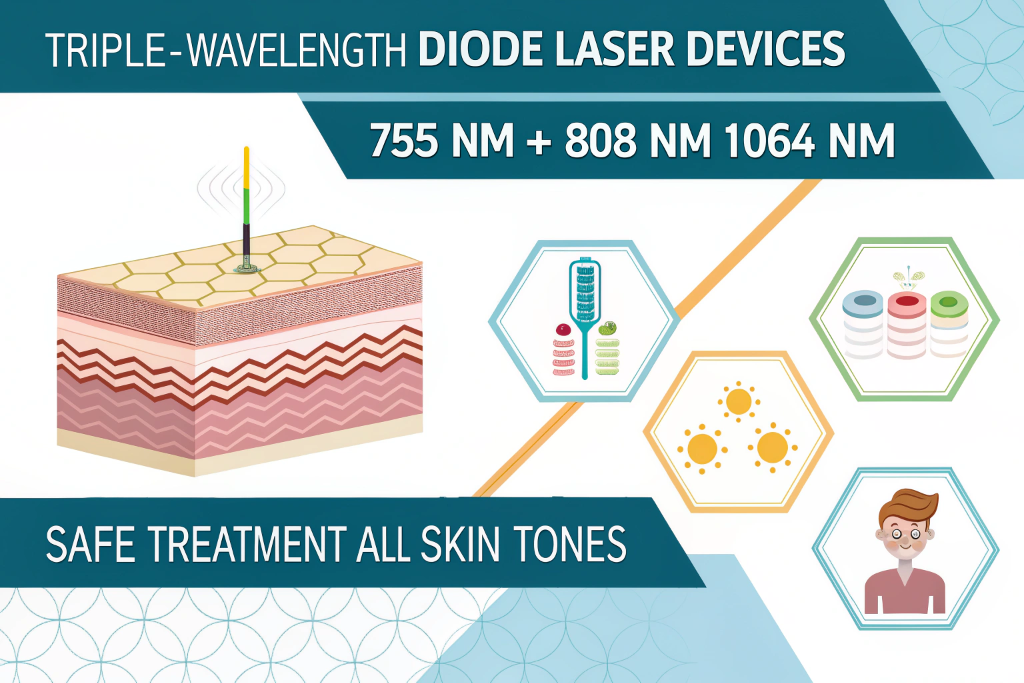
Why Triple-Wavelength is the New Standard
Triple-wavelength devices solve a common challenge in laser hair removal—customizing treatment for different people. Here’s how they do it:
755 nm:
- Best for light skin with fine hair.
- High melanin absorption.
- Targets the upper part of the follicle.
808 nm:
- Standard for most skin and hair types.
- Balanced depth and absorption.
- Ideal for high-frequency usage.
1064 nm:
- Low melanin absorption, deeper reach.
- Safe for dark skin and dense hair.
- Reduces risk of burns or hyperpigmentation.
By combining all three in a single session or alternating pulses, Chinese-made systems deliver safe, efficient results for clients from Type I to VI on the Fitzpatrick scale 6.
How do Chinese suppliers ensure quality and certification?
Clients often ask me, “Can your Chinese suppliers meet our compliance standards?” I used to worry about that too—until I visited their factories myself.
Chinese laser device suppliers ensure quality by using imported laser bars, strong cooling systems, CE/FDA certification 7, and ISO manufacturing standards. Many also offer OEM testing reports and customization services.

Key Quality Features from Chinese Suppliers
| Component | Description |
|---|---|
| Laser Bars | Imported from Germany or USA (Coherent, Dilas, Jenoptik) |
| Cooling System | Water + TEC + Sapphire Contact for stable, painless output |
| Output Power | 1000–2000 W laser module power |
| Certifications | CE, ISO13485, FDA (for select models) |
| Quality Control | Aging test, temperature stability test, energy testing |
| Customization | OEM/ODM services, logo printing, housing design |
Many suppliers also offer demo videos, clinical test results, and sample machines for international partners. During sourcing, I always ask for factory audit reports, CE certificates, and real-time inspection photos.
Conclusion
Chinese laser hair removal machines use diode technology with triple wavelengths to treat all skin types safely and effectively, backed by robust quality systems and global certifications.
Footnotes
-
Learn how diode laser technology enables effective, targeted hair removal. ↩ ↩
-
Study shows diode lasers deliver long-term results with reduced pain. ↩ ↩
-
IPL devices offer multi-functional treatment options at lower cost. ↩ ↩
-
Wavelength comparison in laser hair removal effectiveness by hair and skin type. ↩ ↩
-
Triple-wavelength systems improve safety and efficiency across all skin tones. ↩ ↩
-
Understand the Fitzpatrick scale and its relevance in laser safety. ↩ ↩
-
FDA medical device certification requirements explained. ↩ ↩

 English
  Español de México
  Deutsch
  Français
  العربية
  Русский