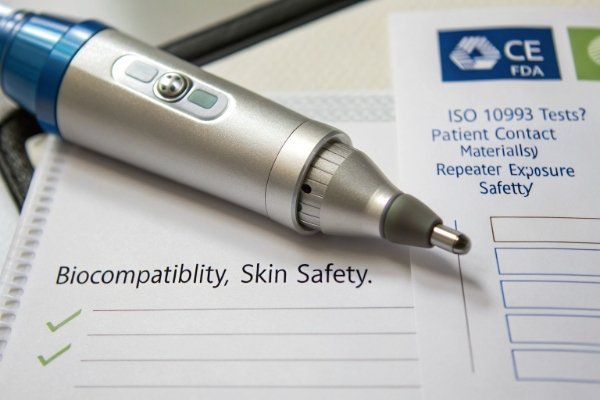
From our side as a company that builds these systems, buyers often ask whether we must prove skin safety through biocompatibility evidence for medical devices 1, or if a CE or FDA mark alone already covers everything.
Suppliers of shockwave therapy machines are not always legally forced to hand over a stand-alone “skin-safety report”, but they must hold and, on request, share biocompatibility evidence showing that all patient-contact materials are safe for repeated skin exposure.
If you treat this as a simple cosmetic device purchase, you can easily miss serious regulatory and liability risks tied to skin-contact safety.
What kinds of skin compatibility tests are common in the industry?
From working with testing labs and regulatory consultants, we see that many buyers underestimate how structured and standardized skin-compatibility testing actually is for shockwave handpieces and accessories.
The most common skin compatibility tests follow the ISO 10993 series and include cytotoxicity, irritation, sensitisation, and sometimes material characterisation, forming a biocompatibility package that proves the handpiece and accessories are safe for intact skin contact.

For external devices like shockwave therapy machines, the main concern is how the materials behave during repeated contact with intact skin over time, which is exactly the focus of ISO 10993-1 biocompatibility standard 2. Even if energy is delivered through air or gel, the handpiece shell, caps, and coupling surfaces all matter.
Typical ISO 10993 test battery for intact skin
Regulators expect manufacturers to follow a risk-based approach, guided by biocompatibility evaluation endpoints by device category 3, but many devices use a standard minimum set of tests, summarized in overviews of the ISO 10993 biocompatibility series 10:
- Cytotoxicity – checks whether materials are toxic to cells
- Irritation – assesses whether contact causes redness or inflammation
- Sensitisation – evaluates risk of allergic reactions
- Material characterisation – identifies ingredients and potential leachables
- Clinical or usability observations – monitors local skin reactions in use
Together, these provide a clear picture of whether the patient-contact parts are safe.
Common test methods at a glance
| Test Type | Purpose | Typical For Shockwave Devices |
|---|---|---|
| Cytotoxicity | Detects cell toxicity | Yes, standard |
| Irritation | Checks for redness / swelling | Yes, standard |
| Sensitisation | Evaluates allergy potential | Yes, strongly recommended |
| Material analysis | Identifies chemicals and leachables | Often included |
| Clinical follow-up | Observes reactions during real use | Sometimes, depending on claims |
How can buyers ensure the handpiece is safe for direct skin contact?
From our experience supporting brand owners, the most successful buyers do not just trust the catalog. They ask smart, specific questions about skin-contact safety and request proof before confirming orders.
Buyers can ensure handpiece skin safety by requesting ISO 10993 biocompatibility data, checking that all patient-contact materials are documented, reviewing clinical or post-market feedback, and confirming that the design supports hygienic use without sharp edges, toxic coatings, or unhygienic surfaces.
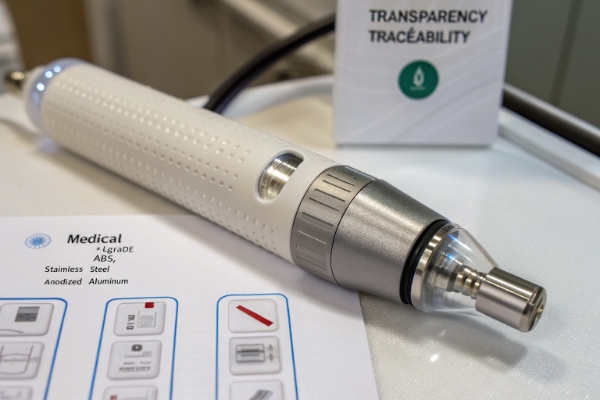
A safe handpiece is not only about test reports. It is also about materials, ergonomics, and how the device behaves in daily salon or clinic use, which should reflect principles in FDA guidance for devices contacting intact skin 4.
Practical steps to verify skin safety
- Request the biocompatibility summary
- Confirm material documentation
- Check design for hygiene
- Review user feedback and complaints
Buyer verification checklist
| Verification Step | What to Ask Supplier | What It Confirms |
|---|---|---|
| Biocompatibility evidence | “Do you have ISO 10993 skin-contact tests?” 5 | Formal skin safety evaluation |
| Material list for contact areas | “What plastics and metals touch the skin?” | Transparency on material choices |
| Cleaning and disinfection guidance | “How should we clean the handpiece safely?” | Practical hygiene and coating durability |
| Complaint history | “Any past skin-irritation cases reported?” | Real-world performance and risk history |
Are specific certifications required for aesthetic vs medical markets?
Because we supply both medical and aesthetic clients, we see a clear gap between what some beauty buyers assume is “enough” and what regulators require for true medical devices.
Medical markets usually require full regulatory clearance (such as CE under MDR or FDA 510(k)), which includes biocompatibility evidence, while pure aesthetic markets may accept only electrical safety and basic documentation—but relying solely on minimal aesthetic standards significantly increases risk.
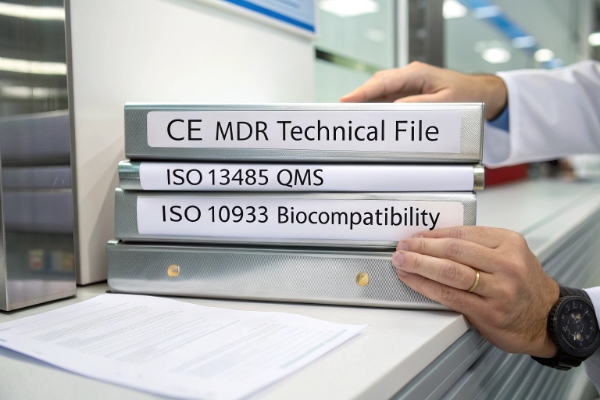
For medical devices, CE marking must follow EU MDR CE-marking processes 6, and FDA devices may require FDA 510(k) premarket notification 7, both of which expect appropriate biocompatibility justification.
Medical vs aesthetic expectations comparison
| Market Type | Typical Requirements | Skin Safety Implication |
|---|---|---|
| Medical (EU MDR) | CE mark, ISO 13485 quality management system 8, ISO 10993, clinical evidence | Strong biocompatibility control |
| Medical (US FDA) | 510(k), FDA biocompatibility guidance 3 | Skin tests expected for contact parts |
| Aesthetic (pro use) | Electrical safety, EMC | Biocompatibility often requested by buyers |
| Aesthetic (home) | Minimal standards | Higher risk if skin-safety data is missing |
What risks are involved if skin-safety data is missing?
From factory and regulatory discussions, we have seen that cutting corners on skin-safety documentation is one of the fastest ways for brands to run into serious trouble—both clinically and legally.
Missing skin-safety data increases the risk of patient irritation, allergic reactions, product recalls, legal liability, import refusal, and long-term damage to brand reputation.
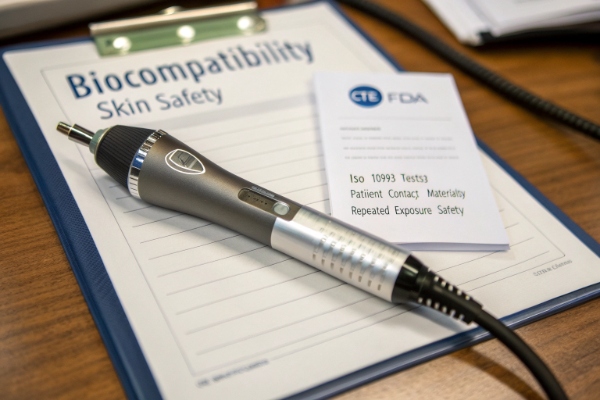
The risk also rises when manufacturers ignore evolving expectations such as the update to biocompatibility policy for skin-contact devices 9, which clarifies when justification versus testing is acceptable.
Risk overview table
| Risk Category | Example Consequence | Impact Level |
|---|---|---|
| Clinical | Irritation, allergy, local skin damage | High |
| Regulatory | Import refusal, sales suspension | High |
| Financial | Returns, warranty claims, recalls | Medium–High |
| Reputational | Loss of trust with clinics and patients | High |
Conclusion
When purchasing a shockwave therapy machine, buyers should treat skin-safety evidence as essential, request ISO 10993-based biocompatibility documentation, and understand that lacking such data exposes them to clinical, regulatory, and reputational risk in both medical and aesthetic markets.
Footnotes
1. Overview of medical-device biocompatibility concepts for skin contact. ↩︎
2. FDA-hosted ISO 10993-1 biocompatibility guidance document. ↩︎
3. FDA biocompatibility endpoint matrix by device category. ↩︎
4. News summary of FDA skin-contact biocompatibility guidance. ↩︎
5. Article on EU MDR biocompatibility requirements and ISO 10993. ↩︎
6. Practical guide to CE marking under the EU MDR. ↩︎
7. FDA page outlining special 510(k) biocompatibility considerations. ↩︎
8. ISO overview of ISO 13485 medical-device QMS standard. ↩︎
9. Legal analysis of updated biocompatibility policy for intact-skin devices. ↩︎
10. Whitepaper explaining ISO 10993 biocompatibility series and test planning. ↩︎

 English
  Español de México
  Deutsch
  Français
  العربية
  Русский