We frequently encounter clients who previously purchased low-cost units from other sources, only to face immediate breakdowns when their clinics get busy. During our product development phase, we discovered that heat accumulation is the primary cause of internal component failure heat accumulation in electronic components 1 in shockwave devices. If you do not verify the thermal management capabilities upfront, you risk buying equipment that shuts down mid-treatment, damaging your reputation and frustrating your staff.
To verify a shockwave therapy machine's cooling system, inspect the technical specifications for duty cycle ratings, ensuring it supports at least 6,000 continuous pulses without pausing. During a demo, use an infrared thermometer to confirm the handpiece surface temperature remains safe and comfortable after a high-intensity session.
Let’s dive into the specifics of how to distinguish a robust professional system Extracorporeal shockwave therapy principles 2 from a device that will overheat under pressure.
Is air cooling or water cooling better for professional shockwave machines?
When we design our portable radial shockwave focused shockwave device cooling 3 units for export to the US market, we often debate which thermal architecture provides the best balance of reliability and maintenance. Many distributors struggle with this choice, fearing that air cooling medical device maintenance requirements 4 is "cheap" while water cooling is "complex," often leading to the wrong selection for their specific business model.
For radial shockwave systems, high-performance air cooling is superior due to lower maintenance requirements and zero risk of internal leakage. However, electromagnetic focused shockwave devices generally require water cooling to effectively dissipate the intense heat generated by the coil during deep tissue treatments.

Understanding the Cooling Architecture
To make an informed decision, you must first understand the type of shockwave technology you are purchasing. In the beauty and rehabilitation industry, the vast majority of therapeutic ultrasound and shockwave devices 5 "shockwave" devices used in salons and med-spas are Radial Pressure Wave systems. These devices use a projectile accelerated by compressed air (or an electromagnetic plunger) to strike a transmitter.
In our manufacturing experience, we have found that Air Cooling is the industry standard for these radial systems for several reasons. The heat generated in a radial handpiece comes primarily from the friction of the projectile and the coil's electrical resistance. A well-designed air system uses a high-RPM fan to force air through the handpiece barrel. This is simple, effective, and lightweight.
However, Water Cooling becomes necessary if you are dealing with high-energy Focused Shockwave machines. These devices generate shockwaves using a powerful electromagnetic pulse inside water. This process generates massive amounts of heat instantly. Without a circulating water system (chiller), the coil would melt within minutes.
The Trade-off: Maintenance vs. Performance
The biggest headache for distributors is after-sales service. Water-cooled systems introduce pumps, reservoirs, and tubing. If a seal fails during shipping or due to age, the coolant leaks onto the circuit boards, causing catastrophic failure. Air-cooled systems eliminate this risk entirely.
Below is a comparison of how we categorize these systems based on reliability and maintenance needs:
Table 1: Air vs. Water Cooling Comparison
| Feature | Air Cooling System | Water Cooling System |
|---|---|---|
| Best For | Radial Shockwave (Ballistic) | Focused Focused Shockwave machines 6 Shockwave (Electromagnetic) |
| Maintenance | Low (Clean dust filters occasionally) | High (Refill water, check for leaks, pump failure) |
| Failure Risk | Low (Fan failure is rare and easy to fix) | High (Leaks can destroy electronics) |
| Portability | Excellent (Lightweight) | Poor (Heavy due to water and pumps) |
| Cost | Cost-effective | Expensive |
| Noise Level | Moderate (Fan noise) | Low to Moderate (Pump hum + Fan) |
Our Recommendation for Salon Distributors
If your target market is beauty salons treating cellulite or basic pain management, an optimized air-cooling system is the correct choice. It reduces your warranty claims significantly. However, "air-cooled" does not mean "passive." You must ensure the manufacturer uses active forced-air cooling, not just passive vents. We have seen cheap knock-offs that rely on passive heat dissipation; these are the units that overheat after 10 minutes. A professional air-cooled handpiece will have audible airflow workplace ventilation and cooling standards 7 and distinct intake/exhaust ports.
How can I test the machine's continuous runtime without it overheating?
Our engineers run thermal stress tests for 48 hours straight on our production line, but as a buyer, you rarely have that much time during a factory visit or a showroom demo. You need a method to quickly expose thermal weaknesses before you commit to a bulk order, ensuring the machine can handle back-to-back clients in a busy salon environment.
Test continuous runtime by setting the machine to its maximum frequency and energy levels, then running it for 3,000 to 5,000 pulses. Monitor the handpiece temperature every 500 pulses and watch for automatic power reduction or error codes indicating thermal throttling.

The "Stress Test" Protocol
When you are evaluating a supplier, do not just turn the machine on and let it idle. You must simulate a "worst-case scenario." In a busy clinic, a therapist might treat three areas on a patient, totaling 6,000 to 8,000 shocks, with only brief pauses. If the machine overheats at 2,000 shocks, it is useless for professional use.
Here is the step-by-step protocol we recommend our partners use when validating a new model:
- Baseline Measurement: Turn the machine on. Use an infrared thermometer to measure the temperature NTC (Negative Temperature Coefficient) sensors 8 of the handpiece handle (where the operator holds it) and the metal transmitter tip. It should be at room temperature NTC temperature sensors functionality 9 (approx. 20-25°C).
- Max Settings: Set the machine to its highest energy output (e.g., 180mJ or 5 Bar) and a high frequency (e.g., 10-15 Hz). Low energy settings do not generate enough heat to test the system.
- The Sprint: Run the machine into a test dummy (like a silicone block or a rolled-up towel) for 2,000 continuous pulses. Do not stop.
- Mid-Point Check: Pause for 10 seconds. Measure the temperature again. The metal tip will be hot (this is normal), but the handle must remain cool. If the handle exceeds 40°C, the internal insulation or cooling airflow is insufficient.
- The Endurance Run: Continue for another 2,000 pulses.
- Recovery Check: Stop the machine. Listen to the fans. In a smart cooling system, the fans should spin up to maximum speed to cool the unit down rapidly.
What is "Thermal Throttling"?
Cheaper machines often lack advanced cooling, so they use software to cheat. When the sensor detects overheating, the software automatically lowers the power output without telling the user.
During your test, listen to the sound of the impact. Does the "pop" sound weaker after 3,000 shots? If the sound becomes quieter or the impact feels softer, the machine is thermally throttling. This means the cooling system cannot keep up with the power supply.
Table 2: Thermal Stress Test Checklist
| Checkpoint | Action | Passing Standard | Red Flag |
|---|---|---|---|
| Start | Measure Handle Temp | 20°C – 25°C | N/A |
| 2000 Pulses | Measure Handle Temp | < 35°C | > 40°C (Uncomfortable to hold) |
| Performance | Listen to Impact Sound | Consistent loudness | Sound becomes weak/muffled |
| System | Check Screen | No warnings | "Overheat" error or system freeze |
| Fan Behavior | Listen to Fan | Speed increases w/ heat | Fan stays at constant low speed |
| Recovery | Stop after 5000 pulses | Cools down in < 2 mins | Handle stays hot for > 10 mins |
Why This Matters for Salons
If a machine overheats, the therapist has to stop the treatment. In a salon charging $150 per session, a 20-minute forced cooldown means a lost customer and a refund. By performing this stress test, you ensure your clients won't face this embarrassment.
What specific cooling components should I check for during a factory inspection?
When we source components for our assembly line, we reject any fans or heat sinks that do not meet strict industrial standards, but many low-end factories cut costs by using standard PC computer parts. It is difficult to tell the difference from the outside, but opening the chassis reveals whether the manufacturer has invested in longevity or is simply looking for a quick sale.
During an inspection, check for large-diameter brushless fans, copper heat pipes rather than aluminum blocks, and dedicated ventilation channels. Verify the presence of NTC temperature sensors on the mainboard and handpiece, which are critical for active thermal management.
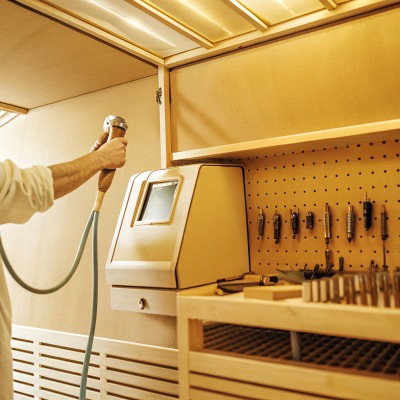
Visual Inspection of the Interior
If you have the opportunity to visit the factory or request a video tear-down, pay close attention to the internal layout. A professional medical device is not just a box of wires; it is an engineered airflow system.
1. The Handpiece Cooling Design
The handpiece is the most critical component. Ask the supplier to unscrew the casing of a sample handpiece.
- Good: You should see a dedicated air channel running alongside the coil or barrel. The outer shell should be separated from the inner mechanism by rubber isolation rings and an air gap. This "double-wall" design keeps the handle cool even if the core is hot.
- Bad: The coil touches the plastic casing directly. There is no visible path for air to escape.
2. The Fan Quality
Look at the fans inside the main unit.
- Size Matters: Larger fans move more air at lower RPMs, which means less noise. Small, screaming fans are a sign of poor design.
- Brushless Motors: Ask if the fans are brushless. Brushless fans last significantly longer and do not generate electrical sparks that could interfere with sensitive medical electronics.
- Filters: Look at the air intake vents. Is there a dust filter? In a salon environment, dust and hair spray are common. Without a filter, the heatsinks will clog up in six months, causing overheating.
3. Heatsinks and Piping
For the power supply board, check the material of the heatsink.
- Copper vs. Aluminum: Copper conducts heat much better than aluminum. High-end machines often use copper heat pipes to transport heat away from critical chips to the fans. Cheap machines use simple, small aluminum blocks.
The Importance of Sensors
Hardware is only half the battle. The "brain" of the cooling system is the sensor network. You should ask the engineer: "Where are the NTC (Negative Temperature Coefficient) sensors located?"
A professional machine should have at least three sensors:
- Inside the Handpiece: To protect the coil and the patient's skin.
- On the Power Board: To prevent voltage spikes caused by heat.
- On the Compressor/Generator: To prevent mechanical seizure.
Table 3: Component Quality Indicators
| Component | Standard / Low Quality | Professional / High Quality |
|---|---|---|
| Cooling Fan | Standard PC Case Fan (Sleeve Bearing) | Industrial Brushless Fan (Ball Bearing) |
| Heatsink | Small Extruded Aluminum | Large Aluminum fin stack with Copper Pipes |
| Airflow Path | Chaotic cabling blocks airflow | Zip-tied cables, clear tunnels for air |
| Dust Protection | Open vents, no filters | Removable, washable mesh filters |
| Temp Sensors | None or only on main CPU | Multi-point monitoring (Handpiece + PSU) |
Will a weak cooling system reduce the lifespan of my shockwave handpiece?
In our experience processing warranty claims, we have seen a direct correlation between insufficient cooling and the rapid degradation of internal components. Many buyers wrongly assume that cooling is only about preventing shutdown, failing to realize that chronic heat exposure silently destroys the expensive handpiece from the inside out.
Yes, excessive heat degrades projectile components, weakens magnetic coils, and dries out O-rings, drastically shortening operational life and increasing service costs. This thermal stress accelerates wear and tear, significantly reducing the lifespan of expensive handpieces and necessitating frequent, costly replacements.

The Physics of Heat Damage
Heat is the silent killer of mechanical and electrical longevity. In a shockwave handpiece, the "bullet" (projectile) moves back and forth millions of times. This requires lubrication and precise seals (O-rings).
1. O-Ring Embrittlement
Rubber O-rings maintain the air pressure required to accelerate the bullet. When rubber is exposed to high temperatures (above 60°C) repeatedly, it undergoes a process called thermal oxidative aging 10 "thermal oxidative aging." The rubber loses its elasticity and becomes brittle.
- Result: The seal fails. Air leaks inside the handpiece. The shockwave loses power (energy drops), and the bullet strikes incorrectly, damaging the metal transmitter.
2. Coil Insulation Breakdown
In electromagnetic handpieces, the copper coil is coated with a thin layer of enamel insulation.
- Result: If the cooling system cannot remove heat fast enough, the coil temperature rises. Over time, the enamel melts or cracks. This causes a "short circuit" between the coil windings. The handpiece will stop working entirely, or worse, it could deliver an electric shock.
3. Deformation of Plastic Parts
Inside the handpiece, there are often plastic guides or dampeners.
- Result: Poor cooling leads to softening of these plastics. Once they deform, the bullet path is no longer straight. This increases friction, which creates more heat, creating a vicious cycle that ends with the handpiece jamming permanently.
The Economic Impact on Your Business
Let’s look at the numbers. A high-quality replacement handpiece for a professional machine can cost anywhere from $300 to $1,500 depending on the technology.
- Scenario A (Good Cooling): The handpiece lasts for 2 million shots. In a typical salon doing 10 treatments a day (30,000 shots/day), this lasts roughly 2-3 months before a simple maintenance kit (bullets/pipes) is needed, not a full replacement.
- Scenario B (Poor Cooling): The handpiece overheats daily. The O-rings dry out after 500,000 shots. The internal friction destroys the barrel after 1 million shots. You are replacing the handpiece twice as often.
If you save $500 buying a machine with poor cooling, but spend $1,000 extra per year on replacement handpieces, you have lost money. Furthermore, the downtime while waiting for parts from China causes you to cancel appointments.
Verifying "Smart" Cooling Protection
To protect your investment, ask the supplier if their machine has "Smart Cooling Logic."
- Post-Treatment Cooling: Does the fan continue running for 1-2 minutes after the treatment stops? This is crucial to remove residual heat.
- Variable Speed: Does the fan speed adjust dynamically? Constant low speed is bad; it needs to ramp up when the work gets hard.
By prioritizing these cooling standards, you are not just buying a machine; you are securing the operational stability of your business for years to come.
Conclusion
Verifying the cooling system of a shockwave therapy machine is not just a technical formality; it is a critical step in protecting your investment and reputation. By choosing the right architecture (air vs. water), stress-testing the duty cycle, inspecting internal components for quality, and understanding the impact of heat on lifespan, you ensure your equipment can handle the demands of a professional environment. Do not let a weak cooling system freeze your business operations—validate before you buy.
Footnotes
1. Academic research supporting the claim that heat causes electronic failure. ↩︎
2. Background information on the medical application of shockwaves. ↩︎
3. Manufacturer specs for high-energy electromagnetic shockwave systems. ↩︎
4. WHO guidance on maintaining medical equipment reliability and safety. ↩︎
5. Official FDA classification for shockwave devices used in rehabilitation. ↩︎
6. Scientific overview of focused shockwave physics and energy generation. ↩︎
7. Official safety standards for ventilation in professional equipment. ↩︎
8. Technical overview of NTC thermistors used for temperature monitoring. ↩︎
9. Technical background on the sensors used for thermal management. ↩︎
10. Standard test method for rubber deterioration due to heat exposure. ↩︎

 English
  Español de México
  Deutsch
  Français
  العربية
  Русский