I often hear buyers ask whether they need focused or radial machines, and many regret the purchase when they pick the wrong type for their clinic.
There are two main categories: focused and radial shockwave 1. Focused machines penetrate deeper with precise targeting, while radial machines spread energy broadly at the surface. Generator technology further divides them into electrohydraulic, electromagnetic, piezoelectric, and pneumatic systems 2.
In practice, knowing these distinctions makes it far easier to choose a device that matches patient cases and avoids wasted investment.
What is the difference between focused and radial shockwave?
Confusion often starts when suppliers use “shockwave” as a general label without stating the type.
Focused shockwave delivers high-energy pulses at specific depths 3, ideal for bone or calcific disorders. Radial shockwave produces surface-level pressure waves 4, better for tendon pain, fascia issues, and trigger points.
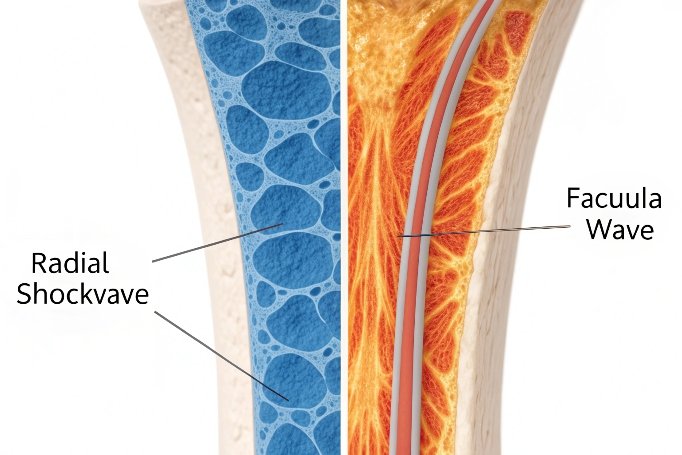
Focused machines can reach 4–12 cm deep with concentrated energy. Radial systems lose intensity quickly but cover wider areas more comfortably. Clinics with diverse patients sometimes combine both types to expand treatment range 5.
Key comparison
| Feature | Focused Shockwave | Radial Shockwave |
|---|---|---|
| Penetration | 4–12 cm | 2–4 cm |
| Energy Density | High (10–100 MPa) | Low (0.1–1 MPa) |
| Treatment Zone | Narrow, precise | Broad, diffuse |
| Best Use | Deep tissue, calcifications | Tendons near surface, trigger points |
Which conditions are best treated with each shockwave type?
Mismatch between device and condition is one of the most common reasons patients see no improvement.
Focused machines target deeper structures such as non-union fractures, calcific tendonitis, and hip pain 6. Radial systems are suited for superficial conditions like plantar fasciitis, tennis elbow, and myofascial pain 7.
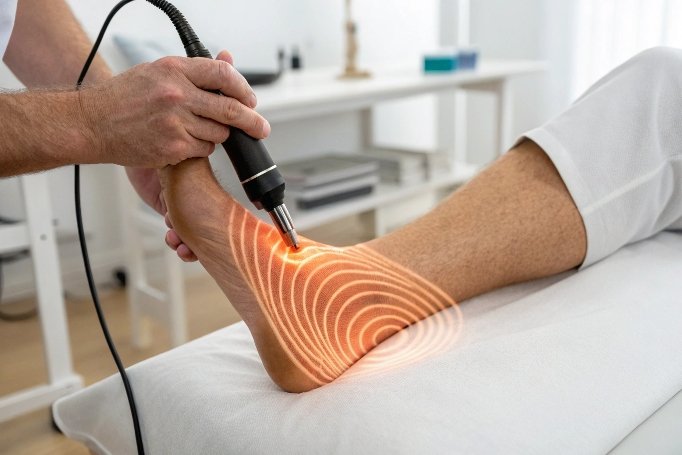
From experience, focused therapy shines in orthopedics where bone healing is needed 8. Radial systems excel in physiotherapy, where larger surfaces and tendon complaints dominate. Clinics that understand these boundaries achieve better outcomes and patient trust.
Clinical fit
| Shockwave Type | Common Applications |
|---|---|
| Focused | Bone non-unions, calcific tendonitis, deep hip pain |
| Radial | Plantar fasciitis, tennis elbow, Achilles tendinopathy |
| Both | Chronic pain, sports injuries, tendinopathies |
Are there different technologies used in shockwave machines?
Not all shockwave generators perform the same. Technology choice affects precision, service costs, and long-term reliability.
Focused machines may use electrohydraulic, electromagnetic, or piezoelectric generators 9. Radial machines usually rely on pneumatic systems 10. Each has pros and cons in terms of output, durability, and accuracy.

Electrohydraulic systems deliver high energy but require electrode replacement. Electromagnetic devices give consistent output and stable operation. Piezoelectric arrays allow pinpoint precision without reflectors. Pneumatic systems are simple and cost-effective, though they generate only radial waves and need regular revision kits.
Technology overview
| Technology | Wave Type | Key Features | Maintenance |
|---|---|---|---|
| Electrohydraulic | Focused | High energy, deep treatment | Electrode wear |
| Electromagnetic | Focused | Stable output, reliable | Moderate |
| Piezoelectric | Focused | Precise targeting, low wear | Low |
| Pneumatic | Radial | Cost-effective, easy to use | Revision kits needed |
How do I choose the right shockwave type for clinics?
The wrong machine leads to poor ROI and unsatisfied patients. Matching device to clinic profile avoids these problems.
Focused systems serve best where bone and calcific pathologies are common. Radial devices are better for tendon, fascia, and surface-level pain. Many clinics benefit from having both technologies or hybrid systems 11.

Decision-making starts with the patient base. Sports-focused clinics often lean radial 12. Orthopedic practices dealing with fractures or calcifications prefer focused. Cost also plays a role: pneumatic radial devices are cheaper to start with, while piezoelectric or electromagnetic focused systems cost more but deliver higher precision.
Decision factors
| Factor | Radial Shockwave | Focused Shockwave |
|---|---|---|
| Patient Profile | Tendon, fascia, superficial | Bone, calcifications, deep |
| Depth | 2–4 cm | Up to 12 cm |
| Investment | Lower | Higher |
| Versatility | Large area, fast | Targeted, precise |
Conclusion
Focused and radial machines serve different needs. Choosing based on patient conditions and clinic goals ensures better outcomes and long-term success.
Footnotes
1. Overview of focused vs. radial shockwave differences. ↩︎
2. Comparison of shockwave generator technologies. ↩︎
3. Explanation of focused shockwave therapy depth and uses. ↩︎
4. NHS guide to radial shockwave applications. ↩︎
5. Study on combining radial and focused therapy. ↩︎
6. AAOS overview of focused shockwave clinical uses. ↩︎
7. NHS description of radial shockwave conditions. ↩︎
8. Mayo Clinic insights on shockwave in orthopedics. ↩︎
9. Research on focused shockwave generator designs. ↩︎
10. Clinical discussion on pneumatic radial shockwave. ↩︎
11. Comparative study of hybrid and dual systems. ↩︎
12. Sports medicine review on radial shockwave use. ↩︎

 English
  Español de México
  Deutsch
  Français
  العربية
  Русский