I have seen too many buyers choose on price alone and regret it when results were weak or machines broke too soon.
The safe way is to check energy flux density, frequency stability, applicator design, durability, and certifications. A proper review of these parameters ensures consistent treatments and long device life.
In practice, focusing on these numbers prevents wasted investment. The sections below explain what matters, how to read the specs, and what to demand from suppliers.
What energy levels are recommended for shockwave therapy?
Clinics often get confused when energy is described in vague terms or without proper units.
For focused systems, therapeutic energy usually falls between 0.08–0.35 mJ/mm² 1, with higher levels up to 0.55–0.6 mJ/mm² for calcific or bone cases. Radial devices use bar (1–5 bar typical), and dosing depends on pressure, frequency, impulses, and applicator choice.
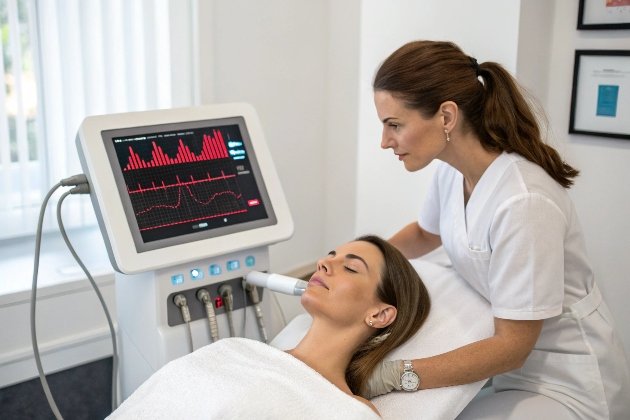
Energy Flux Density (EFD) 2 defines the dose in focused shockwave. Too low, and no biological effect occurs. Too high, and tissue damage may result. Radial devices express energy as pressure at the applicator, which peaks at the skin surface and decays quickly with depth.
Energy reference ranges
| Parameter | Typical Range | Notes | Clinical Use |
|---|---|---|---|
| Focused EFD (mJ/mm²) | 0.08–0.35 | Up to 0.55–0.6 for select cases | Tendinopathies, bone stimulation |
| Radial Pressure (bar) | 1–5 | Depends on applicator size | Plantar fasciitis, elbow pain |
| Impulses per session | 1,500–4,000 | Split across targets | MSK therapy |
| Sessions per course | 3–6 | Weekly or bi-weekly | Chronic cases |
A reliable device allows fine increments and delivers repeatable output validated by hydrophone tests 3 in a water tank.
How important is frequency range in shockwave machines?
Machines that feel inconsistent often suffer from unstable frequency delivery.
Frequency 4 defines how many pulses per second the patient receives. Focused devices often work best at 1–8 Hz for precision, while radial systems may run 8–20 Hz for broader, faster coverage.
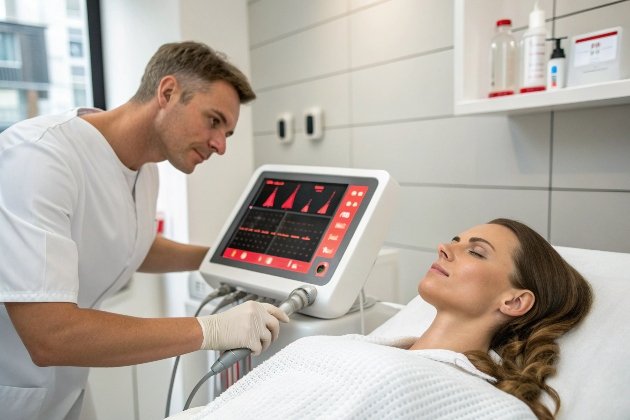
Lower frequencies allow deeper penetration and comfort during focal treatments. Higher frequencies reduce session time when treating large surface areas. A strong system maintains stable output across its frequency range without overheating or losing power.
Frequency guidelines
| Goal | Suggested Frequency | Why | Notes |
|---|---|---|---|
| Deep targets | 1–6 Hz | Maximum control | Bone, calcifications |
| Medium tendons | 6–10 Hz | Balanced effect | Achilles, patellar |
| Myofascial areas | 10–18 Hz | Faster coverage | Back, thigh muscles |
| Sensitive regions | 1–5 Hz | Comfort first | Near bony areas |
Checking runtime and cooling capacity 5 ensures the device can sustain performance at higher pulse rates.
Do applicator heads affect treatment results in shockwave?
Applicator heads are often overlooked, yet they shape the entire treatment experience.
Smaller heads increase energy density for trigger points, while larger heads distribute force for fascia and muscle. Materials like titanium applicators 6 ensure durability, while soft caps improve comfort in sensitive areas.
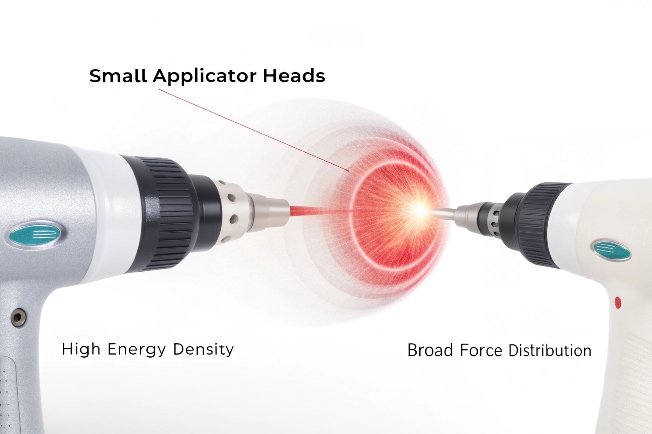
Different shapes—flat, concave, pointed—alter wave entry and coupling with the skin. Focused devices use gel pads and standoffs 7 to adjust focal depth. Clinics with a full applicator set gain flexibility to treat a wider range of cases.
Applicator quick guide
| Head Type | Size | Best For | Notes |
|---|---|---|---|
| Small (6–10 mm) | Trigger points | High intensity | |
| Medium (12–20 mm) | Tendons & muscle | Balanced | |
| Large (25–36 mm) | Fascia & large muscles | Softer impact |
Wear and tear on applicators changes energy output. Reliable suppliers offer revision kits 8 and clear replacement intervals.
What certifications should a shockwave machine have?
Without the right paperwork, machines may not pass inspections or insurance checks.
Look for IEC 60601-1 9 (electrical safety), IEC 60601-1-2 (EMC), ISO 13485 (QMS), and either FDA 510(k) clearance 10 or CE MDR certification. Reports must be full test documents from accredited labs, not just a printed “certificate.”
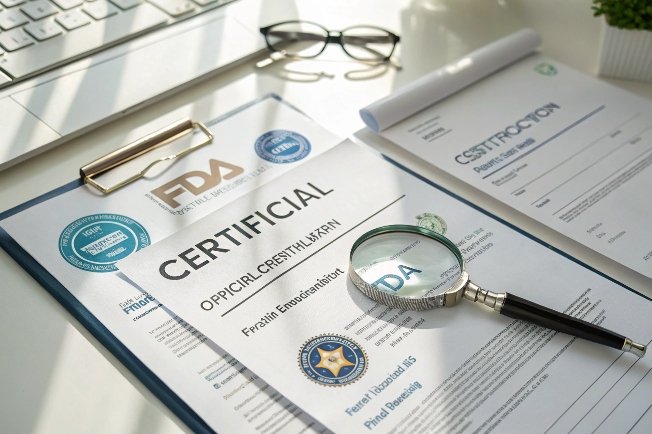
Confirm the exact model appears in the CB Test Report and Declaration of Conformity. If the device has embedded software, check compliance with IEC 62304 and risk analysis per ISO 14971. For market access, FDA summaries and CE marking with a valid Notified Body certificate are essential.
Conclusion
Strong energy control, stable frequency, versatile applicators, and valid certifications set apart professional shockwave systems from unreliable copies. Choose based on these parameters, not price alone.
Footnotes
1. NIH article on therapeutic energy ranges for shockwave therapy. ↩︎
2. Study explaining energy flux density in focused shockwave. ↩︎
3. Hydrophone testing method for shockwave validation. ↩︎
4. Research on the role of frequency in shockwave therapy. ↩︎
5. Cooling system requirements for stable device output. ↩︎
6. Titanium applicator heads improve durability in therapy. ↩︎
7. Gel pads and standoffs for adjusting focal depth. ↩︎
8. FAQ on applicator replacement and revision kits. ↩︎
9. IEC electrical safety standards for medical devices. ↩︎
10. FDA 510(k) clearance database for medical devices. ↩︎

 English
  Español de México
  Deutsch
  Français
  العربية
  Русский