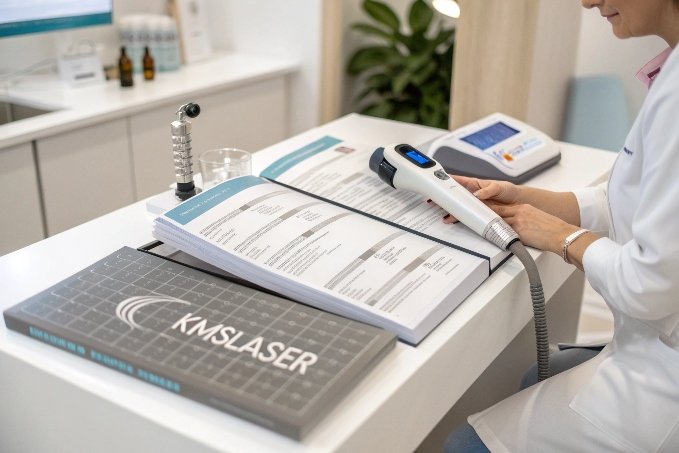
I hear this a lot: “Just send the manual.” Then the device arrives, and the manual is thin, unclear, and risky.
A complete shockwave therapy manual 1 should list the device’s purpose, parts, parameters, setup, safety, contraindications, operation steps, protocols, maintenance, troubleshooting, cleaning, accessories, storage, disposal, legal notices, and support contacts. It should be structured, readable, and written for trained users.
You want a manual that protects patients and your brand. I will show exactly what to include and how to judge quality fast, even if you are not an engineer.
Should manuals cover safety guidelines?
I never accept a manual that hides safety in tiny print. Safety must be obvious, upfront, and practical in the clinic.
Yes. Manuals must include clear safety guidelines 2: absolute and relative contraindications, warnings, precautions, PPE needs, noise and hearing notes, EMC rules, and risks of misuse. They should define trained users and list emergency steps and adverse event procedures.

What good safety content looks like
Strong manuals separate contraindications (never treat here) from precautions (treat with conditions met). They list patient factors like anticoagulation, pregnancy, active infection, metal implants, neuropathy, or open wounds. They mark anatomic zones to avoid, like lung fields with focused energy, eyes, growth plates, or major neurovascular bundles. They add EMC guidance 4: keep distance from RF sources, do not stack unknown medical devices, and follow the grounding plan. They call out hearing protection when acoustic output or compressed-air drive is loud. They give operator qualifications, which prevents use by untrained staff. They include residual risks that remain even after controls, so users stay vigilant. They show emergency procedures for vasovagal events, unexpected pain spikes, or equipment faults mid-session.
Safety at-a-glance matrix
| Topic | Include | Why it matters |
|---|---|---|
| Contraindications | Absolute & relative lists | Prevents harmful use |
| Warnings & Precautions | Clear, bold, near procedures | Guides real-time decisions |
| EMC & Environment | Distances, grounding, temp/humidity | Reduces interference and drift |
| PPE & Noise | Eye/ear protection notes | Protects staff and patients |
| Emergency Steps | Stop rules, who to call | Shortens response time |
Do manuals include troubleshooting steps?
I have stood in clinics when an error code appears and the session clock is ticking. A good manual saves the visit.
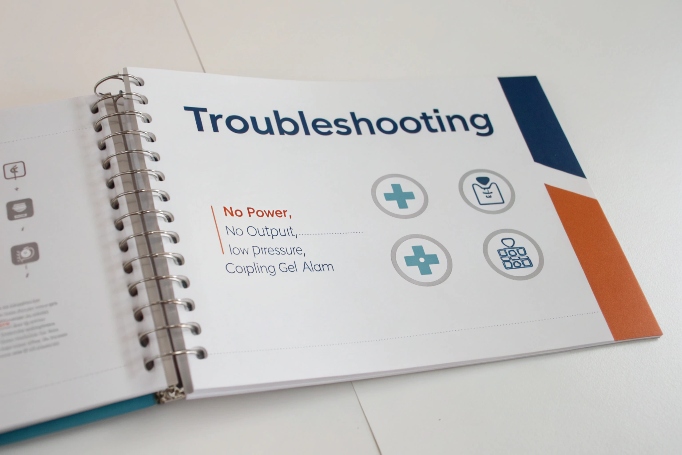
Yes. Manuals should include a structured troubleshooting chapter 8 with error codes, symptoms, likely causes, step-by-step fixes, restart rules, escalation paths, and when to stop use. It must be fast to scan during treatment.
Build troubleshooting for stress, not for desks
Write the chapter as if a patient is already on the table. Place the fault table at the start. Use large headings like “No Power,” “No Shock Output,” “Handpiece Overheat,” “Pressure Low,” “EFD Not Reaching Setpoint,” “Coupling Gel Alarm,” “Footswitch Not Responding,” and “RF/EMC Interference.” For each symptom, list probable causes in order of frequency. Offer clear actions: check mains, check fuses, reseat connectors, change transmitter, cool down the handpiece, reduce frequency for thermal load, replace a worn projectile/liner (for radial), run the self-test again, or call service with the error code.
Are maintenance tips listed in manuals?
I never rely on memory for maintenance. I want a calendar, intervals, part numbers, and photos that show what “good” looks like.
Yes. Manuals should list daily, weekly, monthly, and annual maintenance checklists 9 with torque notes, calibration or verification steps if applicable, part lifetimes, and records to keep. The plan should prevent drift, not react to it.
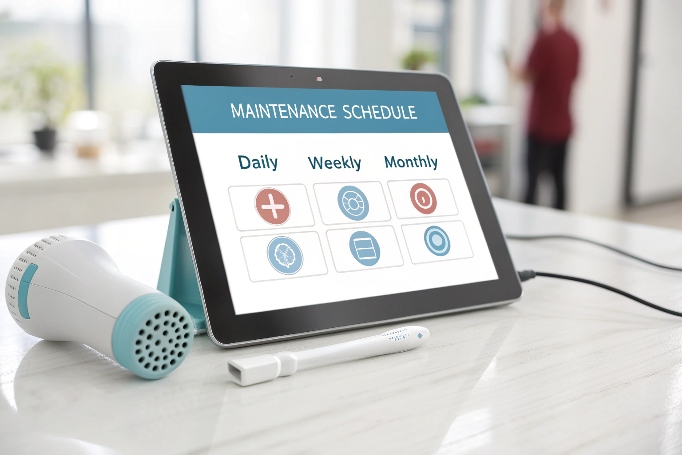
Daily tasks should include visual inspection of housing, cables, and connectors; cleaning of applicators; and function checks at low settings. Weekly, inspect transmitters/stand-offs for wear, check projectiles/liners on radial systems, and verify cooling or vent filters. Monthly, review output consistency: for focused units, run a verification routine; for radial, check that set bar matches displayed and perceived output. Record pulse counters and compare against the expected service life of consumables. Quarterly, tighten or reseat connectors, inspect O-rings and seals, and update any software presets if your clinic standard changed.
Should manuals provide cleaning instructions?
I have seen devices fail from the wrong wipe. I would rather read one more page than replace one more handpiece.
Yes. Manuals must include validated cleaning and disinfection instructions 7 for the housing, handpiece, transmitters/stand-offs, cables, and accessories. They should name compatible agents, list steps, contact times, and drying methods, and warn against damaging chemicals.
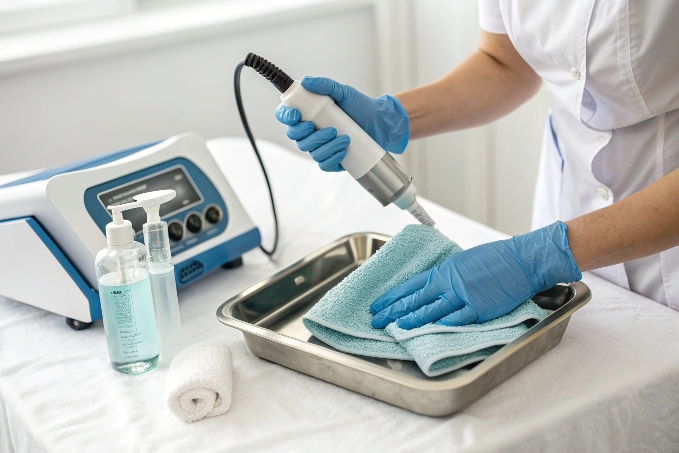
Provide a compatibility table 3 that names approved agents and a list of prohibited chemicals that craze plastics or corrode metal seats. Explain contact times in minutes, not just “spray and wipe.” Show drying rules: air-dry vs cloth-dry, and when to avoid heat. Add gel management: use medical coupling gel only, never oil-based lubricants.
Regulatory and electronic documentation
Modern manuals can also include digital versions and e-labeling 6, allowing manufacturers to distribute updates online. Global harmonization under IMDRF guidance 10 ensures safety and consistent standards across markets.
Conclusion
Write manuals for clinics, not showrooms. Cover everything, put safety and performance standards 5 first, make troubleshooting instant, plan maintenance, and spell out cleaning—so teams can treat patients well.
Footnotes
1. FDA’s IFU Content and Format guidance explains medical device manual structure. ↩︎
2. EN ISO 20417:2021 defines general requirements for medical device information for users. ↩︎
3. IEC 60601-1 covers basic safety and essential performance of medical electrical equipment. ↩︎
4. IEC 60601-1-2 specifies electromagnetic compatibility for medical devices. ↩︎
5. IEC 60601-1-8 focuses on alarm systems in medical electrical equipment. ↩︎
6. FDA guidance on electronic labeling describes acceptable digital manual formats. ↩︎
7. FDA Device Labeling Guidance clarifies inclusion of warnings, precautions, and contraindications. ↩︎
8. Innolitics IFU writing guide explains how to write compliant user manuals. ↩︎
9. Medical Device HQ IFU guide provides practical ISO/FDA alignment advice. ↩︎
10. IMDRF guidance on global harmonization links IEC 60601-1 use with international standards. ↩︎

 English
  Español de México
  Deutsch
  Français
  العربية
  Русский