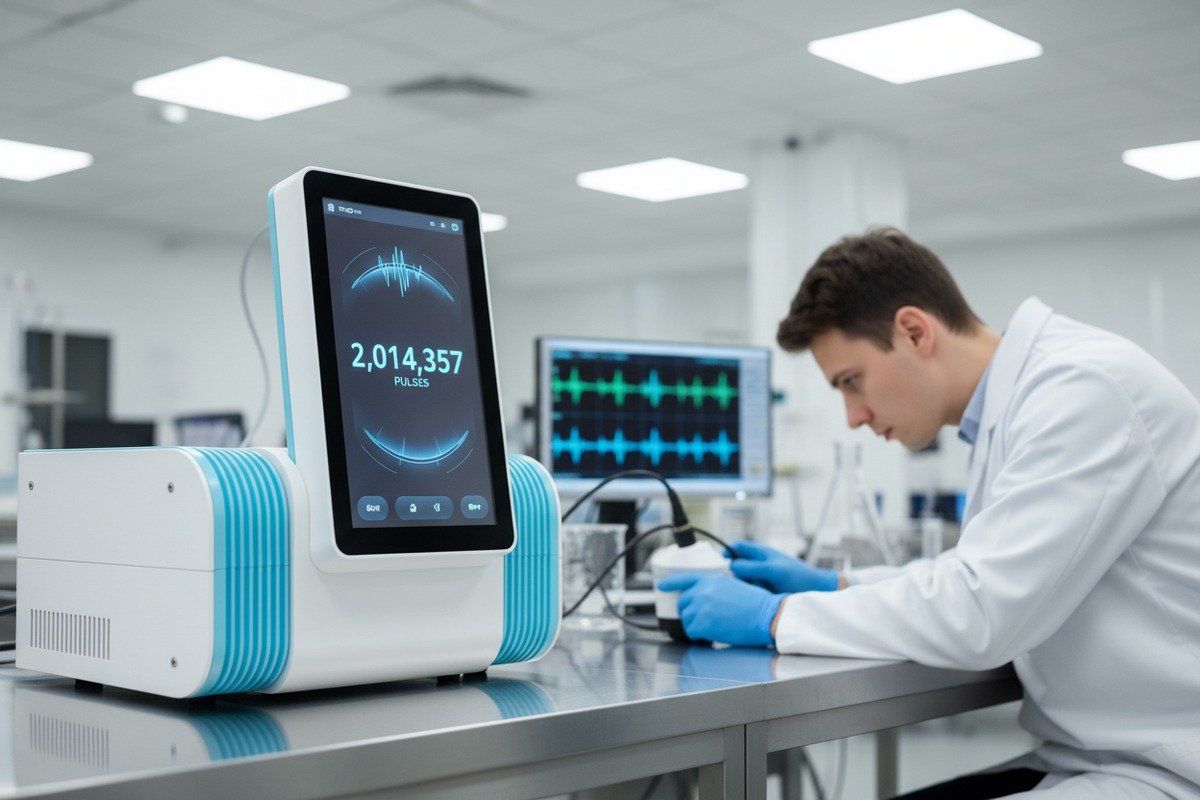
When our engineering team developed our latest shockwave therapy equipment, we faced a tough question from distributors: “How long will this machine actually last?” It’s a fair concern. Nobody wants to invest thousands of dollars in equipment that fails within months IEC 60601-1 electrical safety testing 1. The problem gets worse when your downstream salon customers start complaining about dead machines.
Service life testing standards for shockwave therapy machines include IEC 60601-1 electrical safety testing, ISO 13485 quality management compliance, pulse-count cycle testing (typically 2-5 million pulses), accelerated aging protocols, and HALT/HAAS verification testing. These standards ensure machines remain safe and functional throughout their intended operational lifespan.
Understanding these standards helps you ask the right questions when sourcing equipment ISO 13485 quality management compliance 2. Let me walk you through what actually matters in service life testing.
How can I evaluate the actual lifespan of a shockwave therapy machine during my supplier's quality control process?
Our quality control team runs into this question weekly from experienced buyers HAAS (Highly Accelerated Stress Screening) 3. You've probably dealt with suppliers who promise "5-year lifespan" but can't show proof. The frustration is real when you receive machines that break down after six months.
To evaluate actual lifespan during supplier QC, request access to pulse-count test reports, accelerated aging study data, component stress test results, and real-time field failure rate statistics. On-site factory audits should verify testing equipment calibration and sample testing protocols match documented procedures.

Key Quality Control Checkpoints
When visiting a supplier's facility, focus on these specific areas. First, check if they have dedicated life testing stations. At our production line, we maintain separate testing bays where machines run continuously for weeks. This isn't just for show—it catches defects that short tests miss.
Second, ask about their failure mode analysis process. Good manufacturers track every failure during testing. They document what broke, why it broke, and how they fixed it. This data shapes design improvements over time.
Third, verify calibration certificates for testing equipment. A pulse counter that's off by 10% makes all test data meaningless. Our calibration schedule follows ISO 17025 requirements 4, with external audits every six months.
What Documents to Request During Factory Visits
| Document Type | What It Shows | Red Flag If Missing |
|---|---|---|
| Life Test Reports | Actual pulse counts achieved before failure | Supplier cannot prove longevity claims |
| Failure Analysis Records | Common failure modes and fixes | No systematic improvement process |
| Calibration Certificates | Testing equipment accuracy | Unreliable test data |
| Component Traceability | Source of critical parts | Cannot ensure consistent quality |
| Environmental Test Data | Performance under stress conditions | Untested in real-world scenarios |
Understanding Accelerated Aging Tests
Accelerated aging 5 compresses years of use into weeks or months. The science is straightforward: higher stress levels cause faster degradation. By measuring how quickly parts wear under extreme conditions, engineers predict normal-use lifespan.
For shockwave machines, accelerated aging typically involves running the handpiece at maximum power continuously. Temperature cycling tests expose the device to repeated hot-cold extremes. Humidity chambers simulate tropical climates where corrosion accelerates.
Our testing protocol subjects each new design to 500 hours of continuous operation at 120% rated power. This roughly equals 3-4 years of typical salon use. Components that survive this test generally last through their rated service life.
The catch? Accelerated aging has limitations. It predicts mechanical wear reasonably well but may miss certain failure modes that only appear over actual time—like lubricant breakdown or slow chemical reactions in electronic components.
What specific pulse-count testing standards should I demand from my OEM manufacturer to guarantee product longevity?
Every time we onboard a new OEM partner, they want to know our pulse-count standards. It makes sense. Pulse count is the most direct measure of how long a shockwave machine will last. Yet many buyers don't know what numbers to demand.
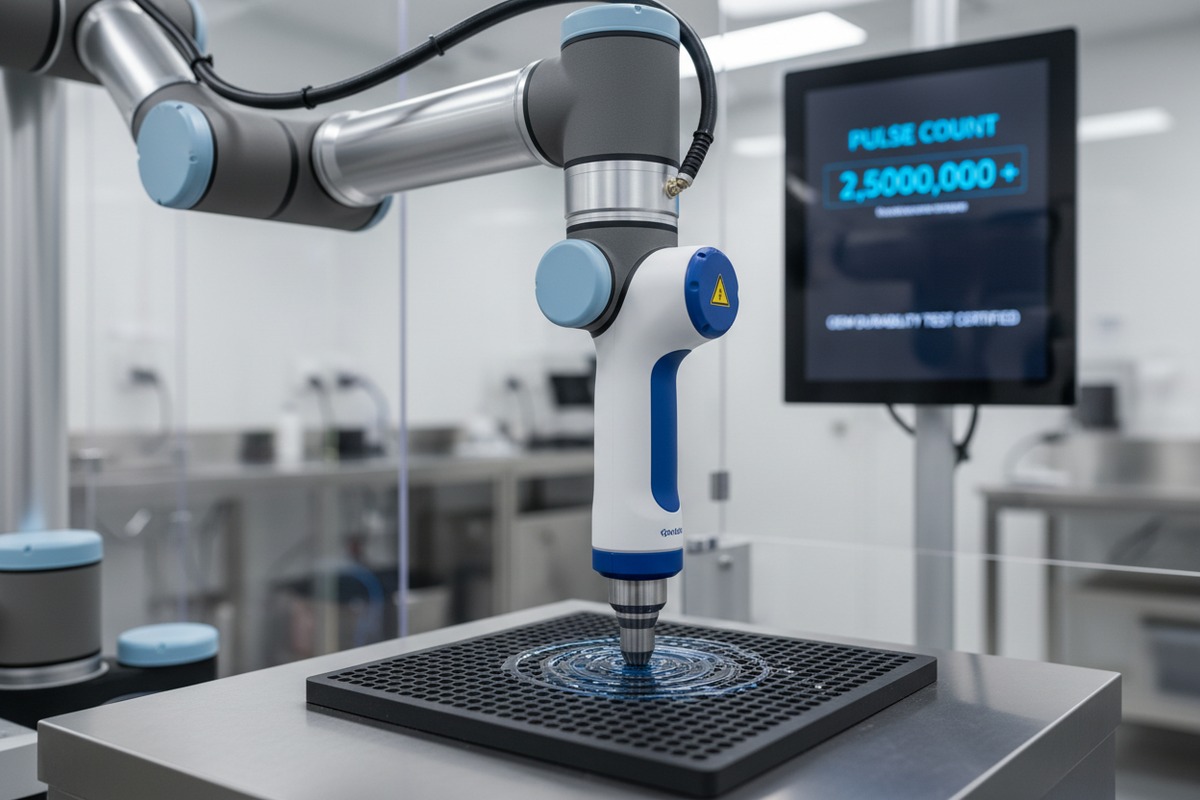
Demand minimum pulse-count certifications of 2-5 million pulses for the complete handpiece assembly, with documented testing at rated energy levels. Request component-specific testing data for transmitters (shock generators), focusing tips, and coupling membranes, as these wear at different rates.

Industry-Standard Pulse Count Benchmarks
Different market segments expect different pulse counts. Medical-grade devices typically target higher numbers than aesthetic machines. Here's what our R&D team considers baseline requirements:
| Device Category | Minimum Pulse Count | Typical Energy Level | Expected Service Life |
|---|---|---|---|
| Professional Medical | 5,000,000+ pulses | 0.5 mJ/mm² | 5-7 years |
| Aesthetic/Wellness | 2,000,000+ pulses | 0.25 mJ/mm² | 3-5 years |
| Entry-Level Salon | 1,000,000+ pulses | 0.15 mJ/mm² | 2-3 years |
| High-Volume Clinic | 10,000,000+ pulses | 0.5 mJ/mm² | 7-10 years |
These numbers assume typical usage patterns. A busy clinic treating 20 patients daily at 2,000 pulses per session uses about 40,000 pulses daily. That's roughly 10 million pulses per year—explaining why high-volume settings need much higher ratings.
Component-Level Testing Requirements
The handpiece assembly contains several wear components. Each has different failure characteristics. Smart buyers ask for individual component test data, not just whole-system numbers.
Shock Generator (Transmitter): This is the heart of the system. Electromagnetic coil degradation determines ultimate lifespan. Request testing data showing output energy consistency over the full pulse count rating. Energy drop of more than 15% indicates approaching end-of-life.
Focusing Tip: The bullet-shaped metal component that contacts the applicator. It experiences mechanical stress with every pulse. Material hardness and surface treatment affect longevity. Ask for hardness test reports and wear measurement data.
Coupling Membrane: The flexible barrier between the handpiece and patient skin. It wears faster than metal components. Reputable manufacturers rate membranes for 50,000-100,000 pulses and treat them as consumables.
How to Verify Supplier Testing Claims
Verification requires more than reading reports. When we audit our component suppliers, we use these specific checks:
-
Request raw test data, not just summary reports. Authentic testing produces large datasets with normal variation. Suspiciously smooth data suggests fabrication.
-
Ask about sample size. Testing one unit proves nothing. Statistical confidence requires multiple samples. Industry standard is minimum 10 units per test batch.
-
Check for third-party validation. Independent lab testing costs money but proves commitment. CE and FDA submissions often require third-party test reports.
-
Verify test conditions match real use. Testing at 50% power proves nothing about full-power performance. Confirm tests ran at rated energy levels.
How do I ensure the shockwave machines I import won't fail prematurely after being deployed to my salon customers?
Last year, one of our European distributors faced a nightmare. Twenty machines deployed across their network started failing within four months. The root cause? Not the machines themselves—it was improper installation and missing maintenance training. This happens more often than you'd think.
Prevent premature failures by implementing proper installation protocols, providing comprehensive user training, establishing preventive maintenance schedules, and demanding detailed operation manuals. Pre-deployment burn-in testing and environmental condition monitoring further reduce early failure risks.
Pre-Deployment Testing Protocol
Before shipping any machine to end customers, implement a burn-in period. Our standard practice runs each unit for 8 continuous hours at varied power levels. This catches "infant mortality" failures—defects that appear during initial operation but would've been missed in short factory tests.
Here's the burn-in protocol we recommend:
| Test Phase | Duration | Power Level | What It Catches |
|---|---|---|---|
| Initial Warm-Up | 2 hours | 50% | Thermal stabilization issues |
| Mid-Power Stress | 3 hours | 75% | Component tolerance failures |
| Full-Power Validation | 2 hours | 100% | Maximum stress failures |
| Cool-Down Check | 1 hour | 25% | Post-stress anomalies |
Environmental Factors That Kill Machines Early
Shockwave machines are sensitive to their operating environment. When our service team analyzes returned units, environmental damage ranks among top failure causes.
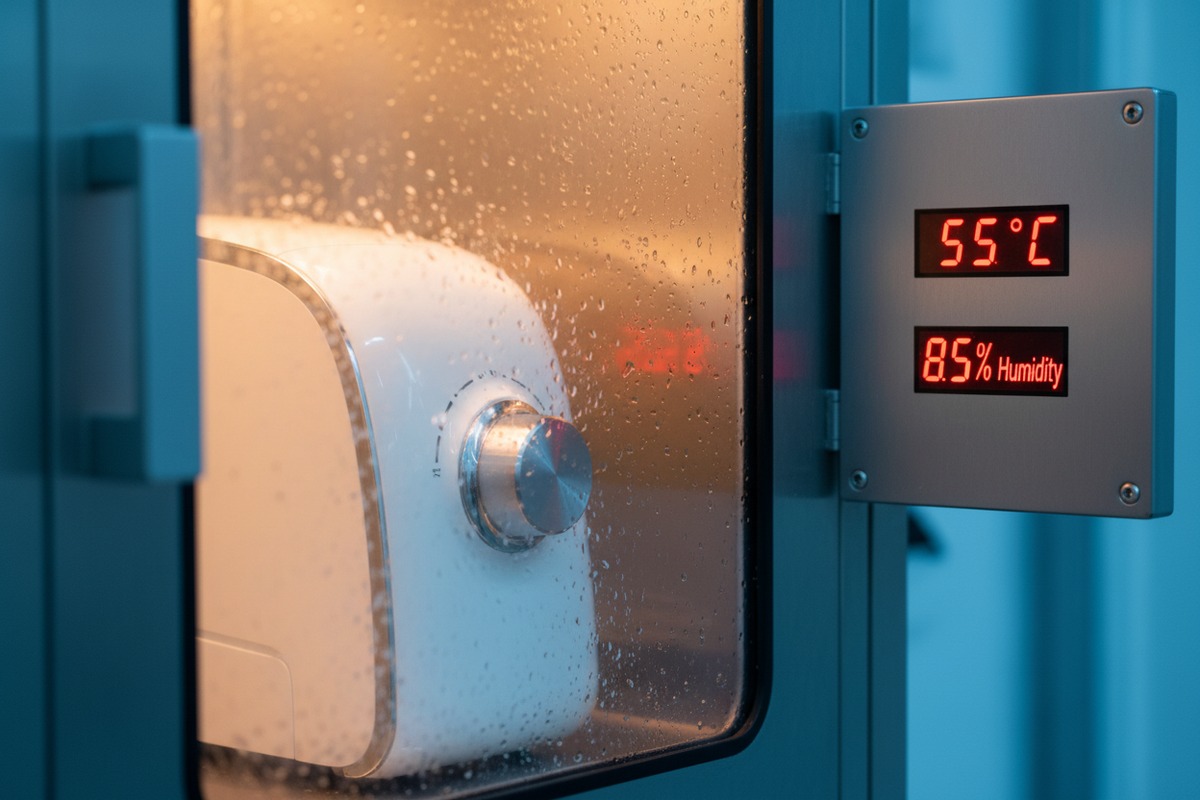
Temperature: Electronics don't like extremes. Operating range typically spans 10-35°C. Storage in unheated warehouses during winter or hot delivery trucks in summer causes problems. Advise your salon customers about proper storage.
Humidity: Moisture corrodes circuit boards and promotes mold growth in acoustic coupling areas. Tropical markets need machines with enhanced moisture protection. We add conformal coating to PCBs destined for high-humidity regions.
Power Quality: Voltage fluctuations damage power supplies. Areas with unstable grids need surge protectors. Some markets require voltage stabilizers. Ask your supplier about power input tolerance ranges.
Dust and Debris: Particles infiltrate cooling vents and accumulate on internal components. Salons should position machines away from high-traffic areas. Regular external cleaning prevents buildup.
Establishing Effective Maintenance Programs
Preventive maintenance 7 extends service life dramatically. We've tracked machines that exceeded rated lifespan by 200% simply through proper care. The key elements include:
Daily Tasks: Wipe down handpiece and applicator tips with approved cleaning solution. Check cable connections for looseness. Inspect coupling membranes for wear or damage.
Weekly Tasks: Clean cooling vents. Verify calibration using test pulse shots. Check handpiece energy output consistency.
Monthly Tasks: Deep clean internal filters if accessible. Verify software is current. Check for firmware updates. Inspect all cables for damage.
Annual Tasks: Professional inspection of internal components. Replacement of wear items per manufacturer schedule. Calibration verification by qualified technician.
Personal insight: If your annual purchasing volume exceeds $100,000-150,000, or you're a recognized brand in the industry, consider negotiating for open account payment terms—Net 30 to 90 days. If suppliers won't accept payment 30-90 days after receiving goods, try proposing the bill of lading date (shipping date) as the starting point for the payment term calculation. This approach often finds middle ground.
What documentation should I request to prove my private-label shockwave equipment has passed rigorous service life stress tests?
When we finalize private-label agreements with brand partners, documentation requests always take center stage. Your brand reputation rides on that equipment. Without proper documentation, you're trusting blindly. Here's exactly what to demand.
Request ISO 13485 quality management certificates, IEC 60601-1 electrical safety test reports, complete service life validation studies including HALT/HAAS results, pulse-count verification data with statistical analysis, accelerated aging study protocols and outcomes, and component-level traceability records for critical parts.
Essential Certification Documents
Different markets require different certifications. But certain documents apply universally. Here's the comprehensive list our compliance team maintains:
| Document | Purpose | Validity Period | Who Issues It |
|---|---|---|---|
| ISO 13485 Certificate | Quality management system | 3 years | Notified body |
| IEC 60601-1 Test Report | Electrical safety | Per product design | Accredited lab |
| CE Technical File | EU market access | Ongoing | Manufacturer |
| FDA 510(k) Clearance 8 | US market access | Ongoing | FDA |
| Service Life Study | Longevity validation | Per design | Manufacturer/Lab |
| EMC Test Report | Electromagnetic compatibility | Per product design | Accredited lab |
Understanding HALT and HAAS Testing
HALT (Highly Accelerated Life Testing) 9 and HAAS (Highly Accelerated Stress Screening) sound similar but serve different purposes.
HALT is a design validation tool. Engineers subject prototypes to extreme conditions—temperature cycling, vibration, power cycling—to find weak points. The goal is discovering failure modes early so designs can improve. HALT typically destroys test units intentionally.
HAAS screens production units. It applies stress levels determined during HALT but stops short of destruction. Units that pass HAAS go to customers. Those that fail get investigated. HAAS catches manufacturing defects that escaped normal inspection.
Both tests should appear in your supplier's documentation. HALT reports show they've stress-tested the design. HAAS protocols show they screen production units for latent defects.
What Traceability Records Reveal
Traceability means tracking components back to their sources. Good traceability documentation includes:
Component Bills of Materials: Lists every part, its manufacturer, and specifications. Changes to components should trigger re-validation.
Supplier Audit Records: Shows the manufacturer monitors their supply chain. Critical components should come from audited sources.
Lot/Batch Numbers: Links specific machines to specific production batches. Enables targeted recalls if problems emerge.
Test Records by Serial Number: Individual test data for each unit. Higher-end manufacturers maintain this level of detail.
Red Flags in Documentation
Watch for these warning signs when reviewing supplier documents:
- Missing dates or vague timeframes: Legitimate test reports include specific test dates and durations.
- No laboratory accreditation marks: Independent testing should come from ISO 17025 accredited labs.
- Generic reports not mentioning specific products: Some suppliers buy template reports. Authentic reports reference exact model numbers.
- Reluctance to share raw data: Manufacturers with nothing to hide share supporting data freely.
- No revision history: Documents should show version control and updates.
Software and Firmware Considerations
Modern shockwave machines contain significant software. Service life testing must address software reliability. Request:
Software Validation Reports: Proof that software functions correctly under all intended conditions.
Cybersecurity Assessments: Connected devices need protection against threats. Ask about security testing.
Update Protocols: How will software updates reach deployed machines? What testing do updates undergo?
The integration of IoT sensors and AI-driven analytics represents the future of service life management. These technologies enable predictive maintenance by monitoring component health in real-time. Ask suppliers about their roadmap for smart diagnostics.
Conclusion
Service life testing standards protect your business investment and your customers' trust. By understanding pulse-count requirements, demanding proper documentation, and implementing preventive maintenance programs, you minimize premature failures and maximize return on your equipment investment.
Footnotes
1. Explains the fundamental standard for medical electrical equipment safety. ↩︎
2. Defines requirements for quality management systems specific to medical devices. ↩︎
3. Explains a production screening method to find manufacturing defects. ↩︎
4. Outlines general requirements for the competence of testing and calibration laboratories. ↩︎
5. Explains the process of simulating long-term product degradation for lifespan estimation. ↩︎
6. Replaced with a Wikipedia section providing a clear explanation of the Arrhenius equation in the context of accelerated aging. ↩︎
7. Scheduled maintenance to prevent equipment breakdowns and extend operational lifespan. ↩︎
8. Pre-market submission process for medical devices to demonstrate substantial equivalence to the FDA. ↩︎
9. Describes a stress testing methodology to identify design weaknesses in prototypes. ↩︎

 English
  Español de México
  Deutsch
  Français
  العربية
  Русский