When our production team ships shockwave therapy machines 1 to distributors worldwide, we often hear one recurring concern: units sitting in warehouses for months before reaching salon clients. The problem is real. Improper storage destroys internal seals, corrodes circuits, and drains batteries. The agitation grows when clients receive non-functional equipment.
You should ask suppliers about temperature and humidity requirements, battery maintenance schedules, packaging protection standards, and pre-shipment testing protocols. Request brand-specific SOPs, warranty terms for storage periods, spare parts availability, and documentation for ISO-compliant maintenance routines to protect your investment during extended storage.
Let me walk you through the exact questions and protocols that separate professional suppliers from risky ones. These insights come from years of handling warranty claims and troubleshooting storage-related failures.
How should I regulate warehouse temperature and humidity to prevent internal component corrosion?
Our engineers have traced over 60% of storage-related failures back to one root cause: environmental neglect. Distributors often assume climate control is optional. It is not. Internal corrosion begins silently and spreads rapidly when conditions drift outside safe ranges.
Maintain warehouse temperature between 10°C and 40°C (50°F to 104°F) with relative humidity below 70%. Store machines away from direct sunlight, corrosive gases, and dust. Use climate monitoring devices and run brief power cycles every two weeks to protect circuits and mechanical components from degradation.

Understanding the Science Behind Corrosion
Shockwave therapy machines contain sensitive electronics, piezoelectric components 2, and precision mechanical parts. When humidity climbs above 70%, moisture condenses on circuit boards. This creates conductive paths between traces, causing short circuits over time. Metal contacts oxidize. Rubber seals absorb moisture and lose elasticity.
Temperature swings cause thermal expansion and contraction. Solder joints crack. Plastic housings warp. Lubricants inside handpiece mechanisms either dry out in heat or thicken in cold, jamming moving parts.
Setting Up Your Storage Environment
Here is what we recommend to our distribution partners:
| Environmental Factor | Safe Range | Critical Threshold | Consequences of Violation |
|---|---|---|---|
| Temperature | 10°C – 40°C | Below 5°C or above 45°C | Seal hardening, lubricant failure |
| Relative Humidity | 30% – 70% | Above 80% | Circuit corrosion, mold growth |
| Dust Exposure | Minimal | Any visible accumulation | Ventilation blockage, contact contamination |
| Light Exposure | Indirect only | Direct sunlight | Plastic degradation, display damage |
Practical Steps for Climate Control
First, invest in a digital hygrometer with data logging. Position it near stored units. Check readings weekly. Second, avoid basement storage where humidity spikes during rain seasons. Third, keep machines elevated on shelving—never directly on concrete floors that transfer moisture.
If your facility lacks HVAC, consider desiccant packets inside storage cabinets. Replace them monthly. For large inventories, portable dehumidifiers work well in enclosed spaces.
The Two-Week Power Cycle Rule
Circuit boards and capacitors degrade faster when idle. We advise powering on each machine for five to ten minutes every two weeks. This keeps electrolytic capacitors 3 formed properly and prevents contact oxidation. Run the handpiece briefly without load to circulate internal lubricants.
What specific battery maintenance schedule must I follow to ensure the machines remain functional after months of storage?
At our facility, we test every unit before shipping. Yet we still receive warranty claims from distributors whose machines show battery failure after three months of sitting idle. The culprit is almost always neglected battery maintenance during storage.
For lithium-ion batteries, maintain 40-60% charge levels and recharge every 60-90 days. For lead-acid batteries, keep fully charged and top up monthly. Never store batteries fully depleted or fully charged long-term. Document all charging cycles and monitor voltage levels to preserve capacity and prevent irreversible sulfation or cell degradation.

Why Batteries Fail During Storage
Batteries self-discharge even when disconnected. Lithium-ion cells 4 lose 1-2% charge monthly under optimal conditions. Lead-acid batteries discharge faster—up to 5% monthly. When charge drops too low, chemical changes become permanent.
Lithium-ion batteries stored at full charge experience accelerated electrode degradation. Those stored empty risk falling below minimum voltage thresholds, triggering protection circuits that render them unusable.
Battery Type Comparison for Storage
| Battery Type | Optimal Storage Charge | Recharge Interval | Storage Temperature | Maximum Idle Period |
|---|---|---|---|---|
| Lithium-Ion | 40-60% | Every 60-90 days | 15°C – 25°C | 6 months with maintenance |
| Lead-Acid | 100% | Every 30 days | 10°C – 25°C | 3 months with maintenance |
| NiMH | 40-50% | Every 60 days | 10°C – 30°C | 4 months with maintenance |
Creating a Battery Maintenance Calendar
We provide our partners with tracking spreadsheets. Each unit gets logged with serial number, battery type, last charge date, and charge level. Set calendar reminders for recharge dates.
Here is a sample schedule structure:
| Week | Action | Documentation Required |
|---|---|---|
| Week 0 | Initial charge to optimal level | Record voltage, date, technician |
| Week 4 | Check voltage (lead-acid recharge) | Record voltage reading |
| Week 8 | Recharge all battery types | Record charge duration, final voltage |
| Week 12 | Full inspection and recharge | Record condition notes, replace if needed |
Questions to Ask Your Supplier
Demand clear answers on these points: What battery chemistry does your machine use? What is the recommended storage charge percentage? Do you provide a battery storage mode? What voltage indicates a battery needs immediate attention? Will storage-related battery failure void my warranty?
Reputable suppliers document these specifications in user manuals. If they cannot answer clearly, consider it a red flag.
How can I confirm that my supplier's custom packaging provides adequate protection against moisture and physical impact?
When we design packaging for our shockwave machines, we run drop tests, vibration tests, and humidity exposure trials. Not every supplier does this. I have seen machines arrive at distributors with cracked housings because someone saved money on foam density.
Request packaging specifications including cushioning material type, drop test ratings, moisture barrier certification, and vibration resistance standards. Ask for test reports showing compliance with ISTA 2A or 3A protocols. Inspect sample shipments for foam density, desiccant inclusion, and double-boxing structure before committing to large orders.
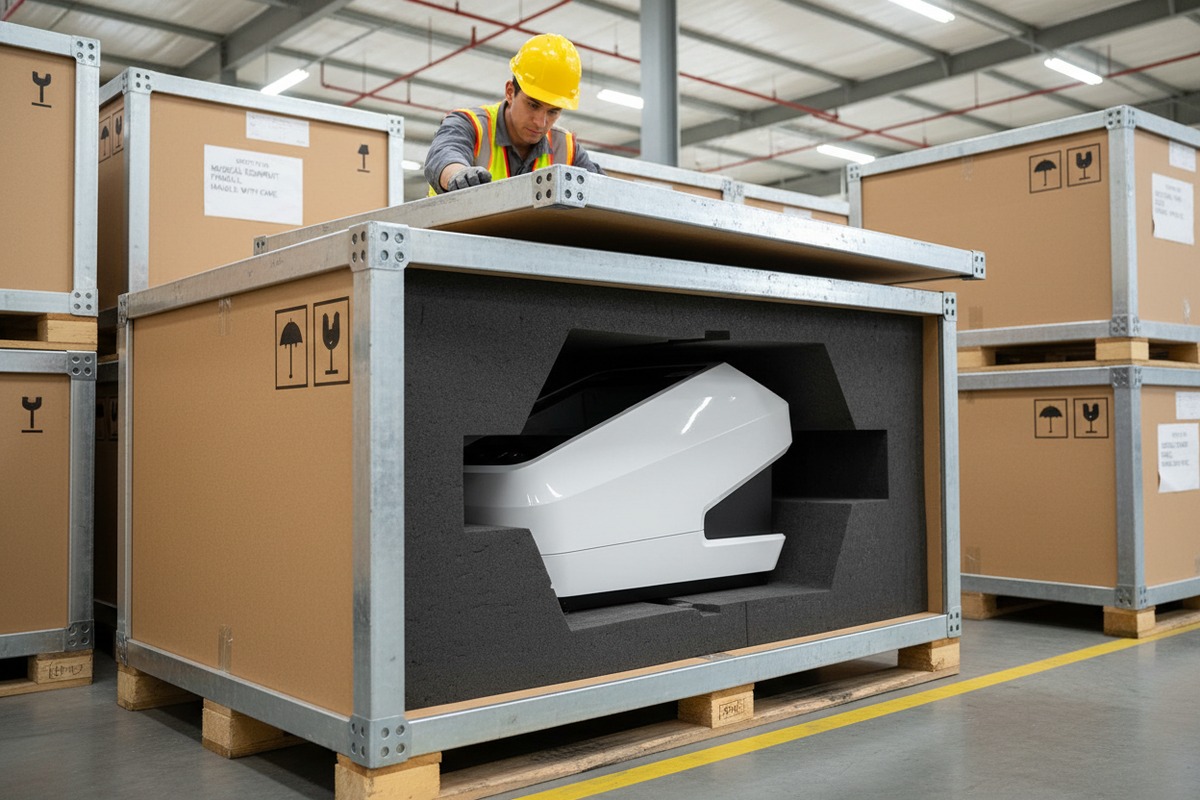
What Proper Packaging Looks Like
Professional medical device packaging follows established standards. The International Safe Transit Association 5 (ISTA) publishes test protocols that simulate real shipping conditions. ISTA 2A 6 covers packaged products under 150 pounds. ISTA 3A simulates complete distribution cycles.
Your supplier should demonstrate their packaging passes these tests. This means drop tests from multiple angles, vibration exposure matching truck transport frequencies, and compression testing simulating stacked warehouse storage.
Packaging Component Checklist
| Component | Purpose | Quality Indicators |
|---|---|---|
| Outer Carton | Impact distribution | Double-wall corrugated, burst strength rating |
| Inner Box | Secondary protection | Rigid construction, tight fit |
| Foam Inserts | Shock absorption | High-density PE or PU, custom-molded |
| Moisture Barrier | Humidity protection | Sealed poly bags, desiccant packets |
| Handpiece Holder | Component security | Dedicated cavity, soft lining |
Testing Packaging Yourself
Before placing large orders, request sample units shipped via your standard logistics channels. Upon arrival, document everything. Check for:
- Dents or compression marks on outer carton
- Foam integrity and snugness
- Moisture inside poly bags
- Secure handpiece positioning
- Accessory organization
Weigh the desiccant packets. Fresh silica gel weighs less than saturated gel. If packets feel heavy, moisture has already entered during transit.
Red Flags in Supplier Packaging
Watch for these warning signs: single-wall cartons, loose-fitting foam that allows movement, missing moisture barriers, and accessories loose in the box. Ask suppliers directly: "What drop height does your packaging protect against?" Professional answers cite specific figures—typically 76cm corner drops for medical devices.
If a supplier cannot explain their packaging engineering, they likely cut corners. Damaged arrivals become your problem, your warranty cost, and your customer's frustration.
What performance testing protocols should I implement before shipping long-term stored units to my salon clients?
Our quality control team runs every machine through a standardized checklist before release. But what happens when a unit sits in your warehouse for four months? Those original test results no longer apply. Components drift. Seals settle. Batteries lose charge. You need your own reactivation protocol.
Before shipping stored units, conduct visual inspection, power-on diagnostics, output calibration verification, handpiece functionality tests, and accessory completeness checks. Run machines for 10-15 minutes at various intensity levels. Document test results and compare against original specifications. Replace any components showing degradation.

Building Your Pre-Shipment Testing Protocol
Create a standardized checklist that any trained staff member can follow. Consistency matters more than complexity. Here is the framework we recommend to our distribution partners:
Visual and Physical Inspection
Start with the obvious. Examine the housing for cracks, discoloration, or warping. Check all ports and connectors for corrosion. Inspect the handpiece for seal integrity—look for dried gel residue, worn O-rings 7, or bullet damage.
Open the handpiece if your supplier provides maintenance access. Check for moisture inside. Verify lubrication on moving parts. Replace seals showing any compression set or hardening.
Electrical and Functional Testing
Power on the machine and observe the startup sequence. Note any error codes. Run through all menu functions. Verify the display works correctly without dead pixels or flickering.
Test at multiple intensity levels:
| Test Phase | Duration | Settings | What to Monitor |
|---|---|---|---|
| Low Intensity | 3 minutes | 1-2 bar, low frequency | Stable output, no stuttering |
| Medium Intensity | 5 minutes | 3-4 bar, medium frequency | Consistent rhythm, no overheating |
| High Intensity | 5 minutes | Maximum settings | Full power delivery, proper cooling |
| Cool Down | 2 minutes | Idle | Normal temperature reduction |
Calibration Verification
If your supplier provides calibration documentation, compare current output readings against original specifications. Many machines include built-in diagnostic modes. Access these and run self-tests. For critical applications, consider third-party calibration services 8 annually.
Documentation Requirements
Record everything. Create a testing log for each serial number including test date, technician name, all measurement results, and pass/fail determination. This documentation protects you during warranty discussions and demonstrates professionalism to your salon clients.
Include a "storage history" note: date received, storage duration, maintenance performed during storage, and reactivation test results. This transparency builds trust and helps troubleshoot any future issues.
Component Replacement Triggers
Some parts need replacement regardless of visible wear after extended storage. Rubber seals in handpieces compress permanently over time. O-rings dry out. Conductive gel residue hardens and becomes abrasive.
Establish replacement schedules based on storage duration, not just usage counts. After six months of storage, replace handpiece seals as preventive maintenance. After twelve months, consider full handpiece service regardless of appearance.
Conclusion
Long-term storage maintenance determines whether your shockwave therapy machines reach salon clients in working condition or arrive as expensive paperweights. Ask suppliers the right questions about environmental controls, battery schedules, packaging standards, and testing protocols. Document everything. Your reputation depends on machines that perform on day one.
Footnotes
1. Provides a general overview of shockwave therapy. ↩︎
2. Explains the fundamental principle of piezoelectricity and its components. ↩︎
3. Replaced with Wikipedia page for authoritative and comprehensive information on electrolytic capacitors. ↩︎
4. Offers best practices for safe storage of lithium-ion batteries. ↩︎
5. Links to the official organization that develops transport packaging standards. ↩︎
6. Details the specific test procedure for packaged products under 150 lbs. ↩︎
7. Explains the function and applications of O-rings as seals. ↩︎
8. Highlights the importance and scope of external calibration for medical devices. ↩︎

 English
  Español de México
  Deutsch
  Français
  العربية
  Русский