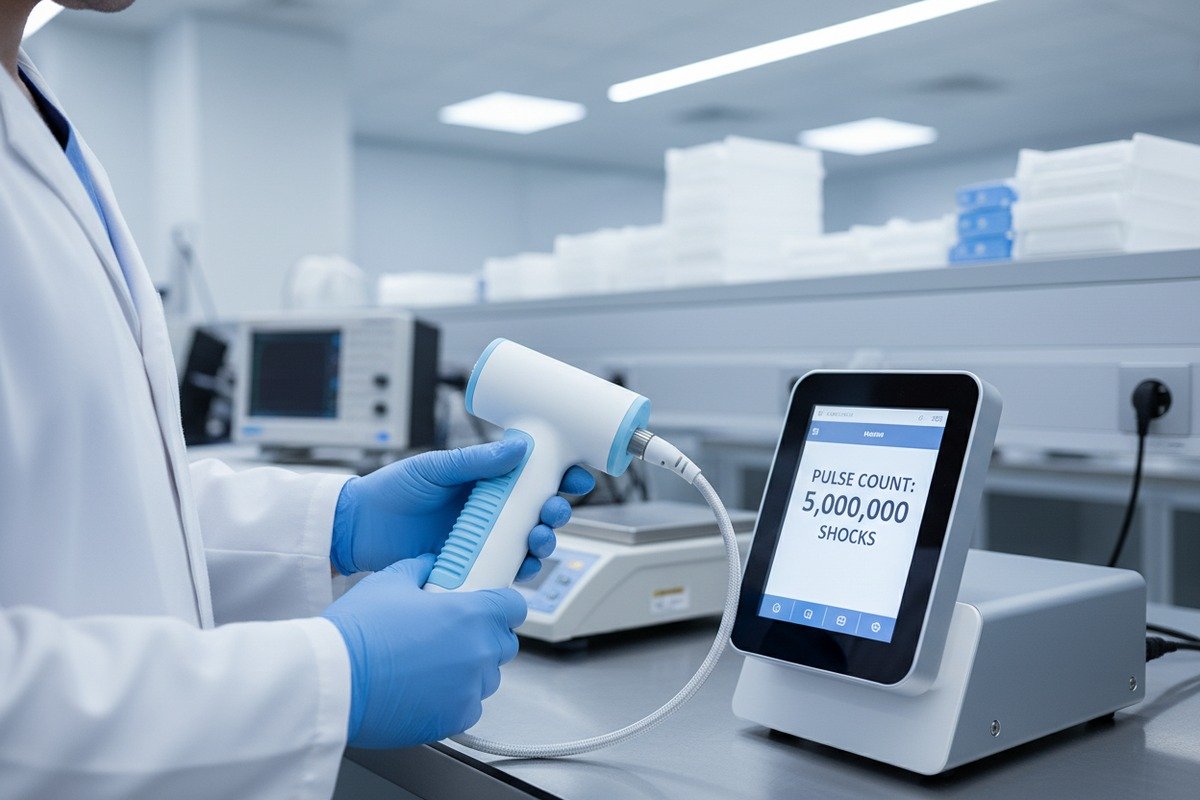
During our production line quality testing, we see this question constantly from clinic owners and distributors worldwide. You invest in professional shockwave equipment 1, but the handpiece lifespan remains unclear. Confusion about shock counts leads to unexpected costs and treatment interruptions. Your patients lose confidence when equipment fails mid-session.
A professional-grade shockwave therapy handpiece typically lasts between 1 million and 5 million shocks. Most manufacturers rate their handpieces at 5 million pulses as the standard lifetime. However, actual lifespan depends heavily on maintenance practices, usage intensity, and component replacement schedules during operation.
Understanding these numbers helps you plan equipment budgets and avoid costly surprises. Let me walk you through everything you need to know about handpiece longevity, from realistic expectations to quality benchmarks.
How many shocks can I realistically expect from a professional-grade handpiece?
When we calibrate handpieces at our facility before shipping, we test each unit against strict shock count standards. Many buyers focus only on purchase price. They ignore the critical question of how long the handpiece will actually last. This oversight creates budget problems down the road.
Professional-grade handpieces deliver between 1 million and 5 million shocks before requiring major service or replacement. Radial shockwave units typically need rebuilds at 200,000 to 1,000,000 shocks. Focused and piezoelectric transducers often endure 3 to 5 million shocks with proper maintenance and care.
Understanding Pulse Count vs. Operating Hours
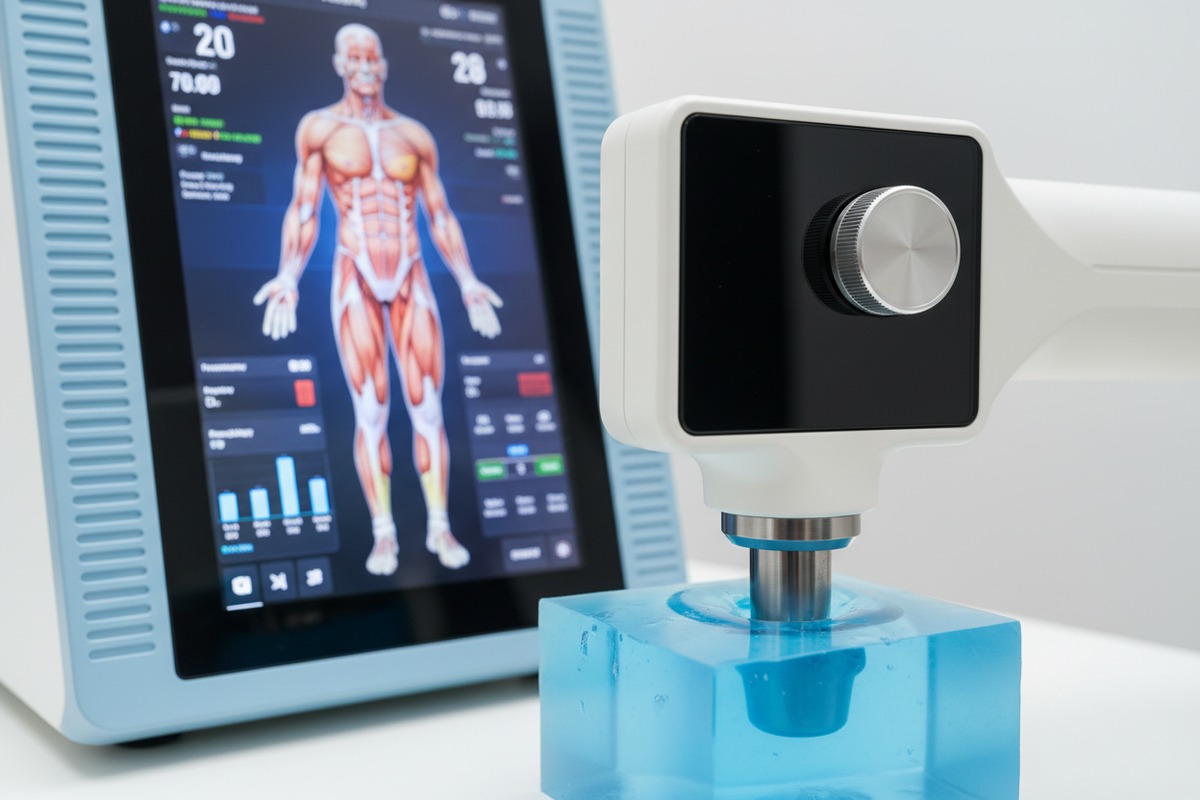
The industry measures handpiece life in total shocks delivered 2, not operating hours. This distinction matters greatly. At maximum frequency of 25 Hz, a handpiece rated for 5 million pulses translates to approximately 55 hours of total lifetime operation at full load.
Think about what this means practically. A busy clinic running 50 treatments weekly at 2,000 shocks per session delivers 100,000 shocks per week. At this rate, a 5-million-shock handpiece lasts roughly 50 weeks of heavy use.
Technology Type Makes a Difference
Different shockwave technologies have different wear profiles. Our engineering team has documented these variations across hundreds of units:
| Technology Type | Typical Lifespan | Primary Wear Component | Overhaul Interval |
|---|---|---|---|
| Radial Pressure Wave | 200,000–1,000,000 shocks | Projectile and guide tube | Every 500,000 shocks |
| Focused Shockwave | 3,000,000–5,000,000 shocks | Transducer stack | Every 1–3 years |
| Piezoelectric | 3,000,000–5,000,000 shocks | Crystal array | Per manufacturer specs |
| Electromagnetic | 2,000,000–4,000,000 shocks | Coil assembly | Every 1,000,000 shocks |
Portable vs. Clinical-Grade Machines
Quality portable machines typically feature handpieces rated for 4 million or more shocks. Clinical-grade equipment often exceeds this threshold. Our testing shows that build quality, not just specifications, determines real-world performance.
The RPW shockwave devices we work with require handpiece overhauls at approximately 1 million pulses. After overhaul, the device continues operating with mean times to failure ranging from 5,000 hours for lite models to 15,000 hours for clinical versions.
How does the handpiece lifespan impact my total cost of ownership?
We often discuss total cost of ownership 3 with distributors during initial consultations. Many focus entirely on unit price. They forget that handpiece replacement and consumables represent significant ongoing expenses. This narrow view leads to poor purchasing decisions.
Handpiece lifespan dramatically affects total cost of ownership. A handpiece requiring replacement every 500,000 shocks costs significantly more over 5 years than one lasting 3 million shocks. Factor in downtime, labor for maintenance, and consumable components when calculating true equipment costs.

Breaking Down Consumable Component Costs
The handpiece contains multiple wear items that fail before the entire unit reaches end-of-life. Understanding these components helps you budget accurately:
| Component | Lifespan in Shocks | Replacement Frequency | Cost Impact |
|---|---|---|---|
| Projectile/Bullet | 200,000–1,000,000 | Every 3–6 months (heavy use) | Medium |
| Guide Tube/Sleeve | 200,000–600,000 | Every 2–4 months (heavy use) | Medium |
| Applicator Heads | 150,000 | Every 2–3 months | Low |
| O-rings and Seals | Time-based (6–18 months) | Quarterly to annually | Low |
| Yellow Spacers | Variable | As needed | Low |
Bulk Pricing Reduces Long-Term Costs
From our experience supplying OEM customers, bulk pricing typically runs 5% to 8% lower than retail quantities. When you commit to larger orders of revision kits and consumables, these savings compound over years of operation.
Consider a clinic operating 5 years with heavy patient volume. The difference between paying retail versus bulk prices for consumables easily reaches thousands of dollars. Smart purchasing managers negotiate consumable pricing upfront during equipment acquisition.
Calculating Your True 5-Year Cost
Here is a practical framework for calculating total ownership cost:
- Initial equipment cost: Purchase price plus shipping and installation
- Annual consumables: Projectiles, tubes, seals, applicator heads
- Overhaul costs: Major handpiece rebuilds at specified intervals
- Downtime value: Revenue lost during repairs
- Training costs: Staff time learning maintenance procedures
Most clinics underestimate items 2 through 5. Our recommendation is to budget 15% to 20% of initial equipment cost annually for maintenance and consumables.
The Economics of Planned Replacement
Clinics increasingly adopt scheduled component replacement before failure. Replacing a projectile early protects energy accuracy and avoids mid-treatment failures. This shift reflects smart cost-benefit analysis.
Planned rebuilds cost less than emergency repairs. A scheduled overhaul might cost $500 and take 2 days. An emergency repair after catastrophic failure could cost $1,500 and require 2 weeks of downtime.
What quality control benchmarks should I require from my OEM supplier to ensure durability?
Our QC team runs every handpiece through rigorous testing before shipping. We have learned what separates reliable suppliers from those who cut corners. Your equipment durability depends heavily on the quality standards your supplier maintains.
Require suppliers to provide documented endurance testing results showing stable energy delivery beyond rated shock counts. Demand HALT testing data, component traceability, and detailed maintenance protocols. Reputable manufacturers stress-test handpieces to 500,000–5 million shocks before certifying production designs.
Essential QC Benchmarks to Request
When evaluating OEM suppliers, request documentation for these specific tests:
| QC Benchmark | What It Measures | Acceptable Standard |
|---|---|---|
| HALT Testing 4 | Stress beyond normal use | Tested to 150% of rated life |
| Energy Consistency | Output stability over time | ±5% variation maximum |
| Component Traceability | Material sourcing records | Full batch documentation |
| Thermal Cycling | Temperature stress response | 1,000+ cycles without failure |
| Impact Endurance | Shock absorption capacity | Exceeds rated count by 20% |
Material Quality Indicators
Advances in material science 5 are producing more durable handpiece components. Look for suppliers using specialized ceramics and alloys designed to withstand higher mechanical stresses and temperatures.
Our R&D department continuously tests new materials. Components made from advanced ceramics show 30% to 40% longer operational life compared to standard materials. Ask your supplier specifically what materials compose critical wear components.
Documentation You Should Receive
A quality OEM supplier provides comprehensive documentation:
- Test certificates: Individual unit test results
- Batch records: Component lot numbers for traceability
- Maintenance manuals: Detailed cleaning and service schedules
- Warranty terms: Clear coverage limits and exclusions
- Calibration data: Energy output verification
Red Flags in Supplier Selection
Watch for these warning signs during supplier evaluation:
- Reluctance to share test data
- Vague specifications without quantifiable metrics
- No documented maintenance protocols
- Short warranties with many exclusions
- Inability to explain component materials
We have seen equipment fail prematurely when buyers ignored these red flags. The lowest price often means the lowest quality control standards.
How can I tell if my handpiece is losing power before it reaches its maximum shock count?
During technical support calls with our customers, we hear about gradual performance decline. Many clinicians continue using degraded handpieces because they lack clear diagnostic criteria. This results in suboptimal patient treatments and eventually catastrophic failures.
Key indicators of handpiece degradation include noticeable decrease in energy delivery, inconsistent pulse frequency, stuttering during operation, the projectile sticking in the tube, and unusual noises or vibrations. Regular monitoring of these symptoms allows proactive service before complete failure occurs.

Early Warning Signs to Monitor
Train your staff to recognize these symptoms during daily operation:
Auditory Changes: A healthy handpiece produces consistent clicking sounds. Irregular rhythm, grinding noises, or muffled impacts indicate wear. The projectile should move freely without hesitation.
Tactile Feedback: Operators feel vibration changes through the handpiece. Excessive vibration or unusual dampening suggests internal component wear. Compare against a new unit periodically.
Visual Inspection: Check the applicator head and tube entrance daily. Visible wear patterns, discoloration, or residue buildup indicate maintenance needs. Black residue on the projectile signals lubrication breakdown.
Quantitative Monitoring Methods
Beyond subjective assessment, implement these objective measurements:
| Monitoring Method | Frequency | Action Threshold |
|---|---|---|
| Energy output measurement | Weekly | Drop below 90% of rated output |
| Pulse frequency check | Weekly | Variation exceeds ±10% |
| Treatment time comparison | Daily | Same protocol takes 15%+ longer |
| Patient feedback tracking | Ongoing | Decreased treatment effectiveness |
Implementing a Monitoring Protocol
Establish systematic monitoring rather than waiting for obvious problems:
- Daily quick check: Visual inspection and brief operational test
- Weekly measurement: Energy output verification using manufacturer test protocols
- Monthly deep inspection: Remove applicator heads and check internal components
- Quarterly calibration: Professional service check against factory specifications
The Emerging Role of Technology
The integration of IoT sensors and AI-driven analytics 6 represents the future of handpiece monitoring. Advanced software algorithms can dynamically optimize shockwave parameters based on real-time wear data.
Some newer models include built-in diagnostics that alert operators to degradation before it affects treatments. When selecting equipment, ask whether the system includes predictive maintenance features 7.
When to Stop Using a Degraded Handpiece
Continue operation if energy output remains above 90% of specification and no mechanical symptoms appear. Schedule immediate service if:
- Energy drops below 85% of rated output
- Projectile sticks more than once per treatment
- Unusual sounds persist after cleaning
- Patient outcomes noticeably decline
Pushing a degraded handpiece risks damaging other components. The cost of running to failure far exceeds proactive maintenance.
Conclusion
Handpiece lifespan directly impacts your clinic's profitability and patient outcomes. Smart operators track shock counts, maintain rigorous cleaning schedules, and partner with quality-focused suppliers. Plan for consumable costs and monitor performance proactively to maximize your equipment investment.
Footnotes
1. Provides a general overview of extracorporeal shockwave therapy and its equipment. ↩︎
2. Explains parameters of shockwave therapy, including pulse count relevance. ↩︎
3. Replaced HTTP 403 link with an authoritative definition of Total Cost of Ownership from IBM. ↩︎
4. Explains Highly Accelerated Life Test (HALT) as a stress testing methodology. ↩︎
5. Replaced HTTP 404 link with an authoritative definition of Material Science from Britannica. ↩︎
6. Discusses the integration of AI and IoT for enhanced predictive maintenance strategies. ↩︎
7. Explains predictive maintenance, its benefits, and key features for equipment longevity. ↩︎

 English
  Español de México
  Deutsch
  Français
  العربية
  Русский