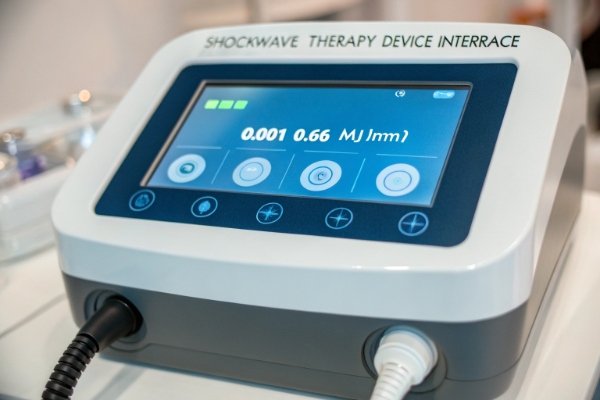
When I first started designing shockwave therapy machines, I realized that everyone talked about “high power,” but few understood what the actual energy range meant in clinical use.
The output energy range of a shockwave therapy machine usually spans from about 0.001 mJ/mm² to 0.60 mJ/mm², depending on the technology type and design 1. In most clinical settings, therapists use 0.01–0.40 mJ/mm² for soft-tissue treatments and 0.30 mJ/mm² or above for deeper indications like calcific tendonitis or bone stimulation. The flexibility of the range allows safe and effective treatment across different tissue types.
In our factory, we calibrate every model to ensure smooth energy adjustment across this range, because true performance depends not just on maximum output—but on precision and stability at every level.
How Does Energy Intensity Affect Treatment Outcomes in Shockwave Therapy?
I remember testing two prototypes in our lab—one with a narrow intensity range and another with a broader one. The wider range gave our testers noticeably better results and comfort.
Energy intensity directly shapes treatment outcomes because it determines how acoustic waves interact with body tissues 2—low levels stimulate healing processes and microcirculation, while higher intensities trigger controlled microtrauma that encourages regeneration. If the intensity is set too high, it can cause pain or bruising; too low, and the treatment might not achieve any biological effect.

Understanding Energy Flux Density (EFD)
Energy intensity in our devices is measured in mJ/mm², known as *Energy Flux Density (EFD)** 3. Here’s how we classify it:
| Energy Level | EFD (mJ/mm²) | Common Applications |
|---|---|---|
| Low | < 0.08 | Trigger points, fascia release |
| Medium | 0.08–0.28 | Tendinopathies, muscle recovery |
| High | 0.28–0.60 | Bone healing, calcific deposits |
Why This Matters Clinically
From our customer feedback, therapists often find that moderate energy around 0.10–0.20 mJ/mm² produces optimal results. It balances effectiveness and comfort, especially for repetitive treatments. For high-energy applications, such as bone regeneration, we recommend careful training to ensure the patient’s tolerance is respected 4.
When we fine-tune machine settings during testing, even a 0.05 mJ/mm² difference can noticeably change the tissue response. That’s why precision energy control 5 is one of the most important quality factors we focus on during manufacturing.
How Does the Energy Range Differ Between Radial vs Focused Shockwave Therapy Machines?
Many customers ask me whether “radial” and “focused” machines deliver the same type of energy. They don’t. They serve different therapeutic purposes.
Focused shockwave therapy machines 6 emit concentrated acoustic energy (0.01–0.55 mJ/mm²), while radial shockwave devices 7 generate mechanical pressure waves (10–190 mJ or 1–5 bar) that spread energy over a wider area. Both can be effective, but their physical principles and clinical uses are quite distinct.
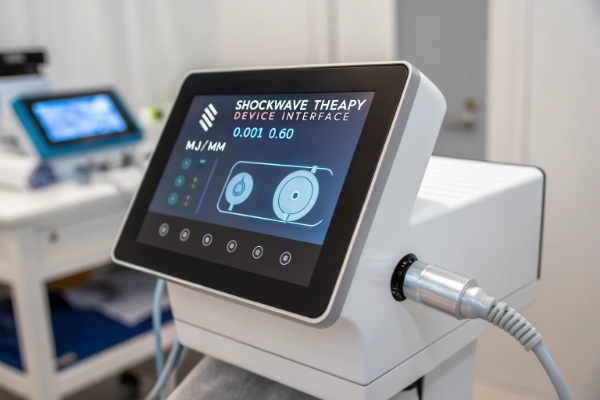
Comparison: Focused vs Radial Shockwave Devices
| Feature | Focused ESWT | Radial ESWT |
|---|---|---|
| Energy Type | True acoustic shockwaves | Compressed-air pressure waves |
| Energy Range | 0.01–0.55 mJ/mm² | 10–190 mJ (~1–5 bar) |
| Penetration Depth | 2–6 cm | 0–3 cm |
| Treatment Zone | Precise and deep | Broad and superficial |
| Typical Use | Bone healing, calcific tendonitis | Muscle tension, trigger points |
How This Impacts Clinical Results
From a manufacturer’s point of view, focused devices require more sophisticated transducer technology and calibration. They deliver energy precisely into deep structures. Radial devices, however, are excellent for surface-level muscle therapy and pain relief.
I often tell distributors that comparing energy numbers between the two types is meaningless—1 bar in a radial system doesn’t equal 0.1 mJ/mm² in a focused system 8. We always provide both specifications to help buyers understand what they’re really purchasing.
Why Does the Specified Energy Range Matter for Device Performance and Treatment Safety?
When I first showcased our focused system, a competitor claimed “up to 1.0 mJ/mm² output.” It sounded powerful—but in real treatments, such high levels could cause tissue trauma.
The specified energy range defines both performance capability and treatment safety 9. A high-quality device should deliver stable, accurate energy at all levels—especially at the low end, where delicate soft-tissue applications need precise control. A poorly calibrated system can output uneven or excessive energy, risking pain or injury to patients.
Safe Engineering Parameters
| Specification | Clinical Meaning | Risk of Poor Design |
|---|---|---|
| Minimum Energy | Defines sensitivity for gentle treatments | Too high → unsafe for post-op or facial use |
| Maximum Energy | Defines deep-therapy capacity | Too high → risk of tissue trauma |
| Step Interval | Defines precision of adjustment | Coarse steps → inconsistent results |
How We Control It in Production
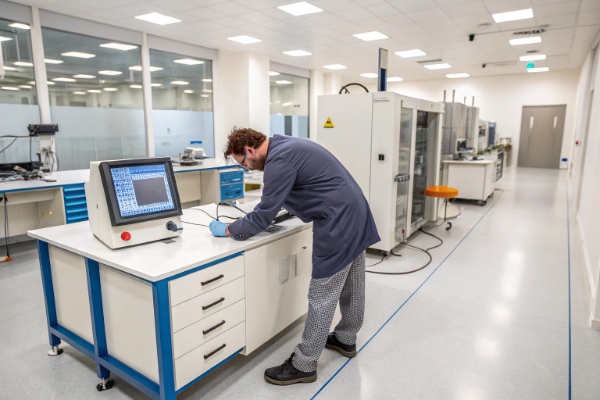
In our facility, every device undergoes calibration using energy sensors and ISO-compliant testing systems 10 to verify accuracy within ±10%. We simulate treatment conditions to check stability across frequency and intensity ranges. This ensures therapists can confidently use the machine for any indication, knowing it won’t exceed safe thresholds.
Safety isn’t only about limiting power—it’s about controlling it. A precisely defined energy range guarantees that.
How Should Purchasers Verify the Claimed Energy Output Range from Suppliers?
Many of our overseas clients tell me they’ve seen wildly inconsistent “energy specs” in supplier catalogs. That’s a real issue in this industry.
Purchasers should always verify a supplier’s claimed energy output range by requesting calibration certificates, laboratory test reports, and technical data sheets that clearly state measurement units (mJ/mm² or bar). Reliable manufacturers can provide third-party validation or in-house QC reports upon request.

Verification Steps for Buyers
| Verification Step | What to Request | Why It Matters |
|---|---|---|
| Calibration Report | Independent or internal test document | Confirms energy accuracy |
| Technical Data Sheet | Includes EFD range and frequency | Ensures unit consistency |
| Video Demonstration | Shows adjustable power response | Proves real functionality |
| Clinical Reference | Verified user feedback | Confirms practical performance |
Practical Advice
As a manufacturer, I always advise our partners to confirm whether the energy measurement is taken at the applicator tip or at tissue depth, because this difference affects the reported range. Also, beware of devices that only list “bar” pressure without mJ/mm² conversion—it’s often a red flag for incomplete testing.
The best suppliers will show transparent calibration results and can explain how their test methods align with IEC 60601-2-62 safety standards. That’s how you separate genuine engineering from marketing hype.
Conclusion
Energy range isn’t just a number—it’s the foundation of safe, effective, and consistent shockwave therapy. As a manufacturer, I ensure every machine we build delivers precise, verifiable energy to support real clinical outcomes.
Footnotes
1. Clinical guide showing ESWT ranges between 0.001–0.5 mJ/mm². ↩︎
2. Article explaining energy intensity’s role in tissue interaction. ↩︎
3. Study describing how EFD defines biological effects of shockwaves. ↩︎
4. Research on optimal energy levels for safe therapeutic use. ↩︎
5. Paper on energy precision and biological response in ESWT. ↩︎
6. Review describing focused shockwave therapy mechanisms. ↩︎
7. Clinical summary explaining radial ESWT parameters. ↩︎
8. Comparative analysis clarifying energy equivalence between bar and mJ/mm². ↩︎
9. Technical paper linking energy stability to patient safety. ↩︎
10. ISO standard reference for calibration and accuracy validation. ↩︎

 English
  Español de México
  Deutsch
  Français
  العربية
  Русский