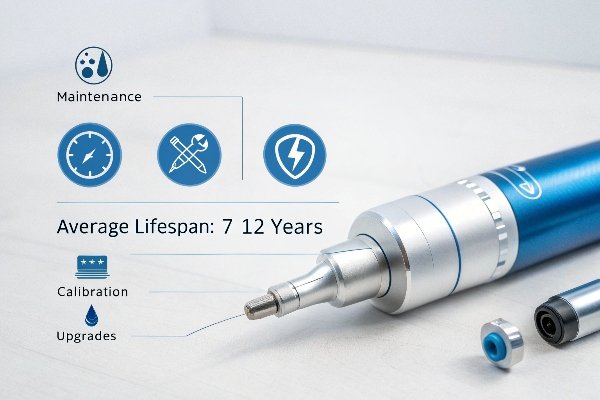
I get this question from nearly every buyer planning capacity: “How long will the machine actually last?” It matters for budgets and uptime.
A well-built shockwave therapy machine typically serves 7–12 years in clinics with proper care. Consumable parts wear faster, so scheduled servicing, calibration, and handpiece rebuilds keep performance stable and extend useful life.
A clear maintenance plan, spare-part kit, and periodic performance checks reduce surprises. The sections below explain component longevity, usage effects, replacement signs, and upgrade paths.
How long do main components usually last?
I always start lifecycle talks with parts, because components—not just age—decide uptime and cost.
Major assemblies follow different clocks. Cores and electronics last years, while wear parts run by shots or hours. Good programs track shot counts, temperatures, and output to time rebuilds before failures.

A machine’s “life” splits into durable cores and predictable consumables. The smartest clinics plan both, aligning maintenance with ISO 13485 preventive maintenance standards 1 and electrical safety verification under IEC 60601-1 2.
Table 1 — Component-level longevity (typical planning ranges)
| Component / Part | Typical replacement trigger | Planning range* |
|---|---|---|
| Handpiece projectile / bullet (radial) | Shot count threshold or reduced energy transfer | 200k–1,000k shots |
| Guide tube / sleeve (radial) | Visible wear, noise, efficiency drop | 200k–600k shots |
| Transducer stack (focused) | Output drift beyond tolerance | 1–3+ years or per M-shots spec |
| O-rings / seals / dampers | Leakage, vibration, failed pressure test | 6–18 months (use-dependent) |
| Fans / filters / vents | Thermal alarms, high internal temp | 12–24 months (clean quarterly) |
| Touchscreen / encoder / buttons | Dead zones, misreads | 3–7 years |
| Power board / PSU | Random resets, voltage ripple beyond spec | 5–10 years |
| Cables / footswitch | Intermittent input, sheath cracks | 2–5 years |
*Ranges vary by brand, energy levels, and duty cycles. Preventive swaps before failure reduce downtime.
Planned rebuilds cost less than mid-treatment failures. Replacing a projectile early protects energy accuracy and avoids emergency repairs, especially when paired with IEC 62353 post-repair testing 3.
Does usage frequency affect lifespan?
I hear, “We will run back-to-back sessions all day—does that shorten life?” The honest answer: yes, if limits are ignored.
Usage frequency strongly affects wear. High daily throughput, high energies, and short rest intervals raise temperature and friction, accelerating handpiece and transducer aging. Duty-cycle discipline and cooling practices preserve lifespan.

Energy output stability indicates proper cooling and operation. Clinics can apply thermal management concepts from ASHRAE equipment environment guidelines 4 to extend system life.
Table 2 — Usage patterns vs. maintenance cadence
| Usage pattern | Typical daily shots | Recommended check | Preventive action |
|---|---|---|---|
| Low volume | ≤10k/day | Weekly visual check | Clean vents; wipe handpiece; log shots |
| Medium volume | 10–30k/day | Biweekly output spot-check | Grease per spec; tighten fasteners |
| High volume | 30–60k/day | Weekly output chart + temp logs | Mid-cycle rebuild at ½ rated shots |
| Very high volume | 60k+/day | Daily temp + energy drift check | Add spare handpiece; enforce rests |
How to identify when replacement is needed?
Replacement is due when energy delivery drifts beyond tolerance, noise or vibration rises, or shot counts cross planned limits. Trend logs make replacement timing objective.
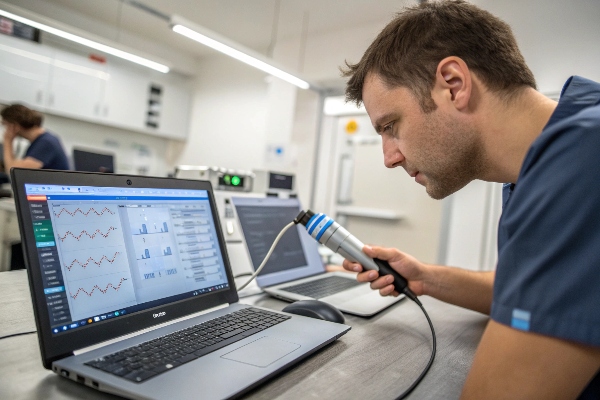
Many clinics use predictive maintenance frameworks 5 combined with FDA 21 CFR 820.200 servicing records 6 to track wear and schedule servicing.
Table 3 — Symptom-to-action guide
| Symptom | Likely cause | Immediate action | Follow-up |
|---|---|---|---|
| Reduced “feel” at same setting | Projectile or transducer wear | Swap to spare handpiece | Schedule rebuild/calibration |
| New rattle / harsh tone | Guide tube wear | Lower power; stop if persistent | Inspect sleeve; replace kit |
| Hot casing / thermal trip | Blocked airflow or fan fatigue | Power down; clean vents | Replace fan; verify temps |
| Intermittent triggering | Footswitch or cable | Try known-good spare | Replace cable/switch |
| Gel seep/leak | Seal wear | Clean; pause use | Replace O-rings/seals |
Can lifespan be extended with upgrades?
Yes. Upgrades that improve cooling, reduce friction, or stabilize electronics extend lifespan. Firmware that smooths ramps and adds lockouts protects hardware. Spare handpieces and revision kits distribute wear.
High-value upgrades like power conditioning systems 7, IEC 62304 firmware lifecycle updates 8, and reprocessing best practices 9 improve both performance and safety.
For long-term planning, facilities can follow ISO 13374 condition monitoring data standards 10 to analyze lifespan trends and reduce unplanned downtime.
Conclusion
A quality shockwave therapy machine delivers many years of service when clinics manage wear parts, respect duty cycles, and act on early signals. Smart upgrades and clear SOPs stretch lifespan and protect outcomes.
Footnotes
1. ISO 13485 – Preventive maintenance standard for medical devices. ↩︎
2. IEC 60601-1 – Core electrical safety requirements for medical equipment. ↩︎
3. IEC 62353 – Post-repair testing ensuring operational integrity. ↩︎
4. ASHRAE – Environmental and temperature management guidelines. ↩︎
5. ISO 17359 – Predictive maintenance implementation guidance. ↩︎
6. FDA 21 CFR 820.200 – Servicing and record-keeping requirements. ↩︎
7. NFPA 99 – Power conditioning standards for healthcare facilities. ↩︎
8. IEC 62304 – Software lifecycle safety for firmware updates. ↩︎
9. FDA guidance – Best practices for cleaning and reprocessing devices. ↩︎
10. ISO 13374 – Data monitoring standards for predictive equipment lifespan. ↩︎

 English
  Español de México
  Deutsch
  Français
  العربية
  Русский