
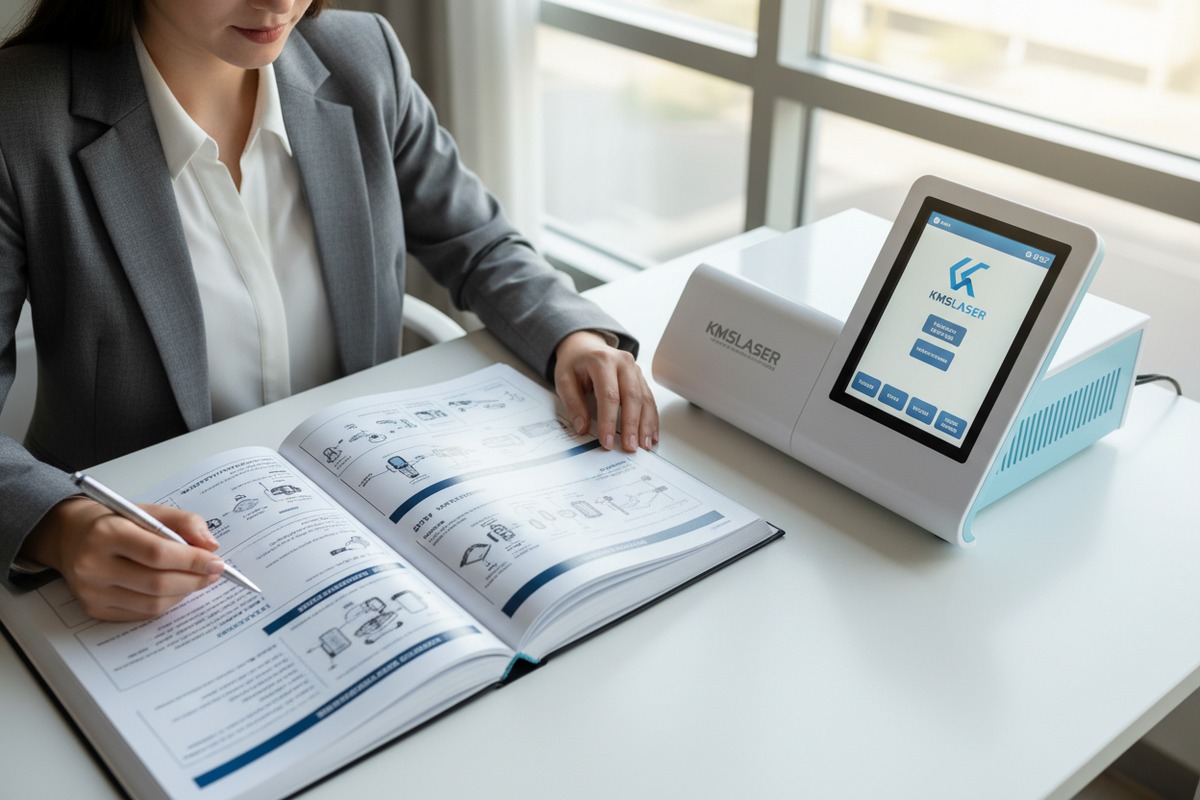
Every week, our customer service team receives calls from distributors struggling with incomplete product documentation. Their salon clients face treatment errors. Equipment sits idle due to preventable issues. The root cause is almost always the same: a poorly structured product manual that creates more questions than it answers.
A comprehensive shockwave therapy machine product manual must include device component identification with diagrams, step-by-step setup instructions, safety protocols and contraindications, treatment parameter guidelines, application techniques, maintenance schedules, troubleshooting guides, and regulatory compliance information to ensure safe and effective operation.
In this guide, we will walk through every essential section your product manual needs. You will learn how to meet regulatory requirements, create effective treatment protocols, customize your documentation for your brand, and build troubleshooting guides that reduce support calls.
How do I ensure my shockwave therapy machine manual meets all safety and regulatory requirements?
When our engineering team develops documentation for export markets, safety compliance is never an afterthought. One missing warning label or unclear contraindication can expose your brand to liability claims. Worse, it can harm end users who trust your equipment.
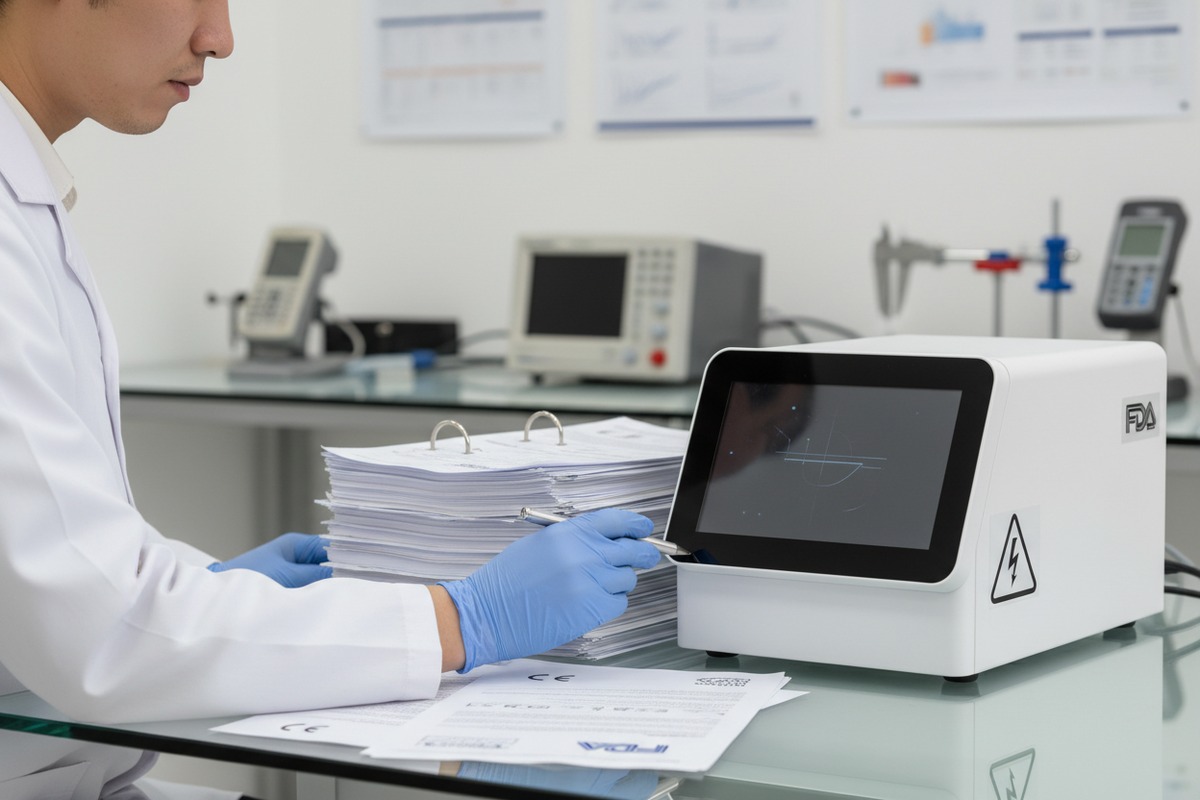
To meet safety and regulatory requirements, your manual must include FDA 21 CFR 878.4685 compliance statements, CE marking documentation, ISMST guidelines adherence, clear contraindication lists, EMC emission warnings, operator qualification requirements, and standardized safety symbols with explanations throughout the document.
Understanding Regional Regulatory Frameworks
Different markets have different expectations. For the US market, the FDA classifies shockwave therapy devices under specific medical device categories. FDA 21 CFR 878.4685 1 Your manual must clearly state intended use and prescription requirements where applicable. For European markets, CE marking requires comprehensive risk assessment documentation. CE marking documentation 2
Our quality control department maintains updated checklists for each export region. This prevents costly delays at customs and protects our distribution partners from compliance issues.
Essential Safety Sections Your Manual Needs
Every shockwave therapy manual should contain these safety elements in dedicated sections:
| Safety Section | Content Requirements | Placement in Manual |
|---|---|---|
| Contraindications | Pregnancy, pacemakers, blood clotting disorders 3, malignancy over treatment area, open wounds | Before treatment protocols |
| Warnings | Electrical safety, unauthorized modifications, untrained operator risks | First 5 pages |
| Precautions | Coupling gel requirements, session limits, pressure settings for sensitive areas | Treatment section |
| EMC Guidelines | Electromagnetic compatibility, distance from other electronics, interference risks | Technical specifications |
| Symbol Explanations | IEC 60601 standard symbols 4 with definitions | Appendix or inside cover |
Operator Qualification Requirements
Your manual must specify who can operate the device. This protects both the manufacturer and the end user. Include clear statements about required training levels. Specify whether the device requires licensed practitioners or can be operated by trained aestheticians.
In our experience shipping to US distributors, unclear operator requirements cause the most compliance headaches. State licensing boards have different rules. Your manual should reference these variations and recommend verification with local authorities.
Building a Complete Contraindication List
A thorough contraindication section prevents adverse events and protects your brand. Based on ISMST guidelines 5 and standard ESWT protocols, your manual should address:
- Absolute contraindications: pregnancy, malignancy in treatment area, blood clotting disorders
- Relative contraindications: corticosteroid injections within 6 weeks, acute inflammation
- Area-specific warnings: caution near growth plates in adolescents, avoid over lungs
- Device-specific limitations: maximum treatment duration, cooling periods between sessions
What treatment protocols and maintenance guides should I provide for my salon clients?
Our distributors tell us that their best-selling feature is not the machine itself. It is the quality of training materials that come with it. Salon owners want protocols they can implement immediately. They want maintenance schedules that prevent expensive repairs.
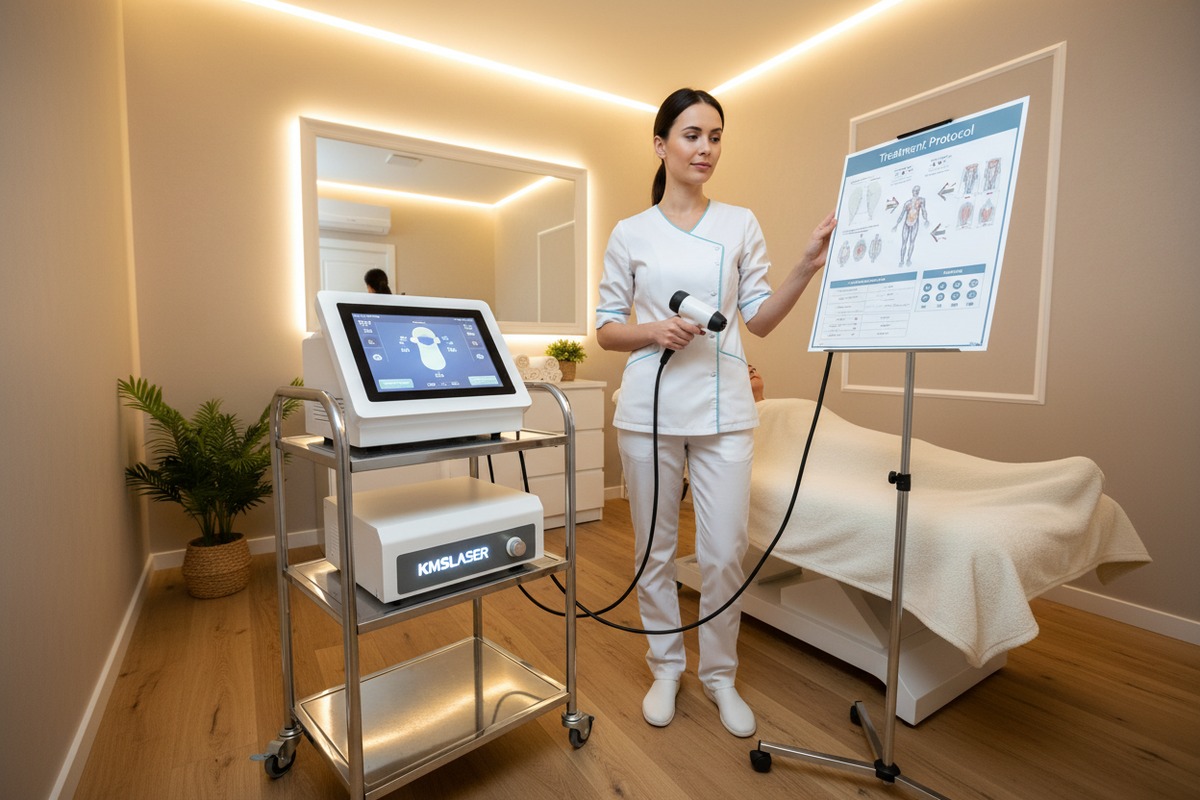
Your manual should provide condition-specific treatment protocols with exact pressure settings, frequency ranges, and session durations, plus weekly maintenance checklists covering applicator cleaning, lubrication schedules, consumable replacement timelines, and performance verification tests to maximize equipment lifespan.
Condition-Specific Treatment Parameters
Modern shockwave devices feature preset protocols, but your manual should explain the reasoning behind each setting. This helps operators adjust for individual patient needs while staying within safe parameters.
| Condition | Pressure (Bar) | Frequency (Hz) | Shots per Session | Sessions Recommended |
|---|---|---|---|---|
| Plantar Fasciitis 6 | 3.0-5.0 | 3-5 | 2000-3000 | 3-5 weekly |
| Lower Back Pain | 4.0-6.0 | 5-7 | 2500-4000 | 4-6 weekly |
| Shoulder Tendinopathy | 2.5-4.0 | 4-6 | 2000-2500 | 4-6 weekly |
| Cellulite Treatment | 2.0-3.5 | 8-12 | 3000-5000 | 8-12 twice weekly |
| Trigger Point Therapy | 3.0-4.5 | 6-8 | 1500-2000 | 2-4 as needed |
Step-by-Step Treatment Application
Your protocol section should walk operators through each treatment type. Include patient positioning instructions. Explain how to identify treatment areas using anatomical landmarks. Describe proper handpiece manipulation techniques including angle, pressure, and movement patterns.
When we train our distributor partners, we emphasize the importance of coupling gel application 7. Insufficient gel causes discomfort and reduces treatment effectiveness. Your manual should specify gel thickness and reapplication intervals during longer sessions.
Patient Preparation Guidelines
Before any treatment, operators need clear patient preparation steps:
- Review patient health history for contraindications
- Explain the procedure and expected sensations
- Clean treatment area and remove lotions or oils
- Apply adequate coupling gel in circular motions
- Confirm patient comfort and establish feedback signals
- Begin at lowest effective settings and adjust upward
Maintenance Schedules That Prevent Breakdowns
Equipment longevity depends on proper maintenance. Our service data shows that 80% of early failures result from neglected routine care. Your manual should include both daily and periodic maintenance tasks.
| Maintenance Task | Frequency | Tools Required | Estimated Time |
|---|---|---|---|
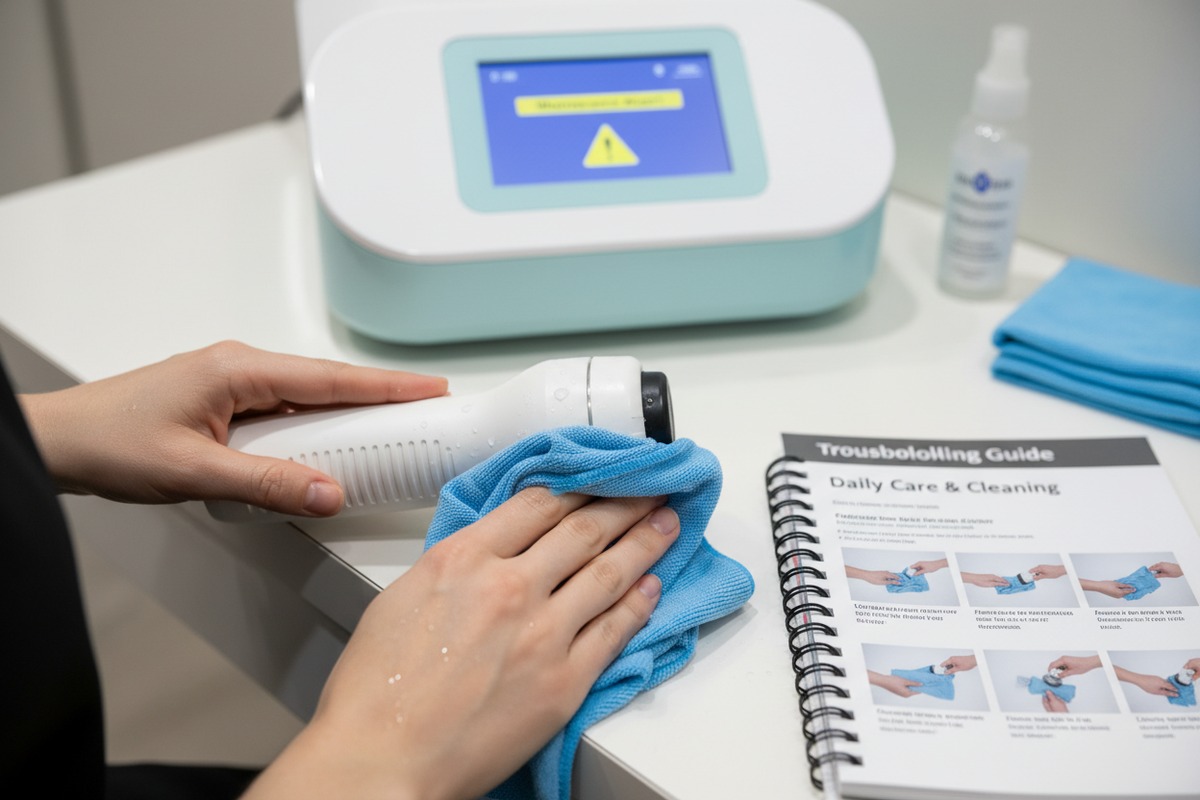
| Wipe applicator head | After each use | Soft cloth, approved cleaner | 2 minutes |
| Clean handpiece exterior | Daily | Damp cloth | 5 minutes |
| Lubricate handpiece | Weekly | Manufacturer-supplied lubricant | 10 minutes |
| Check bullet condition | Monthly | Visual inspection | 5 minutes |
| Replace bullet | Every 2 million shots | Wrench set, new bullet | 15 minutes |
| Professional servicing | Annually | Authorized technician | 2-4 hours |
Consumable Replacement Guidelines
Your manual should clearly list all consumable parts and their replacement intervals. Include part numbers for easy reordering. Specify which replacements operators can perform themselves and which require authorized technicians.
Common consumables include bullets (lifespan approximately 2 million shots), pistons, O-rings, and seals. When we design our service kits, we include color-coded components to prevent installation errors. Your manual should reference these visual guides.
Can I private-label the product manual to match my brand's specific design standards?
When our OEM partners request custom documentation, they want more than a logo swap. They need manuals that reflect their brand positioning, speak to their specific customer base, and integrate with their existing training systems.
Yes, product manuals can be fully private-labeled to match your brand standards, including custom cover designs, branded color schemes, your company logos, contact information, warranty terms, QR codes linking to your training videos, and terminology that aligns with your marketing language and target audience.
Customization Options We Offer Our Partners
Our documentation team works with distributors to create fully branded manuals. This process typically takes 2-3 weeks and includes multiple revision rounds. The goal is documentation that looks and feels like your brand created it from scratch.
Standard customization options include:
- Cover design with your logo, brand colors, and product photography
- Header and footer branding throughout all pages
- Custom warranty terms and service contact information
- QR codes linking to your YouTube tutorials or training portal
- Terminology adjustments to match your marketing language
- Translated versions for multi-language markets
Maintaining Technical Accuracy During Customization
While visual branding is flexible, technical content requires careful handling. Safety warnings, regulatory statements, and treatment parameters must remain accurate. Our engineers review all customized manuals before release to ensure compliance.
We recommend keeping the following sections standardized:
- Contraindication lists and safety warnings
- Technical specifications and electrical ratings
- EMC compliance statements
- Disposal and environmental guidelines
Digital Manual Integration Options
Modern clinics expect digital documentation options. Your branded manual should be available in multiple formats:
| Format | Best Use Case | Advantages |
|---|---|---|
| Printed Manual | Initial training, in-device reference | Durable, no device needed |
| PDF Download | Email distribution, archival | Searchable, easily updated |
| Tablet-Optimized | Point-of-use reference | Interactive, video links |
| Online Portal | Ongoing updates, version control | Always current, trackable |
| QR-Linked Videos | Quick technique demonstrations | Visual learning, multilingual |
Creating Brand Consistency Across Documentation
Your product manual should align with your broader brand identity. This means consistent terminology, visual style, and tone of voice. If your marketing emphasizes luxury spa experiences, your manual language should reflect that positioning. If you target clinical settings, use more technical terminology.
Our design team can adapt existing templates or create entirely new layouts. We maintain source files that allow quick updates when regulations change or when you expand your product line.
What troubleshooting steps must I include to reduce my team's technical support workload?
Last quarter, our technical support team analyzed incoming calls. Over 60% of issues could have been resolved with better troubleshooting documentation. Each unnecessary support call costs time and damages customer confidence. A comprehensive troubleshooting guide pays for itself quickly.
Your troubleshooting section must include error code definitions, diagnostic flowcharts for common symptoms, step-by-step resolution procedures for power issues, pressure inconsistencies, display malfunctions, and connection failures, plus clear escalation criteria indicating when professional service is required.

Common Issues and Resolution Procedures
Most shockwave therapy device problems fall into predictable categories. Your manual should address each category with clear diagnostic steps and solutions. Organize troubleshooting by symptom rather than technical cause. Operators think "the machine won't turn on," not "power supply capacitor failure."
| Symptom | Probable Causes | User-Level Solutions | Escalation Required |
|---|---|---|---|
| No power | Unplugged, tripped breaker, faulty outlet | Check connections, try different outlet, inspect power cord | If solutions fail |
| Weak pressure | Low air supply, worn bullet, clogged filter | Check compressor, inspect bullet, clean air filter | After parts replacement |
| Inconsistent shots | Lubrication needed, piston wear, air leak | Lubricate handpiece, check seals, inspect connections | If lubrication fails |
| Display errors | Software glitch, loose connection, sensor fault | Restart device, check cable connections | If restart fails |
| Overheating warning | Blocked ventilation, extended use, room temperature | Ensure airflow, allow cooling period, check room HVAC | If warning persists |
Building Effective Diagnostic Flowcharts
Visual troubleshooting guides reduce resolution time dramatically. Include decision-tree flowcharts that walk operators through logical diagnostic steps. Each branch should lead to either a solution or clear escalation instructions.
A good flowchart structure:
- Start with the observed symptom
- Ask yes/no diagnostic questions
- Direct to specific solutions based on answers
- Indicate when to contact support
- Provide relevant contact information at endpoints
Error Code Reference Guide
If your device displays error codes, your manual must define each one. Include the code, its meaning, probable causes, and recommended actions. Operators should never see an error without knowing what it means and what to do next.
Our engineering team designs error codes with troubleshooting in mind. We use prefixes to indicate error categories: E1xx for power issues, E2xx for pressure problems, E3xx for communication errors. This system helps operators quickly identify problem areas.
Performance Verification Procedures
Your manual should include periodic performance checks that operators can perform themselves. These tests catch developing problems before they cause treatment failures or safety issues.
Essential verification tests include:
- Pressure output confirmation using built-in diagnostic mode
- Shot counter accuracy check against manual count
- Display calibration verification
- Emergency stop function test
- Handpiece connection integrity check
When to Escalate vs. When to Fix
Clear escalation criteria prevent operators from attempting repairs beyond their skill level. Your manual should explicitly state which troubleshooting steps are appropriate for operators and which require authorized technicians.
Generally, operators can handle:
- Cable and connection checks
- Filter cleaning and replacement
- Routine lubrication
- Software restarts and updates
- Basic consumable replacement
Technicians should handle:
- Internal component access
- Electrical repairs
- Calibration adjustments
- Warranty-affecting repairs
- Any issue involving opened housings
Remote Diagnostic Capabilities
Modern devices often include remote diagnostic features. remote diagnostic capabilities 9 Your manual should explain how to enable support access, what data technicians can view, and how to revoke access after service completion. Address data privacy concerns directly. Operators need confidence that patient information remains protected during remote sessions.
Conclusion
A well-structured product manual protects your brand, empowers your operators, and reduces costly support calls. Include comprehensive safety documentation, clear treatment protocols, maintenance schedules, and practical troubleshooting guides. Invest in quality documentation now, and your distribution partners will thank you for years to come.
Footnotes
1. Official FDA regulation for extracorporeal shock wave devices. ↩︎
2. Official guidance on CE marking requirements for medical devices in the EU. ↩︎
3. Authoritative information on blood clotting disorders from the National Heart, Lung, and Blood Institute. ↩︎
4. Glossary of standardized symbols used in medical device labeling, referencing IEC 60601. ↩︎
5. Official guidelines from the International Society for Medical Shockwave Treatment. ↩︎
6. Comprehensive overview of Plantar Fasciitis symptoms and causes from Mayo Clinic. ↩︎
7. Found a reputable medical supply company providing information on ultrasound gel, including application techniques. ↩︎
8. General explanation of pneumatics, relevant to shockwave device operation. ↩︎
9. Information on remote monitoring and diagnostics in the life sciences and medical sectors. ↩︎

 English
  Español de México
  Deutsch
  Français
  العربية
  Русский