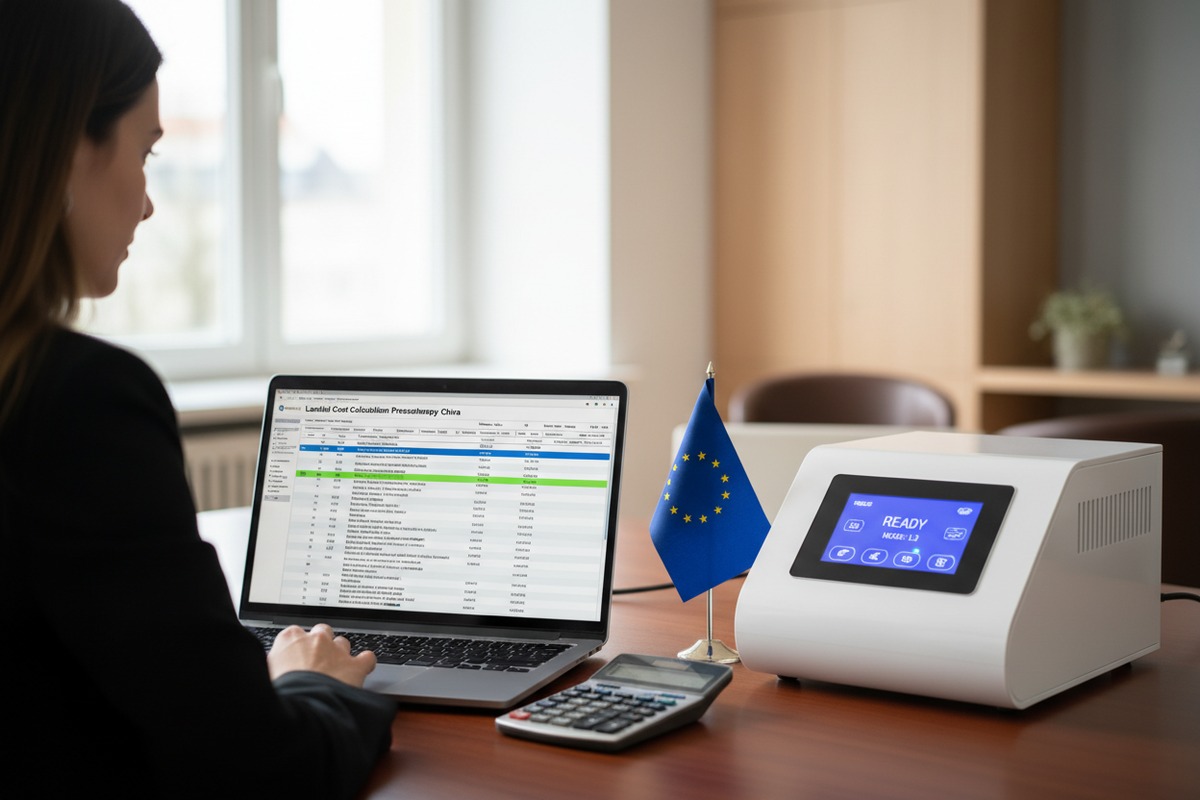
Running a beauty equipment export business from Guangzhou, our team has fielded hundreds of questions from European distributors about import costs. One topic keeps coming up: how much will EU customs actually charge for pressotherapy machines shipped from China? The confusion is real. Between duty rates, VAT calculations, and new trade restrictions, even experienced buyers struggle to budget accurately. VAT rules and rates 1
EU import duty for pressotherapy machines from China is typically 0% under HS code 9019.10 for mechano-therapy appliances. However, you must add VAT (17%–27% depending on EU member state) plus potential IPI restrictions on public procurement contracts exceeding €5 million. Total landed cost includes CIF value, duty, and VAT.
Understanding these costs upfront can save your business from surprise fees and delays. Let’s break down each element step by step so you can import with confidence.
How do I find the correct HS code for my pressotherapy machine imports to the EU?
At our production facility, we label every pressotherapy unit with detailed technical specs. Yet buyers still ask us to confirm the right HS code because one wrong digit can mean higher duties or even held shipments. This confusion causes real headaches at customs clearance.
Pressotherapy machines typically fall under HS code 9019.10, covering mechano-therapy appliances and massage apparatus. The EU uses the TARIC database to provide 10-digit CN codes. For accurate classification, check if your device qualifies as medical equipment under 9018 or therapeutic apparatus under 9019 based on its primary function.
Understanding the HS Code Structure
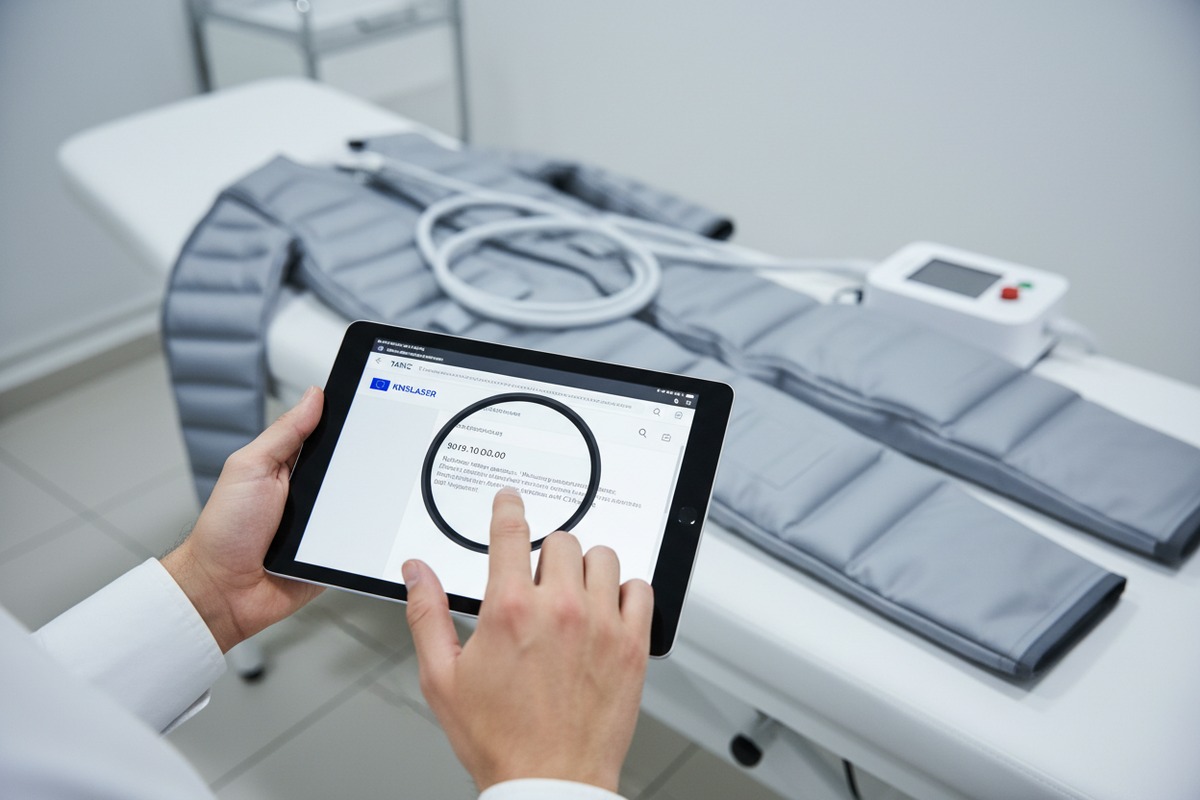
The Harmonized System (HS) code 2 is an international standard for classifying traded goods. HS codes for medical devices begin with 9018 for instruments and appliances used in medical, surgical, dental, or veterinary sciences, and 9019 for mechano-therapy appliances, massage apparatus, psychological aptitude-testing apparatus, and devices used in ozone therapy, oxygen therapy, aerosol therapy, artificial respiration, or other therapeutic respiration apparatus.
Pressotherapy machines use air compression to stimulate lymphatic drainage. They are not surgical instruments. They are not diagnostic devices. They provide mechanical therapy. This places them squarely in the 9019 category.
TARIC: Your Official EU Resource
The EU classifies products using HS codes, the CN, and TARIC. You can use online resources for step-by-step instructions on how to estimate customs duties for EU imports.
The TARIC database 3 (Tarif Intégré de la Communauté) adds four extra digits to the standard 6-digit HS code. This gives you a 10-digit Combined Nomenclature (CN) code specific to EU imports. Always verify your code in TARIC before shipping.
Key Classification Factors
| Factor | HS 9018 (Medical Instruments) | HS 9019 (Mechano-therapy) |
|---|---|---|
| Primary Use | Diagnosis, surgery, treatment | Massage, compression therapy |
| Requires Medical Supervision | Usually yes | Often no |
| Example Products | Ultrasound scanners, surgical tools | Pressotherapy, massage chairs |
| Typical Duty Rate | 0%–2.5% | 0% |
When our engineering team designs pressotherapy systems, we document the therapeutic function clearly. This documentation helps customs officers classify the device correctly.
What If Classification Is Unclear?
Sometimes a device sits between categories. A pressotherapy machine with advanced medical monitoring features might qualify under 9018. The TARIC system covers instruments and appliances used in medical, surgical, dental or veterinary sciences, including scintigraphic apparatus, other electromedical apparatus, and related items.
If you face uncertainty, request a Binding Tariff Information (BTI) ruling 4 from EU customs. This gives you legal certainty before you ship.
What total VAT and duty costs should I budget for when shipping from China?
Our export team prepares cost breakdowns for every EU order. But many first-time importers still underestimate their total landed cost. They see a "0% duty" and think they will pay nothing at the border. That assumption leads to cash flow problems.
For pressotherapy machines from China, budget for: CIF value + 0% customs duty (HS 9019.10) + VAT (17%–27% based on destination country) + handling fees. A €2,000 machine shipped to Germany (19% VAT) costs roughly €2,380 at landing. Hungary (27% VAT) would cost €2,540 for the same unit.

Breaking Down the Cost Components
Most customs duties and value added tax are expressed as a percentage of the value of goods being declared for importation. Thus, it is necessary to dispose of a standard set of rules for establishing the goods' value, which will then serve for calculating the customs duty.
The formula is straightforward:
Total Landed Cost = CIF Value + Import Duty + VAT
Where:
- CIF Value 5 = Cost of goods + Insurance + Freight
- Import Duty = CIF Value × Duty Rate
- VAT = (CIF Value + Import Duty) × VAT Rate
EU VAT Rates by Country (2026)
The EU countries with the highest standard VAT rates are Hungary (27 percent), Finland (25.5 percent), and Croatia, Denmark, and Sweden (all at 25 percent). Luxembourg levies the lowest standard VAT rate at 17 percent, followed by Malta (18 percent), Cyprus, and Germany (both 19 percent).
| EU Country | Standard VAT Rate | Sample Total on €2,000 Machine |
|---|---|---|
| Hungary | 27% | €2,540 |
| Finland | 25.5% | €2,510 |
| Sweden | 25% | €2,500 |
| Netherlands | 21% | €2,420 |
| Germany | 19% | €2,380 |
| Luxembourg | 17% | €2,340 |
The EU's average standard VAT rate is 21.9 percent, nearly seven percentage points higher than the minimum standard VAT rate required by EU regulation.
Real-World Calculation Example
Let us work through a real scenario:
Pressotherapy Machine Order:
- FOB Guangzhou price: €1,800
- Sea freight to Rotterdam: €150
- Insurance: €50
- CIF Value: €2,000
Customs Calculation (Netherlands):
- Duty Rate (HS 9019.10): 0%
- Import Duty: €2,000 × 0% = €0
- VAT Base: €2,000 + €0 = €2,000
- VAT (21%): €2,000 × 21% = €420
- Total at Customs: €420
Actual Landed Cost:
- Product cost: €1,800
- Shipping + Insurance: €200
- Customs payment: €420
- Total: €2,420
Additional Fees to Consider
Beyond duty and VAT, factor in:
- Customs broker fees: €50–€150 per shipment
- Terminal handling charges: €30–€80
- Warehouse storage (if inspection required): €20–€50/day
- Documentation fees: €25–€75
All imports will become dutiable under upcoming EU reforms, so your costs, pricing strategy, and supply-chain models may need revision. You'll also face more rigorous data-reporting and customs-filing requirements.
Does my OEM custom branding impact the customs valuation of my beauty machines?
When clients ask us to add their logo, packaging design, and custom interface to our pressotherapy units, they often wonder: will this change what I pay at customs? The answer matters because incorrect valuation triggers audits and penalties.
OEM branding generally does not change customs classification or duty rates. However, it may affect customs valuation if you paid separately for design services, tooling, or intellectual property rights. Under EU rules, royalties and license fees must be added to the transaction value if they relate to the imported goods and were a condition of sale.

How Customs Valuation Works
The customs value comprises the total amount paid (or to be paid) for the imported goods. The transaction value is subject to certain additions and deductions. If the transaction method does not apply, the other valuation methods would be applied in sequential order.
The EU follows WTO customs valuation rules 6. The primary method is "transaction value"—the price you actually paid for the goods. But certain costs must be added to this base.
Elements That Increase Customs Value
Costs not included in the price that are incurred before the point of entry (outside the customs territory) and that are to be borne by the customer must be added to the customs value. Conversely, costs included in the price but incurred only after the goods enter the customs territory may be deducted.
| Cost Element | Add to Customs Value? | Notes |
|---|---|---|
| Product price (FOB/CIF) | Yes | Base transaction value |
| Freight to EU border | Yes | If not already in CIF price |
| Insurance | Yes | If not already in CIF price |
| OEM design fees (pre-production) | Maybe | If condition of sale |
| Tooling/mold costs | Yes | Must be apportioned |
| Royalties/license fees | Yes | If condition of sale |
| Marketing materials in EU | No | Post-import cost |
| Local installation services | No | Post-import cost |
OEM Branding Scenarios
Scenario 1: Logo Printing Included in Unit Price
Your supplier includes logo printing in the per-unit price. No separate design fee. Customs value = invoice price. Simple.
Scenario 2: Separate Design Fee
You paid €2,000 upfront for mold modifications and interface design. You order 100 units. Each unit must carry €20 of that design cost in its customs value.
Scenario 3: Ongoing Royalty
You license software from a third party. That license fee connects to the imported device. It must be added to customs value.
Customs value is the declared value of goods at import and forms the basis for calculating import duties and taxes. It is a core concept in international trade compliance.
Documentation Best Practices
Customs valuation is a legal requirement and a vital part of international shipping, whether for commercial or non-commercial goods. Declaring the correct value using an approved method is essential to ensure compliance with customs regulations.
At our facility, we provide detailed commercial invoices that separate:
- Unit price
- Included services (standard branding)
- Excluded services (billed separately)
This transparency helps importers declare accurate values and avoid post-clearance audits.
How can I verify that my supplier's paperwork will prevent EU customs delays and extra fees?
Our quality control team inspects every shipment before it leaves Guangzhou. But even perfect products get stuck at EU ports when paperwork fails. Missing documents, incorrect codes, and inconsistent values cause delays that cost real money.
To prevent EU customs delays, verify: commercial invoice matches packing list and bill of lading; HS codes are correct and consistent across all documents; CE marking certification and Declaration of Conformity accompany medical devices; country of origin is clearly stated; and all values reflect actual transaction prices with proper Incoterms.

Essential Documents for EU Import
Every pressotherapy shipment from China to the EU needs these documents:
| Document | Purpose | Who Provides |
|---|---|---|
| Commercial Invoice | Shows transaction value, parties, terms | Supplier |
| Packing List | Details contents, weights, dimensions | Supplier |
| Bill of Lading | Proof of shipment and title | Freight carrier |
| Certificate of Origin | Confirms country of manufacture | Chamber of commerce |
| CE Certificate | Proves EU safety compliance | Notified body or self-declaration |
| Declaration of Conformity | Manufacturer's EU compliance statement | Supplier |
| Technical Documentation | Supports CE mark 7ing claims | Supplier |
Common Paperwork Problems
Problem 1: Value Mismatch
Invoice says €1,800. Packing list says €2,000. Customs flags the shipment.
Solution: We issue invoices and packing lists from the same system. Every number matches.
Problem 2: Wrong HS Code
Supplier writes 8543.70 (electrical machines). Correct code is 9019.10 (mechano-therapy). Customs questions the declaration.
Solution: Confirm the HS code before shipment. Get it in writing from your supplier and cross-check in TARIC.
Problem 3: Missing CE Documentation
Product carries CE mark but no supporting certificate arrives with goods. Customs holds shipment for verification.
Solution: Assigning arbitrary or unsupported figures can lead to serious consequences, including delays, unexpected costs and even legal penalties. To avoid these risks, it's important to ensure all declared values are accurate, justified and properly documented.
The IPI Factor for Public Procurement
The European Commission adopted a measure under the EU's International Procurement Instrument 8 to exclude Chinese medical device suppliers from EU public contracts worth more than €5 million for the next five years, effective 30 June 2025.
Contracting authorities of the EU Member States must now exclude Chinese companies from all public procurement opportunities for the sale of medical devices in the EU if the total contract value exceeds EUR 5 million (net). Moreover, successful bidders are required to guarantee that no more than 50% of their materials or components for the public contract or framework agreement originate from China.
This does not affect private sales. But if your customer is a hospital or government clinic, they face restrictions.
Verification Checklist
Before approving any shipment, run through this checklist:
- Invoice total matches order confirmation
- HS code is verified in TARIC database
- Incoterms clearly stated (FOB, CIF, DDP, etc.)
- CE certificate serial number matches product
- Declaration of Conformity lists correct directives
- Country of origin marked on products and documents
- Weight and dimensions consistent across all docs
- Payment terms match contract
These objectives are met using a single instrument: the rules on customs value. The European Union applies an internationally accepted concept of "customs value," which provides the basis for assessment of the customs debt and proper collection of import duties and taxes.
Working With Reliable Suppliers
At our facility, we assign a dedicated export coordinator to each European client. This person reviews all documents before shipment, catches errors early, and provides digital copies ahead of physical delivery.
We also offer door-to-door logistics with DDP (Delivered Duty Paid) terms 9 for clients who want us to handle customs clearance entirely.
Conclusion
Importing pressotherapy machines from China to the EU involves more than checking a duty rate. You need the right HS code, accurate valuation, proper documentation, and awareness of new trade measures. Get these elements right, and your shipments clear customs smoothly every time.
Footnotes
1. Official European Union page detailing VAT rules and rates, including information relevant to imports. ↩︎
2. Official source for the international standard for classifying traded goods. ↩︎
3. Official EU resource for customs tariff, trade measures, and product classification. ↩︎
4. Official European Commission page explaining Binding Tariff Information (BTI). ↩︎
5. Defines the Cost, Insurance, and Freight (CIF) Incoterm for international trade. ↩︎
6. Details the international agreement on customs valuation methods and principles. ↩︎
7. Explains the mandatory conformity marking for products sold within the European Economic Area. ↩︎
8. Explains the EU’s tool to promote reciprocity in international public procurement markets. ↩︎
9. Explains the Delivered Duty Paid (DDP) Incoterm, placing maximum responsibility on the seller. ↩︎

 English
  Español de México
  Deutsch
  Français
  العربية
  Русский