Nothing frustrates us more FDA classification of shockwave devices 1 during our post-sales support calls than hearing a clinic has stopped treatments because of a single worn-out seal. We see this downtime cost businesses thousands in lost revenue.
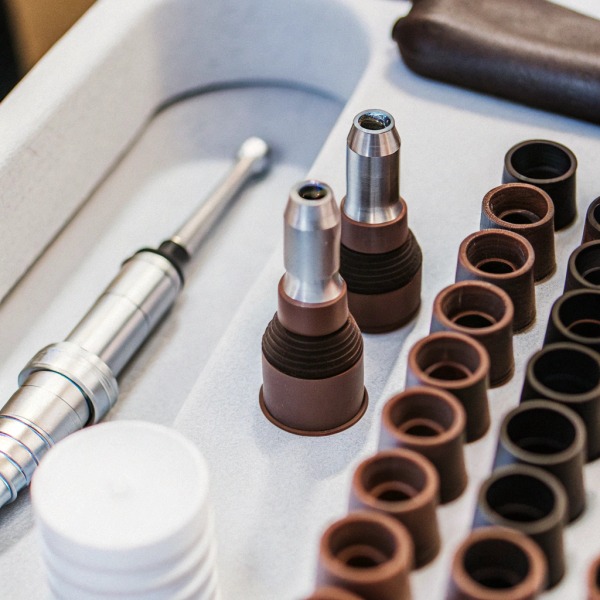
To ensure uninterrupted operation, you must stock up on transmitter tips, handpiece revision kits (containing projectiles and guiding tubes), silicone protective caps, and spare O-ring sets. These components experience the highest physical stress and require regular replacement every 1 to 2 million pulses.
Let’s break down the specific inventory list you need to maintain a reliable service operation hand-arm vibration guidance 2.
Which specific components inside the shockwave handpiece wear out the fastest?
When we assemble these handpieces on our production line, we pay special attention to the moving parts that handle pneumatic acceleration. The internal friction generated during high-frequency treatments inevitably degrades specific materials over time.
The projectile (often called the bullet) and the guiding tube inside the barrel wear out the fastest. These two parts endure constant high-speed impact and friction, leading to deformation or widening of the tube, which directly causes a loss of energy output.

Understanding the internal mechanics of a radial shockwave handpiece helps you realize why certain parts are consumable. The system works on a ballistic principle ballistic principle of operation 3. Compressed air accelerates a projectile radial pressure wave specifications 4 inside a guiding tube. system works on a ballistic principle 5 This projectile then hits the transmitter head, creating the acoustic wave.
The Projectile (Bullet)
The projectile is the workhorse of the system. In our testing lab, we observe that the projectile hits the transmitter head thousands of times per minute. Over time, the metal fatigues. The shape of the projectile might change slightly, or the magnetic coating (if used for return mechanisms) might wear off. If a projectile becomes deformed, it will not travel smoothly. This can damage the guiding tube and result in inconsistent shockwaves.
The Guiding Tube (Barrel)
The tube is where the projectile travels. Even with high-quality lubricants, friction occurs. Over millions of cycles, the inner diameter of the tube widens slightly. When the gap between the projectile and the tube wall increases, compressed air escapes around the bullet rather than pushing it. This is a primary cause of power loss. You might set the machine to 4 Bar, but the output feels like 2 Bar.
O-Rings and Seals
While the metal parts take the impact, the rubber seals maintain the pressure. Every time the handpiece is opened for cleaning or maintenance, these seals are disturbed. They also dry out over time. If an O-ring fails O-ring seal mechanics 6, the pneumatic system loses pressure. This forces the compressor to work harder, which can shorten the lifespan of the main unit.
Component Lifespan and Failure Indicators
We have compiled a table based on our service data to help you identify when these specific parts are failing.
| Component Name | Primary Function | Typical Wear Sign | Consequence of Ignoring |
|---|---|---|---|
| Projectile (Bullet) | Transfers kinetic energy | Flattened tip or rust spots | Damage to transmitter head |
| Guiding Tube | Directs the projectile path | Scratches inside or widened bore | Significant power loss |
| O-Ring Seals | Maintains air pressure | Cracks, dryness, or looseness | Air leaks and compressor strain |
| Damping Spring | Absorbs recoil shock | Loss of tension | Increased vibration in therapist's hand |
How many shots can I expect from a standard bullet and barrel set?
Our engineers test batch samples rigorously, running them continuously to determine failure points. While marketing materials often promise higher numbers, real-world usage in busy clinics provides a more conservative and accurate estimate.
You can generally expect between 1 million to 2 million shocks from a standard bullet and barrel set before performance drops. However, operating consistently at maximum pressure settings or neglecting daily cleaning can reduce this lifespan to under 1 million shocks.

The concept of "1 million shocks" can be abstract. It is vital to translate this into business terms to understand your reordering schedule.
Calculating the Replacement Cycle
If a standard treatment protocol for cellulite or back pain involves 2,000 to 3,000 shots per session, and a clinic treats 5 patients a day, that is roughly 15,000 shots per day.
- Weekly usage: 75,000 – 100,000 shots.
- Monthly usage: 300,000 – 400,000 shots.
At this rate, a single revision kit (bullet and pipe) will last approximately 3 to 4 months. If you are distributing to high-volume clinics, they will need at least 3 kits per year per machine.
Factors That Shorten Lifespan
Not all shocks are created equal. The longevity of the consumable parts depends heavily on how the machine is used:
- Pressure Settings: Running the machine at 4 Bar or 5 Bar creates much higher impact forces than running it at 1.5 Bar. creates much higher impact forces 7 High-pressure treatments wear out the bullet faster.
- Frequency (Hz): Higher frequency generates more heat. Heat expands metal and degrades rubber O-rings.
- Lubrication: If the user fails to clean and lubricate the barrel (if required by the specific model), friction increases drastically.
The Economics of Revision Kits
Distributors often worry about the cost of revision kits. However, when you break down the ROI, the cost is negligible compared to the revenue generated. A revision kit ensures the machine continues to earn money.
Cost Analysis for Distributors
| Item | Estimated Cost (B2B) | Shocks Provided | Revenue Potential (Clinic Level) | ROI Status |
|---|---|---|---|---|
| Revision Kit | $50 – $150 | 2,000,000 | $100,000+ (approx. $50/treatment) | Extremely High |
| Generic Bullet | $20 – $40 | 500,000 (Unreliable) | Risk of machine damage | Negative |
Note: Revenue potential assumes an average treatment price. The key takeaway is that the consumable cost is a tiny fraction of the income, justifying a robust stock.
Do I need to stock multiple sizes of transmitter heads for my inventory?
We often notice purchase orders that stick strictly to the standard 15mm head, leaving out other crucial options. By limiting your inventory to one size, you restrict the versatility of the machine and the treatments your clients can offer.
Yes, you absolutely need to stock multiple sizes of transmitter heads, specifically 15mm, 20mm, and 35mm options. Different diameters regulate the depth and dispersion of the energy, making specific heads necessary for treating delicate areas versus large muscle groups.

Shockwave therapy is not a radial shockwave energy transmission 8 "one size fits all" application. The transmitter head (the part that touches the skin) determines the physics of the wave entering the body.
Understanding Energy Dispersion
Radial shockwaves diverge. A smaller head creates a more focused, intense energy at the surface. A larger head spreads the energy over a wider area.
- Small Heads (6mm – 10mm): These are used for acupuncture points or very specific trigger points. They are intense and can be painful if used on broad areas.
- Standard Heads (15mm): This is the general-purpose head. It works well for tendons, such as in tennis elbow or Achilles tendonitis.
- Large Heads (20mm – 35mm): These are critical critical for aesthetics (cellulite) 9 for aesthetics (cellulite) and large muscle groups (quadriceps, back). They provide a smoother massage effect and cover ground quickly.
Specialized Treatments Drive Sales
If you are selling to beauty salons, the standard 15mm head is insufficient. They need large 35mm transmitters for body contouring. If you sell to men's health clinics, they require specialized, softer heads for ED treatments. Stocking these variations allows you to upsell "Specialist Kits" alongside the main unit.
Material Differences
Transmitters are not just about size; they are about material.
- Stainless Steel: The standard for deep impact and orthopedic conditions.
- Ceramic or Titanium Alloys: Often used for higher energy transmission.
- Soft/Silicone Tipped: Essential for treating sensitive areas or superficial fascia where metal contact is too painful.
Recommended Stocking Ratios
Based on typical usage patterns, we recommend the following inventory mix for your spare parts department.
| Transmitter Size | Primary Application | Stocking Priority | Typical User |
|---|---|---|---|
| 15mm Radial | Tendonitis, Heel Spurs | High (Include in every box) | PT, Chiro |
| 20mm Radial | Myofascial Pain, Back | High | PT, Massage |
| 35mm Large | Cellulite, Lymphatic | Medium | Beauty Salon |
| 6mm/Focus | Trigger Points | Low (Special order) | Specialist PT |
| Soft/ED Tip | Men's Health | Niche (High value) | Urology/Wellness |
How can I tell if a worn-out part is reducing the treatment effectiveness?
In our final quality control ISO 13485 quality management 10 checks, we use precision meters to verify output, but your customers won’t have that equipment. We must teach them to recognize the subtle physical and auditory cues that indicate a machine is losing its therapeutic power.
You can identify worn-out parts by listening for a dull “thud” instead of a crisp “snap,” checking for excessive handle heating, and observing if the projectile fails to slide freely during the “tube test.”

A machine that still makes noise is not necessarily working correctly. When parts wear out, the energy is absorbed by friction and heat rather than being transferred to the patient. This renders the treatment ineffective.
The Auditory Test
A healthy shockwave handpiece has a distinct rhythm. The sound should be a sharp, metallic "clack" or "snap." This indicates the projectile is hitting the transmitter with full force and bouncing back cleanly.
- The Warning Sound: If the sound turns into a dull, muffled thud, or if the rhythm becomes irregular (skipping beats), the projectile or tube is worn. The bullet is dragging inside the barrel.
The Heat Check
Energy cannot be destroyed, only transferred. In a working machine, energy becomes a mechanical wave. in a worn machine, that kinetic energy turns into heat due to friction.
- Symptom: If the handpiece becomes uncomfortably hot to hold after only a few minutes of use, it is a sign of internal friction. This usually means the O-rings have failed or the tube is damaged.
The "Tube Test" (Gravity Check)
This is a simple test we teach all our distributors.
- Remove the transmitter head and the screw cap.
- Take the projectile (bullet) out.
- Clean the bullet and the tube.
- Drop the bullet back into the tube.
- Tilt the handpiece up and down.
Result: The bullet should slide up and down freely with gravity alone. If it gets stuck or moves slowly, the tube is deformed or the bullet is swollen. It is time to replace the kit.
Visual Inspection of Transmitters
The transmitter head takes a beating. Over time, the impact surface (where the bullet hits) can become pitted or concave.
- Erosion: If the back of the transmitter is pitted, the contact surface is reduced. This scatters the energy.
- External Wear: On the patient side, the metal should be smooth. Scratches can harbor bacteria and feel rough on the skin.
Error Messages
Modern machines, including the ones we manufacture, have sensors.
- "Overheat" Warning: Frequent overheating often points to consumable failure, not main unit failure.
- "Pressure Error": If the machine cannot reach the set Bar pressure, it is likely leaking air through worn seals.
Conclusion
The reliability of a shockwave therapy machine depends entirely on the condition of its consumables. By proactively stocking transmitter tips, revision kits (bullets and tubes), and O-rings, you prevent costly downtime for your clients. We recommend keeping at least two full revision kits and a variety of transmitter heads in stock for every machine you sell. This strategy not only protects your brand's reputation for quality but also creates a steady stream of recurring revenue from spare parts sales.
Footnotes
1. Provides official regulatory context for the device type. ↩︎
2. Links to official safety standards regarding hand-arm vibration. ↩︎
3. Explains the physical principle of projectile motion. ↩︎
4. Example of industry-leading technical documentation for radial systems. ↩︎
5. Validates the pneumatic ballistic mechanism of radial shockwave generation. ↩︎
6. Background information on the mechanical function of O-rings. ↩︎
7. Corroborates the relationship between bar pressure settings and energy output. ↩︎
8. Scientific research backing the physics of energy dispersion. ↩︎
9. Cites clinical evidence supporting shockwave therapy for cellulite treatment. ↩︎
10. Reference for international quality standards in medical manufacturing. ↩︎

 English
  Español de México
  Deutsch
  Français
  العربية
  Русский