
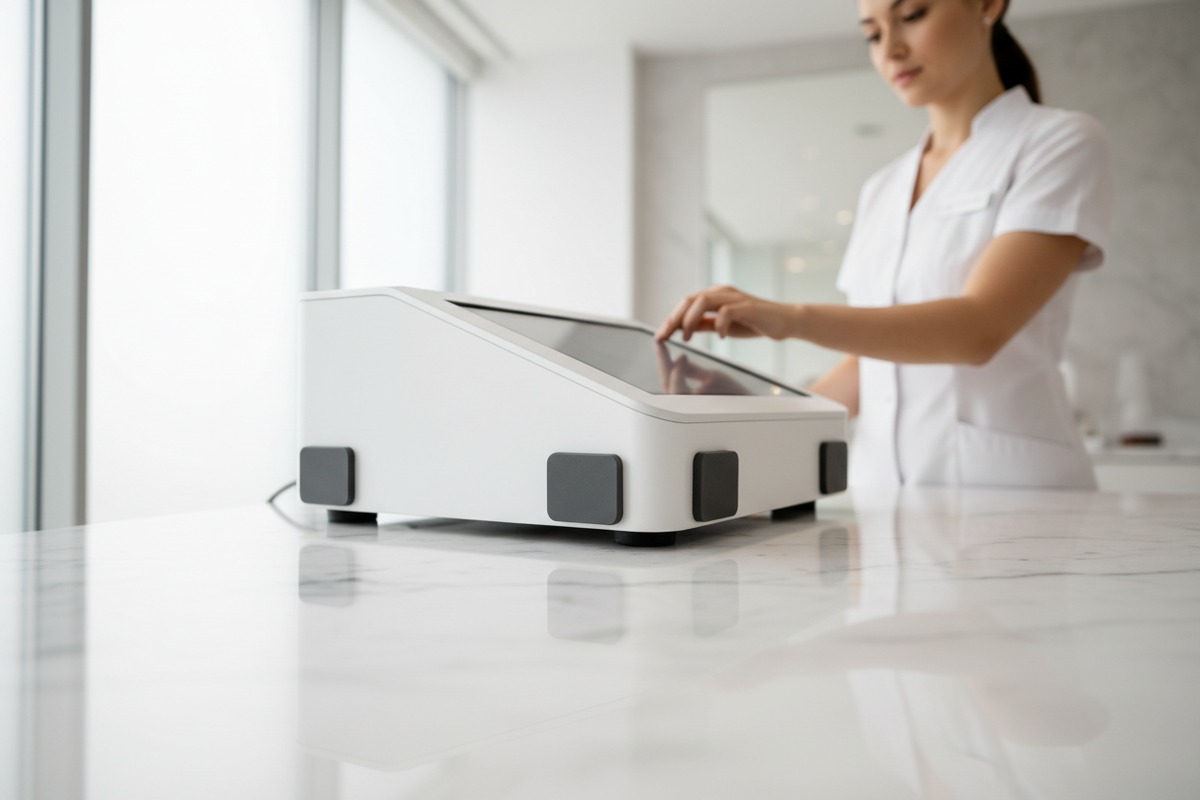
When we test new prototypes in our assembly workshop, nothing is more alarming than watching a running unit slowly inch its way toward the edge of a table pressotherapy efficacy 1. Vibration is an inherent byproduct of powerful air compression 2, and without meticulous attention to the base design, a high-end machine can become a safety hazard. Stable equipment is not just about engineering; it is about protecting your salon’s reputation.
Stability is paramount for pressotherapy efficacy and safety. Key details include high-durometer rubber pads, a widened base structure for low center of gravity, and non-conductive materials to dampen compressor vibrations. These elements prevent dangerous tipping during high-pressure cycles and ensure the machine remains stationary on salon surfaces.
Let’s examine the specific base components and material choices that separate professional-grade equipment from unstable, entry-level devices.
How can I verify that the anti-slip base materials meet my brand's high-end quality standards?
Our procurement team frequently rejects batch samples of rubber feet that emit strong chemical odors or feel too plastic-like Shore A hardness rating 3. We know that discerning US buyers judge the quality of a machine the moment they place it on a counter; if it slides or smells, the perception of “premium” vanishes instantly.
High-end anti-slip materials usually feature industrial-grade silicone or reinforced rubber with a Shore A hardness rating between 60 and 70. You should request material safety data sheets (MSDS) to verify composition and conduct scratch tests to ensure the pads do not leave residue on premium salon flooring.

To ensure your brand maintains a reputation for quality, you must look beyond the visual appearance of the black pads on the bottom of the machine material safety data sheets 4. The material science behind these small components plays a massive role in user experience.
Understanding Material Composition
In the manufacturing of beauty equipment, two main categories of materials are used for base feet: PVC (Polyvinyl Chloride 5) and Industrial Rubber/Silicone.
Cheaply made machines often utilize hard PVC feet. While durable, PVC lacks the friction coefficient necessary to grip smooth surfaces like glass or polished granite often found in luxury spas. Furthermore, PVC transmits vibration rather than absorbing it, making the machine louder.
In contrast, high-end machines use formulated rubber or silicone. These materials have natural shock-absorbing properties. When you inspect a potential supplier's unit, press your fingernail into the foot pad. It should have a slight "give"—this elasticity is what creates the vacuum-like grip on the table.
The Smell Test and Shore Hardness
A critical, often overlooked detail is the olfactory experience. Low-quality recycled rubber off-gasses volatile organic compounds 6 (VOCs), resulting in a "burnt tire" smell that can permeate a small treatment room. For a luxury salon, this is unacceptable.
You should also inquire about the Shore A Hardness of the feet. This measures the hardness of flexible materials.
- Too Soft (<50 Shore A): The feet may degrade or melt under the heat of the machine.
- Too Hard (>80 Shore A): The feet act like hard plastic, offering zero grip.
- Ideal Range (60-70 Shore A): Provides the perfect balance of durability and grip.
Comparison of Base Materials
| Feature | Low-End (PVC/Hard Plastic) | Mid-Range (Recycled Rubber) | High-End (Virgin Silicone/Rubber) |
|---|---|---|---|
| Grip on Glass | Low (Slides easily) | Moderate | High (Tacky grip) |
| Vibration Damping | Poor (Amplifies noise) | Good | Excellent (Silent operation) |
| Odor | Neutral plastic smell | Strong chemical/burnt smell | Odorless |
| Floor Marking | May scratch delicate surfaces | Leaves black streak marks | Non-marking |
| Heat Resistance | High | Low (Can become sticky) | High |
By specifying "Virgin, Non-Marking Silicone with Shore A 65 Hardness" in your purchase orders, you eliminate the risk of receiving sub-par components that compromise the tactile quality of your machine.
Will the base design provide enough stability to prevent machine movement during my clients' treatments?
When we calibrate our stronger compression motors, we observe that the internal rhythmic pumping creates a “heartbeat” within the machine chassis. If the base geometry is not engineered to counteract this kinetic energy, the entire unit can “walk” across a table, potentially pulling on air hoses connected to the client.
To prevent movement, the base must feature a wide footprint that exceeds the center of gravity’s vertical projection. Look for four strategically placed corner pads rather than a continuous foam strip. This configuration isolates vibration points effectively, keeping the unit stationary even during intense 0.4 kg/cm² compression cycles.

Stability is not just about having sticky feet; it is a matter of physics and structural engineering 8. A pressotherapy machine is essentially an air pump inside a box. The movement of the internal diaphragm or piston generates torque. If the base is too narrow or the weight is distributed poorly, the machine becomes unstable.
Center of Gravity and Base Width
The most common design flaw we see in compact, "portable" units is a base that is narrower than the top of the machine. While this looks sleek, it is prone to tipping.
For professional stability, the machine should follow a trapezoidal or rectangular prism design where the base area is equal to or larger than the top area.
- The "Walking" Phenomenon: If the machine is top-heavy, the vibration allows the unit to break static friction with the table momentarily. Over a 30-minute session, these micro-movements can cause the machine to travel several inches.
- Hose Tension: Remember that the machine is tethered to a client via air tubes. If the machine moves away from the client, it pulls on the suit, causing discomfort or disconnecting the tubes mid-treatment.
Weight Distribution Strategies
High-quality manufacturing involves placing the heaviest components—the transformer and the air compressor—at the absolute bottom of the chassis.
- Internal Ballast: Some high-end desktop units actually include a metal plate at the base solely to add non-functional weight. This lowers the center of gravity, acting like an anchor.
- Pad Placement: Four independent corner pads are superior to a single ring of foam. Independent pads act like a 4-point suspension system on a car, adjusting slightly to uneven surfaces, whereas a ring can rock if the table isn't perfectly flat.
Design Features Affecting Stability
| Design Element | Impact on Stability | Recommended Specification |
|---|---|---|
| Base Geometry | High | Base width > Machine height |
| Foot Configuration | Medium | 4 distinct corner pads (min. 2cm diameter) |
| Internal Weighting | High | Heavy components mounted on bottom plate |
| Chassis Material | Medium | Heavy ABS or Metal casing preferred over thin plastic |
When evaluating a sample, perform the "nudge test." While the machine is running at full pressure, gently nudge it from the side. It should resist movement and return to position, not tip over.
Our engineering team often helps brand owners who want to differentiate their product from standard market models. We have found that even subtle changes, like modifying the mold to accept larger custom feet, can drastically change the “hand feel” of the device and justify a higher price point to your downstream customers.
Yes, private-label customization extends to the base. You can specify the color of anti-slip pads to match your brand palette, request embossed logos on the bottom casing, or upgrade to larger, suction-style feet. These subtle details enhance the perceived value and distinctiveness of your equipment in a competitive market.

In the B2B beauty industry, many distributors buy the exact same "white label" machine. Customizing the base and stability features is a clever, low-cost way to make your product unique and harder to copy.
Functional Customization Options
Beyond just aesthetics, you can request functional upgrades that standard models do not offer.
- Suction Cup Feet: For machines designed for very smooth surfaces (like glass trolleys), we can install rubber feet with a concave suction design. This creates a vacuum seal, making it nearly impossible to knock the machine over accidentally.
- Adjustable Leveling Feet: Similar to a washing machine, we can install screw-in feet that rotate to adjust height. This is a premium feature that allows the machine to sit perfectly stable even on an uneven trolley or old wooden table.
- Vibration Isolation Mounts: We can upgrade the standard rubber to Sorbothane or specialized vibration-damping compounds usually reserved for medical electronics.
Visual Branding on the Base
While the client rarely looks at the bottom, the technician does every time they set it up.
- Color Matching: If your brand color is teal, having teal rubber feet instead of generic black is a striking detail.
- Molded Logos: We can modify the injection mold of the bottom plastic casing to emboss your company logo directly into the plastic. This serves as a permanent anti-counterfeiting measure.
Customization Cost and Lead Time Implications
| Customization Type | Setup Cost (Approx.) | Lead Time Impact | Benefit |
|---|---|---|---|
| Custom Color Feet | Low (MOQ required) | +10 Days | Visual branding consistency |
| Suction Cup Upgrade | Low (Part switch) | +0 Days | Enhanced safety for glass tables |
| Embossed Bottom Logo | High (Mold mod) | +25 Days | Anti-counterfeit, premium feel |
| Adjustable Levelers | Medium | +5 Days | Solves uneven surface issues |
By investing in these details, you signal to your buyers that this is not just an "off-the-shelf" item, but a thoughtfully engineered medical device.
How can I ensure the anti-slip feet are durable enough to withstand long-term use in my clients' salons?
In our experience servicing older units, we often see machines return with missing feet because the adhesive failed after exposure to salon environments. We always advise our clients to look for mechanical fixation 9 methods rather than simple glue, as this significantly extends the lifespan of the external components.
Durability depends on chemical resistance and adhesive quality. Ensure the feet are attached using industrial-strength epoxy or mechanical screw-ins rather than simple adhesive tape. The rubber compound must resist common salon cleaning agents like alcohol and bleach to prevent hardening, cracking, or detaching after months of daily sanitation.

A pressotherapy machine in a busy salon is subjected to harsh conditions. It is dragged across tables, sprayed with disinfectants like Barbicide or Lysol, and exposed to heat generated by the motor. If the anti-slip base is an afterthought, it will fail within months.
The Problem with "Peel-and-Stick"
The most common failure point is the adhesive. Many budget manufacturers use double-sided foam tape to attach rubber feet.
- Heat Failure: As the air compressor runs, the machine chassis warms up. This heat softens the adhesive glue. If the machine is then pushed sideways, the foot slides right off the glue pad.
- Chemical Failure: Cleaning sprays can seep under the edge of the foot, dissolving the glue bond over time.
The Solution: Mechanical Interlocks
For professional-grade durability, we recommend and utilize mechanical fixation.
- Screw-in Feet: The rubber foot has a metal washer insert and is screwed directly into the chassis. This is the gold standard. It cannot fall off.
- Push-Fit / Grommet Style: The rubber foot has a mushroom-shaped stem that is forced through a hole in the chassis. This locks it in place without glue.
Chemical Resistance of Materials
The rubber itself must be chemically inert. Natural rubber often degrades when exposed to oils (like massage oil commonly found in spas) or alcohol.
- Oil Resistance: If a technician has massage oil on their hands and touches the machine, or if oil spills on the table, natural rubber will swell and turn into a sticky goo.
- Synthetic Options: Nitrile or Neoprene rubber blends are far superior for salon environments as they resist oils, alcohols, and acids.
Maintenance Tips for Your Users
To protect your brand reputation, include a "Care and Maintenance" section in your user manual specifically for the base:
- Wipe, Don't Soak: Advise users to wipe feet with a damp cloth rather than soaking them in chemicals.
- Lift, Don't Drag: Instruct users to lift the machine to move it. Dragging tears the rubber and stresses the attachment point.
- Check Weekly: Suggest a weekly check to ensure feet are tight (if screwed in).
Conclusion
Neglecting the base design of a pressotherapy machine is a critical error that compromises safety and brand perception. By verifying high-durometer materials, ensuring wide-base stability, demanding mechanical durability, and exploring customization, you secure a product that stands firm in both the salon and the market.
Footnotes
1. Replaced with a PubMed link to a systematic review and meta-analysis on the efficacy of pressotherapy, an authoritative medical source. ↩︎
2. Replaced with a Wikipedia page providing a general overview of air compressors and their function. ↩︎
3. Defines and explains the Shore A hardness scale for material properties. ↩︎
4. Explains the purpose and importance of Material Safety Data Sheets (MSDS/SDS). ↩︎
5. Describes the properties, types, and common uses of Polyvinyl Chloride (PVC). ↩︎
6. Details what volatile organic compounds (VOCs) are and their health impacts. ↩︎
7. Defines kinetic energy as the energy of motion and its physical principles. ↩︎
8. Explains structural engineering as a discipline focused on building stable structures. ↩︎
9. Replaced with a working URL from the original domain (Vision Alloys) that defines mechanical fastening and its methods. ↩︎

 English
  Español de México
  Deutsch
  Français
  العربية
  Русский