When we design our shockwave systems, our engineering team prioritizes one specific metric: "Serviceability." We know that shipping a machine back to the factory for minor maintenance is a logistical nightmare for distributors like you. Therefore, we build our handpieces to be as modular and accessible as possible, following principles of design for serviceability 1.
Replacing consumables on a modern shockwave therapy machine is incredibly easy and typically takes less than 5 minutes. Most systems are designed with "Plug-and-Play" components, allowing clinic staff to swap out worn parts like transmitters and projectiles right in the treatment room without needing specialized tools.
Here is the complete guide to maintaining your fleet without headaches.
What consumables will I need to replace regularly on the Shockwave Therapy Machine?
To keep your supply chain management 2 running smoothly, you need to know exactly what is inside the box. Unlike laser machines which have expensive flashlamps, shockwave machines have mechanical wear parts that are low-cost but high-frequency.
The primary consumables you must replace are the projectile (bullet) inside the handpiece and the metal transmitter head that touches the skin. Secondary consumables include the O-rings that maintain air pressure seals and the silicone caps or gel pads used for patient comfort.

The Core Wear Parts: Bullet and Pipe
The heart of a pneumatic shockwave machine is the ballistic system. A small metal projectile (the bullet) is shot back and forth inside a metal tube (the pipe) by compressed air.
- The Bullet: It hits the transmitter tip thousands of times per session. Eventually, it deforms or wears down due to metal fatigue 3.
- The Pipe: The friction of the bullet traveling at high speeds wears out the inner lining of the pipe.
When we ship a "maintenance kit," it almost always includes these two items together. We recommend replacing them as a pair to ensure the tolerances match perfectly.
Transmitter Heads
The metal tip (transmitter) is made of stainless steel or alloy. While it is durable, the constant impact from the bullet eventually causes metal fatigue. The surface can become pitted or rough.
- Radial Tips (Standard): These last a long time but should be checked for surface smoothness.
- Focus Tips (Specialized): These may have silicone or plastic covers that wear out faster.
Table 1: Common Consumables and their Function
| Consumable Part | Function | Material | Typical Pack Size |
|---|---|---|---|
| Projectile (Bullet) | Generates the impact energy | Hardened Alloy | 1-2 per kit |
| Guide Tube (Pipe) | The barrel for the bullet | Steel/Ceramic | 1 per kit |
| Transmitter (Head) | Transfers energy to skin | Stainless Steel 4 | Sold Individually |
| O-Rings | Seals air pressure | Rubber | 5-10 per bag |
| Ultrasound Gel | Conducts the wave | Water-based Gel 5 | 5L Jugs |
How do I know when it’s time to replace the consumables?
We program our machine interfaces to remove the guesswork for the operator. Relying on "feeling" is subjective; relying on data is professional. Utilizing predictive maintenance 6 allows clinics to schedule downtime effectively.
You should replace consumables based on the "Shot Count" displayed on the machine’s interface, which typically alerts you after 1 million to 2 million pulses. Additionally, physical signs such as a sudden drop in impact power, irregular noise during operation, or the machine overheating are clear indicators that maintenance is required immediately.

The "Shot Counter" Feature
Every machine we manufacture has an internal odometer, similar to a car. It counts every single shock delivered.
- Standard Lifespan: A high-quality bullet is usually rated for 2,000,000 shocks.
- Warning System: When the handpiece reaches 1.8 million shots, a prompt usually appears on the screen suggesting a kit change.
For a busy clinic doing 10 patients a day (approx. 30,000 shots daily), a 2-million-shot kit lasts about 2 to 3 months. This is a vital calculation for your inventory forecasting 7.
Auditory and Tactile Signs
Sometimes, parts fail before the count is reached due to lack of cleaning. Train your downstream customers to listen to the machine.
- Good Sound: A crisp, rhythmic tak-tak-tak.
- Bad Sound: A hollow, rattling, or skipping sound (tak…tak-tak…tak). This means the bullet is sticking in the pipe.
Table 2: Warning Signs of Worn Consumables
| Symptom | Probable Cause | Action Required |
|---|---|---|
| Loss of Power | Bullet is worn/smaller | Replace Bullet & Pipe |
| Irregular Rhythm | Dirt inside pipe / O-ring failure | Clean & Re-grease |
| Loud Rattling | Broken spring or bullet | Stop immediately & Replace |
| Air Hissing | O-ring seal broken | Replace O-rings |
| Error Code E-04 | Pressure sensor fault | Check handpiece connection |
Can I replace the consumables myself, or do I need technical support?
We specifically design our export models to be "Self-Service." We know you cannot afford to wait for a technician to fly in from China or a local depot.
You can replace almost all standard consumables yourself without technical support. The handpieces are designed with simple screw-on caps and accessible chambers, allowing any trained staff member to swap out the projectile and tube in under five minutes using just the basic tools provided in the machine’s accessory box.
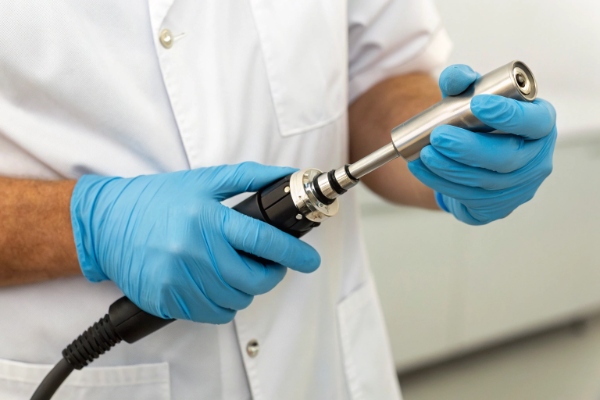
The DIY Replacement Process
The process is deliberately low-tech.
- Unscrew the Cap: The front of the handpiece (where the transmitter is) unscrews by hand.
- Remove Old Parts: Tip the handpiece upside down. The old bullet and pipe slide out.
- Clean: Use a pipe cleaner (provided) to wipe out any metal dust or old lubricant.
- Insert New Parts: Drop the new pipe and bullet in.
- Screw Back: Tighten the cap. Reset the counter on the screen. Done.
When to Call for Help
While the consumables are DIY, the internal electronics are not. If the machine itself (the main console) is not turning on, or the touchscreen is dead, that is a job for technical support. Do not open the main console chassis; this voids the warranty and exposes staff to electrical safety 8 hazards like high voltage.
Table 3: DIY vs. Technician Tasks
| Task | Difficulty Level | Who Can Do It? | Time Required |
|---|---|---|---|
| Change Bullet | Very Low | Receptionist / Therapist | 3 Minutes |
| Change Transmitter | Very Low | Therapist | 30 Seconds |
| Clean Handpiece | Low | Therapist | 5 Minutes |
| Replace Handpiece Cord | Medium | Maintenance Staff | 10 Minutes |
| Fix Screen/Software | High | Certified Technician | N/A |
| Repair Air Compressor | High | Certified Technician | N/A |
Are there tips for sourcing or managing consumables for my Shockwave Therapy Machine?
From our logistics experience, the biggest friction point is the "Panic Order"—when a clinic realizes they are out of bullets on a Friday afternoon.
To manage consumables effectively, always keep at least one backup "Overhaul Kit" in stock for every machine you own. Sourcing these kits directly from your machine supplier in bulk bundles (e.g., 5 or 10 kits at a time) ensures compatibility and significantly reduces the shipping cost per unit compared to buying them individually.

The "One on the Shelf" Rule
We advise all our distributors to enforce a simple rule with their clinics: "One in the gun, one on the shelf."
The moment the clinic uses the backup kit, they should order a replacement immediately. This prevents downtime. Since these parts are small and non-perishable, there is no risk in holding inventory.
Bundle Your Orders
Shipping is expensive. A replacement bullet kit costs maybe $30-$50, but shipping it via DHL from China or a central warehouse might cost $40.
- Smart Buying: Order consumables when you order a new machine. We can pack 50 kits inside the crate of a new machine for zero extra shipping cost.
- Volume Discounts: We offer discounts for bulk spare part orders. If you buy 100 kits, the price drops significantly, increasing your margin when you resell them to your salons.
Genuine vs. Generic Parts
This is a critical warning. Shockwave handpieces are precision instruments. The bullet must fit the pipe with engineering tolerance 9 measured in micrometers.
- Generic Parts: We see clients buying "universal" bullets from random suppliers. These are often slightly off-sized. They can jam the barrel or shatter, destroying the expensive handpiece permanently.
- Our Advice: Only source consumables from the Original Equipment Manufacturer 10 (OEM). The few dollars saved on a generic bullet are not worth the risk of a $1,000 handpiece replacement.
Conclusion
Replacing consumables on a shockwave machine is a simple, DIY task that takes minutes. By keeping a close eye on the shot counter and maintaining a "safety stock" of overhaul kits, you can ensure 100% uptime for your clients and a steady stream of recurring revenue for your business.
Footnotes
1. Explanation of designing products for easy repair and maintenance. ↩︎
2. Guide to logistics and end-to-end supply chain mastery. ↩︎
3. Technical overview of how repeated stress weakens metal parts. ↩︎
4. Properties and applications of medical-grade stainless steel. ↩︎
5. Research on the importance of coupling media in ultrasound therapy. ↩︎
6. Using data to predict equipment failure before it occurs. ↩︎
7. Methods for predicting future inventory needs to prevent stockouts. ↩︎
8. OSHA standards for working safely with electrical equipment. ↩︎
9. Guide to precision machining tolerances and their importance. ↩︎
10. Definition and role of OEMs in manufacturing and warranty. ↩︎

 English
  Español de México
  Deutsch
  Français
  العربية
  Русский