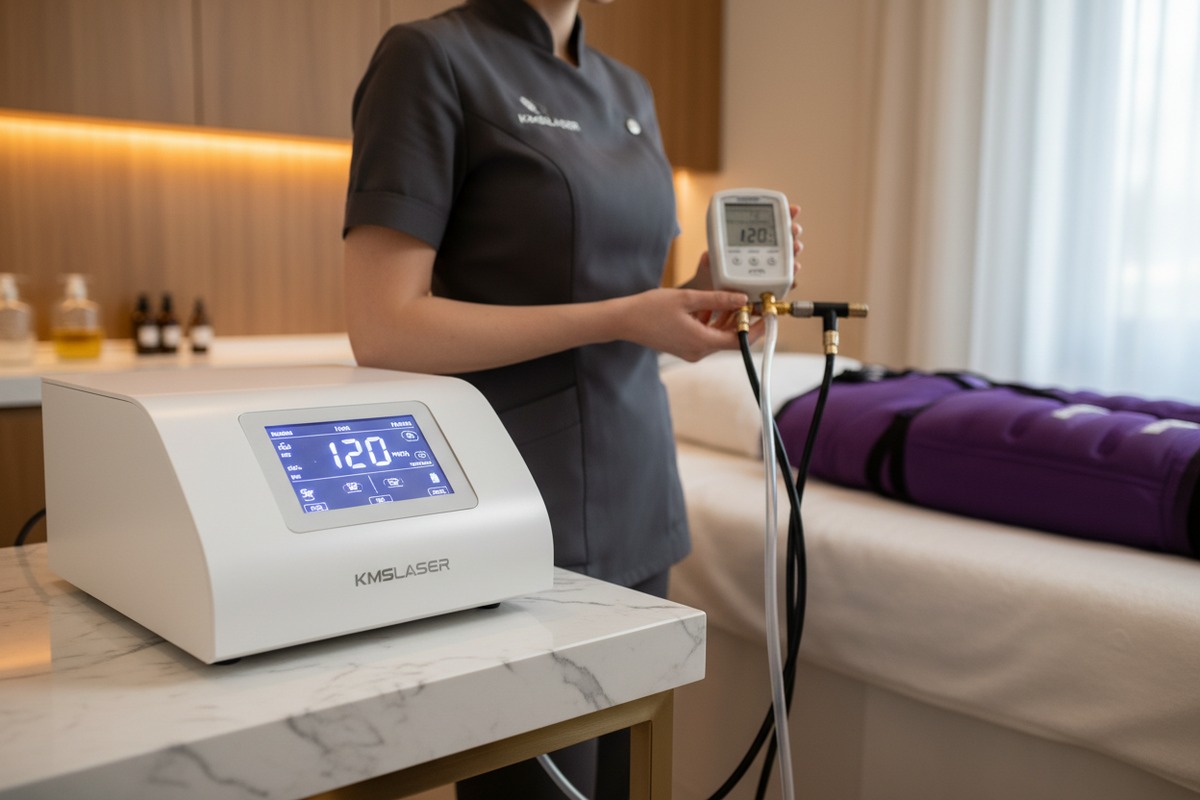
When we design circuits for our newest premium series, we often find that raw power isn’t the challenge—control is peristaltic wave 1. Clients frequently complain about jerky movements ruining the spa experience, turning a relaxing lymphatic drainage session 2 into a mechanical ordeal. You need a way to ensure the equipment matches your spa’s luxury standards.
To verify start-stop smoothness, prioritize machines with 24-chamber architectures and digital pressure regulation that allows distinct ramp-up settings. During testing, run the device at 50% capacity and monitor the transition between chambers for pressure spikes using a digital manometer, ensuring variations remain under ±3mmHg for seamless therapy.
Here is exactly how we ensure fluid operation for our high-end export models and how you can verify it.
How do I test the air pressure transition smoothness during my factory inspection?
Walking through our assembly line, I often show clients that a silent pump doesn't guarantee a smooth cycle Pulse Width Modulation (PWM) signals 3. You must feel the airflow transition physically because visual indicators often mask the subtle jolts that a sensitive spa client will notice immediately.
Test transition smoothness by wearing the suit yourself during the inspection and focusing on the deflation-to-inflation overlap. A luxury-grade system should maintain residual pressure in the previous chamber while the next inflates, creating a peristaltic wave rather than a robotic "on-off" sensation that disrupts client relaxation.

When you visit a factory or evaluate a sample unit, you cannot rely solely on the specification sheet Medical-Grade TPU (Thermoplastic Polyurethane) 4. The "smoothness" of a pressotherapy machine is defined by the overlap efficiency between chambers. In cheaper systems, Chamber A deflates completely before Chamber B starts inflating Aging Test 5. This creates a "gap" in pressure, which the body perceives as a jerky, mechanical step.
The "Blindfold" Sensory Test
We recommend a sensory test protocol for all our B2B partners. Put on the leg cuffs and close your eyes. Without visual cues, your body becomes hyper-aware of the pressure changes. You are looking for a "wave" sensation. If you can distinctly tell the exact second one chamber stops and the next begins due to a sudden drop in pressure, the machine has failed the smoothness test. The transition should be indistinguishable, mimicking the fluid motion of a manual lymphatic drainage massage performed by a therapist.
Using a Digital Manometer for Objective Data
Subjective feeling is important, but for a Purchasing Manager, objective data is king. Bring a digital manometer 6 to the inspection. Connect it to the air output valves using a T-junction connector (most factories have these, but bring your own to be safe).
Watch the digital readout during the transition phase. In a smooth system, the pressure curve should look like a rolling hill, not a square wave. If you see the pressure drop to zero instantly before rising again, the solenoid valves 7 are closing too abruptly.
Visual vs. Sensory Inspection Indicators
| Feature | Visual Indicator (What you see) | Sensory Reality (What you feel) | Luxury Standard |
|---|---|---|---|
| Chamber Inflation | Suit expands rapidly. | Sudden squeeze or "grab." | Gradual, linear pressure increase. |
| Chamber Overlap | LED lights switch from 1 to 2. | Pressure drops, then builds again. | Continuous pressure wave; no drop felt. |
| Deflation Phase | Suit creates wrinkles. | Vacuum effect or suction. | Gentle release, like a slow exhale. |
| Cycle Reset | Pause in machine noise. | Abrupt silence or "clunk." | Seamless loop with no mechanical shock. |
Can I request custom software tuning to ensure a more gradual start-stop for my brand?
Our engineering team frequently adjusts firmware for private label partners who want a "signature" massage feel. Standard settings often prioritize speed or strong compression to impress entry-level buyers, but this often results in a rough experience that luxury clients dislike.
Yes, you can request custom firmware tuning to adjust the Pulse Width Modulation (PWM) signals controlling the air valves. This modification allows for a slower pressure ramp-up curve (soft start) and a tapered release, eliminating the mechanical shock often felt in standard, off-the-shelf pressotherapy units.
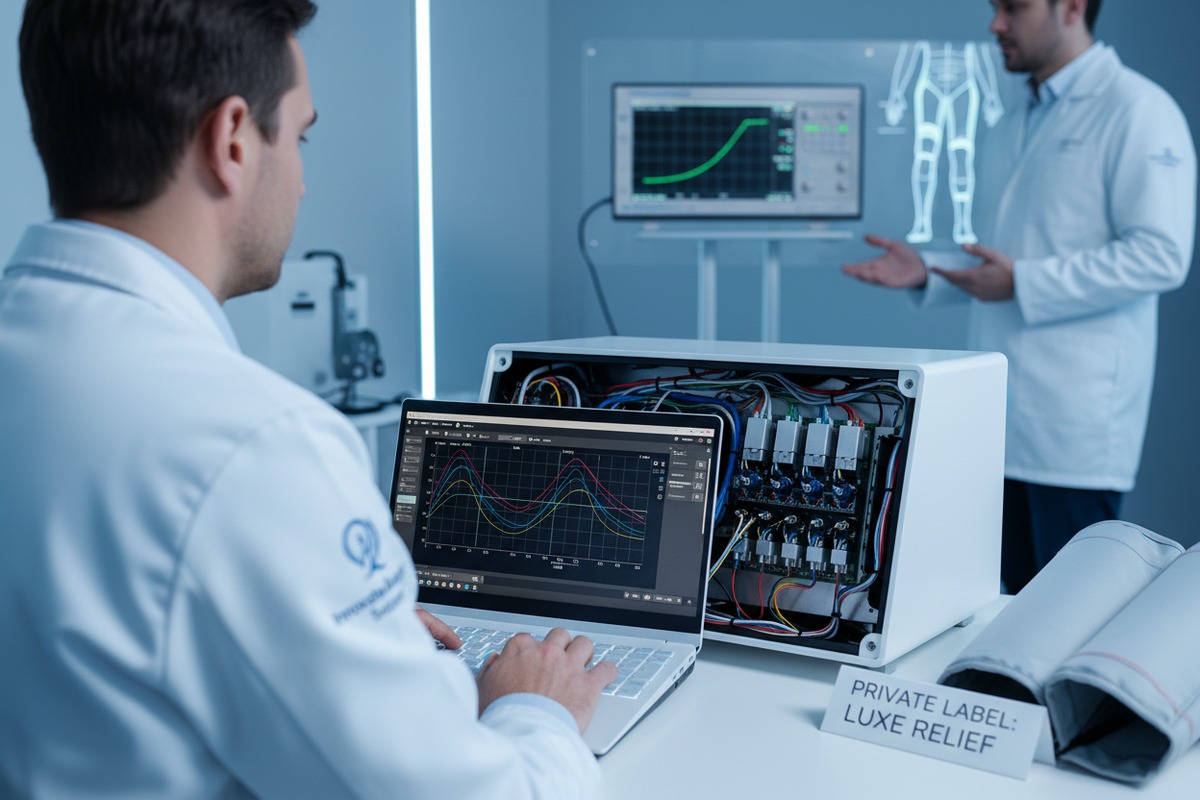
Many buyers do not realize that the "brain" of the pressotherapy machine is just as important as the pump. The smoothness of the start-stop cycle is largely dictated by how the microcontroller sends signals to the valves.
Adjusting the Pressure Ramp Curve
In standard coding, a valve is often binary: open (100%) or closed (0%). This results in a rush of air that hits the limb suddenly—a "hard start." Through ODM services, we can program the valves to open using Pulse Width Modulation (PWM). This rapidly toggles the valve on and off milliseconds at a time to simulate a partially open valve, allowing air to enter gradually.
This creates a "Soft Start" curve. Instead of hitting 100mmHg in 2 seconds, the machine might reach it in 5 seconds. For a luxury spa, this difference is vital. It transforms the treatment from a medical procedure into a relaxing ritual.
The Trade-off: Cycle Time vs. Smoothness
You must be aware of the trade-off. Smoother transitions usually mean slower cycle times. If a standard machine completes a full leg flush in 45 seconds, a tuned "smooth" machine might take 60 seconds.
When developing your private label product, you need to decide if your selling point is "efficiency" or "luxury." For the US market, specifically high-end salons, the slower, deeper wave is almost always preferred.
Firmware Customization Options
| Parameter | Standard Factory Setting | Luxury Custom Tuning | Effect on Experience |
|---|---|---|---|
| Valve Open Speed | Instant (Binary) | PWM Graded (0-100% over 2s) | Eliminates the initial "kick" of air. |
| Hold Time | 0-2 Seconds | 4-6 Seconds | Allows tissue to settle; feels deeper. |
| Deflation Rate | Rapid Dump | Tapered Release | Prevents sudden loss of support. |
| Overlap Timing | < 0.5 Seconds | > 1.5 Seconds | Ensures the "wave" is unbroken. |
What specific QC benchmarks should I set to avoid jerky movements in my pressotherapy machines?
We have rejected batches of valves that met pressure specs but failed our noise and vibration standards. Consistency is the true marker of quality, and if you don't define what "smooth" means in numbers, the factory will default to what is functional, not what is comfortable.
Set QC benchmarks that limit pressure variance to ±5% during chamber transitions and require a noise level below 50dB during valve switching. Additionally, specify a "Zero-Jolt" protocol where the sudden pressure drop during deflation must not exceed 10mmHg per second, ensuring the client never feels a vacuum collapse.

To avoid receiving a container of jerky machines, you must translate "smoothness" into engineering constraints in your purchase contract. A vague request for "good quality" will not protect you.
Establishing Valve Timing Tolerances
The "jerk" usually happens when one valve closes before the next one opens. This is a timing error. Your QC benchmark should state that the Valve Overlap Window must be positive.
- Negative Overlap: Valve A closes, 0.5s pause, Valve B opens. (Result: Jerky)
- Positive Overlap: Valve B begins opening 1 second before Valve A begins closing. (Result: Smooth)
You can verify this by listening to the machine. If you hear a "click-pause-hiss" rhythm, the timing is off. It should be a continuous hum where the sounds blend into each other.
The Suit Material Factor
Even with perfect machine mechanics, a stiff suit can cause jerky movements. Low-cost nylon suits have no "give." When air enters, they snap tight instantly.
Your QC standards must include the suit material. We recommend specifying Medical-Grade TPU (Thermoplastic Polyurethane) with a high elasticity rating. TPU stretches slightly as it inflates, acting as a shock absorber. This dampens the start-stop force of the air pump, smoothing out the sensation for the client.
Recommended QC Checklist for Luxury Pressotherapy
| QC Check Item | Acceptable Limit | Testing Method |
|---|---|---|
| Valve Switching Noise | < 50 dB | Decibel meter at 1m distance. |
| Pressure Spike | < ±5 mmHg | Digital Manometer during transition. |
| Deflation Speed | < 15 mmHg/sec | Manometer monitoring pressure drop. |
| Suit Elasticity | > 10% Stretch | Material stress test. |
How do I ensure the start-stop mechanism remains reliable after months of high-volume salon use?
We track warranty data closely, and valve fatigue is the number one cause of deteriorating smoothness over time. A machine might feel perfect on day one, but after 500 hours of high-pressure switching, cheap components will begin to stick or lag, ruining the rhythm.
Ensure reliability by selecting systems with industrial-grade electromagnetic valves rated for at least 100,000 cycles rather than cheaper plastic rotary valves. Demand a 48-hour continuous aging test report from the manufacturer to verify that heat buildup does not degrade the air pump's ability to maintain smooth pressure gradients.

Durability and smoothness are linked. As components wear out, friction increases, and timing drifts. For a luxury spa running machines 8 hours a day, you cannot afford equipment that "drifts" out of calibration.
Solenoid vs. Rotary Valves
There are two main ways to distribute air.
- Rotary Valves: A mechanical disc spins to open/close ports. It is cheap and quiet initially but wears down physically. As the disc wears, air leaks between chambers, causing pressure fluctuations and jerky "hiccups" in the cycle.
- Solenoid Valves: These are electromagnetic switches. They are more expensive but offer precise digital control. They do not rely on physical friction to seal. For reliable smoothness over years, you must specify Solenoid Valves in your BOM (Bill of Materials).
Heat Management and Pump Performance
Pressotherapy pumps generate significant heat. In cheap compact units, this heat expands the internal seals of the pump. As the seals expand, the airflow becomes inconsistent—sometimes weak, sometimes surging.
To ensure the start-stop mechanism stays smooth under high volume, look for machines with active cooling systems (dedicated fans for the pump, not just vents). Ask for the "Aging Test" data. We run our units for 48 hours continuously to ensure the pressure curve at hour 48 matches hour 1. If the factory cannot provide this graph, they haven't tested for durability.
Preventative Maintenance for Spas
Finally, reliability depends on airflow. If the air intake filter is clogged with dust, the pump struggles to "start," leading to a delay followed by a surge. Educate your salon clients to clean the air intake filters monthly. This simple step preserves the smooth ramp-up curve by ensuring the pump can "breathe" effortlessly.
Conclusion
Start-stop smoothness is the hidden detail that separates medical utility from luxury spa experiences. To secure this for your brand, you must move beyond standard specs. Verify smoothness through sensory "blindfold" tests, demand custom PWM firmware for softer ramp-ups, set strict QC limits on pressure variance, and insist on durable solenoid valves. By controlling these variables, you ensure your equipment delivers the premium feel your clients expect.
Footnotes
1. Explains peristalsis as wave-like muscle movements in the digestive system. ↩︎
2. Explains what lymphatic drainage massage is and its benefits. ↩︎
3. The original URL was a 404 error. Replaced with an authoritative Wikipedia page explaining Pulse Width Modulation. ↩︎
4. Details the properties and benefits of medical-grade TPU for healthcare applications. ↩︎
5. Explains accelerated aging tests to estimate product lifespan and reliability. ↩︎
6. Defines digital manometers, their function, and various applications. ↩︎
7. The original URL was a 403 error. Replaced with an authoritative Wikipedia page explaining Solenoid Valves. ↩︎

 English
  Español de México
  Deutsch
  Français
  العربية
  Русский