When we refine the air pressure algorithms in our production facility, we often think about the high-volume lymphatic drainage 1 needs of busy clinics in Brazil and Colombia.
To verify a supplier, evaluate their knowledge of regional post-surgical recovery protocols, voltage compatibility for 110V/220V grids, and ability to provide Spanish or Portuguese interfaces. A qualified partner must prove they understand the unique humid climates and high-intensity salon usage patterns typical across the South American market.
The following guide details exactly how to vet your manufacturing partner to ensure your investment thrives in the Latin American beauty landscape dual-voltage compatibility 2.
How can I tell if a supplier understands the specific lymphatic drainage protocols used in my South American salon network?
Our engineering team recently collaborated with Colombian aestheticists to adjust chamber inflation sequences specifically for post-liposuction recovery, which is a massive market segment in the region.
Suppliers demonstrate understanding by offering specialized modes for post-operative care, cellulite reduction, and venous insufficiency. They should explain how their 12-chamber or 24-chamber systems mimic manual lymphatic drainage techniques preferred in Brazil and Argentina, rather than just offering generic inflation patterns.
Understanding the Regional Treatment Mix
In South America, pressotherapy is rarely a standalone service. It is deeply integrated into "Body Contouring Packages." In Brazil, for example, it is the standard follow-up to manual lymphatic drainage (MLD) 3 and cavitation. A supplier who knows this will suggest machines that allow for adjustable pressure starting at 20mmHg to avoid damaging sensitive post-surgical tissue.
Key Protocol Requirements
South American technicians often perform 30 to 45-minute sessions. If a supplier’s machine only has 15-minute presets, they do not understand your operational flow. You need to see "Sequential" and "Peristaltic" modes clearly defined in their software.
| Feature | Importance for South America | Supplier Capability Check |
|---|---|---|
| Post-Op Mode | Critical for Brazil/Colombia liposuction recovery | Does it have a "Soft" start setting? |
| Cellulite Mode | High demand for "Summer Body" prep | Does it include high-pressure cycles (100+ mmHg)? |
| Overlapping Chambers | Ensures no gaps in drainage | Are the air bags built with zero-gap design? |
Probing with Targeted Questions
Ask the supplier: "How does your machine handle the high protein load in lymph fluid after a bariatric surgery?" If they look confused, they lack the clinical depth required for your market. Expert suppliers will discuss "gradient pressure," where the pressure is higher at the ankles and decreases as it moves toward the torso.
What questions should I ask to ensure their pressotherapy machines meet the voltage and safety standards required in South America?
When we assemble power modules for our export orders, we carefully check whether the destination is the 127V grid in Brazil or the 220V standard in Chile.
Ask for specific documentation on dual-voltage compatibility (110V-240V) and regional safety certifications like CE or IEC. Inquire about internal surge protection features, as many South American urban centers experience power fluctuations that can easily fry sensitive air pump electronics.

Dealing with Electrical Variability
The South American electrical landscape is fragmented. Unlike Europe’s unified 230V, you might find 110V in Colombia and 220V in Argentina. A supplier must provide a machine with a wide-range switching power supply. If they only offer a single-voltage transformer, you will face high failure rates in your salon network.
Safety Certifications and Build Quality
While ANVISA is the gold standard in Brazil, international suppliers should at least provide CE and RoHS certifications 4. However, certification on paper is not enough. You must verify the internal components.
- Air Pump Lifespan: Ask for the decibel rating and expected hours of operation. High-quality pumps should last over 5,000 hours.
- Heat Dissipation: Tropical climates in countries like Venezuela or Northern Brazil require extra cooling fans within the control unit to prevent overheating during 10-hour workdays.
Essential Electrical Specification Table
Use this table to compare supplier responses against your local requirements:
| Component | Standard Requirement | Why it Matters |
|---|---|---|
| Input Voltage | 110V/220V Auto-Switch | Prevents motor burnout in different regions |
| Plug Type | Type N (Brazil) / Type L (Chile) | Avoids dangerous third-party adapters |
| Safety Fuse | External Access | Allows salon staff to fix minor surges quickly |
| Cooling System | Dual High-Speed Fans | Vital for humid, non-air-conditioned environments |
Verification Strategies
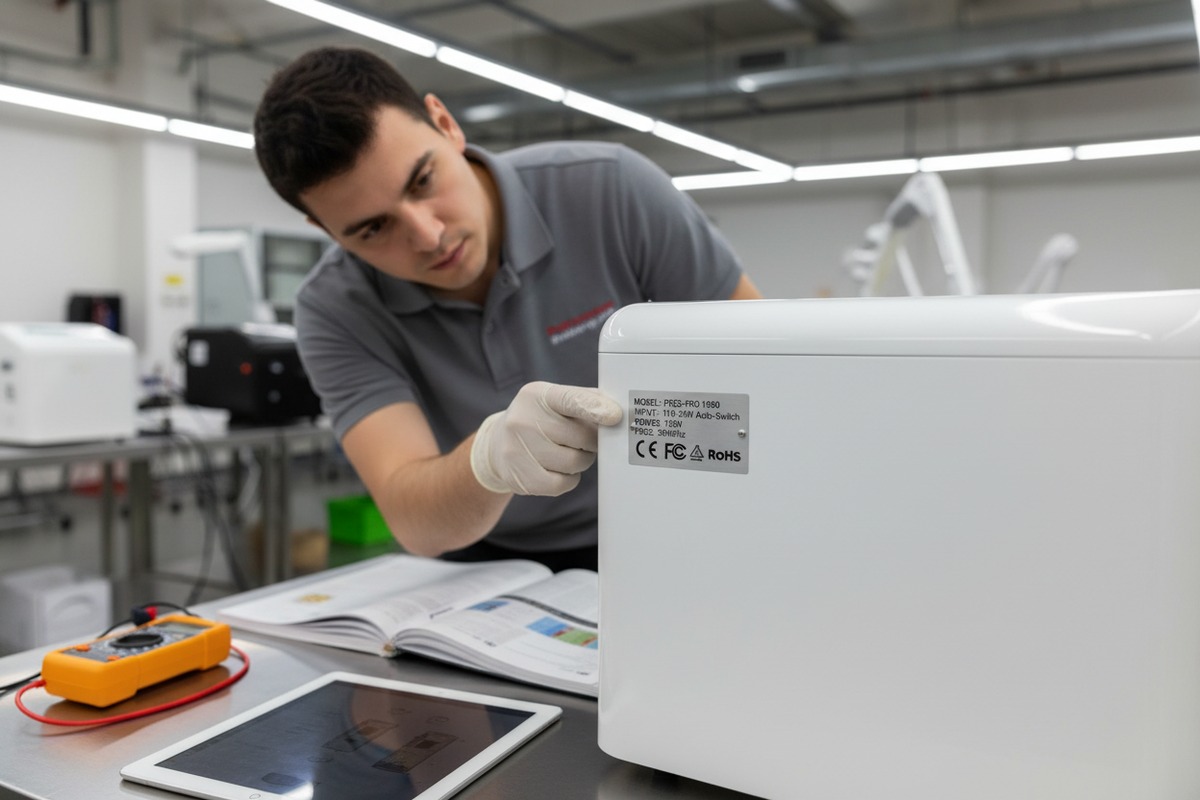
Request a photo of the machine’s rear silver sticker. It should clearly list the voltage range and serial number. If the supplier refuses to show the internal wiring or the power board during a video call, they are likely using cheap, non-standard components that will fail under South American power conditions.
Can the supplier customize the machine interface and training manuals to match the language and operational habits of my local technicians?
In our design department, we prioritize translating our touch-screen software into Spanish and Portuguese because we know local technicians work faster when the interface is intuitive.
Confirm if the supplier offers OEM customization for language and branding. A true partner provides translated manuals and video tutorials that reflect South American body types and beauty standards, ensuring your staff can operate the equipment safely without a language barrier.

Overcoming the Language Barrier
Most Chinese or European suppliers provide manuals in "Chinglish" or broken English. For a South American salon chain, this is a liability. You should demand a supplier that has professional translators for Spanish (LatAm) and Portuguese. The interface should not just be translated; it should be localized. For example, using terms like "Drenaje Linfático" instead of "Air Massage."
Training for Local Habits
South American technicians often value visual learning. Ask the supplier if they provide:
- Instructional Videos: Are they subtitled in the local language?
- Quick-Start Guides: Can they be printed in a waterproof format for salon use?
- Treatment Charts: Do they include protocols for specific local trends, like "Post-Carneval Slimming"?
Customization Capability Comparison
| Customization Level | Basic Supplier | KMSLASER (Professional) |
|---|---|---|
| Screen Language | English Only | Multilingual (Spanish/Portuguese) |
| Logo Placement | Sticker only | Software boot screen + Shell etching |
| Manuals | PDF in English | Hardcopy and Video in local language |
| Preset Programs | Generic 3 modes | Custom protocols for local treatments |
The "Operational Habit" Audit
South American salons are fast-paced. Technicians prefer large touch-screen icons that can be pressed even when wearing gloves. Ask for a video of the UI (User Interface) flow. If it takes ten clicks to start a basic session, it will frustrate your staff. A "One-Touch Start" feature is a green flag for a supplier who understands high-volume environments.
How do I verify if their quality control process accounts for the long-distance shipping and climate conditions typical of the South American market?
While overseeing our pre-shipment inspections, we always ensure the use of moisture-absorbing silica packets and reinforced plywood crates to survive the humid, 45-day sea journey to ports like Santos or Valparaíso.
Inquire about their "stress testing" for high humidity and their specific packaging standards for sea freight. A reliable supplier should use multi-layer foam protection and vacuum-sealed bags for the fabric suits to prevent mold and corrosion during the long transit through tropical waters.
The Challenge of Sea Freight
Shipping from China to South America is one of the longest transit routes in the world. The cargo crosses the equator twice. The temperature inside a shipping container can reach 60°C with 90% humidity. A supplier who uses thin cardboard boxes is setting you up for "Dead on Arrival" equipment.
Verification of Packaging
Ask for photos of their "Export Grade" packaging. Look for:
- Honeycomb Cardboard or Plywood: These resist crushing better than standard boxes.
- Anti-Static Bags: Essential for protecting the motherboard from the salty sea air.
- Corner Protectors: To prevent damage when the container is jolted during crane transfers.
Quality Control Checkpoints
A supplier should perform a "Burn-in Test." This means running the machine continuously for 24-48 hours before packing. For South American orders, this test should be done in a high-temperature chamber to simulate local salon conditions.
Shipment Durability Checklist
- Vibration Test: Does the supplier simulate the movement of a truck on rough roads?
- Drop Test: Can the packaged machine survive a 1-meter fall?
- Humidity Test: Are the suits made of medical-grade TPU that won't peel in 80% humidity?
Why Material Choice Matters
In the humid climates of Colombia or Brazil, cheap PVC sleeves will become sticky and eventually crack. High-end suppliers use TPU (Thermoplastic Polyurethane) or nylon-coated fabrics. Thermoplastic Polyurethane (TPU) 5 These are breathable, easier to disinfect, and far more durable in tropical weather. Ask the supplier for a material safety data sheet (MSDS) 6 for the suit fabrics.
Conclusion
Verifying a pressotherapy supplier for the South American market requires looking beyond the price tag. Focus on technical localization, robust electrical engineering, and climate-resilient packaging to ensure long-term success.
Footnotes
1. Provides a medical definition and benefits of lymphatic drainage massage. ↩︎
2. Technical explanation of dual power supplies and their configurations in electronics. ↩︎
3. Explains MLD as a therapeutic tool for lymphedema relief, often post-surgery. ↩︎
4. Authoritative source on compliance requirements for medical devices in the EU. ↩︎
5. Replaced with an authoritative Wikipedia page providing a comprehensive overview of Thermoplastic Polyurethane (TPU). ↩︎
6. Official definition and purpose of Material Safety Data Sheets from a government health institution. ↩︎

 English
  Español de México
  Deutsch
  Français
  العربية
  Русский