When our production team first started exporting pressotherapy machines to Europe, we quickly learned that RoHS compliance 2 isn’t just a checkbox—it’s a gatekeeper. A single non-compliant component can block your entire shipment at customs. Worse, it can result in costly recalls that damage your brand and drain your finances.
To verify EU RoHS compliance when buying pressotherapy machines, check for authentic CE marking, request the manufacturer’s Declaration of Conformity (DoC), review technical documentation including test reports, and confirm that all restricted substances—lead, mercury, cadmium, hexavalent chromium, PBBs, PBDEs, and four phthalates—remain below legal thresholds through supplier declarations or independent lab testing.
This guide walks you through the exact steps to verify RoHS compliance. We cover certificate authentication, required testing reports, lead-free component verification, and the real risks of importing non-compliant devices. Let’s get started.
How can I verify the authenticity of a supplier's RoHS certificate for pressotherapy machines?
We’ve seen it happen more than once on our factory floor: a component supplier presents a certificate that looks legitimate, but something feels off. Fake or outdated RoHS certificates circulate widely, and accepting one can put your entire import operation at risk.
Verify a supplier’s RoHS certificate authenticity by cross-checking the certificate number with the issuing body, confirming the certificate covers your specific product model, reviewing the testing laboratory’s ISO 17025 accreditation, and requesting the full Declaration of Conformity with supporting technical documentation dated within the last 12 months.

Understanding RoHS Documentation Structure
The RoHS compliance system operates differently from many other certifications. The EU RoHS directive (in most cases) is a self-certification endeavor, with producers ensuring compliance before listing the regulation on the product's EU Declaration of Conformity 3 and applying the CE-Mark.
This self-certification model means there's no single "RoHS certificate" issued by the EU. Instead, manufacturers create their own documentation. Here's what you should request:
| Document Type | What It Proves | Red Flags |
|---|---|---|
| Declaration of Conformity (DoC) | Manufacturer's legal commitment to compliance | Missing product model numbers, unsigned, no date |
| Technical File | Testing evidence and risk analysis | No lab accreditation info, generic reports |
| Certificate of Compliance (CoC) | Third-party verification (if obtained) | Expired date, wrong product category |
| Supplier Material Declarations | Component-level substance data | Missing substance concentrations |
Steps to Authenticate RoHS Documents
Step 1: Check the CE Marking
Electrical and electronic products required to carry the CE Mark for EU market access must also demonstrate EU RoHS compliance if they fall within the scope of EU RoHS. The CE Mark indicates that a product meets all applicable EU regulations, including EU RoHS when relevant.
Look for the CE mark on the pressotherapy machine's control unit, packaging, and documentation. The mark should be at least 5mm tall and clearly visible.
Step 2: Review the Declaration of Conformity
Manufacturers or their authorized representatives must issue a Declaration of Conformity (DoC) for the product. The DoC confirms that the product complies with RoHS requirements and includes information about the product, the manufacturer, and the substances it restricts.
A legitimate DoC should include:
- Manufacturer name and address
- Product identification (model, serial number range)
- Reference to Directive 2011/65/EU (RoHS 2)
- Signature and date from an authorized person
- List of applicable harmonized standards
Step 3: Verify Lab Accreditation
When suppliers provide test reports, confirm the testing laboratory holds ISO 17025 accreditation 4. Test reports should list methods (e.g., XRF, ICP-MS), sample descriptions, measured concentrations (e.g., "Lead: 0.05% w/w"), and lab accreditation (e.g., ISO 17025).
Step 4: Cross-Reference with EN IEC 63000:2018
Currently the only standard is EN IEC 63000:2018 5 (based on IEC 63000:2016 superseded EN 50581:2012), a risk-based method to reduce the amount of test data required.
Ask if the manufacturer's technical file aligns with this harmonized standard. It demonstrates they've followed accepted industry practice.
Warning Signs of Fraudulent Certificates
From our experience working with dozens of overseas buyers, these patterns often indicate problems:
- Certificates listing multiple unrelated product categories
- No specific product model numbers mentioned
- Test dates older than 3 years without renewal documentation
- Missing or vague laboratory contact information
- Generic language that doesn't reference specific restricted substances
What specific testing reports should I request to ensure my equipment meets EU environmental standards?
When we qualify new component suppliers for our pressotherapy machines, our quality team follows a strict testing protocol. Without proper test reports, you’re essentially gambling with your business. The EU enforcement authorities actively test products at random, and failures mean market withdrawal.
Request XRF screening reports for heavy metals (lead, mercury, cadmium, chromium), GC-MS test reports for organic compounds (PBBs, PBDEs, and four phthalates), ICP-MS confirmatory analysis for borderline results, and supplier material declarations for each component. All reports should reference IEC 62321 testing standards and come from ISO 17025-accredited laboratories.
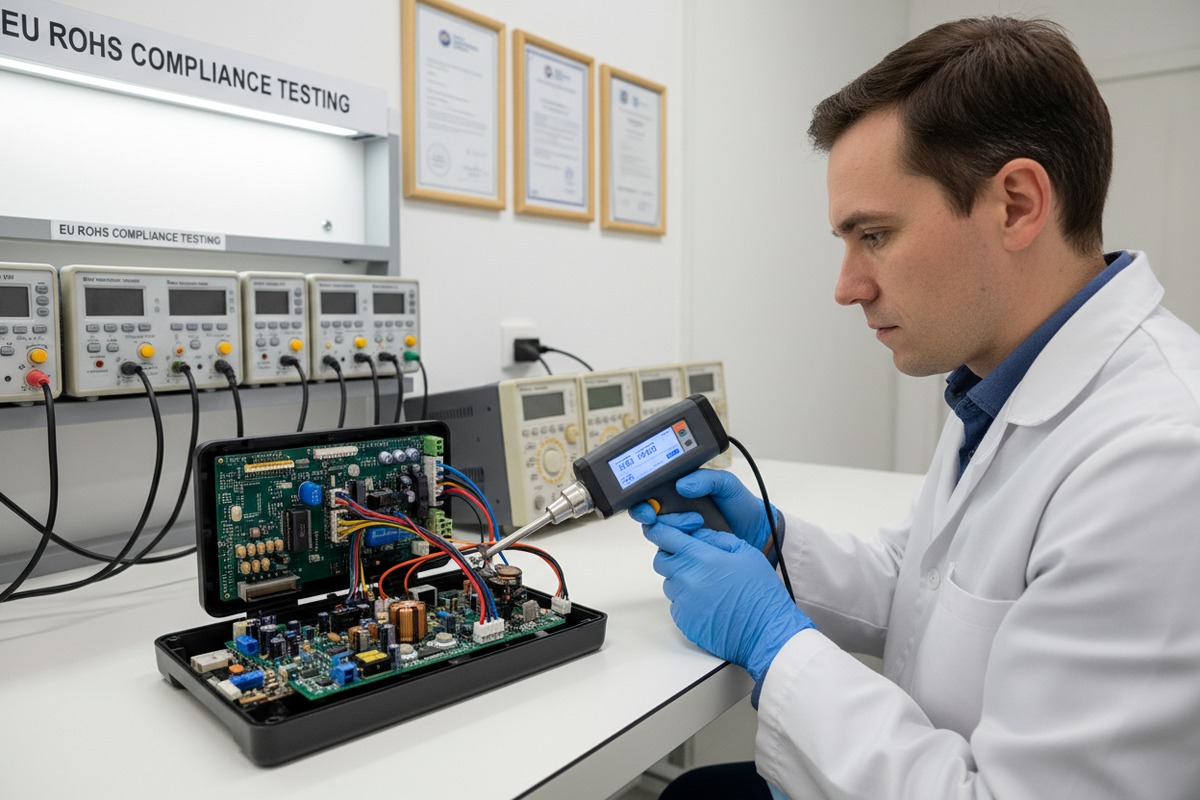
The 10 Restricted Substances Under RoHS 3
Before requesting test reports, you need to understand what's being tested. The substances banned under RoHS are lead (Pb), mercury (Hg), cadmium (Cd), hexavalent chromium (CrVI), polybrominated biphenyls (PBB), polybrominated diphenyl ethers (PBDE), and four different phthalates (DEHP, BBP, BBP, DIBP).
| Substance | Threshold Limit | Common Sources in Pressotherapy Machines |
|---|---|---|
| Lead (Pb) | 0.1% (1000 ppm) | Solder joints, PVC cables, PCB coatings |
| Mercury (Hg) | 0.1% (1000 ppm) | Display backlights, switches |
| Cadmium (Cd) | 0.01% (100 ppm) | Battery contacts, plastic pigments |
| Hexavalent Chromium (Cr VI) | 0.1% (1000 ppm) | Corrosion-resistant coatings on screws |
| PBB | 0.1% (1000 ppm) | Flame retardants in plastics |
| PBDE | 0.1% (1000 ppm) | Flame retardants in circuit boards |
| DEHP | 0.1% (1000 ppm) | PVC cable insulation, soft plastics |
| BBP | 0.1% (1000 ppm) | Vinyl flooring, cable jacketing |
| DBP | 0.1% (1000 ppm) | Flexible adhesives, coatings |
| DIBP | 0.1% (1000 ppm) | Cellulose plastics, printing inks |
Primary Testing Methods
XRF Screening (X-Ray Fluorescence)
XRF analyzers are an effective screening tool when testing for RoHS compliance, as they can quickly identify the presence of restricted substances in electronic equipment without damaging the product tested.
XRF is the first-line screening tool. IEC 62321 specifies test methods for quantifying levels of these substances. XRF is recommended in part 3-1 of IEC 62321 as a screening method for lead, mercury, cadmium, total chromium, and total bromine.
Key points about XRF testing:
- Non-destructive method preserves your samples
- Results available in seconds to minutes
- Detects heavy metals effectively
- Cannot identify organic compounds like phthalates
GC-MS Testing (Gas Chromatography-Mass Spectrometry)
XRF cannot identify the remaining RoHS substances – PBB, PBDE, and the RoHS phthalates – since they are compounds. Gas chromatography mass spectrometry (GC-MS) is a more suitable analysis method.
For the four phthalates added under RoHS 3, you must request GC-MS test reports. Standards: Supports IEC 62321-8:2017 for phthalates.
ICP-MS Confirmation Testing
Dissolves samples (destructive) and ionizes them in plasma, measuring mass-to-charge ratios for precise elemental quantification (e.g., lead, cadmium). Applications: Gold standard for lab confirmation, detecting trace levels (parts per billion) in complex materials. Limits: Costly, time-intensive, and requires sample destruction, making it less viable for screening.
How to Interpret Test Results
When reviewing test reports, pay attention to these elements:
For RoHS, Pb pass/fail requirements in a homogenous material are: Pb for RoHS: Pass ≤ 700 – 3σ ≤ Inconclusive ≤ 1300 + 3σ ≤ Fail. The Pb action level for RoHS is 1000 ppm. Using XRF for screening, the IEC guidelines put in a 30% buffer for pass/fail that is designated as inconclusive.
If any result falls in the "inconclusive" range, request confirmatory testing using ICP-MS or wet chemistry methods. ICP-MS Confirmation Testing 6
How do I confirm that the internal components of my custom-branded machine are lead-free?
During our OEM projects, we’ve discovered lead in unexpected places—cable insulation, solder joints on secondary boards, even decorative paint on casings. For custom-branded pressotherapy machines, you can’t simply trust the final product certificate. You need component-level verification.
Confirm lead-free internal components by requesting supplier material declarations for every electronic part, verifying solder composition specifications (SAC305 or similar lead-free alloys), conducting XRF spot-checks on PCBs and cable assemblies, and maintaining a bill of materials with documented RoHS status for each line item throughout your supply chain.

Where Lead Hides in Pressotherapy Machines
Lead contamination typically occurs in these areas of pressotherapy equipment:
| Component | Lead Risk Level | Verification Method |
|---|---|---|
| PCB solder joints | High | XRF analysis on solder points |
| Air pump motor windings | Medium | Supplier declaration + spot testing |
| LCD display connections | Medium | XRF screening 8 |
| PVC cables and tubing | High | GC-MS for stabilizers |
| Metal fasteners | Low-Medium | XRF on plating |
| Paint and coatings | Medium | XRF surface analysis |
| Power supply unit | High | Full component testing |
Building a Component-Level Verification System
Step 1: Map Your Bill of Materials
Create a comprehensive list of every component in your pressotherapy machine. Our engineering team breaks this down to approximately 150-200 individual parts for a standard unit.
Step 2: Collect Supplier Material Declarations
If a supplier has done their due diligence to ensure RoHS compliance, they should be able to produce a document stating that their processes meet the required specifications, and the materials used are under the limits of the 10 restricted substances 9.
Request IPC-1752 material declaration forms from each component supplier. This standardized format makes data collection consistent.
Step 3: Focus on High-Risk Components
Not all components carry equal risk. Prioritize verification for:
- Printed circuit boards: Request solder composition certificates. Lead-free solder should be SAC305 (96.5% tin, 3% silver, 0.5% copper) or equivalent.
- Cables and wiring: PVC insulation historically used lead stabilizers. Request test reports specifically addressing cable materials.
- Power supply units: These often contain multiple soldered connections and represent a concentrated risk area.
Step 4: Implement Incoming Quality Checks
Ensure consistency across batches. Tin/Lead vs. Lead-Free Verification: Quickly distinguish between tin/lead and lead-free solders. Comply with RoHS and other environmental regulations.
Even with supplier declarations, periodic verification testing catches problems before they reach your customers. Thermo Scientific Niton portable analyzers are trusted by the US Consumer Product Safety Commission (CPSC), the European Union's Product Safety Enforcement Forum (PROSAFE), and other regulatory agencies to screen consumer products for lead and other regulated elements.
Managing Lead-Free Requirements During Custom Branding
When you private-label a pressotherapy machine, you become the legal "manufacturer" for EU purposes. This means RoHS compliance responsibility transfers to you.
Compliance is the responsibility of the company that puts the product on the market, as defined in the Directive; components and sub-assemblies are not responsible for product compliance.
To protect your brand:
- Include RoHS compliance requirements in your purchase contract
- Specify lead-free solder in all manufacturing specifications
- Require batch-specific test reports, not just product-line certificates
- Conduct periodic third-party audits of your supplier's facilities
Documentation Retention Requirements
Additional compliance recordkeeping (which must be kept for 10 years) can include a conformity assessment, CE marking 10, maintenance of compliance throughout production, and self reporting of non-compliance.
Keep all component test reports and supplier declarations for a minimum of 10 years. EU enforcement authorities can request this documentation at any time.
What are the risks to my business if my imported pressotherapy devices fail RoHS compliance checks?
We’ve watched competitor brands vanish from the EU market overnight after failing compliance checks. The financial and reputational damage extends far beyond the initial fine. Recovery can take years—if it happens at all.
Importing non-compliant pressotherapy devices risks mandatory product recalls, market access bans, substantial financial penalties varying by EU member state, customs seizure and destruction of goods, legal liability including potential imprisonment in some jurisdictions, damaged brand reputation, and loss of retail partnerships across the entire European Economic Area.

Enforcement Actions Are Increasing
The EU has intensified RoHS enforcement in recent years. In the first quarter of 2025, importers of 60 products were ordered to recall their products from the European market for failure to comply with the EU RoHS Directive. Several of the products were also found to be non-compliant with the Persistent Organic Pollutant (POP) Regulation.
In the fourth quarter of 2024, importers of 52 products were ordered to recall their products from the European market for failure to comply with the EU RoHS Directive. Several of the products were also found to be non-compliant with the Persistent Organic Pollutant (POP) Regulation.
Categories of Business Risk
Market Access Restrictions
Market Access Restrictions: Non-compliant products may be barred from entering or remaining on the EU market. Customs authorities may seize and prevent importing or selling products not meeting RoHS requirements.
Non-compliant products may be forcibly removed from the market. Companies must halt sales and distribution until the product(s) meet EU RoHS standards.
Financial Penalties
Fines and Penalties: EU member states can impose fines and penalties on businesses that fail to comply with RoHS regulations. The specific penalties can vary by country and depend on the severity of the violation.
EU member states have established rules on penalties for RoHS non-compliance, which may include fines and imprisonment provisions.
| Risk Category | Potential Impact | Recovery Time |
|---|---|---|
| Product recall | €50,000-500,000+ depending on volume | 3-6 months |
| Customs seizure | Total loss of shipment value | Immediate |
| Market ban | Complete loss of EU revenue | 6-18 months |
| Legal penalties | Fines, potential criminal charges | Varies by country |
| Reputation damage | Lost retail partnerships, customer trust | 1-3 years |
Operational Disruptions
If a product is flagged as non-compliant, non-conforming components must be identified, redesigned, and replaced. Companies face operational disruptions as they work through this process, causing production halts and missed market opportunities.
Real-World Enforcement Example
In July 2020, Nikon Corporation issued a recall for its Nikon F6 film camera after finding that units sold on or after July 22, 2019, contained dibutyl phthalate (DBP), which is an endocrine disruptor prohibited by the European Union (EU) Restriction of Hazardous Substances (RoHS) Directive. In production since 2004, the once best-selling camera has become more of a niche product in recent years, and the recall affects a little over 150 cameras that had been sold past the date that the DBP restriction came into effect. The case represents one of the few times a household name has been publicly announced as running afoul of RoHS compliance.
How Enforcement Authorities Discover Non-Compliance
Regulatory authorities identify non-compliant products by conducting random inspections of items available on the market. They may buy a product from a retailer and analyze it in a laboratory to determine its compliance status. Additional physical testing may be carried out after this initial investigation to more acutely assess the extent of the violation.
The EU RoHS Directive is actively enforced by the member states, which coordinate their efforts through regular meetings of formal Administrative Cooperation Groups (AdCos). The relevant enforcement authority for a specific product is typically determined by a product's point of entry into the EU, but can also be decided by where the company is headquartered. The AdCos share information related to targeted industries or products, audit results, and enhance the ability of authorities to discover breaches and hold companies to account.
Protecting Your Business
Based on our experience exporting to European markets, here's how to minimize risk:
-
Build compliance costs into your pricing: Testing, documentation, and audits have real costs. Factor them into your business model from day one.
-
Never skip incoming quality checks: Even trusted suppliers can have batch variations or substitute components without notice.
-
Maintain audit trails: Retention: 10 years post-market placement. Keep all test reports, supplier declarations, and correspondence.
-
Stay current on exemptions: Multiple exemptions contained in Annex III and Annex IV are set to expire in 2025 and are no longer renewable. Exemption expirations apply to all categories, including 8 (medical devices).
-
Work with accredited testing labs: Third-party verification from recognized laboratories adds defensibility if questions arise.
Conclusion
RoHS compliance verification requires diligence at every step of your pressotherapy machine procurement process. From authenticating supplier certificates to testing internal components and understanding enforcement risks, the effort you invest upfront protects your business from costly failures later. Start with proper documentation, verify through testing, and maintain records that prove your commitment to compliance.
## Footnotes

<span id="footnote-1">
1. Standardized format for collecting material composition data from suppliers. <a href="#ref-1" class="footnote-backref">↩︎</a>
</span>

<span id="footnote-2">
2. Official EU page explaining the RoHS Directive and its objectives. <a href="#ref-2" class="footnote-backref">↩︎</a>
</span>

<span id="footnote-3">
3. Explains the Declaration of Conformity as a key document for RoHS compliance. <a href="#ref-3" class="footnote-backref">↩︎</a>
</span>

<span id="footnote-4">
4. Defines the international standard for the competence of testing and calibration laboratories. <a href="#ref-4" class="footnote-backref">↩︎</a>
</span>

<span id="footnote-5">
5. Details the harmonized standard for technical documentation to demonstrate RoHS compliance. <a href="#ref-5" class="footnote-backref">↩︎</a>
</span>

<span id="footnote-6">
6. Explains Inductively Coupled Plasma Mass Spectrometry for precise elemental quantification. <a href="#ref-6" class="footnote-backref">↩︎</a>
</span>

<span id="footnote-7">
7. Describes Gas Chromatography-Mass Spectrometry for detecting organic compounds like phthalates. <a href="#ref-7" class="footnote-backref">↩︎</a>
</span>

<span id="footnote-8">
8. Explains X-ray Fluorescence as a non-destructive screening tool for RoHS substances. <a href="#ref-8" class="footnote-backref">↩︎</a>
</span>

<span id="footnote-9">
9. Official EU list of hazardous substances restricted under the RoHS Directive. <a href="#ref-9" class="footnote-backref">↩︎</a>
</span>

<span id="footnote-10">
10. Official EU information on CE marking, its meaning, and requirements. <a href="#ref-10" class="footnote-backref">↩︎</a>
</span>

 English
  Español de México
  Deutsch
  Français
  العربية
  Русский