
When we source components for our production line, we know that the difference between a reliable compressor and a cheap one is often reflected immediately in the cost. If you feel overwhelmed by the wide range of price quotes from different suppliers, you are not alone. It is frustrating to see one machine listed for $2,000 and a seemingly similar one for $15,000, leaving you to wonder where the real value lies.
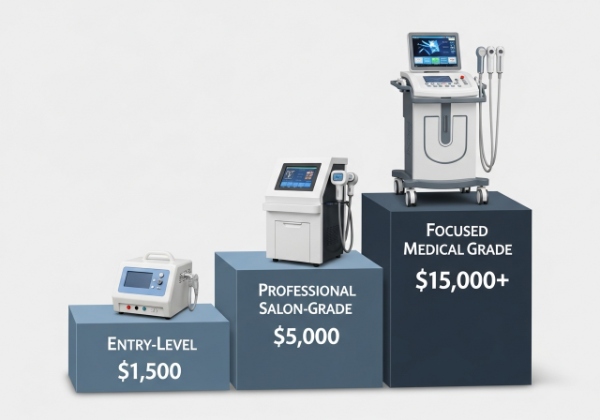
Determining fair pricing requires categorizing the equipment by technology: radial machines typically range from $1,000 to $5,000, while focused shockwave devices start around $15,000. To assess if a quote is high or low, you must compare these base ranges against specific specifications like energy output, frequency limits, and included accessories.
The following sections will guide you through the specific benchmarks and comparison methods we use internally to evaluate market value, starting with the bill of materials 1 breakdown.
What benchmarks can I use to evaluate Shockwave Therapy Machine prices?
Our engineering team constantly monitors market trends to ensure our bill of materials remains competitive without sacrificing performance. We understand that for a buyer, the lack of a clear standard makes the purchasing process difficult.
You can benchmark prices by distinguishing between home-use, salon-grade, and medical-grade tiers. Entry-level radial units usually cost under $3,000, whereas professional salon-grade systems with higher durability fall between $3,000 and $6,000. Any price significantly below these averages likely indicates compromised internal components or a lack of necessary safety certifications.

To understand the price tags you see on Alibaba or in supplier emails, you need to look at the hardware architecture. The price is rarely arbitrary; it is dictated by the physics of the machine.
The Technology Split: Radial vs. Focused
The biggest benchmark is the technology itself. You cannot compare a Radial Shockwave Therapy (RSWT) 2 machine with a Focused Shockwave Therapy (ESWT) machine. They are fundamentally different beasts.
- Radial Machines (Ballistic): These create pressure waves using a projectile accelerated by compressed air. This is the most common type for beauty salons and physical therapy clinics. The manufacturing cost is lower because the mechanism is mechanical.
- Focused Machines (Piezoelectric/Electromagnetic): These use advanced physics to focus energy deep inside the tissue. The components required to generate and focus this wave are expensive. If a supplier offers you a Focused Shockwave Therapy (ESWT) 3 machine for $3,000, it is likely a mislabeled radial machine.
Performance Benchmarks
When we build a machine, we test for two main performance metrics: Bar (Pressure) and Hz (Frequency).
- Standard Benchmark: A standard professional machine should deliver at least 4 Bar of pressure and up to 21 Hz frequency comfortably.
- High-End Benchmark: Premium machines can sustain 5 Bar or higher and reach frequencies of 22 Hz or more without overheating.
If a machine is priced at the high end ($5,000+ for radial), it must meet those high-end specs. If it is priced at $1,500 but claims 5 Bar pressure, you should be skeptical about whether it can actually sustain that power during a real treatment session.
Benchmark Reference Table
Use this table to quickly categorize the quotes you receive.
| Machine Category | Typical Price Range (USD) | Key Specs to Expect | Target User |
|---|---|---|---|
| Entry-Level Radial | $1,000 – $2,500 | 1-3 Bar, 10-15 Hz | Home use / Small esthetician |
| Professional Radial | $2,800 – $6,500 | 4-5 Bar, 1-21 Hz | Busy Salons / PT Clinics |
| Focused (ESWT) | $12,000 – $40,000+ | High energy density | Hospitals / Specialists |
By grouping your suppliers into these buckets, you can immediately spot the outliers. A $7,000 radial machine is overpriced unless it comes with an incredible warranty or brand name. A $800 machine is likely a disposable toy.
How do I compare pricing from multiple suppliers effectively?
When we prepare export documentation for our US clients, we notice that many buyers focus solely on the "EXW" (Ex Works) price. This often leads to a distorted view of the actual cost.
Effective comparison requires standardizing all quotes to the same Incoterms, usually DDP or CIF, to account for shipping and duties. You must also divide the total machine cost by the estimated lifespan of the handpiece bullets to calculate the cost-per-treatment, which reveals the true long-term value of the supplier’s offer.

Comparing Supplier A and Supplier B is never as simple as looking at the bottom line of a PDF invoice. You have to strip the quote down to its bare essentials and then rebuild it to see the total cost.
The "Apples to Apples" Checklist
To compare effectively, you must force your suppliers to quote on the same basis, utilizing standard Incoterms 4 rules. We recommend asking for DDP (Delivered Duty Paid) pricing whenever possible. This places the burden of shipping, insurance, and import taxes on the supplier.
- Supplier A: Quote is $2,500 (EXW Factory).
- Supplier B: Quote is $3,200 (DDP – Delivered Duty Paid 5) to your door.
At first glance, Supplier A looks cheaper. However, once you add air freight ($400-$800), US import duties (which can be 25% depending on tariff codes), and local trucking fees, Supplier A’s machine might actually cost you $3,800. Always compare the Landed Cost 6.
Assessing the "Kit" Contents
Price variations often come down to what is in the box. When we pack our machines, we include specific accessories that others might charge extra for.
1. Transmitters/Heads: Does the price include just one head, or a full set (15mm, 20mm, 35mm)? Additional heads can cost $50-$100 each if bought later.
2. Replacement Bullets: The projectile inside the handle wears out. A good quote includes at least one or two replacement kits.
3. Foot Switch: Is this standard or an optional extra?
The Hidden Cost of Payment Terms
Check the payment structure. A supplier offering "Net 30" or accepting credit cards with no fees is offering a financial service that justifies a slightly higher price. A supplier demanding 100% T/T (wire transfer) upfront carries more risk for you.
Comparative Analysis Table
Here is how you should structure your comparison spreadsheet.
| Feature | Supplier A (Low Quote) | Supplier B (Mid Quote) | Supplier C (High Quote) |
|---|---|---|---|
| Base Price | $1,800 (EXW) | $2,900 (DDP) | $4,500 (DDP) |
| Shipping & Duty | Not Included (Est. +$900) | Included | Included |
| Warranty | 1 Year (Parts only) | 2 Years (Free Ship) | 3 Years (On-site) |
| Spare Parts | None | 2 Bullet Kits | 5 Bullet Kits |
| True Landed Cost | $2,700 | $2,900 | $4,500 |
| Risk Factor | High (Customs issues) | Low | Low |
In this scenario, Supplier B is actually the best value, even though Supplier A appeared cheaper initially.
Are there industry standards for Shockwave Therapy Machine pricing that I should know about?
We undergo rigorous audits to maintain our ISO certifications 7, and we know that compliance is expensive. However, many buyers are unaware of how these backend costs influence the final market price.
While there is no fixed industry price list, the standard markup correlates directly with regulatory compliance like FDA clearance or Medical CE markings. Machines lacking these certifications are significantly cheaper because the manufacturer has bypassed the expensive testing and quality management systems required to legally sell medical-grade devices.

The term "Industry Standard" in pricing is loosely defined, but there are structural tiers that almost every legitimate manufacturer follows. Understanding these will help you realize why a machine might be priced the way it is.
The Certification Premium
Obtaining an FDA 510(k) 8 clearance or a Medical CE (MDR) certificate is a massive undertaking. It involves clinical data gathering, third-party lab testing for electrical safety, and biocompatibility testing.
- Non-Certified (Grey Market): These machines are often sold as "massagers" to bypass regulations. They are cheap ($1,000 – $2,000) because they carry zero regulatory overhead.
- Certified Devices: A manufacturer who has invested $50,000+ in certification and testing for IEC 60601 9 safety standards must amortize that cost across their sales. This is why a certified machine will rarely drop below a certain price floor ($3,500+).
Component Standards
There are unwritten standards for component quality.
- The Compressor: This is the heart of a radial machine. An industry-standard oil-free compressor from a reputable brand costs 3x more than a generic standard compressor. The standard expectation for a professional machine is a compressor that can run for 8 hours a day without overheating.
- The Handpiece: The standard lifespan for a handpiece bullet is 1 million to 2 million shots. If a supplier promises 5 million shots on a radial machine, they are likely exaggerating, as this deviates from the physical limitations of the metal used in the industry.
Software and UI Standards
Modern industry standards now demand intelligent software. Buyers expect preset protocols (e.g., "Plantar Fasciitis" mode with pre-calculated frequency and bar).
- Basic Standard: Simple screen, manual adjustment only.
- Current Industry Standard: Touchscreen, anatomical diagrams, patient data storage, and recommendation engines.
Developing this software takes R&D time. If a machine lacks these features, it should be priced in the lower quartile of the market. If it has them, it justifies a mid-to-high price point.
Why "Beauty" vs. "Medical" Matters
In the US, the intended use dictates the standard.
- Beauty/Salon Use: Often falls under different regulations (body contouring). Prices are generally lower as the liability insurance requirements for the manufacturer are different.
- Medical Use: Requires strict adherence to Medical CE (MDR) 10 efficacy claims. Pricing is higher to cover liability and higher-grade materials.
What factors could justify a higher or lower price for a Shockwave Therapy Machine?
When we develop a new model, we have to make choices about the casing materials, the cooling system, and the screen quality. These choices are invisible to you in a photo, but they dictate our manufacturing cost.
Higher prices are often justified by advanced cooling systems, robust pneumatic components, and comprehensive after-sales service that guarantees uptime. Conversely, lower prices usually result from using plastic internal gears, cheaper casing materials, and minimal quality control, which significantly increases the risk of malfunction during client treatments.

It is easy to make a machine look good on a website. It is much harder to make it last for five years. Here is a breakdown of the specific factors that justify a price variance.
Factor 1: The Cooling System
Heat is the enemy of shockwave machines. The projectile moves back and forth rapidly, generating friction and heat.
- Low Price: Uses a small, simple fan. The handle gets hot after 15 minutes, forcing you to stop the treatment to let it cool down. This is bad for business.
- Justified High Price: Uses a water-cooling system or a sophisticated air-cycle system. This allows for continuous operation. If you have back-to-back clients, paying extra for this is essential.
Factor 2: The "Kick" (Energy Transfer)
Cheap machines often have a "soft" impact. They might say 4 Bar, but it feels like 2 Bar. This is because the pneumatic efficiency is poor.
- Justified High Price: The machine uses high-precision valves and a heavy-duty projectile. The energy transfer is efficient, meaning the patient actually feels the therapeutic benefit. You are paying for clinical efficacy.
Factor 3: Service and Support Structure
This is arguably the most critical factor for a Purchasing Manager.
- Low Price: The supplier sells the box and disappears. If it breaks, you have to ship it back to China (which is expensive and slow), or they send you a part and a YouTube link, expecting you to fix it yourself.
- Justified High Price: The supplier has a local service center or provides a "hot swap" warranty (sending a replacement unit immediately). They have English-speaking engineers available on WhatsApp for video calls. You are paying for business continuity.
Factor 4: Customization (OEM/ODM)
If you need the machine to carry your brand logo on the screen and the casing, this requires custom setup.
- Standard Model: Cheaper.
- Private Label: Slightly higher unit cost or requires a Minimum Order Quantity (MOQ). The extra cost pays for the brand exclusivity.
Price Justification Matrix
Use this to check if a supplier’s high price is actually worth it.
| Component/Service | Cheap Implementation (Red Flag) | Quality Implementation (Worth the Cost) |
|---|---|---|
| Outer Casing | Thin plastic, feels hollow | ABS or Metal, EMI shielded |
| Screen | Resistive touch (pressure needed) | Capacitive touch (like an iPhone) |
| Internal Tubing | Generic rubber (cracks over time) | Reinforced industrial silicone |
| Packaging | Thin cardboard box | Aluminum Flight Case |
| Training | PDF Manual only | Video training, Zoom certification |
Conclusion
Evaluating shockwave therapy machine pricing requires looking beyond the sticker price to the technology type, landed costs, and internal build quality. By benchmarking against industry standards and verifying the supplier’s service capabilities, you can secure equipment that offers true value and long-term reliability for your business.
Footnotes
1. Definition of a Bill of Materials (BOM) and its role in calculating the final cost of goods sold in manufacturing. ↩︎
2. Clinical overview of Radial Shockwave Therapy (RSWT), explaining its mechanism of pneumatic pressure waves. ↩︎
3. Research comparison between Radial and Focused Shockwave Therapy technologies, highlighting cost and efficacy differences. ↩︎
4. Official government guide to Incoterms, helping importers understand the division of costs and risks in international trade. ↩︎
5. Explanation of Delivered Duty Paid (DDP), where the seller assumes all responsibility for transportation and fees until delivery. ↩︎
6. Guide to calculating Landed Cost, including freight, insurance, and customs duties, to determine true profitability. ↩︎
7. ISO 13485 standard for medical device quality management systems, often required for premium pricing justification. ↩︎
8. Database of FDA 510(k) clearances, a key regulatory benchmark for medical devices sold in the US market. ↩︎
9. Overview of IEC 60601 testing standards for medical electrical equipment safety and essential performance. ↩︎
10. Information on the EU Medical Device Regulation (MDR), which imposes stricter safety requirements and costs on manufacturers. ↩︎

 English
  Español de México
  Deutsch
  Français
  العربية
  Русский