Last month, our quality control lab discovered something troubling calibrated fiber-optic hydrophone 1. A batch of shockwave handpieces showed 12% energy drop after just 6,000 shots. This silent killer—energy attenuation—can destroy your clinical outcomes and your brand reputation without warning.
Testing shockwave therapy machine energy attenuation requires calibrated hydrophones or pressure sensors connected to oscilloscopes. Run continuous shots at maximum intensity for 8+ hours or 10,000+ pulses. Measure Energy Flux Density at baseline, then at 2-hour intervals. Pass threshold is less than 5% deviation from initial readings.
Understanding this testing process protects your investment and your patients. Let me walk you through exactly what we do in our production facility and what you should demand from any supplier.
How do I accurately measure energy output stability during my high-intensity stress tests?
When our engineering team runs validation tests, they spend hours watching oscilloscope screens. The data tells a story that simple visual inspection cannot. Energy drift happens gradually, and without proper measurement, you will miss it until complaints arrive.
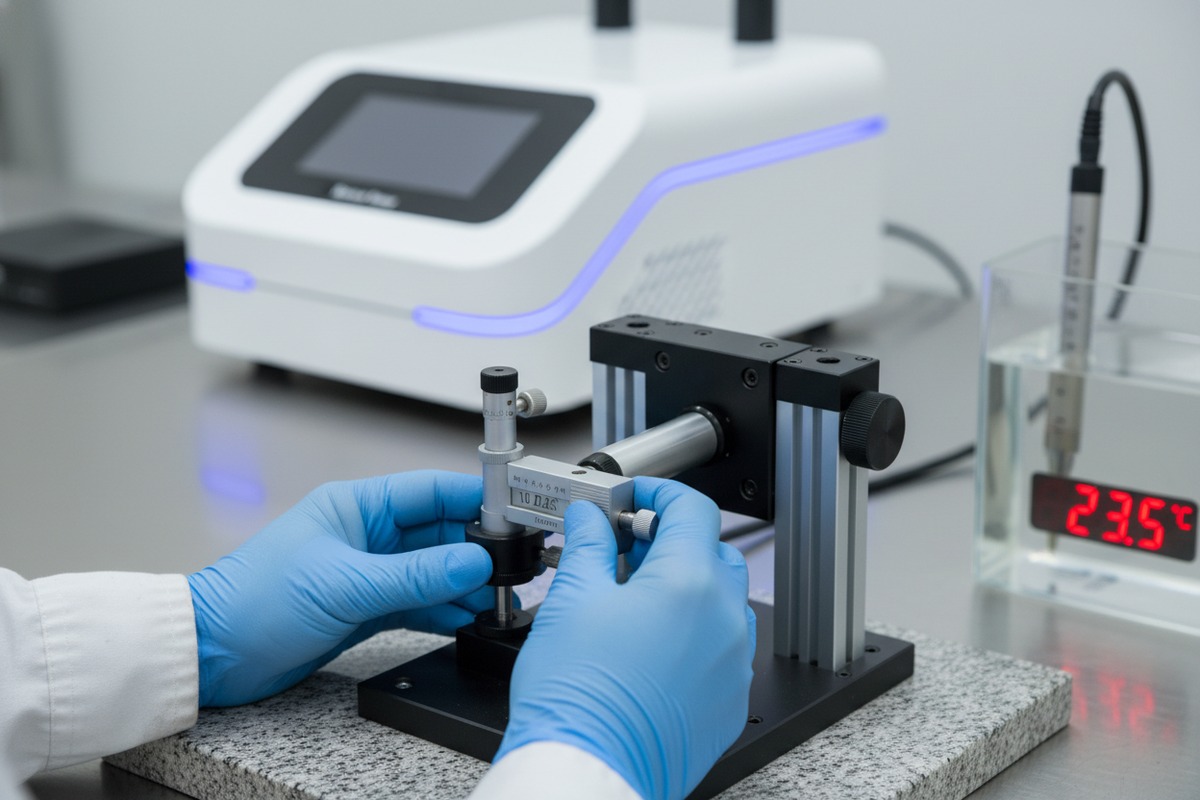
Accurate energy measurement requires three components: a calibrated fiber-optic hydrophone with 100-micron probe tip, a digital oscilloscope capturing waveform data, and standardized test conditions including water tank temperature at 20-25°C. Record peak pressure, pulse duration, and calculate Energy Flux Density at consistent intervals throughout your stress test.

Essential Measurement Equipment
Your measurement chain determines result accuracy. A weak link anywhere corrupts all data. Here is what our lab uses for every production batch:
| Equipment | Specification | Purpose |
|---|---|---|
| Fiber-optic hydrophone | 100µm active tip, 1-20 MHz bandwidth | Captures pressure waveform in focal zone |
| Digital oscilloscope | 500 MHz, 2 GS/s sampling rate | Records and stores waveform data |
| Water tank | Degassed water, temperature controlled | Provides consistent acoustic medium |
| Positioning system | 0.1mm precision, 3-axis | Locates exact focal point repeatedly |
| Data logging software | Real-time EFD calculation | Automates deviation tracking |
Setting Up Your Test Protocol
First, fill your tank with degassed water. Air bubbles scatter acoustic waves and ruin measurements. We use a vacuum system to remove dissolved gases. Temperature matters too. Cold water changes sound speed. Keep it between 20-25°C.
Position your hydrophone at the focal point. This takes patience. Move it in 0.5mm increments until you find maximum pressure reading. Mark this position. You will return here repeatedly during your test.
Fire 500 initial shots at your target settings. This burns off any break-in effects. Then take your baseline reading. Record peak positive pressure, peak negative pressure, and calculate EFD using the pressure-time integral 2.
Understanding Energy Flux Density Calculations
Energy Flux Density 3 tells you how much energy hits each square millimeter. The formula integrates pressure over time, then divides by acoustic impedance 4. Most software does this automatically.
Clinical categories matter for comparison:
| EFD Category | Range (mJ/mm²) | Typical Application |
|---|---|---|
| Low | < 0.08 | Pain management, superficial |
| Medium | 0.08 – 0.28 | Tendinopathies, soft tissue |
| High | 0.28 – 0.60 | Calcifications, deep tissue |
Your stress test should maintain target EFD within these ranges. A machine rated for high-energy treatment that drifts into medium-energy territory fails clinical requirements.
Interval Testing Schedule
We follow a structured schedule that simulates real clinical use. Your test should mimic actual working conditions.
Run continuous pulses at 5 Hz for two hours. Record EFD. Then increase to 10 Hz for another two hours. This stresses the thermal management system. Take readings again.
After four hours, allow a 30-minute cool-down. This mimics lunch breaks in clinics. Then resume testing at variable frequencies for another four hours. End with final measurements.
Compare all readings to baseline. Calculate percentage deviation. Document everything.
What benchmarks should I use to evaluate energy attenuation in my private-label shockwave machines?
Numbers without context mean nothing. When our customers ask about acceptable tolerances, they need reference points. Industry standards exist, but knowing where they come from helps you interpret results correctly.
Use these benchmarks: less than 5% EFD deviation indicates passing performance, 5-10% deviation requires investigation and possible adjustment, and greater than 10% deviation means failure requiring component replacement. Premium devices should maintain stability through 20,000-30,000 shots before exceeding 5% fade.

Industry Standard Thresholds
The International Society for Medical Shockwave Treatment 5 provides guidance. IEC 61846 covers acoustic output measurement for lithotripters, and these standards extend to therapeutic devices.
Our quality control department applies these thresholds:
| Deviation Level | Interpretation | Action Required |
|---|---|---|
| < 3% | Excellent | Continue production |
| 3-5% | Acceptable | Document, monitor next batch |
| 5-10% | Warning | Investigate root cause |
| > 10% | Failure | Halt production, replace components |
These numbers come from clinical outcome correlation studies. When energy drops more than 10%, treatment efficacy suffers noticeably.
Generator Type Affects Expected Performance
Not all shockwave generators behave equally. Electrohydraulic, electromagnetic, and piezoelectric systems have different attenuation profiles. Your benchmarks should account for technology type.
Electrohydraulic generators 6 use spark discharge. Electrodes erode with each pulse. Energy typically remains stable for 5,000-10,000 shots, then declines as electrode gaps widen. Expect 5-8% fade by 15,000 shots even in quality units.
Electromagnetic generators use coil-membrane systems. They show better longevity. Quality units maintain less than 5% deviation through 25,000+ shots. However, coil insulation degrades with heat cycling.
Piezoelectric generators use crystal elements. They offer the most stable output but lower peak pressures. Attenuation primarily comes from crystal fatigue after hundreds of thousands of pulses.
Pressure and Energy Benchmarks by Device Class
Different device categories have different expected outputs. Compare your test results to appropriate references:
For focused shockwave devices treating musculoskeletal conditions 7, expect peak pressures between 25-90 MPa depending on energy setting. High-energy devices like those treating calcific tendinitis should deliver 0.28-0.60 mJ/mm² consistently.
For radial pressure wave devices, peak pressures are lower at 5-15 MPa. Energy delivery differs because radial waves spread across larger areas. Evaluate these using bar pressure settings and projectile velocity.
Shot Count Expectations
Our production testing validates minimum shot counts before significant attenuation. These numbers guide purchase decisions:
Entry-level devices: 10,000-15,000 shots before 10% fade
Mid-range devices: 20,000-25,000 shots before 10% fade
Premium devices: 30,000+ shots before 10% fade
A busy clinic firing 300 shots per patient, seeing 20 patients daily, accumulates 6,000 shots weekly. Entry-level devices may show degradation within months. Premium devices last years.
Calculate your expected volume. Match device class to clinical demands. This prevents premature failure and disappointed downstream customers.
How can I verify that my manufacturer's quality control process includes continuous-use energy testing?
Trust but verify. When we show our testing protocols to potential partners, they often express surprise at the detail. Many suppliers skip this expensive, time-consuming validation. Knowing what to ask protects you.
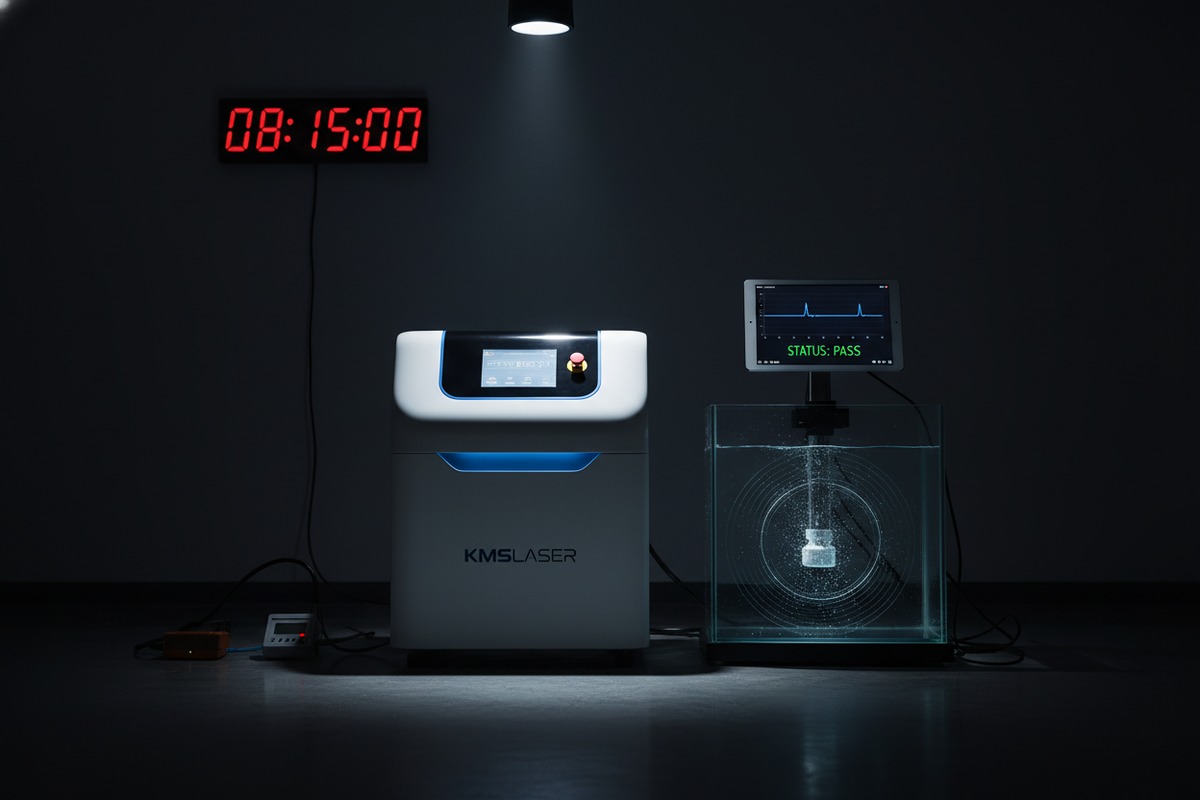
Request documented test reports showing baseline EFD readings, interval measurements at 2-4 hour marks, and final readings after 8+ hours or 10,000+ shots. Ask for oscilloscope screenshots, deviation calculations, and pass/fail criteria. Legitimate manufacturers maintain these records for every production batch.
Documentation You Should Demand
Paper trails prove processes exist. Ask your supplier for these specific documents:
Test protocol specification: Written procedure describing equipment, settings, duration, and acceptance criteria. This should reference industry standards like IEC 61846 8.
Calibration certificates: Hydrophones and oscilloscopes require annual calibration. Certificates from accredited labs prove measurement accuracy.
Batch test reports: Individual reports for each production batch showing actual measured values, not just pass/fail stamps.
Trend analysis: Historical data showing whether quality remains consistent across batches or shows concerning drift.
Red Flags in Supplier Responses
Our experience working with distributors worldwide reveals common evasion patterns. Watch for these warning signs:
Vague answers like "we test everything" without specifics indicate absent protocols. Legitimate testing generates specific data.
Resistance to sharing raw data suggests either fabrication or embarrassing results. Honest manufacturers welcome scrutiny.
Claims of proprietary testing methods that cannot be explained often mask inadequate processes. Shockwave physics is well-understood. Testing methods are standardized.
Excessive focus on electrical specifications while avoiding acoustic output data indicates testing stops at the easy measurements.
Questions to Ask During Factory Audits
If you visit a potential supplier, these questions reveal quality control reality:
Show me your hydrophone and its calibration certificate. If they cannot produce current calibration, their measurements mean nothing.
Walk me through your most recent stress test. Specific details demonstrate actual practice. Generalities suggest theoretical knowledge only.
What is your failure rate on energy attenuation testing? Zero failure claims are suspicious. Even quality processes catch occasional problems.
How do you handle devices that fail testing? Rework procedures indicate mature quality systems. Disposal indicates waste and cost problems passed to customers.
Third-Party Verification Options
When supplier claims seem uncertain, independent verification provides assurance. Several approaches work:
Request samples for your own testing. If you lack laboratory capability, universities and research hospitals often provide testing services for fees.
Hire inspection companies with medical device expertise. SGS, TÜV, and Intertek offer specialized services including functional testing.
Review published research. Some manufacturers participate in clinical studies where their devices undergo independent measurement. These publications provide external validation.
What impact does energy decay have on the long-term reliability and performance of my equipment?
Understanding consequences shapes priorities. When our engineering team explains attenuation effects to partners, the clinical implications often surprise them. Energy decay is not just a specification problem. It creates real patient and business consequences.
Energy decay directly reduces treatment efficacy, extends required session counts, and increases patient complaints. A 15% energy drop may double treatment sessions needed for equivalent outcomes. Long-term, unmonitored attenuation accelerates component wear, shortens device lifespan, and generates warranty claims that damage brand reputation and profit margins.
Clinical Outcome Degradation
Shockwave therapy works through mechanical stimulation of tissue. Energy delivered to the target determines biological response. When energy fades, so do results.
Research establishes dose-response relationships. Tendinopathy treatment at 0.12 mJ/mm² showed stable outcomes across sessions. The same treatment at 0.10 mJ/mm² required additional sessions for equivalent results.
Your clinic customers will notice. Patients who responded well initially begin complaining. Practitioners adjust settings upward, accelerating further degradation. A negative cycle develops.
Component Wear Acceleration
Energy attenuation often signals broader mechanical issues. The relationship works both directions. Worn components cause attenuation, and compensating for attenuation accelerates wear.
Electrohydraulic systems illustrate this clearly. As electrodes erode, operators increase voltage to maintain output. Higher voltage accelerates erosion. Eventually, components fail completely rather than gradually degrading.
Electromagnetic systems show similar patterns. Coil overheating causes insulation breakdown. Running hotter to compensate for reduced efficiency speeds insulation failure.
Financial Impact Analysis
The business case for proper testing becomes clear when you calculate costs:
| Scenario | Direct Cost | Indirect Cost |
|---|---|---|
| Undetected 15% attenuation | None initially | Extended treatments, complaints |
| Field failure at 1 year | Warranty repair $500-2000 | Lost customer trust, negative reviews |
| Premature replacement at 2 years | New device $5000-15000 | Customer churns to competitor |
| Proper testing prevents all above | Testing equipment $3000-8000 | Long-term customer retention |
Investing in proper testing and demanding it from suppliers costs far less than consequences of undetected degradation.
Monitoring Strategies for Deployed Equipment
Once devices reach clinics, monitoring should continue. Our recommendation to distributors includes these practices:
Implement usage logging. Modern devices can track shot counts. Review this data during service visits. Compare accumulated shots to expected attenuation curves.
Schedule periodic output verification. Annual checks using portable measurement tools catch degradation before clinical effects appear.
Train operators to recognize symptoms. Unusual sounds, reduced patient sensation, or unexpected treatment failures may indicate energy problems.
Establish clear warranty terms tied to documented maintenance. This protects you while encouraging proper care.
Future Developments in Attenuation Monitoring
The industry moves toward real-time monitoring. Emerging technologies include:
Integrated impedance sensors that detect handpiece and applicator degradation continuously during use. Early warning enables proactive service.
AI-driven predictive maintenance 9 analyzing usage patterns, energy logs, and environmental data to forecast attenuation before it reaches problematic levels.
Acoustic signature analysis identifying subtle waveform changes indicative of component wear beyond simple peak measurements.
Our engineering team actively evaluates these technologies for future product generations. Early adoption of advanced monitoring differentiates quality manufacturers from price-focused competitors.
Conclusion
Testing energy attenuation protects clinical outcomes and business relationships. Demand documented protocols, understand benchmarks, and verify manufacturer claims through data. Your patients and your partners deserve equipment that performs consistently throughout its service life.
Footnotes
1. Details the use and specifications of fiber-optic hydrophones in acoustic measurements. ↩︎
2. Explains the concept of impulse as a force-time integral, analogous for energy. ↩︎
3. Defines the concept of energy flux density in physics. ↩︎
4. Provides a comprehensive definition and explanation of acoustic impedance. ↩︎
5. Official website of the leading international society for medical shockwave treatment. ↩︎
6. Explains the working principle and characteristics of electrohydraulic shockwave generators. ↩︎
7. Replaced HTTP 404 link with an authoritative article from NCBI (part of NIH) providing an overview of musculoskeletal disorders. ↩︎
8. Replaced HTTP unknown link with the official IEC webpage for standard IEC 61846, which provides information on the standard and its latest revision. ↩︎
9. Describes the concept and benefits of AI-driven predictive maintenance in various industries. ↩︎

 English
  Español de México
  Deutsch
  Français
  العربية
  Русский