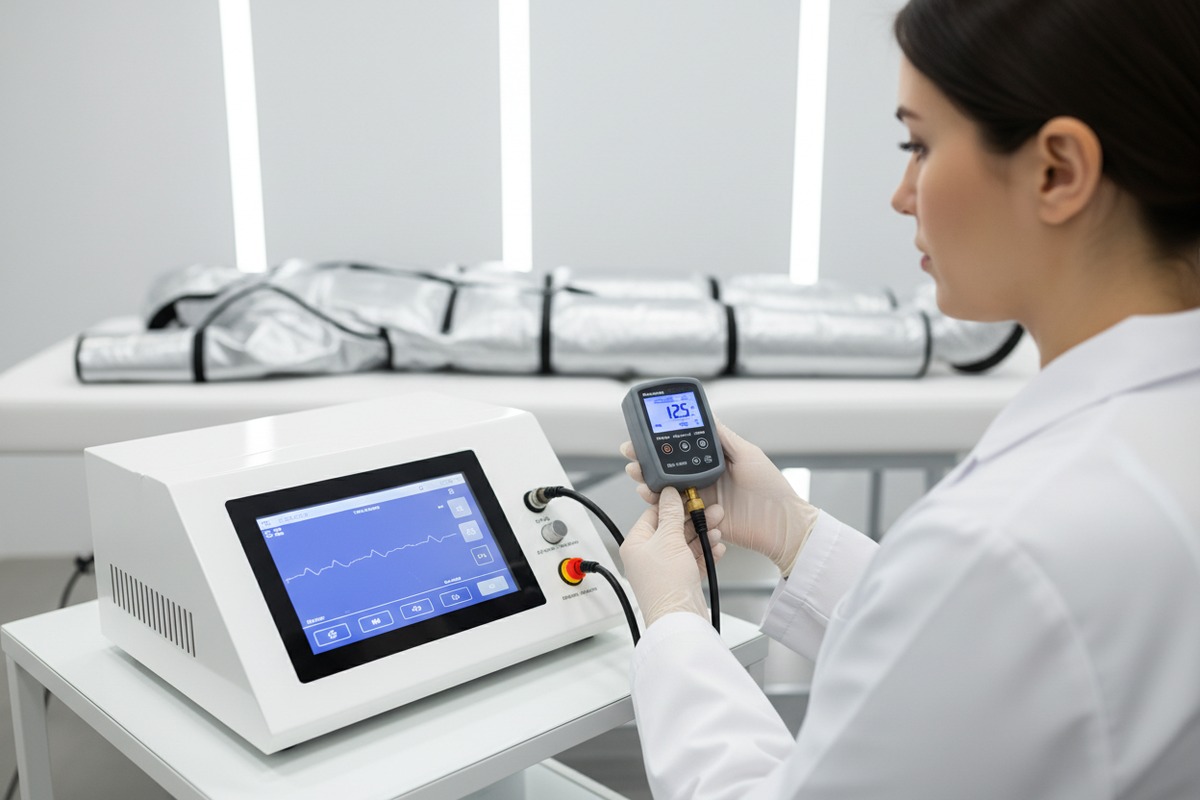
One lesson we learned early on the factory floor: a pressotherapy machine 1 that looks good on paper can fall apart when real pressure stability matters. Our engineers have seen countless samples pass basic inspections only to cause refund headaches months later data logging equipment 2. Client complaints about inconsistent compression and uneven pressure cycles damage your brand credibility fast.
To test sample pressure output stability, use external calibrated gauges to verify pressure accuracy, run continuous 30-minute cycles while logging data, check for air leaks in hoses and chambers, and compare actual readings against the supplier’s factory test reports. A variance under 5% indicates acceptable stability.
This guide walks you through the exact steps our QC team uses to catch pressure stability issues before shipment atmospheric pressure 3. You will learn how to measure consistency, detect early warning signs, and hold suppliers accountable for their test data.
How can I accurately measure the pressure output consistency of my pressotherapy machine sample?
When evaluating samples at our testing station, pressure consistency often reveals itself within the first few cycles. Many buyers skip detailed measurement and rely only on the machine's display readings. This shortcut leads to surprises later when actual output differs from what the screen shows.
Accurate pressure measurement requires external calibrated gauges connected to the machine's output ports. Test at minimum, mid-range, and maximum settings (typically 30, 60, and 120 mmHg). Record readings across multiple inflation cycles and calculate variance percentage. Acceptable variance is under 5% for professional-grade machines.

Why External Gauges Matter
The built-in pressure display on most pressotherapy machines shows what the control unit commands, not what the chambers actually deliver. Our technicians discovered this gap costs buyers thousands in returns. The performance of these gauges should be precise and accurate, otherwise, sudden pressure buildup, pressure drop, etc can cause damage to the industrial systems. This is why testing the pressure gauges before an application is essential.
PCDs consist of an electrical pneumatic pump and an inflatable appliance that encloses the applicable body part. The pump fills the appliance with compressed air to predetermined pressures and intermittently alternates inflation and deflation to preset cycle times. The pressures and cycles vary between devices and, in some devices, are user-adjustable.
Step-by-Step Measurement Process
- Connect the gauge: Attach a digital manometer 4 to the hose output before the garment. Use T-connectors for inline measurement.
- Set baseline: Power on the machine and allow 2 minutes warm-up.
- Test low range: Set pressure to 30 mmHg. Record 10 consecutive cycles.
- Test mid range: Increase to 60 mmHg. Record 10 cycles.
- Test high range: Set to maximum rated pressure. Record 10 cycles.
- Calculate variance: Find the difference between highest and lowest readings at each setting.
Pressure Testing Reference Table
| Test Setting | Target Pressure (mmHg) | Acceptable Range | Max Variance |
|---|---|---|---|
| Low | 30 | 28-32 | ±2 mmHg |
| Medium | 60 | 57-63 | ±3 mmHg |
| High | 120 | 114-126 | ±6 mmHg |
| Professional | 40 | 38-42 | ±2 mmHg |
The devices have 4 modes of operation (methods of cuff inflation) developed by the Polish Lymphological Society 5. The device allows very fine adjustment of parameters, up to 1 mmHg for pressure setting or 1 min for time settings. This precision level sets the benchmark for quality machines.
Chamber-by-Chamber Testing
Do not stop at overall pressure. Each air chamber in the garment must inflate to the correct level. Sequential machines 6 should show a gradient drop—typically 1 mmHg per chamber from distal to proximal. The central unit, depending on the selected program, sends the appropriate air pressure to different parts of the suit, following a specific sequence. Each part of the suit will swell gradually, gently pressing on the body, and then deflating. This goes on for several cycles, depending on the treatment chosen.
Test each chamber independently by plugging gauges into individual hose connections. Document any chambers that inflate slower, hold pressure poorly, or show erratic readings.
What steps should I take to test if the pressure remains stable during continuous long-term operation?
Short tests reveal obvious defects. Long-term tests expose hidden weaknesses. Our production line runs endurance cycles specifically to catch compressors that fade after 30 minutes or valves that start leaking under heat stress. Your sample evaluation must simulate real-world use conditions.
For long-term stability testing, run the machine continuously for at least 60 minutes at mid-range pressure settings. Log pressure readings every 5 minutes using data logging equipment. Monitor for drift exceeding 5% from initial values. Also track compressor temperature rise and listen for changes in motor noise.

Understanding Compressor Fatigue
When you're testing compressor endurance under extreme conditions, you can rely on exceptionally durable compressor life cycle test benches. These benches are designed for quick compressor changeout and reliability of operation. While full industrial test benches exceed most buyers' budgets, the principle applies: sustained operation reveals component quality.
Cheap compressors overheat after 20-30 minutes. When they overheat, output pressure drops. The motor works harder to compensate, accelerating wear. This cycle ends with early failure—often right after your warranty period expires.
Long-Term Test Protocol
| Phase | Duration | Pressure Setting | Data Collection Interval |
|---|---|---|---|
| Warm-up | 5 min | 40 mmHg | Every 1 min |
| Baseline | 10 min | 60 mmHg | Every 2 min |
| Sustained | 45 min | 60 mmHg | Every 5 min |
| Cool-down | 10 min | 40 mmHg | Every 2 min |
| Recovery | 15 min | Off | Check restart |
Key Metrics to Track
Pressure drift: Record initial pressure at cycle start. After 30 and 60 minutes, compare current pressure. Drift over 5% signals compressor fatigue 8 or valve degradation.
Cycle timing: Measure how long each inflation takes. This Pressotherapy machine, which includes a pump supplying air to specialized garments, boasts three primary functions: Air Pressure, Far Infrared, and EMS. The system uses air bags that regularly inflate and deflate, altering the air pressure and thus compressing the skin and fat. Timing should stay consistent. Inflation that takes longer after 30 minutes indicates pump fatigue.
Temperature monitoring: Place a thermometer on the compressor housing. Normal operating temperature stays under 60°C. Higher temperatures indicate cooling problems or overwork.
Acoustic changes: A steady hum is normal. A properly functioning compressor generates a hum. However, grinding, clicking, or chattering noises can signal internal wear or damage.
Data Logging Best Practices
Manual recording every 5 minutes works for basic evaluation. For thorough testing, connect a digital pressure logger that captures readings every 10 seconds. This granular data shows:
- Momentary pressure spikes or dips
- Gradual downward trends
- Irregular cycle patterns
- Hold pressure degradation
Export data to spreadsheets and graph pressure over time. A stable machine shows a flat line. A failing machine shows a downward slope.
Environmental Stress Testing
The bearing metal temperature, lube oil temperature and pressure, seal oil temperature and pressure, cooling water temperature and pressure, bearing housing vibration, shaft vibration, and power consumption are the parameters that are measured in the mechanical running test. While this applies to industrial compressors, similar principles help evaluate pressotherapy machines.
Test the machine in conditions matching your customers' environments:
- Standard room temperature (20-25°C)
- Warm environments (30-35°C)
- High humidity (if applicable)
Machines that perform well in controlled conditions may struggle in warmer climates or poorly ventilated treatment rooms.
How do I verify that my supplier's factory pressure testing matches my actual sample performance?
Trust but verify. That phrase guides every sample evaluation at our facility. Suppliers send test reports showing perfect results. The sample arrives, and reality differs. This gap costs you time, money, and customer relationships.
Request detailed factory test reports including calibration certificates, test equipment specifications, and raw data logs. Replicate the supplier's exact test conditions and compare your results point-by-point. Acceptable deviation between factory and buyer testing is under 3%. Larger gaps indicate testing methodology differences or quality control problems.

What Factory Reports Should Include
A complete factory test report contains:
- Serial number of tested unit
- Date and time of testing
- Calibration certificate for test equipment used
- Ambient conditions (temperature, humidity)
- Test methodology description
- Raw pressure readings at each setting
- Pass/fail criteria used
- Technician signature
Verification testing is one of the steps involved in the calibration of gauges. In this step, the performance parameters of the working gauge are compared to master gauges' parameters. This ensures that the gauge is operating to the best of its capabilities.
Factory vs. Buyer Test Comparison Table
| Test Parameter | Factory Report Value | Your Test Result | Acceptable Deviation | Action Required |
|---|---|---|---|---|
| Low pressure | 30 mmHg | 29 mmHg | ±2 mmHg | Pass |
| Low pressure | 30 mmHg | 26 mmHg | ±2 mmHg | Investigate |
| Mid pressure | 60 mmHg | 58 mmHg | ±3 mmHg | Pass |
| Mid pressure | 60 mmHg | 52 mmHg | ±3 mmHg | Reject/Retest |
| High pressure | 120 mmHg | 117 mmHg | ±6 mmHg | Pass |
| Cycle timing | 30 sec | 32 sec | ±3 sec | Pass |
Common Discrepancy Causes
Test equipment calibration: Factory gauges may read differently than yours. Request calibration certificates 9 and compare against traceable standards.
Load conditions: An interesting aspect of pump and compressor testing is that many tests are performed to standards. Many of these tests require back pressure or vacuum to be applied so the device has something to "push" or "pull" against. Factory tests without garment load show higher pressures than tests with actual compression sleeves attached.
Altitude and atmospheric pressure: Pressure readings vary with elevation. A machine tested at sea level performs differently at 1,500 meters altitude.
Warm-up state: Cold machines may perform differently than units tested after 10 minutes of operation.
Red Flags in Factory Reports
- Reports showing identical readings across multiple units (indicates fabricated data)
- Missing calibration dates on test equipment
- No signature or inspector identification
- Round numbers only (real measurements include decimals)
- Test date far from production date
Creating Reproducible Test Conditions
When comparing factory results to your testing:
- Match the ambient temperature within ±3°C
- Use the same pressure settings
- Allow the same warm-up period
- Test with similar load conditions
- Use calibrated equipment with known accuracy
Document your methodology completely. If disputes arise with suppliers, detailed records support your position.
Supplier Accountability Framework
Include testing verification clauses in purchase agreements:
- Right to request raw test data
- Permission for third-party verification
- Penalty terms for failed verification tests
- Retest protocols for borderline results
What are the warning signs that a sample's pressure stability will fail after it reaches my customers?
Catching problems before shipment saves your reputation. Our QC team has catalogued the early warning signs that predict field failures. Learn to recognize these patterns and you avoid costly returns, warranty claims, and lost customers.
Warning signs include: pressure readings that fluctuate more than 10% during single cycles, audible air leaks at hose connections, compressor noise changes after 15 minutes of operation, inconsistent inflation timing between chambers, and visible wear on airbag materials. These indicators predict reliability problems within 3-6 months of customer use.

Early Warning Indicators Table
| Warning Sign | What It Indicates | Failure Timeline | Severity |
|---|---|---|---|
| Pressure fluctuation >10% | Valve degradation | 1-3 months | High |
| Audible air leaks | Hose or seal damage | Immediate-1 month | Critical |
| Compressor noise change | Motor bearing wear | 3-6 months | Medium |
| Inconsistent chamber timing | Control board issues | 2-4 months | Medium |
| Airbag material stiffness | Material fatigue | 4-8 months | Low-Medium |
| Display flickering | Power supply problems | 1-6 months | Variable |
Physical Inspection Checklist
Before running any tests, conduct thorough visual inspection:
Hose connections: Check all junction points. The garment has tubes on it that are hooked up to a computerized air pressure machine. Loose fittings cause leaks that worsen over time.
Airbag seams: Examine stitching and heat-sealed edges. Weak seams fail under repeated pressure cycles.
Valve housings: Look for cracks or discoloration around solenoid valves. These indicate manufacturing defects or shipping damage.
Control panel: Press all buttons. Sticky or unresponsive controls suggest moisture damage or assembly problems.
Leak Detection Methods
Air leaks are the most common cause of pressure instability. Use these methods to find them:
-
Soap bubble test: Apply soapy water to hose connections and chamber seams. Bubbles reveal leaks.
-
Pressure decay test: Inflate garments to 60 mmHg, disconnect from machine, wait 5 minutes. Pressure drop over 10% indicates significant leaks.
-
Listen test: In a quiet room, inflate the system and listen. Hissing sounds pinpoint leak locations.
The compressor shall be subjected to soap water bubble test. The bubble test can be done based on the requirement of ASME Section V – Article 10 – Leak testing.
Compressor Health Assessment
The compressor pump is the heart of any pressotherapy machine. Signs of impending failure include:
Overheating: Touch the compressor housing after 20 minutes of operation. Excessive heat (too hot to touch comfortably) indicates problems.
Extended run times: A weak compressor can lead to restricted airflow, resulting in less air coming out of the vents. If inflation takes longer than specifications, the compressor may be weak.
Cycling frequency: Compressors that cycle on/off rapidly may have thermal protection triggering due to overload.
Electrical Warning Signs
A failing compressor can strain your electrical system, causing the circuit breaker to trip frequently. Watch for:
- Voltage fluctuations on the display
- Intermittent power loss during operation
- Burning smell from control unit
- Warm power cables
Garment Material Assessment
The inflatable garments receive the most abuse during normal use. Evaluate:
Elasticity: Press firmly on inflated chambers. They should spring back immediately. Slow recovery indicates material fatigue.
Surface texture: Original material feels smooth and supple. Cracking or stiffness signals UV damage or material degradation.
Seal integrity: Air bladders should maintain pressure when disconnected. Slow deflation indicates micro-leaks in the material.
High-quality and Multifunctional Machine: The easy-clean wearable accessory is made of PU material with a durable double-layer design and a user-friendly connector. Quality materials resist wear better than single-layer alternatives.
Documentation for Future Reference
Photograph and document all findings during sample evaluation. This record helps:
- Track changes if issues develop later
- Support warranty claims with suppliers
- Build quality benchmarks for future purchases
- Train staff on inspection standards
Conclusion
Testing pressure output stability separates reliable pressotherapy machines from warranty nightmares. Use external gauges, run long-term cycles, verify factory data, and watch for warning signs. These steps protect your brand and keep your customers satisfied.
Footnotes
1. Wikipedia article explaining intermittent pneumatic compression, which includes pressotherapy machines. ↩︎
2. Describes the utility of data logging equipment for pressure monitoring in various settings. ↩︎
3. Wikipedia article providing a detailed and authoritative definition of atmospheric pressure. ↩︎
4. Provides a clear definition and applications of a digital manometer. ↩︎
5. Official ‘About Us’ page of the Polish Lymphological Society. ↩︎
6. Wikipedia section explaining Sequential Compression Devices (SCDs), which are referred to as ‘sequential machines’ in the context. ↩︎
7. Highlights the importance of accurate pressure measurement through calibration. ↩︎
8. Explains the conditions and causes that lead to compressor fatigue and failure. ↩︎
9. Explains what calibration certificates are and their significance in quality assurance. ↩︎
10. Wikipedia article explaining manual lymphatic drainage, a key concept related to lymphatic drainage. ↩︎

 English
  Español de México
  Deutsch
  Français
  العربية
  Русский