Every year, our quality control team sees the same problem. Distributors return shockwave machines 1 not because the generator failed, but because the handpiece cable 2 cracked after three months. This small component causes big losses. Your clients complain. Your reputation suffers. And the repair costs eat into your margins.
To test handpiece cable strength and flexibility before bulk ordering, request sample units and perform manual bend tests, pull tests at 5-10 pounds of force, and functional pulse tests during operation. Inspect strain relief points, check for material hardening after repeated flexing, and run 100-500 pulse cycles while manipulating the cable to detect intermittent failures.
This guide will walk you through every test method our engineering team uses. You will learn exactly what to check, what questions to ask manufacturers, and how to protect your investment before signing any purchase order.
How can I test the cable's resistance to repeated bending before I place a bulk order?
When we ship sample units to distributors in the US and Europe, we always recommend one thing first. Test the cable yourself. Do not trust photos or spec sheets. Your hands will tell you what marketing materials hide.
Test cable bending resistance by flexing the cable into a U-shape at multiple points, holding for 30 seconds, and repeating 50 cycles. Watch for kinking, creasing, or white stress marks on the outer jacket. Good cables return to their original shape without permanent deformation or internal wire exposure.

The 50-Cycle Bend Test Protocol
Our factory uses a simple but effective test. You can do it too. Hold the cable about 15 centimeters from the handpiece connector. Bend it into a U-shape with a radius similar to your forearm. Hold this position for 30 seconds. Then release and straighten the cable. Repeat this 50 times.
After 50 cycles, inspect the cable carefully. Look for these warning signs:
- White stress marks on dark-colored cables
- Visible creases that do not smooth out
- A stiffer feel compared to before testing
- Any cracking sound during bending
Critical Bend Points to Test
Not all parts of the cable face equal stress. Focus your testing on these three areas:
| Test Location | Why It Matters | What to Look For |
|---|---|---|
| Near handpiece connector | Highest flex frequency during treatment | Kinking, strain relief 3 separation |
| Cable midpoint | Operator movement stress | Material fatigue, stiffness |
| Near main unit connection | Coiling and storage stress | Cracking, permanent curves |
Document Your Findings
When testing samples from different suppliers, record everything. Take photos before and after your bend tests. Note the date, number of cycles, and any changes you observe. This documentation becomes valuable evidence if you need to negotiate warranties or reject a shipment later.
Our engineering team photographs cables at 0, 25, and 50 cycles. We also measure the bend radius before and after. Good cables maintain a minimum bend radius of 3-4 centimeters without permanent deformation.
What should I look for in the cable material to ensure it doesn't stiffen or crack over time?
In our production facility, we have tested dozens of cable materials over the past eight years. Some looked premium but failed within months. Others seemed ordinary but lasted through thousands of treatment sessions. The difference comes down to material composition 4.
Look for cables made with medical-grade silicone or thermoplastic polyurethane (TPU) outer jackets, which resist stiffening from repeated flexing and exposure to clinical disinfectants. Avoid PVC cables, as they harden over time, especially in warm environments. Check for multi-strand copper cores with proper shielding to prevent signal interference.
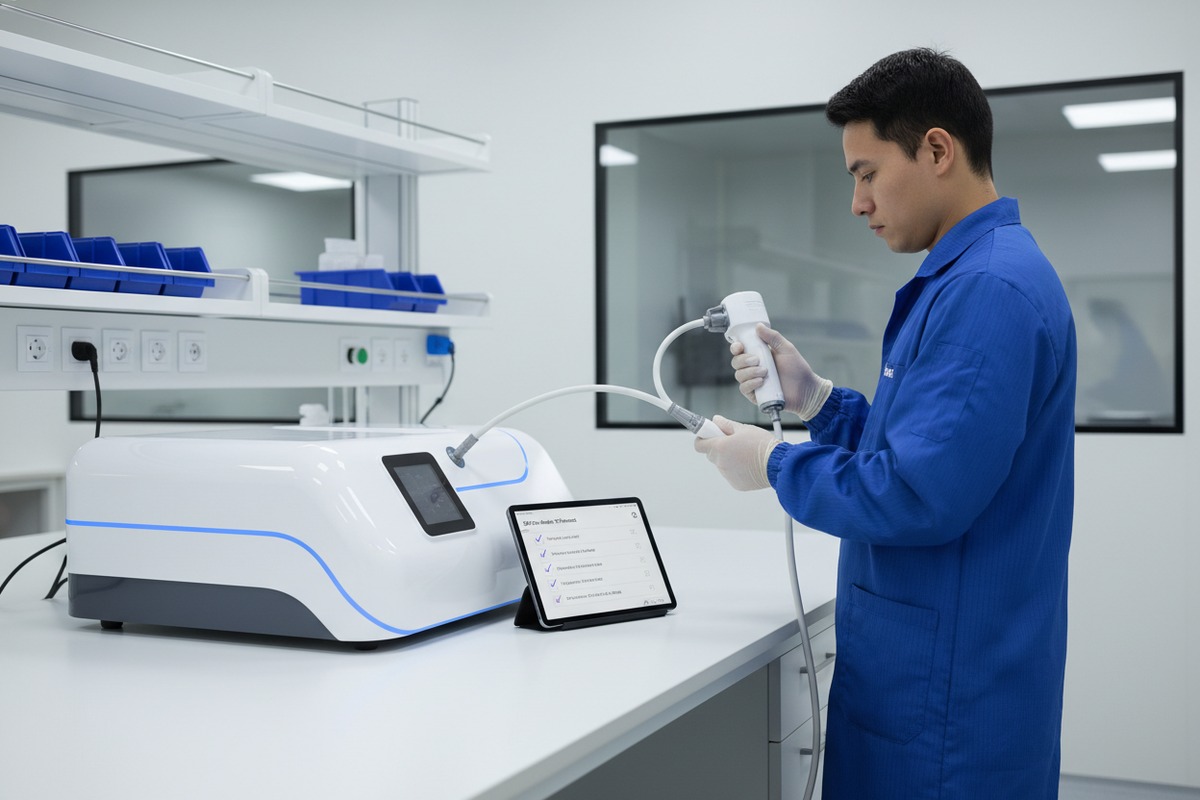
Understanding Cable Construction Layers
A quality shockwave handpiece cable has multiple layers. Each layer serves a specific purpose. When evaluating suppliers, ask them to explain their cable construction 5.
| Layer | Material Options | Quality Indicator |
|---|---|---|
| Outer jacket | Silicone, TPU, PVC | Silicone or TPU preferred; PVC stiffens over time |
| Shielding | Braided copper, foil | Braided copper provides better flexibility |
| Insulation | Cross-linked polyethylene | Must resist heat from high-voltage pulses |
| Conductors | Multi-strand copper | Higher strand count means better flexibility |
The Disinfectant Compatibility Test
Your salon clients clean their equipment daily. Some use harsh disinfectants. These chemicals can degrade cable materials quickly.
Before ordering, ask your supplier which disinfectants are compatible with their cables. Better yet, test it yourself. Apply common clinical disinfectants to a small section of the sample cable. Wait 24 hours. Check for tackiness, discoloration, or surface degradation.
We have seen cables that passed every mechanical test but failed because alcohol-based cleaners made the outer jacket sticky and eventually cracked.
Temperature Resistance Matters
Shockwave machines generate heat during operation. Cables in warm climates face additional stress. Ask your supplier for temperature ratings.
Quality cables should maintain flexibility from 5°C to 40°C. Our cables are tested at these extremes. We bend them cold, then warm, then cold again. The material should feel consistent at all temperatures.
Red Flags in Material Quality
Watch out for these warning signs during your evaluation:
- Shiny, hard-looking outer jackets often indicate cheap PVC
- Cables that feel sticky or have a strong chemical smell
- Very light cables may lack proper shielding
- Cables that hold their coiled shape after unrolling
How do I confirm that the handpiece cable connection can withstand high-intensity daily use in a salon?
When our distributors ask about durability, we tell them one story. A salon in California used one of our machines for 40 treatments per day. After two years, the handpiece cable still worked perfectly. But a competitor's machine at a nearby clinic failed in four months. Same treatment volume. Different cable quality.
Confirm connection durability by running a functional load test: power on the machine, execute 100-500 pulses at maximum energy while gently twisting and bending the cable. Monitor for error codes, pulse interruptions, or flickering indicators. Also perform a pull test with 5-10 pounds of steady force at the connector to check for loosening or play.

The Functional Load Test Protocol
This test simulates real salon conditions. Connect the handpiece to the main unit. Power on the machine. Set it to maximum energy output.
Now fire pulses while moving the cable. Start with 100 pulses. During this time:
- Twist the cable gently near the handpiece
- Bend the cable at various angles
- Apply light pulling pressure
- Move the handpiece as if treating a patient
Watch the display screen. Listen for audio changes. Feel for vibration consistency. Any interruption indicates a connection problem.
Connector Types and Their Strengths
Different shockwave machines use different connector designs. Each has advantages and disadvantages for salon use.
| Connector Type | Advantages | Disadvantages | Best For |
|---|---|---|---|
| Screw-lock | Very secure, no accidental disconnection | Takes longer to change handpieces | High-volume single-treatment clinics |
| Quick-release | Fast handpiece swapping | Can loosen over time | Multi-treatment facilities |
| Hybrid locking | Balance of security and speed | More complex mechanism | Premium machines |
The Pull Test for Connection Integrity
Our quality control team performs this test on every batch. You should do it with your samples.
Disconnect the handpiece from the main unit. Hold the connector housing firmly. Pull the cable with steady force. Use a spring scale if available. Apply 5-10 pounds of pressure for 30 seconds.
The cable should not:
- Slip from the connector
- Show any visible movement at the junction
- Make clicking or popping sounds
- Reveal any internal wires
Strain Relief Inspection
The strain relief is the rubber or plastic boot where the cable meets the connector. This component prevents sharp bends that damage internal wires.
Inspect strain relief at both ends of the cable. Good strain relief:
- Extends at least 2-3 centimeters from the connector
- Transitions smoothly from rigid to flexible
- Shows no cracks or separation from the connector body
- Allows cable movement without exposing the junction
Push the cable sideways at the strain relief. It should flex gradually, not create a sharp angle at the connector edge.
Our factory implemented strict cable QC protocols 6 five years ago. Before that, we had a 3% cable failure rate in the field. Now it is below 0.2%. The difference came from demanding more from our suppliers and testing more rigorously ourselves. You should demand the same from whoever manufactures your machines.
Demand documented flex cycle testing (minimum 10,000 cycles), pull force ratings (minimum 10 pounds without damage), material certificates for the outer jacket and conductors, earth leakage test results, and batch-level quality records. Request third-party test reports if available, and include cable-specific warranty terms in your purchase agreement.

Essential QC Documentation to Request
When evaluating manufacturers, ask for these specific documents:
| Document Type | What It Shows | Red Flag If Missing |
|---|---|---|
| Flex cycle test report | Number of bends before failure | Manufacturer has not tested durability |
| Material certificates | Exact jacket and conductor materials | Unknown or cheap materials used |
| Pull force test data | Maximum tension before damage | Weak connections likely |
| Earth leakage test results 7 | Electrical safety compliance | Safety risk for your customers |
| Batch inspection records | Consistency across production runs | Quality varies between orders |
Minimum Standards to Specify in Contracts
Do not accept vague quality promises. Put specific numbers in your purchase agreement 8:
Flex Cycle Requirements:
- Minimum 10,000 flex cycles at 90-degree bend
- Testing performed at ambient temperature (20-25°C)
- No visible damage or conductivity loss after testing
Pull Force Requirements:
- Connector withstands 10 pounds (4.5 kg) for 60 seconds
- No slippage, loosening, or visible damage
- Cable jacket withstands 15 pounds (6.8 kg) without tearing
Electrical Safety Requirements:
- Earth leakage below national regulatory limits
- Proper shielding to prevent electromagnetic interference
- High-voltage pulse transmission without signal loss
Pre-Shipment Inspection Checklist
Before any bulk order leaves the factory, insist on these checks:
- Visual inspection of 100% of cables for defects
- Flex test on random samples from each batch (minimum 5%)
- Pull test on random samples (minimum 5%)
- Functional pulse test on every unit
- Connector security verification on every unit
Warranty Terms to Negotiate
Standard warranties often exclude cables as "consumable items." Push back on this.
Negotiate for:
- Minimum 12-month cable warranty
- Coverage for manufacturing defects, not just DOA (dead on arrival)
- Clear definition of "normal use" conditions
- Replacement process that does not require shipping the entire machine
Our company offers 18-month cable warranties because we trust our testing. Suppliers who refuse reasonable cable warranties may be hiding quality problems.
Conclusion
Testing handpiece cables before bulk ordering protects your business from costly returns and damaged customer relationships. Use the protocols outlined here: bend tests, pull tests, functional load tests, and material inspections. Demand proper documentation from your manufacturer. Your diligence today prevents problems tomorrow.
Footnotes
1. Explains what extracorporeal shockwave therapy is and its medical uses. ↩︎
2. Replaced with a working overview of medical cable assemblies from the original domain, which aligns with the general topic of the failed URL. ↩︎
3. Explains the function and importance of strain relief in cable protection. ↩︎
4. Discusses various material compositions and their properties for medical cables. ↩︎
5. Explores various aspects of cable construction for medical applications. ↩︎
6. Replaced with an authoritative article detailing quality control principles, methodologies, and best practices in medical device manufacturing, which covers QC protocols. ↩︎
7. Details electrical safety testing, including earth leakage current measurements. ↩︎
8. Explains key components and purpose of medical equipment purchase agreements. ↩︎

 English
  Español de México
  Deutsch
  Français
  العربية
  Русский