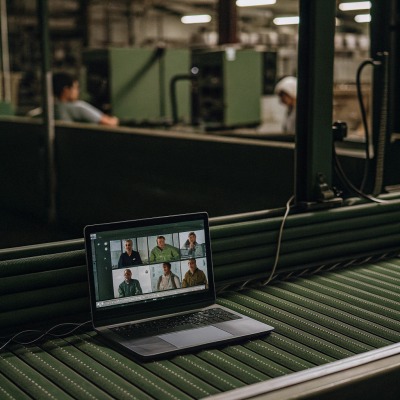
When we coordinate video audits for our overseas clients, we notice their biggest fear is unexpected supply chain failure supply chain failure 1. Relying on blind trust can be disastrous for your inventory.
To remotely assess capacity, request a live, uninterrupted walkthrough of the assembly line to calculate workstation throughput speeds. Verify inventory levels of critical components like handpiece applicators and touchscreens, inspect active quality control logs for defect rates, and cross-reference worker density with their claimed daily output figures.
Here is how you can systematically verify a supplier’s true capabilities without leaving your office.
How do I confirm the facility is a real factory and not just a trading company?
Our sales team frequently encounters skepticism from new buyers who have been burned by middlemen before. You need to see the raw manufacturing inputs, not just a showroom.
Confirm authenticity by demanding a live look at the raw material warehouse, specifically requesting to see the injection molds for the machine’s blue and white casing. Trading companies rarely possess proprietary molds, massive component stocks, or active production lines with workers assembling internal electronics in real-time.

The "Uninterrupted Shot" Technique
When you are on a video call, the easiest way to spot a trading company is by analyzing the physical layout of the space. A trading company often operates out of a commercial office building. trading company 2 They might have a small room set up as a "lab" or a showroom, but they cannot fake the noise and scale of a real industrial floor.
We suggest you ask the cameraperson to walk from the front entrance directly to the raw material warehouse without cutting the video feed. A real factory will have a logical flow:
- Raw Material Storage: This area should be large and filled with boxes of specific components, not just finished boxes ready to ship.
- Production Floor: You should hear the sound of pneumatic screwdrivers, testing beeps, and fans.
- Aging Room: A dedicated space for testing machines.
Inspecting the Molds
For a shockwave therapy machine, the casing is unique. shockwave therapy machine 3 It features a dominant blue and white color scheme and specific cutouts for the touchscreen and the blue glowing button. Trading companies buy finished goods; they do not own the molds.
Ask the supplier to show you the Injection Molds or the semi-finished plastic casings before they are painted or assembled. If they cannot show you stacks of empty plastic housings waiting for assembly, they are likely buying from someone else. A factory will always have "Work in Progress" (WIP) inventory, whereas a trading company usually only has "Finished Goods."
The Warehouse Check
Zoom in on the labels in the warehouse. You want to see boxes of:
- Touchscreens: Specifically the ones that display the skeletal human figure.
- Power Supply Units: The heavy internal components.
- Handheld Applicators: These are the most expensive parts.
If the warehouse only contains sealed cardboard boxes with shipping labels, you are looking at a distribution center, not a manufacturing plant.
Checklist: Factory vs. Trading Company
| Feature to Inspect | Real Factory Evidence | Trading Company Red Flag |
|---|---|---|
| Video Background | Industrial ceilings, concrete floors, loud machinery noise. | Drop ceilings, carpeted floors, office quietness. |
| Inventory Type | PCBs, empty casings, cables, raw aluminum parts. | Only sealed, finished boxes ready for shipping. |
| Staff Activity | Workers in uniform assembling or soldering parts. | People in business casual wear sitting at computers. |
| Customization | Can show you a half-assembled unit if asked. | Refuses to open a unit or says "it is sealed." |
| Documentation | ISO 13485 certificate hanging on the factory wall ISO 13485 certificate 4. | Only digital PDFs sent via email (potentially forged). |
What specific production lines should I inspect to gauge their daily output capacity?
Our production managers calculate daily targets based on the slowest station on the line. Focusing solely on the final packaging area will give you an inflated and inaccurate number.
You must inspect the sub-assembly stations for the pneumatic shockwave generators and the handheld applicator construction, as these are the common bottlenecks. Measure the cycle time of a single technician assembling the projectile mechanism to mathematically determine the maximum theoretical daily output per worker.

Identifying the Bottleneck
In manufacturing, your capacity is not defined by how fast you can pack a box; it is defined by how fast you can build the most complex part. For shockwave therapy machines, the bottleneck is almost always bottleneck is almost always 5 the Handheld Applicator. This device contains the projectile, the barrel, and the dampening mechanism. It requires precision assembly to ensure the shockwaves are delivered effectively to the patient.
During your video call, ask to see the "Applicator Assembly Station." Watch a worker complete one full cycle.
- Does it take 5 minutes?
- Does it take 15 minutes?
If it takes 10 minutes to assemble one applicator, and they have only two workers at that station, their maximum capacity is 12 units per hour, regardless of what the salesperson promises you.
The "Skeletal" Screen Station
Another critical check is the PCB and Screen mounting station. The device features a touchscreen displaying a skeletal human figure. This interface requires careful connection to the mainboard.
Ask the supplier:
"Can we watch the installation of the mainboard for 5 minutes?"
Count how many units are finished in that time. If the worker struggles with the ribbon cables or the fitment of the blue glowing button is poor, it slows down the entire line. This observation gives you a "Heartbeat Rate" for production.
Calculating Real Capacity
Do not accept the "Monthly Capacity" number on their Alibaba profile. Calculate it yourself based on what you see.
The Formula:Daily Capacity = (Working Hours x Workers at Bottleneck Station) / Time per Unit
For example:
- Shift Length: 8 hours (480 minutes)
- Bottleneck: Applicator Assembly
- Time per Unit: 10 minutes
- Workers: 4 people
Capacity = (480 x 4) / 10 = 192 units per day.
If they claim they can produce 1,000 units a day but you only see 4 people assembling applicators, they are lying, or they are outsourcing the work to a lower-quality facility you haven't seen.
Assembly Line Assessment Matrix
| Production Stage | What to Look For | Capacity Indicator |
|---|---|---|
| Applicator Assembly | Precision tools, clean environment, specific jigs for barrels. | The number of active jigs determines max concurrent output. |
| Main Unit Assembly | Wiring management for the blue/white casing. | Speed of screwing the chassis together. |
| Software Loading | Screen showing the "Skeletal Figure" interface booting up. | How many screens are flashing at once? |
| Final Packaging | Custom foam inserts vs. generic bubble wrap. | Stacks of boxes waiting indicate flow rate. |
H3: Assessing Component Supply for the "Blue Button"
The distinct blue glowing button on the front panel is a custom component. If they run out of this specific button, they cannot ship the machine. Ask to see the bin where these buttons are stored. A shallow bin means they live "hand-to-mouth" on parts. A pallet full of them means they are ready for bulk orders.
How can I validate their quality control standards through a camera lens?
We invite clients to virtually visit our burn-in room because it is where the reliability of a medical device is proven. medical device 6 Without seeing this step, you cannot guarantee the machine’s longevity.
Validate quality control by observing the “aging room” where machines run continuously for 24-48 hours, ensuring the screens displaying the skeletal figure are active. Request a live “blue button” stress test and zoom in on internal calibration logs to confirm testing rigor matches ISO standards.

The Importance of the Burn-In Room
For electronic electronic medical devices 7 medical devices, the "Burn-In" or "Aging" test is non-negotiable. electronic medical devices 8 This process involves running the machine at high power for an extended period (usually 24 to 72 hours) to force any early failures to happen in the factory, not in your customer's salon.
On the video call, ask to see the Aging Room.
- Visual Check: You should see shelves of the white and blue machines turned on.
- Screen Check: The touchscreens should be active, likely cycling through the anatomical menus or displaying the skeletal figure.
- Sound Check: You should hear the rhythmic clicking of the shockwave applicators firing into test pads.
If the room is silent or empty, they are likely skipping this step to save electricity and time. This is a massive risk for you.
The "Blue Button" and Touchscreen Test
Ask the QC technician to perform a random spot check on a unit that is about to be packed.
- Touchscreen Responsiveness: Ask them to tap the "Anatomical Labels" on the skeletal figure. Does the screen respond instantly, or does it lag? A laggy screen suggests cheap processors or poor software optimization.
- The Blue Button: Ask them to press the front glowing button 10 times rapidly. It should trigger the device immediately every time without sticking.
- Visual Inspection: Ask for a close-up of the seam where the blue and white plastic parts meet. Is the gap even? Are there scratches?
Verifying Calibration Equipment
Shockwave machines deliver energy Energy Meter or Oscilloscope 9. If the energy output is too high, it hurts the patient; if it is too low, it does nothing.
You need to see the Energy Meter or Oscilloscope.
Ask the supplier: "Show me how you calibrate the energy output."
They should place the handheld applicator against a sensor. When the machine fires, the sensor should read the bar pressure and frequency. If they do not have this testing equipment and only rely on "listening" to the sound, their QC is subjective and dangerous.
QC Documentation Verification
Do not just look at the machines; look at the paperwork. Every medical device should have a "Traveler Card" or a QC sheet that follows it down the line.
Ask the camera operator to pick up a random sheet attached to a machine.
- Is it filled out with real data (e.g., "Output: 4.2 bar")?
- Or is it just a row of "OK" checkmarks all written in the same pen ink?
Real QC involves variable data. Lazy QC involves simply ticking boxes.
Table: Essential QC Stations for Shockwave Machines
| QC Station | Method of Remote Verification | Passing Standard |
|---|---|---|
| PCB Testing | Visual inspection of test rigs with green/red lights. | No manual soldering fixes visible on the line. |
| Aging / Burn-In | Live video of screens on and applicators firing. | Minimum 24-hour runtime logs visible. |
| Output Calibration | View of Oscilloscope or Pressure Meter screen. | Output variance less than ±10%. |
| Cosmetic Check | High-def zoom on the casing and screen. | No gaps, scratches, or glue residue. |
| Safety Test | View of Hi-Pot (High Potential) tester. | Electrical leakage is within safe limits (ISO 13485). |
What are the red flags that indicate they might struggle to fulfill my bulk order?
Our logistics team knows that a crowded warehouse is actually a good sign, while an empty one signals danger. We always advise buyers to look for organized chaos rather than pristine emptiness.
Major red flags include a low inventory of critical chips or screens, vast empty spaces on the production floor suggesting a lack of steady orders, and the inability to show a digital ERP system tracking raw materials. These signs indicate a high risk of delays during demand spikes.

The "Ghost Town" Factory
One of the biggest misconceptions is that a clean, empty factory is efficient. In China, space costs money. If a factory has huge empty sections with no machines and no workers, it often means they do not have enough consistent orders to fill the space.
If you are planning a bulk order (e.g., 500 units), you need a factory that is already busy. A busy factory has supply chains in motion. An empty factory will have to restart its supply chain just for you, which leads to massive delays.
Red Flag: You see lines of tables, but no workers sitting at them.
Red Flag: Machines are covered in dust sheets.
Inventory Mismatches
Go back to the raw material warehouse mentally. Did you see enough stock to build your order?
If you want to order 200 machines, but you only saw 10 boxes of the blue/white plastic casings, they will have to order those parts after you pay your deposit. Lead time for plastic injection molding production runs can be weeks.
Ask specifically about the Touchscreens. These components are often subject to global shortages.
"Show me your current stock of the 8-inch skeletal display screens."
If they hesitate or cannot show you a shelf full of them, expect a 30-day delay on top of the production time.
The "Manual" Logistics System
Ask to see how they track their orders.
"Do you use an ERP system ERP system 10?"
If they show you a whiteboard with handwritten notes or a simple Excel sheet, they will likely struggle with a complex bulk order involving custom private labeling.
- ERP System: Tracks every screw and screen. If stock gets low, it alerts the purchasing manager.
- Manual System: Relies on human memory. "I thought we had those blue buttons in stock" is a common excuse for a 2-week delay.
Worker Skill and Stability
Watch the hands of the workers during the video call.
- Skilled Workers: Move fluidly, do not look at their hands constantly, and have a rhythm.
- Temporary Workers: Look confused, ask neighbors for help, or move slowly.
Factories that struggle with orders often fire staff during low seasons and hire random temporary labor when a big order comes in. This destroys quality consistency. If the workers look like they are learning the job while you are watching, your bulk order will be their "training session," and the defect rate will be high.
H3: Space Constraints for Testing
Finally, look at the floor space near the power outlets. If you order 100 machines, and they only have 10 power outlets in their testing room, how will they test your order?
They will either:
- Test them in tiny batches (taking weeks).
- Skip testing for 90% of the units.
A factory capable of bulk orders will have walls lined with industrial power strips and racking systems designed to hold hundreds of units simultaneously.
Conclusion
Remotely assessing a shockwave therapy machine factory requires moving beyond the sales pitch to inspect the physical reality of the production floor. By calculating throughput at bottleneck stations, verifying live QC processes like the burn-in test, and inspecting the depth of their raw material inventory, you can filter out trading companies and incapable workshops. This visual verification is your best insurance policy against delays and quality issues.
Footnotes
1. Authoritative resource on managing supply chain risks and disruptions. ↩︎
2. Explains the business model of trading companies versus manufacturers. ↩︎
3. General background on the medical technology and its therapeutic applications. ↩︎
4. Official standard page for Medical devices — Quality management systems. ↩︎
5. Defines bottlenecks in operations management and manufacturing contexts. ↩︎
6. Official FDA regulatory information regarding medical device safety and standards. ↩︎
7. Global health authority defining standards and regulations for medical devices. ↩︎
8. WHO standards and nomenclature for electronic medical equipment. ↩︎
9. Technical specifications for equipment used to calibrate and test electronic output. ↩︎
10. Industry leader explaining Enterprise Resource Planning systems in manufacturing. ↩︎

 English
  Español de México
  Deutsch
  Français
  العربية
  Русский