

When we plan our production schedules for the upcoming year, nothing disrupts efficiency more than sporadic, last-minute orders that scramble our supply chain tiered pricing structure 1. We see many brand owners struggling with fluctuating costs and inconsistent availability because they rely on spot purchasing rather than strategic planning. supply chain management 2 Moving from single transactions to a long-term strategy can stabilize your operations.
A framework agreement is a long-term contract that establishes terms, pricing, and service standards for a period of 1 to 4 years without committing to a fixed upfront quantity. This approach allows you to lock in unit costs and quality guarantees while maintaining the flexibility to place orders as demand dictates.
Here is how you can structure these agreements to secure better value and reliability.
How can I leverage my annual order volume to negotiate lower unit prices for pressotherapy machines?
Our raw material procurement relies heavily on volume forecasts; when a client shares their annual projection, we can purchase components like air pumps and LCD screens in bulk to lower costs. However, many buyers hesitate to commit to numbers they cannot guarantee. You typically face the dilemma of wanting bulk discounts without the risk of overstocking your warehouse.
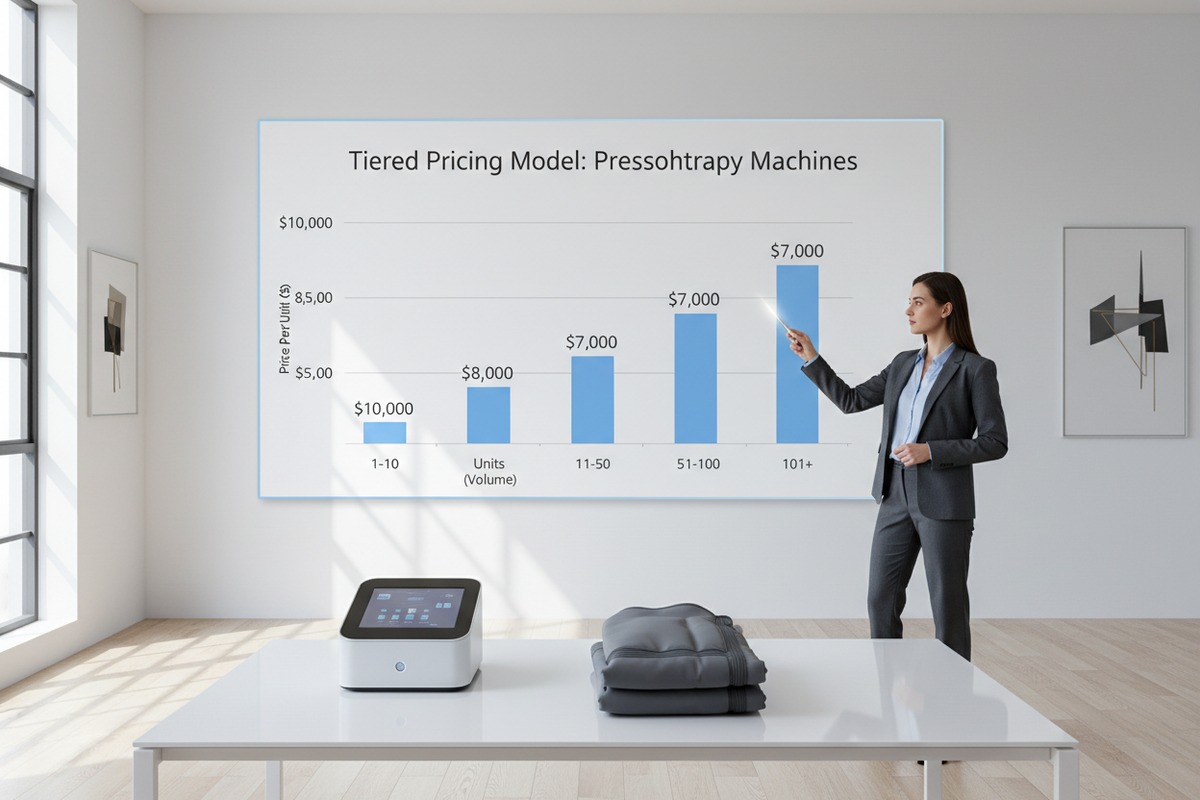
To secure lower unit prices, negotiate a tiered pricing structure based on total Annual Contract Value (ACV) or cumulative volume rebates. Instead of committing to a single massive order, establish price breaks that trigger retroactively once you hit specific quantity milestones throughout the contract year.
Structuring Price Tiers Effectively
Negotiating price is not just about beating the supplier down to the lowest number. It is about aligning your growth with their production efficiency. In our dealings with major distributors, we prefer transparency. If you can show us a realistic forecast, we can calculate the cost savings on our assembly line and pass them on to you.
The most effective method is a Tiered Pricing Model. This allows you to start with a fair base price but unlocks significant savings as your sales grow. This protects you if sales are slow, but rewards you when you succeed.
Understanding Cost Drivers
You should understand what drives the cost of a pressotherapy machine. The main components are the digital control unit (PCBs, software, casing) and the compression suit (fabric, air bladders, hoses).
- Raw Material Locking: Ask your supplier to lock in the cost of key components like the air compressor motor for 12 months.
- Escalation Caps: In your agreement, include a clause that caps price increases (e.g., max 3% per year) to protect against inflation. This is critical for multi-year deals.
Pricing Model Example
You can propose a table like this in your negotiation. It incentivizes the supplier to support your sales efforts because your success directly leads to larger orders.
| Annual Order Volume (Units) | Discount on Base Price | Retroactive Rebate | Condition |
|---|---|---|---|
| 0 – 50 | 0% | None | Standard Wholesale Price |
| 51 – 150 | 5% | 2% | Applies to all units once tier is reached |
| 151 – 300 | 10% | 3% | Significant raw material savings shared |
| 301+ | 15% | 5% | Priority production slot allocation |
Avoiding Hidden Costs
Be careful with "True-up" clauses. Some suppliers may try to charge you the difference if you fail to hit a forecast. Ensure the contract states that forecasts are non-binding estimates, not hard commitments. The tiered structure naturally handles this: if you buy less, you just don't get the discount, but you shouldn't pay a penalty.
What quality assurance clauses should I include in my framework agreement to protect my brand reputation?
Our quality control team often struggles when a client’s requirements are vague, such as simply asking for “good quality” or “no scratches.” Without specific standards, subjective interpretation leads to disputes. If you receive a batch of pressotherapy machines with faulty air pressure sensors, your brand’s reputation takes the hit before you can even process a return.
Your agreement must include detailed technical specifications, a maximum allowable defect rate (typically under 1%), and clear penalties for non-compliance. Explicitly define “defects” into critical, major, and minor categories, and mandate a pre-shipment inspection right for third-party agencies before final payment.

Defining Quality Metrics
Vague contracts cause the most headaches. In the framework agreement 3, you need to attach a detailed "Quality Standard Sheet" as an appendix. This sheet should define exactly what constitutes a defect. For pressotherapy systems, this is crucial because the equipment involves both electronics and pneumatic components.
Critical vs. Major vs. Minor Defects
You cannot treat a scratch on the packaging the same way as a machine that won't turn on.
- Critical Defect: Hazardous to the user or totally non-functional (e.g., electrical short, air pump failure). Tolerance should be 0%.
- Major Defect: Affects function or saleability (e.g., cracked casing, loud noise during operation, pressure not reaching set levels). Tolerance is usually 1.5% – 2.5%.
- Minor Defect: Cosmetic issues that don't affect function (e.g., slight color variation on the logo). Tolerance is usually 4%.
Warranty and Spare Parts
A standard warranty is often not enough for a B2B partnership. Service Level Agreement 4 You need a Service Level Agreement (SLA) for support.
- Spare Parts Allocation: Require the supplier to provide a free "spare parts kit" (e.g., 2% of the order quantity) with every shipment. This allows you to fix simple issues locally without waiting for shipping from China.
- Response Time: Define how quickly their engineering team must respond to a technical query (e.g., within 24 hours).
Quality Defect Classification Table
Include this classification in your contract to avoid arguments later.
| Defect Type | Description | Allowable Limit (AQL) | Remedy |
|---|---|---|---|
| Critical | Safety hazard, smoke, electric shock, complete failure. | 0% | Entire batch rejected; Supplier pays for return and replacement. |
| Major | Functional failure (low pressure), broken screen, damaged suit. | 1.0% | Supplier provides credit or free replacement units immediately. |
| Minor | Scratches on case, dirty packaging, crooked label. | 2.5% | Supplier provides discount on next order or spare parts. |
Software Consistency
For modern pressotherapy machines, software is key. Ensure a clause that forbids the supplier from changing the firmware version without written notice. Unannounced updates can cause bugs or change the user interface, confusing your customers.
How do I lock in guaranteed lead times and door-to-door shipping rates for the entire year?
We handle logistics daily and know that shipping rates can spike unpredictably, and production lines can get jammed before holidays. Relying on “best effort” delivery dates often leaves you with empty shelves during peak seasons. You need assurance that your orders will be prioritized over spot buyers when capacity is tight.
Negotiate a guaranteed manufacturing lead time (e.g., 25 days) with specific financial penalties for late delivery to ensure priority. For shipping, while you cannot fix fuel prices, you can lock in the supplier’s handling margins or agree on a safety stock model where they hold inventory for immediate dispatch.

The Power of Safety Stock
Lead time is the silent killer of sales. If your standard lead time is 45 days (30 production + 15 shipping), you are always reacting slowly to market changes.
In an annual framework, you can negotiate a Safety Stock Agreement.
- How it works: You agree to buy, say, 500 units over the year. You ask the manufacturer to keep 50 units of finished goods or semi-finished components (like the plastic housing and screens) in their warehouse at all times.
- The Benefit: When you place an order, the lead time drops from 30 days to 7 days because the goods are already made. You only pay for them when they ship.
Managing Logistics Costs
Shipping rates fluctuate (especially air freight or sea freight). It is hard for a manufacturer to give a fixed shipping price for a whole year. However, you can lock in the methodology.
- Fixed Margin: Agree that the supplier will charge the carrier's base rate + a small fixed handling fee (e.g., $50 per pallet). Ask for copies of the carrier bills to verify.
- DDP Terms: If you prefer door-to-door service, define the Incoterms 6 clearly. For DDP (Delivered Duty Paid), the supplier handles customs.
Lead Time Penalties
To ensure your order isn't pushed back for a larger client, you need teeth in the contract.
- Grace Period: Allow a small buffer (e.g., 5 days).
- Penalty Clause: If delivery is late beyond the grace period, the supplier pays a penalty (e.g., 0.5% of the order value per day of delay, capped at 10%).
Logistics Service Level Agreement (SLA)
| Metric | Target | Penalty for Non-Compliance |
|---|---|---|
| Production Lead Time | 25 Days max from deposit | 0.5% discount per day late |
| Documentation Accuracy | 100% (Invoice, Packing List) | Supplier covers all customs storage fees due to errors |
| Safety Stock Availability | 95% availability of agreed stock | Priority production on next order + 2% discount |
Peak Season Planning
Always include a specific clause for the "Chinese New Year" period. Production stops for 3-4 weeks. Your agreement should mandate that the supplier informs you of the cutoff date 60 days in advance and guarantees production slots for orders placed before that date.
Can I request open account payment terms within my annual contract with a Chinese manufacturer?
Our finance department reviews credit requests carefully, as cash flow is the lifeline of any factory. We understand that tying up your capital in 30% deposits and 70% pre-shipment payments restricts your ability to scale marketing. Moving to payment terms where you pay after delivery requires building significant trust and demonstrating financial stability.
Yes, you can negotiate open account (OA) terms, but this usually requires a structured credit transition plan or the use of credit insurance like Sinosure. Start by requesting a lower deposit (e.g., 10%) or Net 30 terms for a portion of the order, backed by your trade references and a history of on-time payments.

The Reality of Credit in China
Most Chinese manufacturers operate on thin margins and need cash to buy raw materials. "Net 30" or "Net 60" (paying 30 or 60 days after shipment) is risky for them. However, for a long-term framework agreement, it is a reasonable request.
Utilizing Sinosure
The key to unlocking credit is Sinosure (China Export & Credit Insurance Corporation).
- How it works: You provide your company's financial details to the supplier. They submit this to Sinosure 8. If Sinosure approves your credit rating, they insure the supplier against non-payment.
- The Result: The supplier is safe to offer you OA 60 or OA 90 days because the insurance covers them if you default. You might need to pay the small insurance premium (usually 0.5% – 1%), but it frees up your cash flow significantly.
The "Stair-Step" Approach
Do not expect Open Account terms on day one. Propose a phased evolution of payment terms in your contract based on trust milestones. This shows you are reasonable and allows the relationship to mature.
Payment Term Progression Table
| Phase | Duration | Payment Terms | Requirement to Advance |
|---|---|---|---|
| Trial Phase | First 2 Orders | 30% Deposit, 70% Before Shipment | Complete payments on time. |
| Growth Phase | Orders 3 – 5 | 10% Deposit, 90% Before Shipment | Cumulative volume > $50k. |
| Partner Phase | Orders 6+ | Net 30 Days (from Bill of Lading date) | Sinosure credit approval. |
| Strategic Phase | Year 2+ | Net 60 Days | Annual volume > $200k + Contract Renewal. |
Letter of Credit (LC)
If your annual volume is very high (e.g., over $500,000) but the supplier is hesitant about Open Account, suggest a Letter of Credit. It costs a bit in bank fees, but it offers security for both sides. The bank guarantees payment to the factory, and you only pay the bank when documents are compliant.
Conclusion
Negotiating an annual framework agreement shifts your relationship from a transactional buyer to a strategic partner. By leveraging your total annual volume for pricing tiers, defining strict quality metrics, locking in safety stock for faster logistics, and creating a roadmap for better payment terms, you gain control over your supply chain. This stability allows you to focus on marketing and growing your brand, knowing your pressotherapy equipment supply is secure, consistent, and cost-effective.
Footnotes
1. Describes a pricing model with different price points based on quantity or features. ↩︎
2. Explains the design, planning, and control of supply chain activities. ↩︎
3. Working page from the same authoritative domain, relevant definition. ↩︎
4. Defines a contract outlining service conditions, performance, and responsibilities between parties. ↩︎
5. Explains the maximum tolerable defect rate in a product batch per ISO 2859-1. ↩︎
6. Details international commercial terms published by the International Chamber of Commerce (ICC). ↩︎
7. Authoritative source (Wikipedia) providing a comprehensive definition of safety stock, which is the core concept of the original anchor. ↩︎
8. Official site of China Export & Credit Insurance Corporation, providing trade credit insurance. ↩︎

 English
 Español de México
 Deutsch
 Français
 العربية
 Русский
