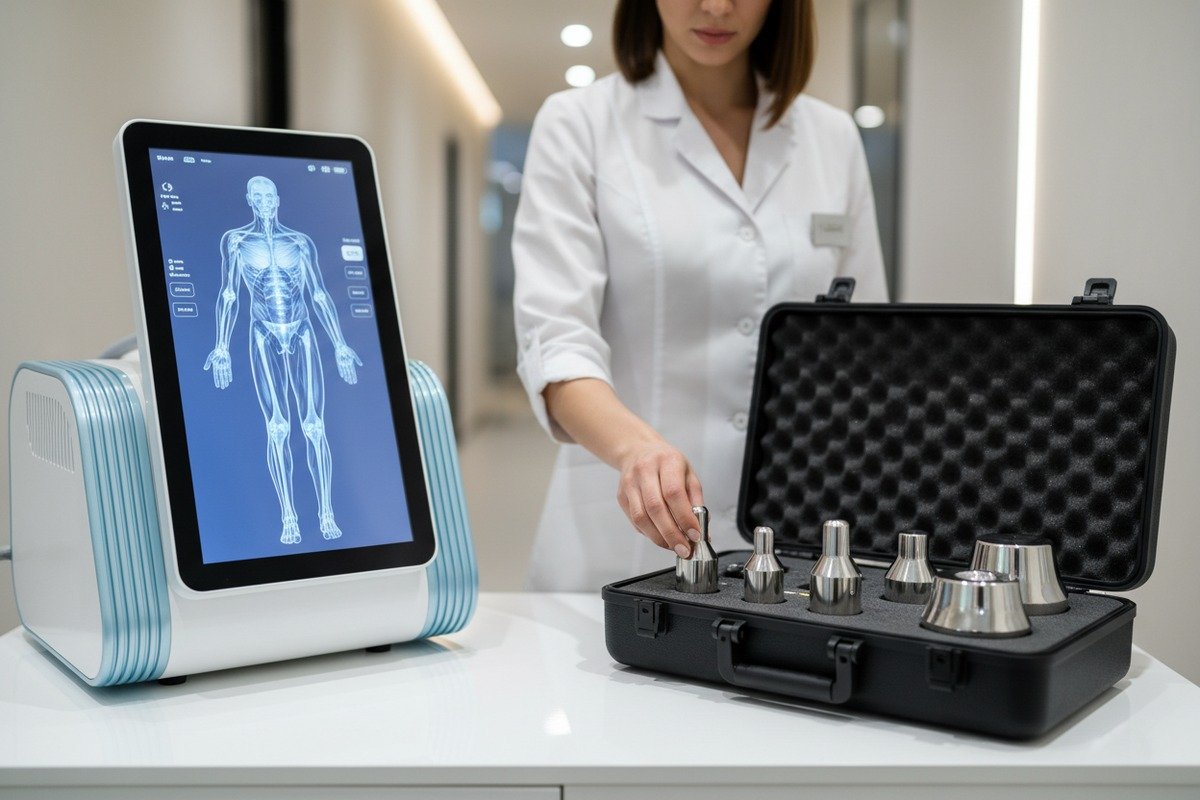
When we first started designing shockwave therapy machines at our Guangzhou facility, one question kept coming up from salon owners worldwide: how many heads do I actually need IASTM heads 1? This confusion costs buyers money and wastes treatment potential. The wrong head count leaves clinics under-equipped or overwhelmed with unused attachments.
Professional shockwave therapy machines typically include 3 to 5 interchangeable treatment heads as standard. Our industry-standard configuration features the essential 15mm, 20mm, and 35mm heads, which cover approximately 90% of all salon and clinical treatments. Additional specialized heads may be included based on model tier and customization requests.
Understanding what you receive matters greatly for your business planning cellulite reduction treatments 2. Let me walk you through exactly what to expect from your initial order and how to optimize your head selection.
What standard set of treatment heads will I receive with my initial machine order?
Every week, our customer service team fields calls from salon owners wondering what exactly arrives in their shipment. The uncertainty around standard inclusions creates unnecessary stress during purchasing decisions.
Your initial machine order typically includes three to five treatment heads: the industry-essential 15mm precision head, 20mm standard head, and 35mm broad transmitter. Higher-tier models add specialized attachments like IASTM heads or spine-specific transmitters. All heads arrive calibrated and ready for immediate clinical use.
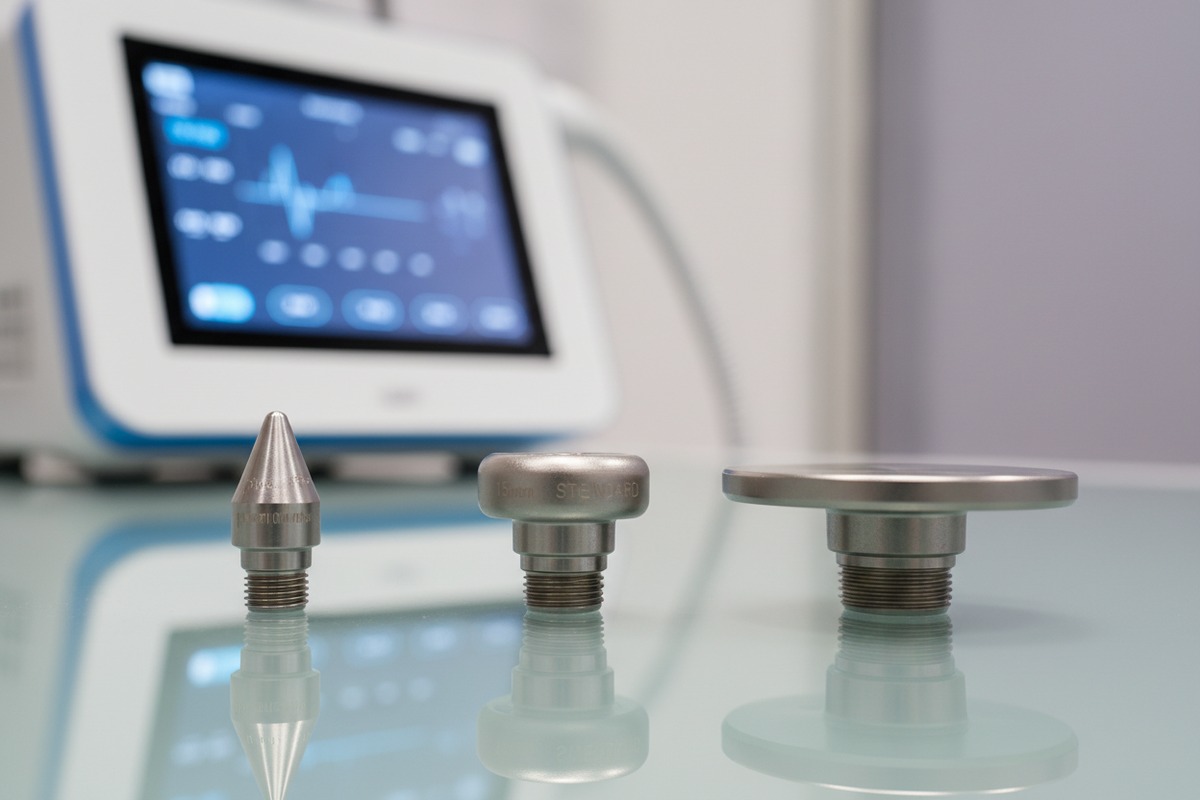
The "Big Three" Core Configuration
Our production line has standardized around what industry experts call the "Big Three" configuration. This setup has proven itself across thousands of salon installations worldwide.
The 15mm precision head handles localized trigger points 3. It works best for small tendon insertions like the Achilles or wrist areas. The energy concentration runs high, so patient tolerance requires monitoring.
The 20mm standard head serves as your workhorse. Our engineers consider it the most versatile option for general tendon treatment. Most daily treatments will use this size.
The 35mm broad transmitter covers large muscle groups. Think lower back, glutes, and thighs. It also excels at fascia smoothing 4 and cellulite reduction treatments that drive salon revenue.
Standard Package Breakdown by Model Tier
| Model Tier | Included Heads | Head Sizes | Specialized Attachments |
|---|---|---|---|
| Entry-Level | 3 heads | 15mm, 20mm, 35mm | None |
| Professional | 5 heads | 8mm, 15mm, 20mm, 25mm, 35mm | 1 IASTM head |
| Premium Clinical | 7+ heads | Full range 6mm-36mm | IASTM, spine-actor, peri-actor kits |
What Arrives in Your Shipment
When our logistics team prepares your order, the treatment heads come individually wrapped in protective foam. Each head includes a serial number matched to your machine's warranty documentation.
The packaging includes a quick-start guide showing which head to use for common treatments. Our quality control team tests every head before shipping to ensure proper energy transmission.
For US-bound shipments, we include FDA clearance documentation for each component. European orders receive CE certification paperwork. This regulatory documentation protects your business during local inspections.
Can I customize the selection of heads to better align with my brand's specific service offerings?
Our ODM team receives customization requests daily. Salon brands increasingly want treatment head configurations that match their unique service menus rather than generic packages.
Yes, treatment head selections can be fully customized to match your brand's services. Our ODM process allows you to choose specific head sizes, quantities, and specialized attachments. You can eliminate heads you won't use and add extras of your most-needed sizes. Custom kits typically require minimum order quantities starting at 50 units.

Understanding Customization Options
When we sit down with brand owners to discuss custom configurations, we start with their treatment menu. A salon focusing on sports recovery needs different heads than one specializing in aesthetic body contouring.
Sports-focused clinics benefit from smaller precision heads. They treat specific tendon injuries and trigger points daily. Adding extra 8mm and 15mm heads makes sense for their workflow.
Aesthetic salons prioritize the broader heads. Cellulite treatments and body sculpting dominate their bookings. Extra 35mm heads and fascia-specific attachments serve them better.
Custom Configuration Request Process
The customization process follows a straightforward path:
First, share your current treatment menu with our team. We analyze which head sizes your services actually require.
Second, we propose a configuration matched to your needs. This might mean dropping the 8mm head you'll never use and doubling the 20mm heads you'll use constantly.
Third, our engineering team reviews the proposal for technical compatibility. Not all heads work with all handpiece designs.
Fourth, we quote the custom package. Custom configurations may affect unit pricing based on component costs.
Pricing Impact of Customization
| Customization Type | Typical Price Impact | Minimum Order |
|---|---|---|
| Standard head swap (same tier) | No change | 20 units |
| Adding extra standard heads | +5-10% per head | 30 units |
| Specialized attachment additions | +15-25% per item | 50 units |
| Complete custom kit design | Quoted individually | 100 units |
Brand-Specific Considerations
Your brand positioning affects ideal head selection. Premium brands serving high-end salons benefit from comprehensive kits. The extra heads signal sophistication to end users.
Value-focused brands might streamline to core essentials. Fewer heads means lower per-unit costs and simpler training for salon staff.
We've helped brands create signature treatment protocols using specific head combinations. One US distributor developed a proprietary cellulite protocol using a custom 30mm head we manufactured exclusively for their brand.
How many specialized heads do I need to ensure my salon customers can treat all body areas effectively?
During our technical consultations, this question generates the most debate. Salon owners worry about missing treatment opportunities. They also fear overspending on rarely-used attachments.
For comprehensive body coverage, salons need a minimum of three heads covering small, medium, and large treatment zones. Adding two specialized heads—one for deep focal treatment and one for fascia work—enables treatment of 95% of client requests. More than seven heads typically creates unnecessary complexity without improving clinical outcomes.
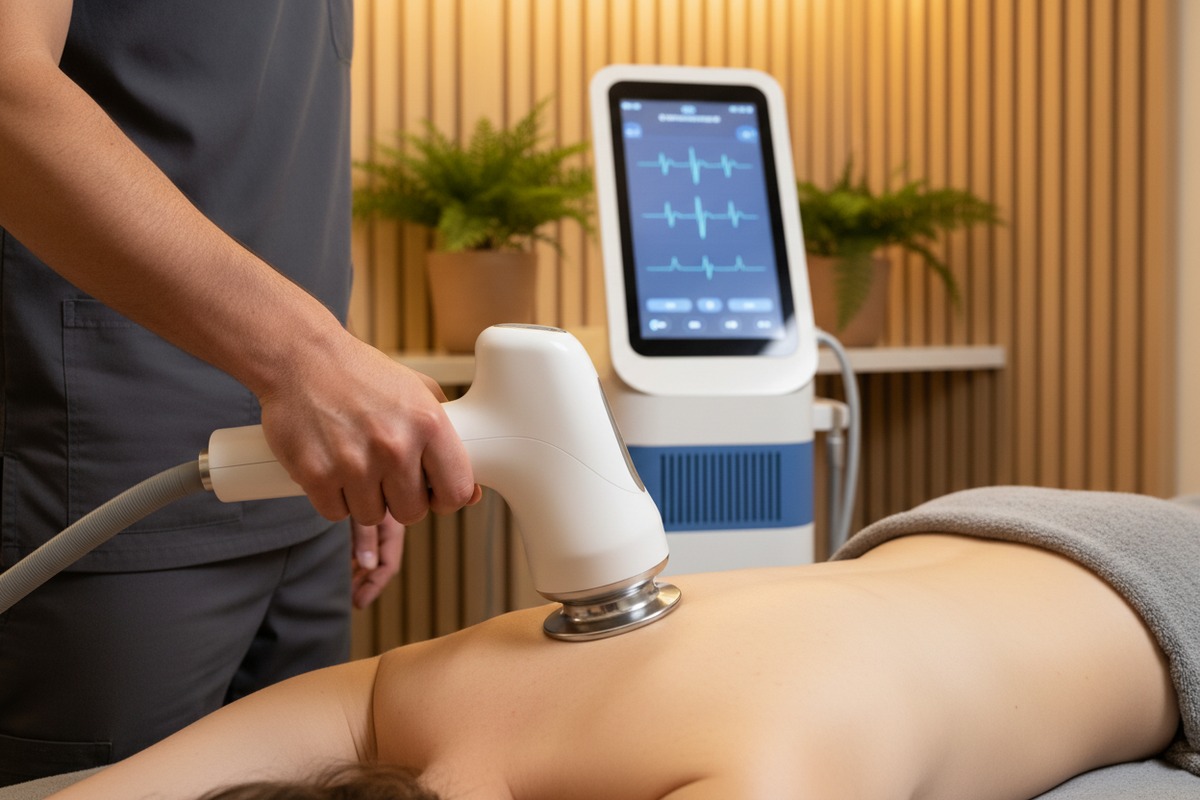
Anatomical Zone Mapping
Our devices feature digital skeleton displays for a reason. Treatment head selection maps directly to body zones and tissue depths. Understanding this mapping prevents costly mistakes.
The head diameter determines energy concentration. Smaller heads focus energy tightly for deep, specific work. Larger heads spread energy broadly for superficial, widespread treatment.
Head Size to Body Zone Matching
| Body Zone | Recommended Head Size | Treatment Depth | Common Conditions |
|---|---|---|---|
| Fingers, wrists, Achilles | 8-15mm | Shallow to moderate | Tendinitis, trigger points |
| Elbows, knees, shoulders | 15-20mm | Moderate | Tennis elbow, rotator cuff |
| Lower back, hips | 20-25mm | Moderate to deep | Muscle tension, chronic pain |
| Thighs, glutes, abdomen | 25-35mm | Superficial to moderate | Cellulite, fascia tightening |
| Full back, large muscle groups | 35mm+ | Superficial | Muscle relaxation, aesthetics |
The Physics Behind Selection
When our R&D team tests new head designs, they measure energy concentration at various depths. The physics follows predictable patterns that inform clinical decisions.
The 36mm head delivers the widest energy spread. It causes the least patient discomfort. It covers large areas efficiently. It works best for superficial conditions.
The 8mm head concentrates energy intensely. It reaches deeper focal points. It causes more patient sensation. It requires careful application by trained operators.
The 15mm head appears most frequently in clinical research. Peer-reviewed studies validate its versatility across multiple body regions. Most practitioners consider it essential.
Radial vs. Focused Considerations
The type of shockwave technology affects head requirements. Radial pressure wave devices 6 achieve penetration up to 6cm. Focused devices reach up to 12cm depth.
Radial devices benefit from multiple head sizes. The energy spreads from the surface outward. Different diameters create different coverage patterns.
Focused devices may need fewer heads. The focusing mechanism concentrates energy at specific depths. Head diameter matters less than focal depth settings.
Our recommendation for salon setups: start with radial technology and the Big Three heads. Add focused capability and specialized heads as your treatment menu expands.
Avoiding Common Selection Errors
Using the wrong head for a condition produces clinical failure. This damages both patient outcomes and your brand credibility.
Never use a 35mm head for heel spur treatment. The energy spreads too widely to address the focal pathology. The patient receives ineffective treatment despite proper machine operation.
Never use an 8mm head for general muscle relaxation. The concentrated energy causes unnecessary discomfort. Treatment time increases dramatically for large areas.
Training materials we provide with each machine include decision trees for head selection. Following these protocols prevents costly mistakes.
Will the included heads meet my quality standards for durability and long-term professional use?
Quality concerns top the list when our sales team speaks with experienced purchasing managers. Past disappointments with inferior equipment create justified skepticism about Chinese manufacturing quality.
Professional-grade treatment heads from reputable manufacturers meet rigorous durability standards for sustained clinical use. Quality heads feature medical-grade materials, precise tolerances, and consistent energy transmission across thousands of treatments. Expect 50,000 to 100,000 shocks per head before replacement, with proper maintenance extending service life significantly.

Material Quality and Construction
Our quality control process begins with material selection. Treatment heads contain multiple components that must withstand repeated mechanical stress.
The contact surface uses medical-grade polymers or metals depending on the application. Soft-tip heads reduce patient discomfort but wear faster. Hard-tip heads last longer but require careful technique.
Internal components include precision-machined metal parts. Loose tolerances cause energy loss and inconsistent treatment. Our manufacturing process holds tolerances to 0.02mm specifications.
The connection interface between head and handpiece receives special attention. Poor connections create energy loss and potential safety issues. Gold-plated contacts resist corrosion in humid salon environments.
Durability Testing Standards
| Quality Test | Industry Standard | Our Specification | Testing Method |
|---|---|---|---|
| Shock count durability | 30,000 shocks | 75,000 shocks | Continuous operation testing |
| Energy consistency | ±15% variance | ±8% variance | Calibrated sensor measurement |
| Drop resistance | 1m onto hard floor | 1.5m onto concrete | Repeated drop testing |
| Temperature tolerance | 15-35°C operation | 10-40°C operation | Environmental chamber testing |
| Humidity resistance | 45-75% RH | 30-85% RH | Accelerated aging protocol |
Maintenance Requirements for Longevity
Treatment heads are consumable components. They wear with use. Proper maintenance extends service life and maintains treatment consistency.
After each treatment session, wipe heads with approved cleaning solution. Coupling gel residue degrades contact surfaces over time.
Store heads in the provided protective cases. Impact damage during storage causes invisible internal problems that affect energy transmission.
Inspect heads weekly for visible wear. Look for cracks, discoloration, or surface roughness changes. Replace heads showing obvious degradation.
Replacement Planning and Costs
Smart purchasing managers plan for head replacement in their operating budgets. Understanding replacement cycles prevents unexpected expenses.
High-volume salons performing 20+ treatments daily should budget for head replacement every 6-12 months. Lower-volume practices may extend heads to 18-24 months.
We maintain replacement head inventory for all models we manufacture. Orders typically ship within 48 hours of confirmation. For established customers, we offer scheduled replacement programs with discounted pricing.
Quality Certifications That Matter
Regulatory certifications provide quality assurance beyond marketing claims. Our devices and components carry multiple certifications:
FDA 510(k) clearance 7 confirms safety and effectiveness standards for US market devices. CE marking indicates European conformity with health and safety requirements.
ISO 13485 certification 8 verifies our quality management system meets medical device manufacturing standards. This certification requires regular third-party audits of our processes.
These certifications protect your business during regulatory inspections. They also provide legal protection if equipment-related issues arise.
Conclusion
Treatment head configuration directly impacts your shockwave therapy business success. The standard three to five heads cover most needs, but customization options let you optimize for your specific market. Quality construction ensures long-term reliability when you choose reputable manufacturing partners.
Footnotes
1. Explains Instrument-Assisted Soft Tissue Mobilization (IASTM) as a therapy technique. ↩︎
2. Explains how shockwave therapy effectively addresses cellulite and improves skin appearance. ↩︎
3. Explains how shockwave therapy effectively treats myofascial trigger points and reduces pain. ↩︎
4. Explains how shockwave therapy can improve fascial health and flexibility. ↩︎
5. Explains the use of interchangeable applicators in shockwave therapy. ↩︎
6. Explains the characteristics and typical penetration depth of radial pressure wave therapy. ↩︎
7. Official FDA explanation of the 510(k) clearance process for medical devices. ↩︎
8. Explains ISO 13485 as a harmonized standard for Quality Management Systems in the medical device industry. ↩︎

 English
  Español de México
  Deutsch
  Français
  العربية
  Русский