We frequently encounter clients who face customs seizures or safety recalls because they underestimated the regulatory gap Bill of Materials (BOM) 1. Sourcing complex lymphatic drainage systems 2 requires navigating a maze of incompatible safety protocols and voltage requirements.
Managing quality standard differences requires mapping local regulations like FDA or CE against Chinese GB standards early in the negotiation. You must explicitly define component specifications, mandate IEC-compliant testing reports, and enforce rigorous third-party pre-shipment inspections to bridge the gap between domestic manufacturing norms and your market’s safety requirements.
Here is a proven framework regarding compliance and quality control to align our production lines with your specific import needs.
How can I ensure the pressotherapy machines meet my local safety and certification standards?
Importing non-compliant devices can trigger immediate customs seizures and ruin a brand’s reputation. Our engineering team constantly updates our internal protocols to match the evolving regulatory landscape of export markets like the US and Europe.
Ensure compliance by requesting a Declaration of Conformity that specifically references IEC 60601-1 for safety and IEC 60601-1-2 for EMC. Do not rely solely on a standard CCC certificate; verify that the manufacturer has performed gap analysis testing to meet the specific voltage, plug, and safety directives of your target country.

Navigating the landscape of international certifications is one of the most challenging aspects of our daily operations in Guangzhou. Many buyers assume that a certificate valid in China, such as the China Compulsory Certification (CCC), automatically translates to safety in the United States or the European Union. This is a dangerous misconception. While our domestic standards are rigorous, they do not always align with the specific electrical and risk management requirements of the FDA or the EU Medical Device Regulation (MDR) 3.
The Regulatory Gap
When we develop a new pressotherapy model for the domestic market, we focus on GB standards. However, for our export clients, we must shift our focus to the IEC 60601 series. This is the global benchmark for medical electrical equipment. A machine wired for China's 220V/50Hz grid may physically work in Europe, but without specific EMC (Electromagnetic Compatibility) shielding required by CE standards, it could interfere with other electronic devices.
For the US market, the distinction is even sharper. Pressotherapy devices are often classified as Class II medical devices. This means we must assist our clients by providing a detailed Device Master Record (DMR) and ensuring our manufacturing process aligns with 21 CFR Part 820 4 quality system regulations.
Key Standards Comparison
To help you understand the specific documentation you need to request from us or any other supplier, we have compiled the following comparison table.
| Standard Category | China (Domestic) | United States (FDA) | European Union (CE) |
|---|---|---|---|
| Electrical Safety | GB 9706.1 | ANSI/AAMI ES60601-1 | EN 60601-1 |
| EMC (Interference) | YY 0505 | IEC 60601-1 5-2 | EN 60601-1-2 |
| Biocompatibility | GB/T 16886 | ISO 10993 | ISO 10993 |
| Quality Management | YY/T 0287 | 21 CFR Part 820 | ISO 13485 |
Verification Strategy
Do not just ask for "certificates." Ask for full test reports. A certificate is a single piece of paper; a test report is a 50+ page document detailing exactly how the machine performed under stress. We always advise our clients to verify the authenticity of these reports by contacting the testing laboratory directly. This step eliminates the risk of forged documentation, which unfortunately happens in the industry.
What steps should I take to verify the internal component quality of my custom pressotherapy units?
Hidden cheap components often cause premature pump failure or inaccurate pressure readings. We meticulously source air pumps and PCBs to prevent the common overheating issues found in budget models sold by trading companies.
Verify internal quality by specifying key components like the air pump type, solenoid valves, and PCB layout in your purchase agreement. Request a Bill of Materials (BOM) listing specific brands or technical parameters, and demand photos of the internal assembly during production to confirm these specified parts are actually installed.
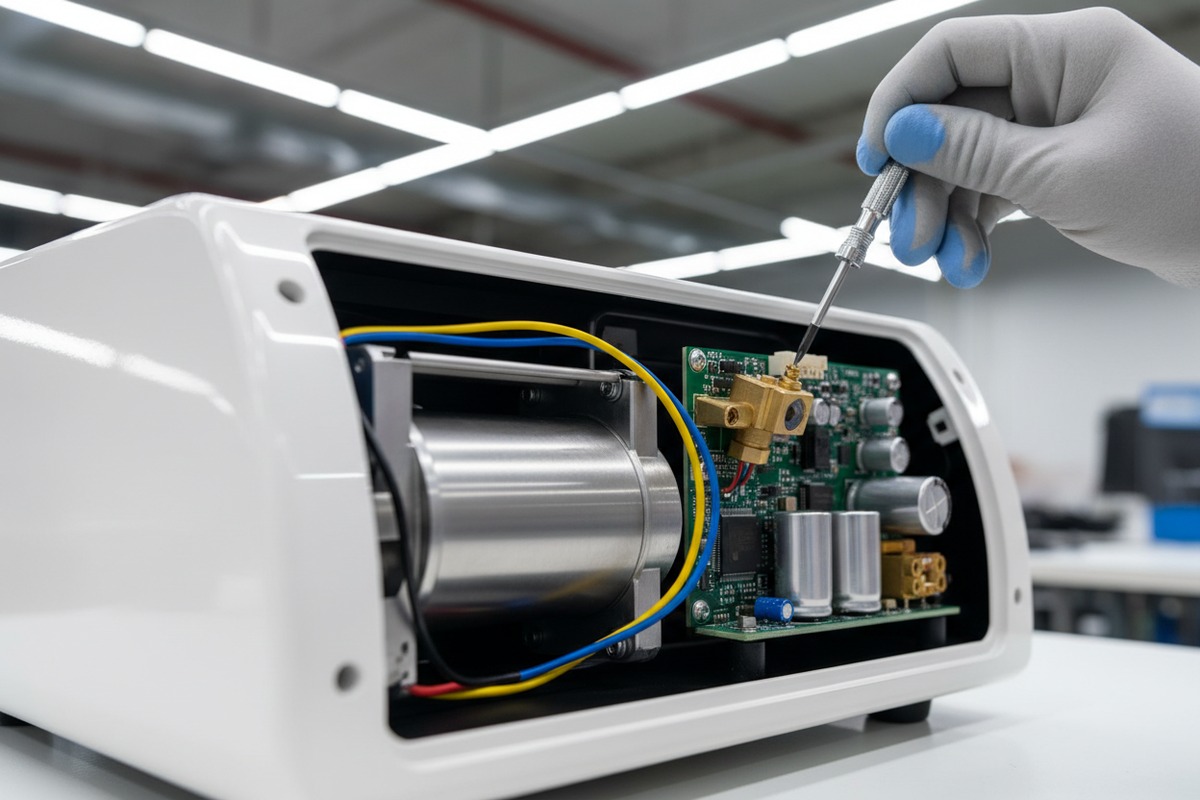
The exterior of a pressotherapy machine often tells you very little about its longevity. We have seen competitors produce machines that look identical to our high-end models on the outside but use inferior components on the inside to cut costs. This "black box" issue is where quality standard differences most frequently occur. As a buyer, you must penetrate the casing and define what goes inside.
The Heart of the System: Air Pumps
The air pump is the most critical component. In cheaper models, manufacturers often use diaphragm pumps with plastic gears. These are prone to overheating and losing pressure consistency after a few months of heavy salon use. In our high-end export models, we utilize heavy-duty piston pumps with metal components. These provide stable pressure (up to 250 mmHg) and have a significantly longer lifespan. You should specifically ask your supplier about the "continuous working time" rating of the pump.
Material Selection for Cuffs
The quality of the suit or cuffs is just as important as the main unit. This is the part that touches the client's skin. We frequently see disputes arise because the supplier used PVC (Polyvinyl Chloride) instead of TPU (Thermoplastic Polyurethane) 7.
- PVC: Rigid, prone to cracking, smells like plastic, cheaper.
- TPU: Flexible, durable, hypoallergenic, higher cost.
If you do not specify TPU in your contract, many factories will default to PVC to save money.
Component Specification Checklist
When negotiating, we recommend attaching a component specification sheet to your contract. This removes ambiguity.
| Component | Standard/Low-End Spec | High-End/Export Spec | Impact on Quality |
|---|---|---|---|
| Air Pump | Plastic Diaphragm | Metal Piston / Oil-less | Longevity & Noise Level |
| Solenoid Valves | Generic Chinese Brand | Taiwan/Japan Imported | Airflow Control Precision |
| Suit Material | 0.2mm PVC | 0.4mm High-grade TPU | Comfort & Durability |
| PCB Board | Single-layer, Uncoated | Multi-layer, Moisture-proof | System Stability |
The "Open Box" Audit
We encourage our clients to perform an "open box" audit on the pre-production sample. Ask us to unscrew the casing and show you the wiring harness. Are the wires organized and zip-tied, or are they a tangled mess? Are the soldering points clean? These visual cues are strong indicators of the overall manufacturing discipline.
How do I implement a reliable pre-shipment inspection process to avoid receiving defective equipment?
Discovering defects after the container arrives in the US destroys profit margins and damages distributor relationships. We encourage clients to send inspectors to our Guangzhou floor before final packaging begins to ensure everything works perfectly.
Implement reliable inspections by defining a checklist that covers functional testing, pressure accuracy verification, and visual checks for cosmetic flaws. Hire a third-party agency to conduct a random sampling based on AQL standards, and condition the final payment on a “PASS” report to ensure the factory addresses any issues before shipping.
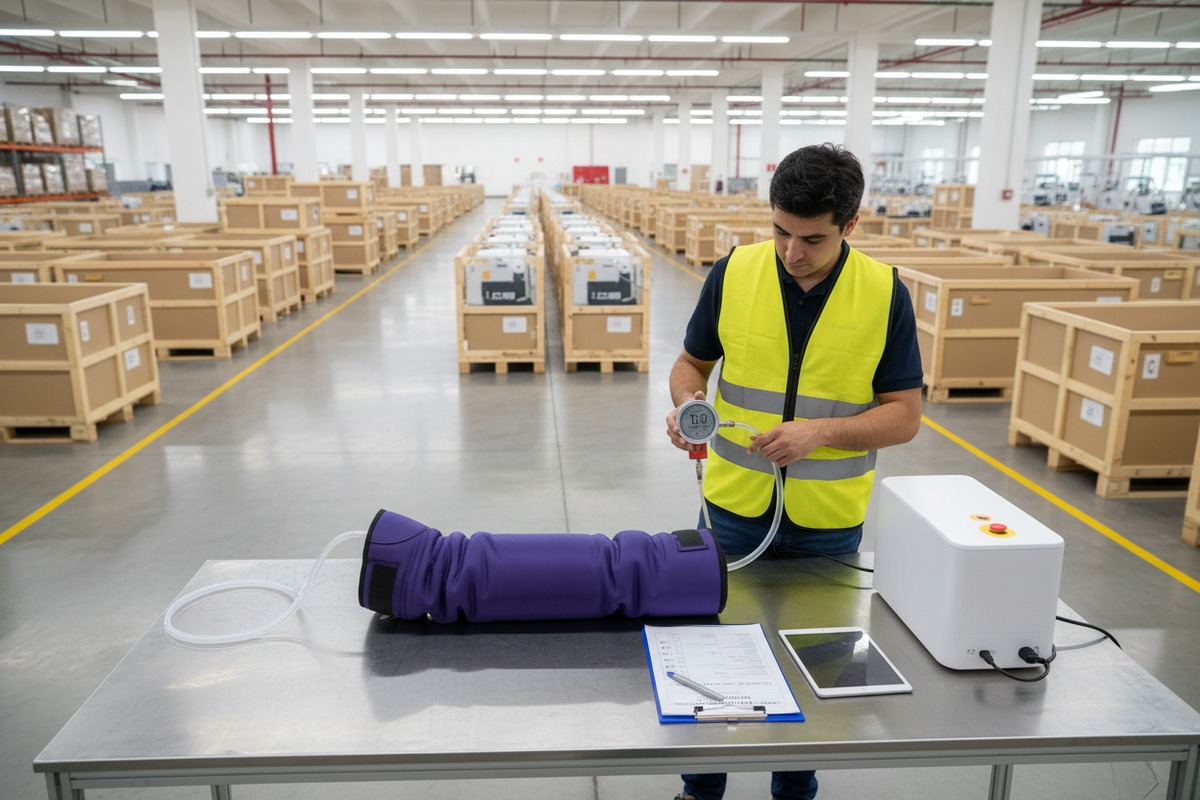
In our experience, the most successful importers are those who trust but verify. Even with our rigorous internal QC, we always welcome third-party inspectors. It adds a layer of security for you and validates our quality claims. However, an inspection is only as good as the instructions you provide. If you just tell an inspector to "check the machine," they might only look for scratches. You need a functional testing protocol specific to pressotherapy.
Defining the AQL Standard
You should use the Acceptable Quality Limit (AQL) 8 standard, typically AQL 2.5 for major defects and 4.0 for minor defects. This statistical method determines how many units the inspector needs to test from a batch. For a typical order of 100 machines, they might test 20 units extensively.
Critical Functional Tests
For pressotherapy machines, visual inspection is not enough. The inspector must run the machine. We recommend including the following specific tests in your inspection booking form:
- Pressure Accuracy Test: Use an external digital manometer to verify the machine's display matches the actual output. If the screen says 120 mmHg, the cuff output should be within ±10%.
- Air Leakage Test: Inflate the suit to maximum pressure and hold it for 5 minutes. There should be no significant drop in pressure.
- Cycle Logic Test: Verify that the inflation sequence (e.g., foot to thigh) operates exactly as described in the manual.
- Noise Level Test: Measure the decibel level during operation. It should generally be under 50-55dB for a salon environment.
Dealing with Failed Inspections
If the inspection fails, what happens? This must be agreed upon beforehand. Our standard policy—and what you should demand from any supplier—is that if the failure is due to manufacturing defects, the factory bears the cost of re-work and the cost of the second inspection. This creates a financial incentive for us to get it right the first time.
Visualizing the Inspection Criteria
Below is an example of how to categorize defects for your inspector.
| Defect Type | Definition | Example in Pressotherapy | Action |
|---|---|---|---|
| Critical | Hazardous or unsafe | Exposed wiring, non-functional emergency stop | Reject Shipment |
| Major | Functional failure | Pressure deviation >10%, air leakage, screen glitch | Reject Batch |
| Minor | Cosmetic only | Slight scratch on bottom, logo misalignment <2mm | Accept with Note |
How can I clearly communicate my brand’s specific quality requirements to a Chinese manufacturer?
Misunderstandings often arise when specifications are vague or lost in translation during late-night WhatsApp chats. We appreciate clients who provide visual guides and precise technical data sheets during the initial inquiry phase.
Communicate requirements effectively by creating a detailed Quality Control (QC) dossier that includes annotated photos, Pantone color codes, and acceptable tolerance levels. Avoid vague terms like “high quality” and instead use quantifiable metrics, such as “noise level under 50dB” or “pressure range 80-250mmHg,” to leave no room for interpretation.
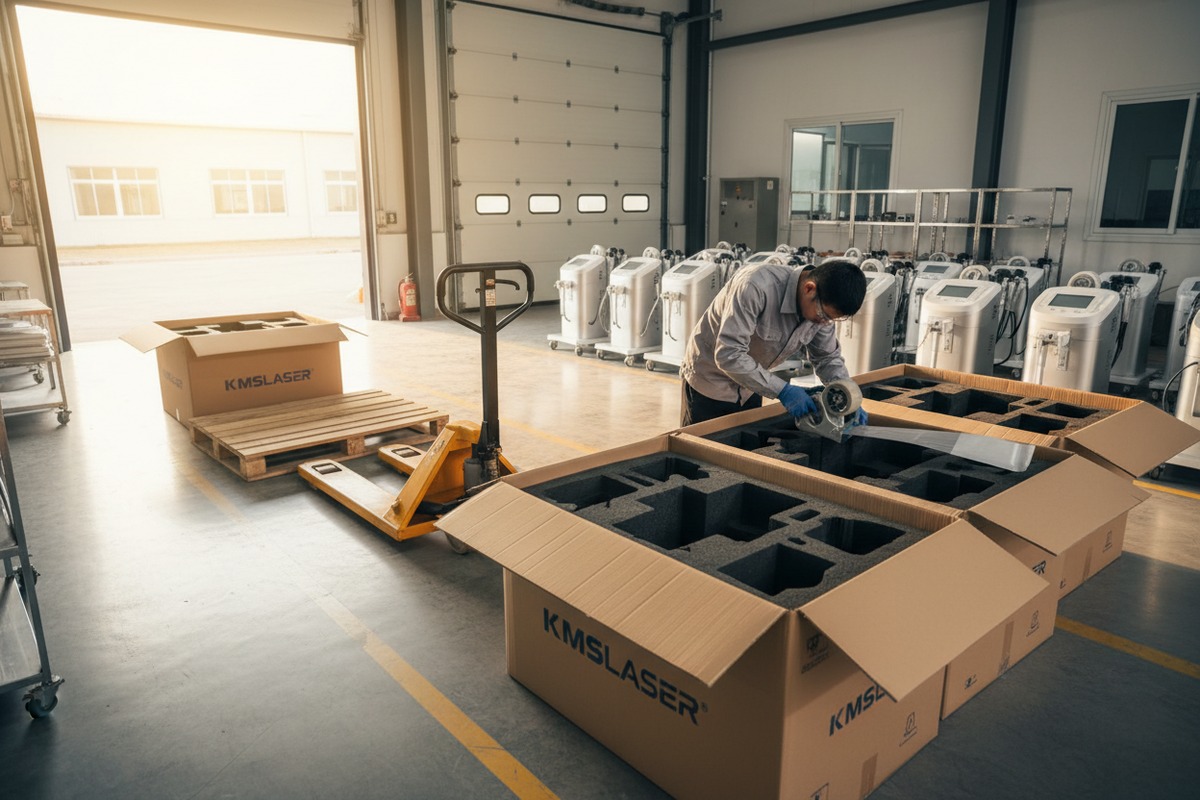
The biggest friction point we see in international trade is the definition of "quality." To a factory production manager, "quality" might mean the machine turns on. To you, it means the white plastic finish is matte, not glossy, and the buttons have a specific tactile click. To bridge this gap, you must move from subjective adjectives to objective data.
The Power of the "Golden Sample"
Before mass production begins, we always aim to produce a "Golden Sample." This is the perfect prototype that you have signed, sealed, and approved. We keep one, and you keep one. If a dispute arises regarding the color of the casing or the texture of the cuffs, we simply compare the production unit to the Golden Sample. This physical benchmark is worth a thousand emails.
Building a QC Dossier
Do not rely on scattered emails. compile a single PDF document—your QC Dossier—that we can print and hang on the assembly line. This document should include:
- Pantone Colors: Don't say "dark purple"; say "Pantone 2685 C."
- Logo Placement: Use schematics showing the exact millimeter distance from the edge.
- Packaging: Specify the thickness of the cardboard (e.g., K=K corrugated) and the type of foam (EPE vs. EPS).
- User Manual: Provide the exact English text. We are experts in manufacturing, not English grammar. If you leave the manual writing to the factory, you will get "Chinglish."
Cultural Competency in Communication
We value directness, but context matters. When you send requirements, explain why something is important. For example, instead of just saying "Use reinforced tubing," say "Our market uses these machines for 10 hours a day, so reinforced tubing prevents bursting." When our engineers understand the usage scenario, they are more likely to respect the stringent requirement rather than viewing it as the buyer being difficult.
Communication Checklist
- Avoid: "Make it look nice."
- Use: "Surface finish must be free of scratches visible from 30cm away."
- Avoid: "Pack it safely."
- Use: "Must pass ISTA 1A drop test standards."
- Avoid: "I want good pressure."
- Use: "Pressure must reach 250mmHg ±10% within 45 seconds."
Conclusion
Successfully managing quality standards requires shifting from passive sourcing to active supply chain management. By aligning regulatory certifications, verifying internal components, enforcing strict pre-shipment inspections, and communicating through precise data rather than vague descriptions, you secure your brand's reputation. We are ready to collaborate with buyers who value these rigorous standards to build long-term success.
Footnotes
1. Replaced with a Wikipedia link for a general and authoritative overview of Bill of Materials. ↩︎
2. Provides a comprehensive medical definition and function of lymphatic drainage systems. ↩︎
3. Explains the scope, objectives, and key requirements of the EU Medical Device Regulation. ↩︎
4. Replaced with a comprehensive guide from a reputable industry source, as a direct FDA.gov page for the current regulation was not readily available without being a PDF. ↩︎
5. Details the fundamental standard for basic safety and essential performance of medical electrical equipment. ↩︎
6. Found an authoritative EU source for Declaration of Conformity. ↩︎
7. Describes the properties and characteristics of Thermoplastic Polyurethane as a versatile material. ↩︎
8. Explains the statistical method used in quality control to determine acceptable defect levels. ↩︎

 English
  Español de México
  Deutsch
  Français
  العربية
  Русский