
Navigating technical specs for air compression systems 1 can be frustrating. We often see distributors struggle when machines don’t deliver the precise wave patterns their high-end clinic clients demand for recovery.
To inquire about pressotherapy pressure profiles, ask for a stage-by-stage mmHg map, verify the distal-to-proximal inflation sequence, and request calibration logs. Ensure the machine supports independent chamber control and specific clinical modes like lymphatic drainage, venous insufficiency, and muscle recovery for targeted results.
Knowing the right questions ensures you get a device that performs as promised. Let’s dive into the specific ways to verify these technical details with your supplier.
How can I verify that the manufacturer’s pressure profiles meet my specific clinical treatment standards?
When we design our circuit boards, we prioritize how the air pressure builds up in each chamber. You need to know if the software actually matches the physical output during a session.
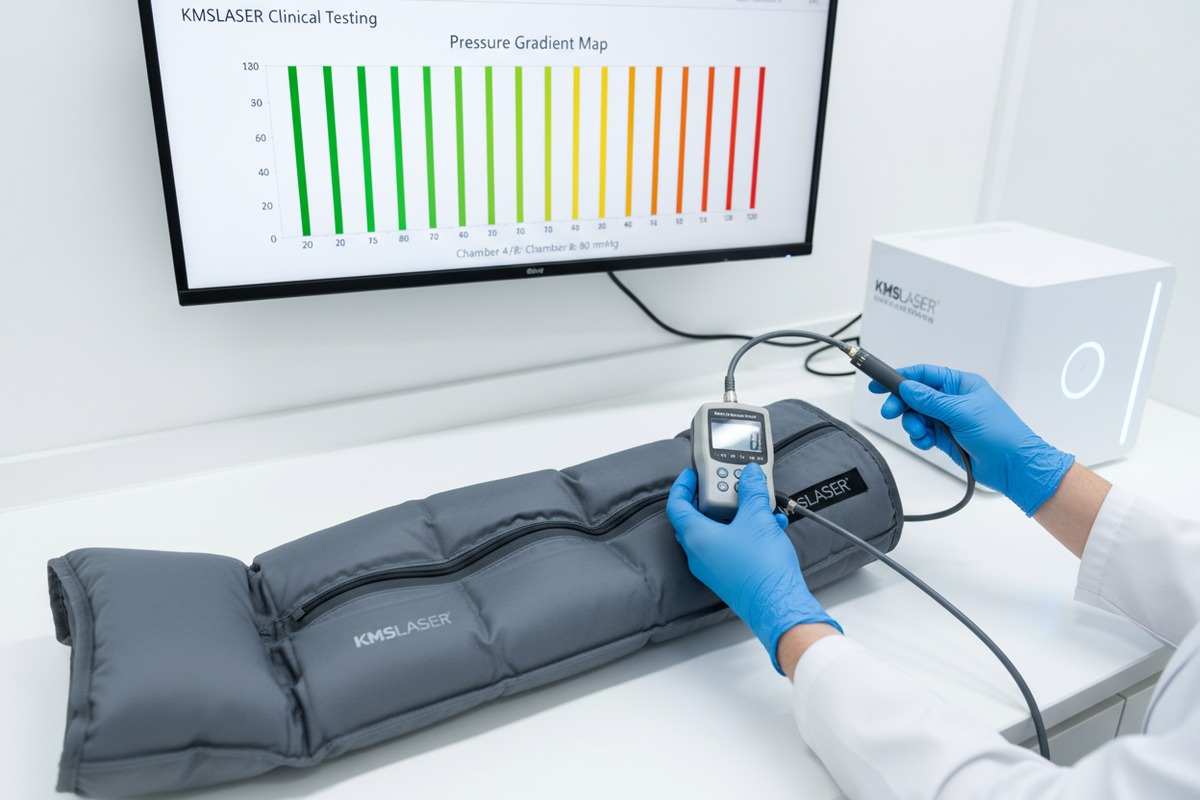
Verify clinical standards by requesting a "Pressure Gradient Map" for each pre-programmed mode. Check if the mmHg ranges align with medical benchmarks: 20-40 mmHg for lymphatic drainage and up to 120 mmHg for lymphedema. Cross-reference these with independent laboratory accuracy certifications.
Understanding Pressure Gradients
Clinical effectiveness depends on the gradient. In a high-quality system, the pressure should be highest at the ankle (distal) and gradually decrease as it moves toward the thigh (proximal). This mimics the natural movement of lymph 2. If the machine applies uniform pressure everywhere, it may actually block flow instead of encouraging it. We recommend asking for a chart that shows the specific mmHg target for each of the 5 to 24 chambers.
Comparing Modes for Specific Outcomes
Not all "drainage" modes are created equal. You should compare how the machine handles different pathologies. For example, a "Wave" mode is different from a "Squeeze" mode. A wave mode inflates one chamber at a time, while a squeeze mode might keep previous chambers inflated to create a continuous sleeve of pressure.
| Treatment Goal | Recommended Pressure Range | Common Inflation Pattern |
|---|---|---|
| Lymphatic Drainage | 20 – 40 mmHg | Sequential Wave |
| Cellulite Reduction | 60 – 80 mmHg | Peristaltic Squeeze |
| Muscle Recovery | 100 – 150 mmHg | Rapid Pulse |
| Lymphedema (Lower Limb) | 60 – 120 mmHg | Gradient Compression |
Testing Real-World Accuracy
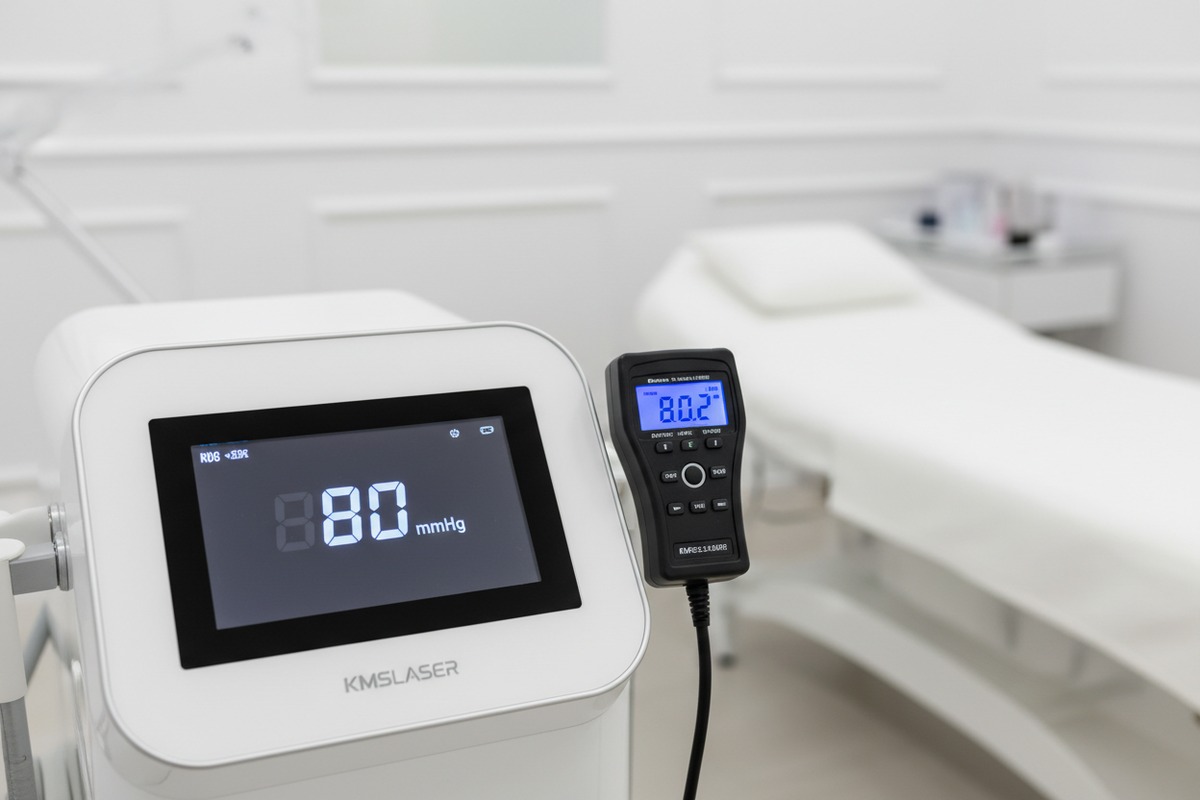
Ask your supplier if they use external digital manometers 3 during their final QC check. A screen might display "80 mmHg," but the actual pressure inside the garment could be lower due to air leaks or poor pump strength. We always provide our distributors with a calibration report that proves the "Displayed Value" vs. the "Actual Value" has less than a 5% deviation. This transparency protects your brand reputation when selling to medical professionals.
What technical documentation should I request to evaluate the stability of the machine’s pressure stages?
In our testing lab, we run compressors for hundreds of hours to ensure they don't lose power mid-cycle. Stability is the difference between a professional tool and a cheap home-use toy.
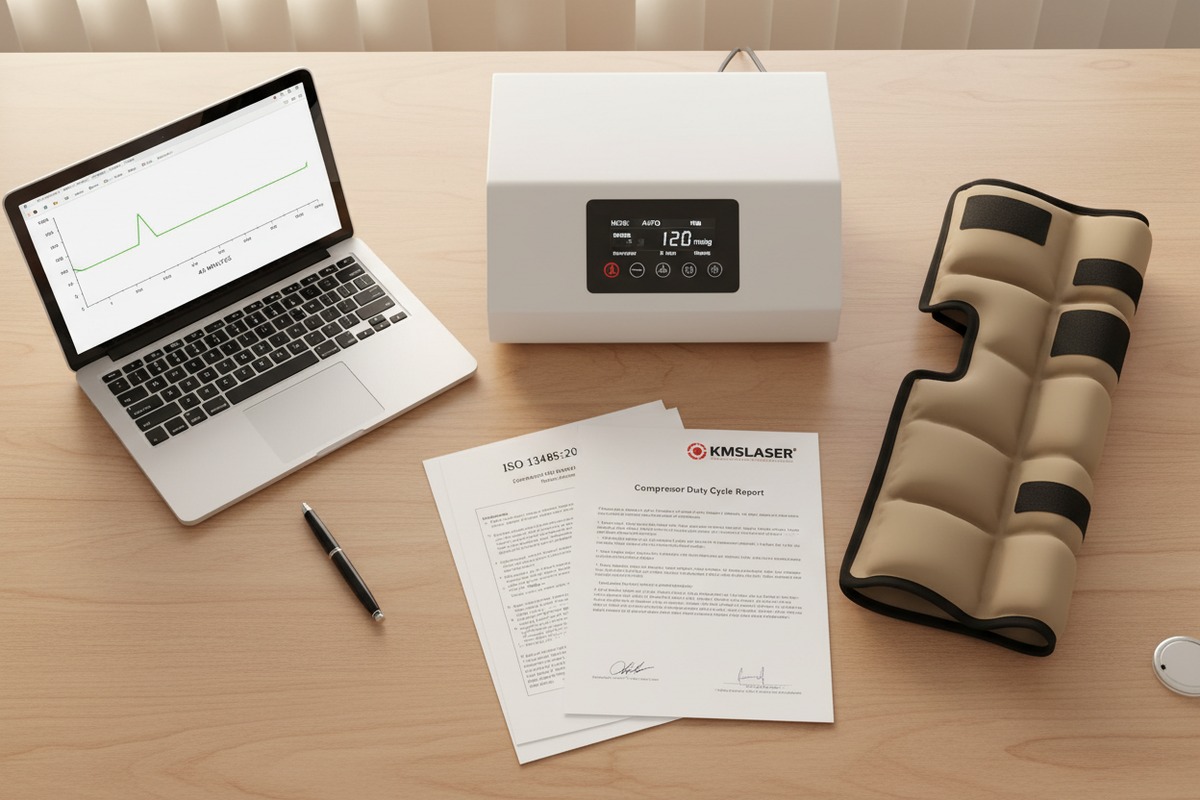
Request the "Compressor Duty Cycle Report," "Pressure Stability Logs," and "ISO/CE Compliance Certificates." These documents prove the machine maintains consistent mmHg levels throughout a 45-minute session without overheating or losing pump efficiency across multiple inflatable air chambers.
Evaluating Compressor Performance
The heart of the system is the pump. You need to know if the compressor can handle back-to-back sessions in a busy salon. If the pressure drops by 10 mmHg after thirty minutes, the treatment loses its clinical value. Ask for the "Mean Time Between Failures 4" (MTBF) data. This tells you how long the machine is expected to run before requiring maintenance. A high-end machine should handle at least 5,000 hours of active operation.
Component Quality and Lifespan
Documentation should also cover the solenoid valves 5. These valves control which air chamber inflates and for how long. If the valves are low-quality, they might "stick," causing a chamber to stay inflated too long, which is painful for the patient.
| Document Type | What it Proves | Importance for Brands |
|---|---|---|
| Calibration Certificate | Accuracy of mmHg sensors | Prevents medical liability |
| Material Safety Data Sheet (MSDS) | Non-toxic suit materials | Ensures skin safety |
| Electromagnetic Compatibility (EMC) | No interference with other tools | Crucial for hospital environments |
| Thermal Stability Test | No overheating during long use | Ensures machine longevity |
The Role of Software Logs
Modern machines use digital control boards to manage pressure stages. Ask if the software includes an "Error Log" feature. If a chamber fails to reach the target pressure within a certain timeframe, the machine should trigger an alarm. This technical safeguard ensures that every treatment stage is completed as programmed, providing a stable experience for the end-user.
Can I customize the sequential compression cycles to align with my brand’s unique treatment protocols?
When we work on ODM projects, we find that many brand owners want a "Signature Mode" that sets them apart. Customization is the key to creating a unique value proposition for your salons.
Yes, high-end manufacturers allow you to customize inflation sequences, hold times, and deflation intervals via the machine's software interface. You can define specific "Pre-treatment" and "Intensive" stages to create proprietary protocols exclusive to your brand’s equipment.

Defining Your Signature Protocol
To customize effectively, you must understand the three variables: Pressure (mmHg), Duration (seconds of inflation), and Sequence (order of chambers). For example, you might want a protocol that focuses 50% of the session time on the abdominal area for digestive health. A flexible manufacturer will allow you to adjust the "Hold Time"—the duration the pressure stays at its peak—to maximize fluid displacement.
Software vs. Hardware Limitations
Not all machines allow deep customization. Some use "Fixed Logic" chips where the programs are hard-coded. You should look for machines with "Programmable Logic Controllers 6" (PLCs) or Android-based touchscreens. These allow for easy updates and new mode uploads. We often help clients develop a "Post-Liposuction Recovery" mode that uses very gentle, pulsating pressure to reduce bruising without stressing the surgical site.
Branding Through Innovation
Customization isn't just about the pressure; it's about the user experience. You can request specific names for the modes on the screen, such as "Athletic Recovery" or "Metabolic Boost." This makes your machine feel like a specialized tool rather than a generic mass-market product. By tailoring these cycles, you solve the pain point of "one-size-fits-all" treatments that fail to impress discerning clients.
| Customization Level | Features Included | Best For |
|---|---|---|
| Basic | Renaming existing modes | New brands on a budget |
| Intermediate | Adjusting hold times and pressure caps | Established distributors |
| Advanced | Creating entirely new sequences from scratch | Medical-grade specialized brands |
How do I ensure my supplier’s quality control process includes testing for pressure accuracy across all treatment modes?
During our pre-shipment inspections, we use a specialized "artificial limb" equipped with sensors to verify every chamber. You must ensure your supplier doesn't just "turn it on" to see if it works.
Ensure QC accuracy by demanding a "Multi-Point Calibration Report" for every unit. This report should confirm that each chamber reaches the programmed mmHg across all modes (Wave, Squeeze, Pulse) and that the safety emergency-stop valve functions instantly.

The Importance of Load Testing
A machine might perform perfectly when the suit is empty. However, when a patient is inside, the resistance changes. Your supplier should be testing the pressure accuracy "under load." This means the air chambers are restricted (simulating a human body) to see if the compressor can still reach the target pressure without straining. Ask for a video of the pressure gauge during a 100% load test.
Garment Integrity and Airflow
Pressure accuracy isn't just about the machine; it's about the suit. If the connectors or hoses are leaky, the pressure in the chamber will never be accurate. We inspect the heat-sealing on the TPU (Thermoplastic Polyurethane) chambers to ensure they can withstand 200% of the maximum rated pressure. This "Burst Test" is a critical part of a high-end QC process.
Standardized QC Checklist
When communicating with your supplier on WhatsApp or Email, provide them with a checklist of what you expect in the inspection report. This forces them to follow a standardized process.
- Individual Chamber Test: Does Chamber 1-12 reach 100 mmHg?
- Mode Sequence Test: Does the "Sequential" mode follow the correct distal-to-proximal order?
- Leak Test: Do the chambers hold pressure for 60 seconds without dropping?
- Interface Sync: Does the screen display match the physical pressure readings?
- Safety Over-ride: Does the "Emergency Stop" button vent all air within 3 seconds?
Long-Term Reliability Checks
Ask about "Burn-in Testing 7." A professional manufacturer will run the machine continuously for 24 to 48 hours before packing it. This identifies "infant mortality" issues—components that might fail within the first few days of use. If your supplier skips this, you risk high return rates and unhappy salon owners.
Conclusion
Inquiring about pressotherapy pressure profiles requires focusing on gradient accuracy, documentation, and customization. By asking for specific mmHg maps and load-test reports, you ensure your equipment delivers the clinical results your brand promises.
Footnotes
1. Explains the fundamental components and working principles of compressed air systems. ↩︎
2. Describes the physiological process of lymph movement and its role in the body. ↩︎
3. Found a working, authoritative explanation of digital manometers. ↩︎
4. Defines MTBF as a key metric for assessing system reliability and predicting failures. ↩︎
5. Explains the function and operation of solenoid valves in controlling fluid flow. ↩︎
6. Provides a comprehensive overview of PLCs as industrial computers for automation. ↩︎
7. Explains burn-in testing as a process to detect early failures and ensure component reliability. ↩︎

 English
 Español de México
 Deutsch
 Français
 العربية
 Русский
