

Maintaining high sanitary standards is a challenge we face daily on our production lines non-woven polypropylene (PPSB) 1. If your clients worry about sweat or cross-contamination during treatments, you need a reliable consumable strategy.
To inquire effectively, ask suppliers for material certifications like ISO 13485, request samples of non-woven PPSB fabric to test durability, and confirm compatibility with your machine’s air chambers. Negotiate bulk pricing and explore private labeling options to ensure consumables align with your professional brand identity.
Understanding these details helps you maintain equipment longevity and client trust CE certifications 2. Let’s dive into the specific quality standards you should demand from your supplier.
What quality standards should I demand for hygiene pants to protect my brand's reputation?
When we test new fabrics for our pressotherapy suits, we prioritize skin safety and tear resistance Minimum Order Quantity (MOQ) 3. Substandard liners can rip mid-treatment, causing a poor experience for your high-end salon clients.
Demand hygiene pants made from medical-grade, hypoallergenic non-woven polypropylene (PPSB) with a minimum weight of 35g/m². Ensure they carry CE or ISO certifications to prove they are free from toxic dyes and irritants, providing a safe, professional barrier for every session.

Material Composition and Weight
The foundation of a good hygiene pant is the material weight Sea Freight 4. In our manufacturing process, we have found that anything below 30g/m² is prone to puncturing when the air pressure reaches its peak. A weight of 35g/m² or 40g/m² offers the perfect balance of breathability and strength. This ensures the pants do not stick to the client’s skin while protecting the expensive inner lining of your pressotherapy machine from oils and perspiration.
Certification and Safety
Your reputation relies on client safety. You should always ask for documentation proving the materials are hypoallergenic. In the medical and beauty industry, ISO 13485 5 and CE certifications are the gold standard. These documents verify that the production environment meets strict cleanliness requirements.
Standardized Sizing for Global Markets
A common mistake is buying "universal" sizes that are too small for North American or European clients. We recommend verifying dimensions before placing a bulk order.
| Feature | Standard Requirement | Why It Matters |
|---|---|---|
| Material | PPSB (Polypropylene) | Prevents skin irritation and ensures breathability. |
| Weight | 35g/m² to 45g/m² | High durability under air pressure; prevents tearing. |
| Certifications | CE, ISO 13485, FDA | Guarantees compliance with international safety laws. |
| Waistband | High-elasticity elastic | Fits diverse body shapes comfortably without slipping. |
Construction Quality
Check the seams. Ultrasonic welding 6 is superior to traditional stitching because it creates a flatter, stronger bond that won't irritate the skin. Poorly stitched seams are the first point of failure when the compression bags inflate, leading to air leaks or a "cheap" feeling for the end-user.
Can I private label the consumables and hygiene pants to match my pressotherapy machine branding?
When we handle OEM requests for US distributors, branding is often the top priority. Your consumables should not look like generic medical supplies; they should feel like an extension of your luxury equipment.
Yes, most manufacturers offer private labeling for hygiene pants, including custom logo printing on the fabric or branded outer packaging. This requires a Minimum Order Quantity (MOQ), typically starting at 1,000 units, allowing you to create a cohesive, high-end brand experience for salons.

The Importance of Brand Cohesion
In our experience, brand owners who provide customized consumables see higher customer retention. When a salon owner opens a box of pants and sees your logo, it reinforces the value of the equipment you sold them. It moves the product from being a "commodity" to a "proprietary system."
Customization Options
There are two main ways to brand your consumables:
- Logo Printing on Fabric: This is usually done with eco-friendly ink. It is a subtle but powerful way to remind the client of your brand during the entire 30-minute treatment.
- Custom Packaging: Branded poly-bags or boxes are easier to produce and have lower MOQs than printing directly on the fabric.
MOQ and Cost Considerations
Customization adds to the lead time and initial cost. However, for a distributor, this creates a "locked-in" effect where salons will continue to buy the branded refills from you rather than searching for generic alternatives on Amazon.
| Customization Type | Typical MOQ | Estimated Lead Time | Impact on Brand |
|---|---|---|---|
| Branded Box/Carton | 500 units | 7-10 days | Professional shipping and storage. |
| Logo on Pant Leg | 5,000+ units | 15-20 days | High-end, exclusive feel. |
| Branded Poly-bag | 1,000 units | 10-12 days | Cost-effective way to show brand identity. |
Technical Limitations
It is important to note that printing on non-woven fabric has limitations. You should use simple, one-color logos. Complex gradients do not show up well on textured PPSB materials. Always ask your supplier for a digital mockup before the production run begins to avoid errors.
How do I verify the durability and skin-friendliness of the materials before placing a bulk order?
Our engineering team spends weeks testing the friction coefficient of materials against machine fabrics. You don't want a liner that makes a "crinkly" plastic noise or causes the client to overheat and sweat excessively.
To verify quality, request a "Sample Kit" containing different material weights (30g, 35g, 45g) and perform a "Stress Test" by inflating them inside your machine at maximum pressure. Conduct a skin-patch test to ensure the fabric remains comfortable and non-irritating during a full 45-minute cycle.
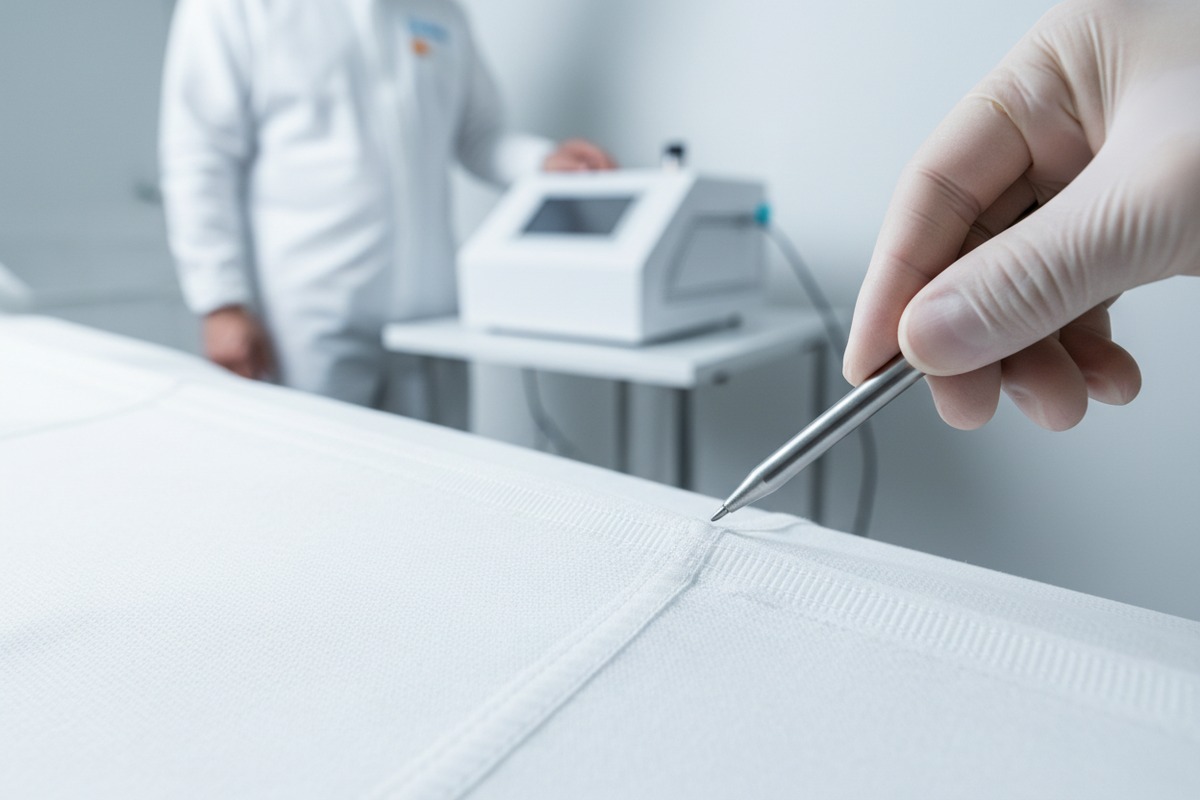
The Sample Testing Protocol
Never skip the sampling phase. When we send samples to our B2B partners, we encourage them to put the product through "real-world" stress. This includes wearing the pants for a full session to check for breathability. If the material feels like a trash bag, it will trap heat and make the client uncomfortable.
Physical Strength Tests
A professional buyer should perform the following checks:
- The Pull Test: Try to tear the seam with your hands. If it zips open easily, it won't hold up under 200mmHg of air pressure.
- The Water Barrier Test: Pour a small amount of water on the fabric. While the material should be breathable, it should slow down the absorption of sweat into the machine's air chambers.
- The Elasticity Check: Stretch the waistband to its limit. It should return to its original shape without snapping or losing tension.
Analyzing Material Types
Not all pressotherapy treatments use the same consumables. Depending on the machine's functions (like Infrared heat), you might need different materials.
| Material Type | Best Use Case | Skin Feel | Durability |
|---|---|---|---|
| Non-woven (PPSB) | Standard Lymphatic Drainage | Soft, fabric-like | Moderate |
| Polyethylene (PE) | Mud/Seaweed Wraps | Plastic, waterproof | High |
| Laminated Foil | Infrared/Thermal Therapy | Reflective, hot | Very High |
Long-term Stability
Ask the supplier about the shelf life. Non-woven materials can become brittle if stored in direct sunlight or humid warehouses. A reliable manufacturer will provide storage guidelines to ensure the items you buy today are still usable a year from now.
What are the logistics options for shipping consumables together with my equipment to minimize my landed cost?
Shipping air is expensive. In our Guangzhou warehouse, we specialize in "space-optimization" to help clients save on freight. Consumables are lightweight but bulky, making them the perfect "filler" for shipping containers.
Optimize your landed cost by "bundle shipping" consumables inside the empty cavities of your pressotherapy machine crates. By shipping pants and machines together via Sea Freight or Rail, you eliminate the high volumetric weight charges typically associated with shipping lightweight consumables separately.

The "Void Filling" Strategy
Pressotherapy machines often come in large, protective wooden crates. Inside these crates, there is often unused space. When we pack orders for our US distributors, we suggest filling these gaps with packs of hygiene pants. Since you are already paying for the volume of the crate, the shipping cost for the consumables effectively becomes zero.
Understanding Shipping Methods
If you are ordering consumables separately, you must choose your method wisely.
- Sea Freight (LCL): Best for orders of 5,000+ units. It takes longer but has the lowest per-unit cost.
- Air Freight: Only recommended for urgent restocks. The volumetric weight of 1,000 pants can often exceed the actual weight, leading to massive shipping bills.
- Rail Freight: A great middle-ground for European buyers, offering a balance of speed and cost.
Customs and Tariffs
Consumables are often classified under different HS Codes 7 than the machines. In the US, for example, non-woven apparel may have different duty rates than electronic beauty equipment. We provide our clients with a "split invoice" to help them navigate customs efficiently and avoid overpaying on taxes.
Inventory Management for Distributors
For our partners in Canada and the US, we recommend maintaining a 3-month buffer of consumables. Equipment sales are one-time events, but consumables are a recurring revenue stream. If you run out of stock, your salon clients will look elsewhere, and you lose that "sticky" relationship.
| Shipping Method | Cost Level | Speed | Best For |
|---|---|---|---|
| Bundled (Sea) | Lowest | 30-45 Days | New machine orders. |
| LCL Sea Freight | Low | 30-45 Days | Bulk restocking (10k+ units). |
| Air Cargo | High | 5-7 Days | Emergency shortages only. |
Conclusion
Choosing the right hygiene consumables is as vital as the machine itself. By demanding high material standards, exploring branding, verifying durability through samples, and optimizing your logistics, you ensure a profitable and professional operation.
Footnotes
1. Provides information on the properties and uses of non-woven polypropylene. ↩︎
2. Replaced HTTP unknown with an official and authoritative source from the European Union, explaining CE marking. ↩︎
3. Defines the smallest quantity of a product a supplier is willing to produce. ↩︎
4. Describes the method of transporting goods via cargo ships across oceans. ↩︎
5. Explains the international standard for medical device quality management systems. ↩︎
6. Describes the industrial process of joining materials using high-frequency acoustic vibrations. ↩︎
7. Explains the international system for classifying traded products. ↩︎

 English
 Español de México
 Deutsch
 Français
 العربية
 Русский
