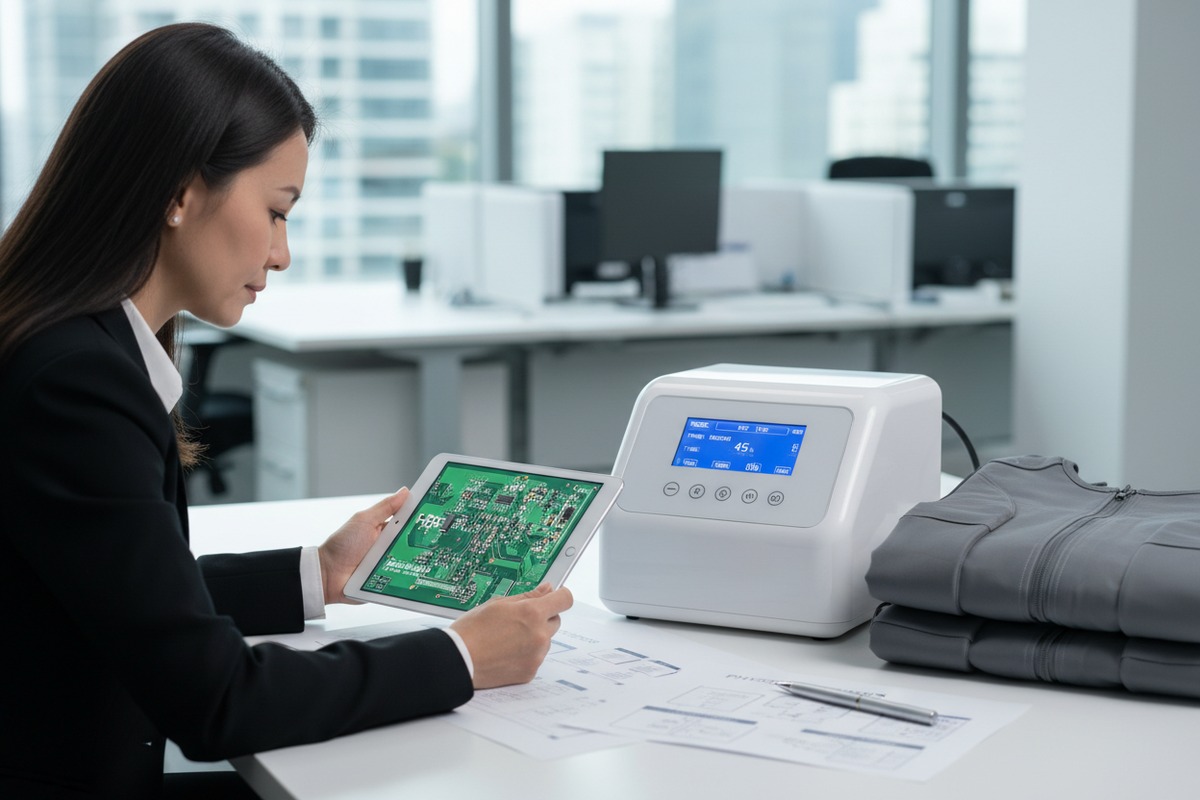
When our engineering team first started designing pressotherapy systems 1, one thing became clear: the control board is everything. A weak or generic board leads to inconsistent pressure, frustrated clients, and endless maintenance headaches.
To identify in-house control boards, request detailed PCB photos, firmware documentation, and unique part numbers from suppliers. Check for branded components, proprietary interfaces, and custom software. Manufacturers with genuine in-house boards can demonstrate R&D capability, offer firmware updates, and provide direct technical support for their control systems.
This guide breaks down exactly how to verify control board 2 authenticity. You will learn what to look for, what questions to ask, and why it matters for your brand’s long-term success.
How can I verify if a supplier truly develops their own pressotherapy control boards?
When we export machines to North American clinics, procurement managers always ask us the same question: "How do I know your boards are truly proprietary?" It is a fair question. The market is flooded with machines that look premium but rely on cheap, off-the-shelf electronics inside PCB Gerber files 3.
Request PCB photos showing branded markings, firmware version logs, and a bill of materials. Ask for a live demo of unique software features. Suppliers with genuine in-house boards will have design patents, custom interfaces, and the ability to explain their R&D process in detail.
Physical Inspection Methods
Start with the basics. Ask your supplier for high-resolution photos of the control board itself. Look for these indicators:
- Branded PCB silkscreen markings: A proprietary board will have the manufacturer's name, model number, and revision date printed directly on the PCB.
- Custom chip configurations: Generic boards use standard microcontroller chips without custom firmware. Proprietary boards often have labeled EEPROM chips or application-specific integrated circuits.
- Unique connector layouts: In-house designs feature proprietary connector placements that match specific garment systems.
Documentation to Request
| Document Type | What It Reveals | Red Flag If Missing |
|---|---|---|
| Block diagram | Overall system architecture | Cannot explain internal design |
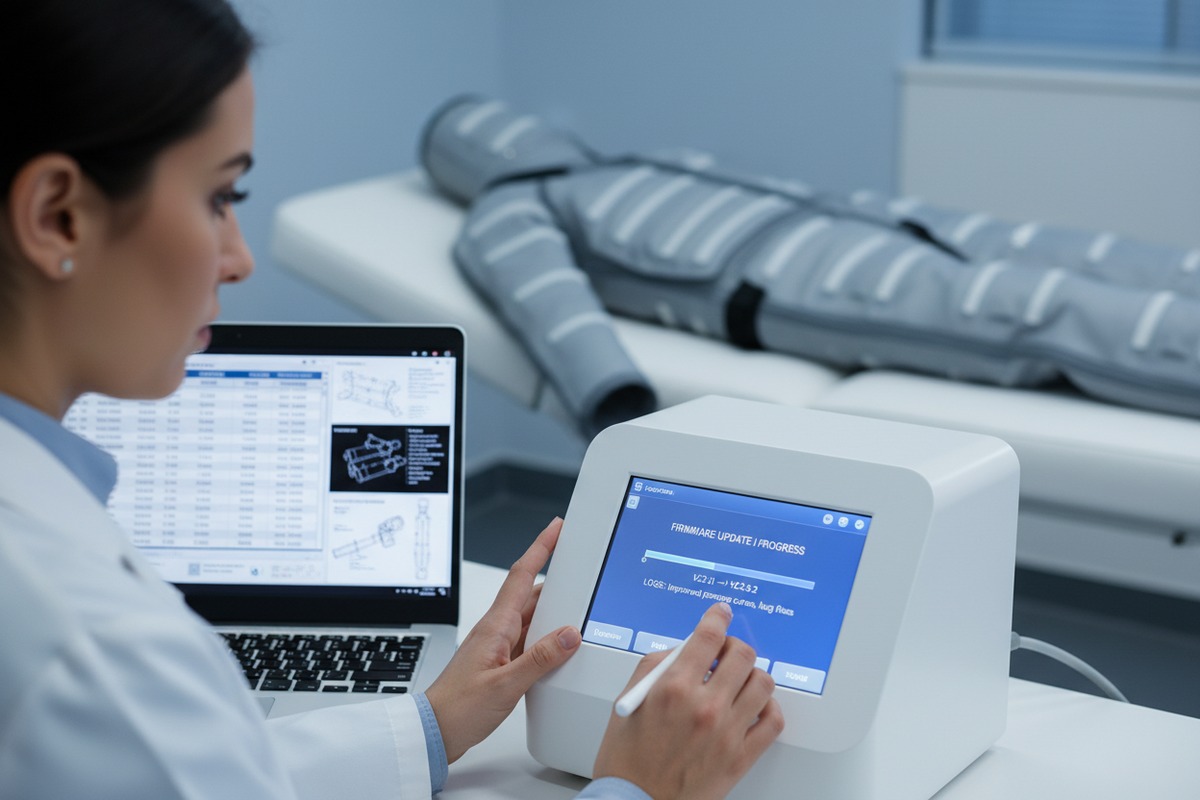
| Firmware changelog | Software version history | No update path available |
| Bill of Materials (BOM) 4 | Component sourcing details | Generic chip numbers only |
| Design patent certificate | IP ownership proof | No registered designs |
| ISO 13485 audit scope 5 | R&D process verification | Manufacturing only, no design |
Questions That Expose Generic Boards
Try asking these questions during your supplier evaluation:
- "Can you walk me through your firmware update process?" Suppliers with in-house boards have clear procedures. Those using generic boards will hesitate.
- "What happens if I need a custom pressure algorithm?" Proprietary developers can modify code. Resellers cannot.
- "Who designed your pressure sensor integration?" Look for specific engineer names or team references.
Why should I prioritize proprietary board designs for my high-end beauty brand?
In our experience working with premium spa chains, the difference between a proprietary and generic control system shows up within the first year. Generic machines start failing. Pressure becomes inconsistent. Clients notice. And your brand reputation suffers.
Proprietary board designs offer precise pressure control, seamless firmware updates, direct manufacturer support, and accessory compatibility. For high-end brands, these factors reduce downtime, enable product differentiation, and build long-term customer trust.

The Business Case for Proprietary Systems
When you invest in machines with in-house boards, you gain several competitive advantages:
Consistent Performance: Proprietary control systems deliver stable pressure output. Our machines maintain pressure accuracy within ±2 mmHg throughout the treatment cycle. Generic boards often drift by 10-15 mmHg, causing uneven compression.
Direct Support Access: When issues arise, you communicate directly with the design team. No middlemen. No finger-pointing between resellers and third-party board suppliers.
Future-Proof Investment: In-house developers can release firmware updates that add features, improve safety protocols, or adapt to new regulations.
Feature Comparison Table
| Feature | Proprietary Board | Generic Board |
|---|---|---|
| Pressure accuracy | ±2 mmHg | ±10-15 mmHg |
| Chamber independence | Full individual control | Limited or grouped |
| Firmware updates | Direct from manufacturer | None available |
| Custom programming | Available | Not possible |
| Warranty coverage | Comprehensive (2-3 years) | Limited (1 year typical) |
| Spare parts | Guaranteed availability | Uncertain supply |
Long-Term Cost Analysis
While proprietary machines cost more upfront, the total cost of ownership favors quality. Consider these factors:
- Repair frequency: Generic boards fail more often. Each service call costs money and client goodwill.
- Part availability: Proprietary manufacturers stock their own components. Generic boards may become obsolete without replacement options.
- Training investment: Staff learn one system deeply rather than adapting to inconsistent interfaces.
What technical evidence can I request to prove the control system isn't a generic part?
Our quality control team has inspected hundreds of competitor machines over the years. We have learned exactly what separates a genuine proprietary system from a relabeled generic unit. The evidence is always in the details.
Request these technical documents: PCB layout files with version numbers, firmware source code copyright certificates, sensor calibration reports, and safety circuit schematics. Also ask for demonstration of unique features like individual chamber pressure adjustment or proprietary treatment algorithms.

Essential Technical Documents
Here is a checklist of evidence that proves in-house development:
Hardware Documentation
- PCB Gerber files or layout screenshots: Shows board design ownership
- Component datasheets with custom specifications: Indicates tailored engineering
- Tooling ownership certificates: Proves investment in dedicated molds and fixtures
Software Documentation
- Firmware version history: Demonstrates ongoing development
- Source code copyright registration: Proves IP ownership
- Algorithm documentation: Shows understanding of internal logic
Testing and Compliance Records
- Pressure calibration certificates: Proves measurement accuracy
- EMC test reports with board identification: Links compliance to specific design
- Safety circuit test records: Confirms integrated protection systems
Live Demonstration Requests
| Test Request | What It Proves | Expected Response |
|---|---|---|
| Adjust individual chamber pressure | Independent control capability | Should allow 1-10 mmHg increments per chamber |
| Show firmware update process | Software maintenance capability | Clear procedure with version management |
| Demonstrate error codes | Integrated diagnostic system | Specific codes with troubleshooting guidance |
| Test emergency stop response | Hardwired safety integration | Immediate deflation, logged event |
Red Flags During Technical Review
Watch for these warning signs that suggest generic components:
- Identical interfaces across brands: Multiple suppliers showing the same touchscreen graphics indicates shared generic boards.
- Vague technical specifications: Statements like "advanced microprocessor" without specific model numbers hide generic origins.
- Refusal to share PCB photos: Legitimate manufacturers protect trade secrets but can show enough to prove originality.
- No firmware update history: If the software has never been updated since launch, development likely stopped after initial production.
Component Traceability Questions
Ask about supply chain depth:
- "Where do you source your pressure sensors?"
- "Who manufactures your display modules?"
- "What is the lead time for replacement boards?"
Manufacturers with in-house boards know their supply chain intimately. Resellers often cannot answer these questions.
How will an in-house board design affect my long-term maintenance and after-sales support?
When we set up service partnerships with distributors, we always emphasize one point: after-sales support is only as good as your access to the original engineers. Machines built on generic boards create a support gap that grows wider over time.
In-house board designs enable faster diagnostics, guaranteed spare parts availability, remote firmware updates, and direct engineering support. This reduces downtime, extends machine lifespan, and protects your investment. Generic boards create dependency on third-party suppliers who may discontinue products.

Support Capabilities Comparison
| Support Factor | In-House Board Manufacturer | Generic Board Reseller |
|---|---|---|
| Diagnostic capability | Remote access to error logs | Limited to visible symptoms |
| Repair turnaround | 24-48 hours with genuine parts | Weeks while sourcing components |
| Firmware support | Regular updates available | No updates possible |
| Technical hotline | Direct engineering access | General customer service |
| Training depth | Full system understanding | Surface-level operation only |
| Parts guarantee | Minimum 5-7 years | Often discontinued within 2-3 years |
The Hidden Costs of Generic Board Machines
Over a typical five-year equipment lifecycle, generic board machines create several hidden costs:
Service Delays
Without direct engineering support, troubleshooting takes longer. Each day of downtime costs your clients and your reputation.
Parts Obsolescence
Generic boards are often discontinued without notice. When a critical component fails in year three, you may find no replacement available.
Training Gaps
Service technicians cannot receive in-depth training on boards the supplier did not design. This leads to trial-and-error repairs that risk further damage.
Questions for After-Sales Evaluation
Before committing to a supplier, ask these questions:
- "What is your spare parts availability guarantee period?"
- "Can your technicians perform component-level board repairs?"
- "How do you handle firmware bugs discovered in the field?"
- "What diagnostic tools do you provide to service partners?"
Building a Support Partnership
Manufacturers with in-house boards can offer:
- Training certification programs: Deep technical knowledge transfer
- Spare parts consignment: Pre-positioned inventory at your location
- Remote diagnostics: Online access to machine logs for faster troubleshooting
- Engineering escalation path: Direct contact with design team for complex issues
These capabilities are impossible without control over the core technology.
Conclusion
Identifying in-house control boards requires examining hardware, software, documentation, and support infrastructure. The effort pays dividends through better performance, reliable service, and protected investment.
Footnotes
1. Explains what pressotherapy is and how pressotherapy systems work. ↩︎
2. Provides a definition and functions of a control board in electronic systems. ↩︎
3. Explains what Gerber files are and their critical role in PCB manufacturing. ↩︎
4. Replaced with a Wikipedia page providing a comprehensive definition and explanation of a Bill of Materials (BOM). ↩︎
5. Replaced with an Advisera article that details the ISO 13485 standard, including its scope and requirements for a Quality Management System in the medical device industry. ↩︎
6. Provides a comprehensive overview of electromagnetic compatibility (EMC) and its importance. ↩︎
7. Offers information about lymphedema, its causes, symptoms, and treatment. ↩︎

 English
  Español de México
  Deutsch
  Français
  العربية
  Русский