
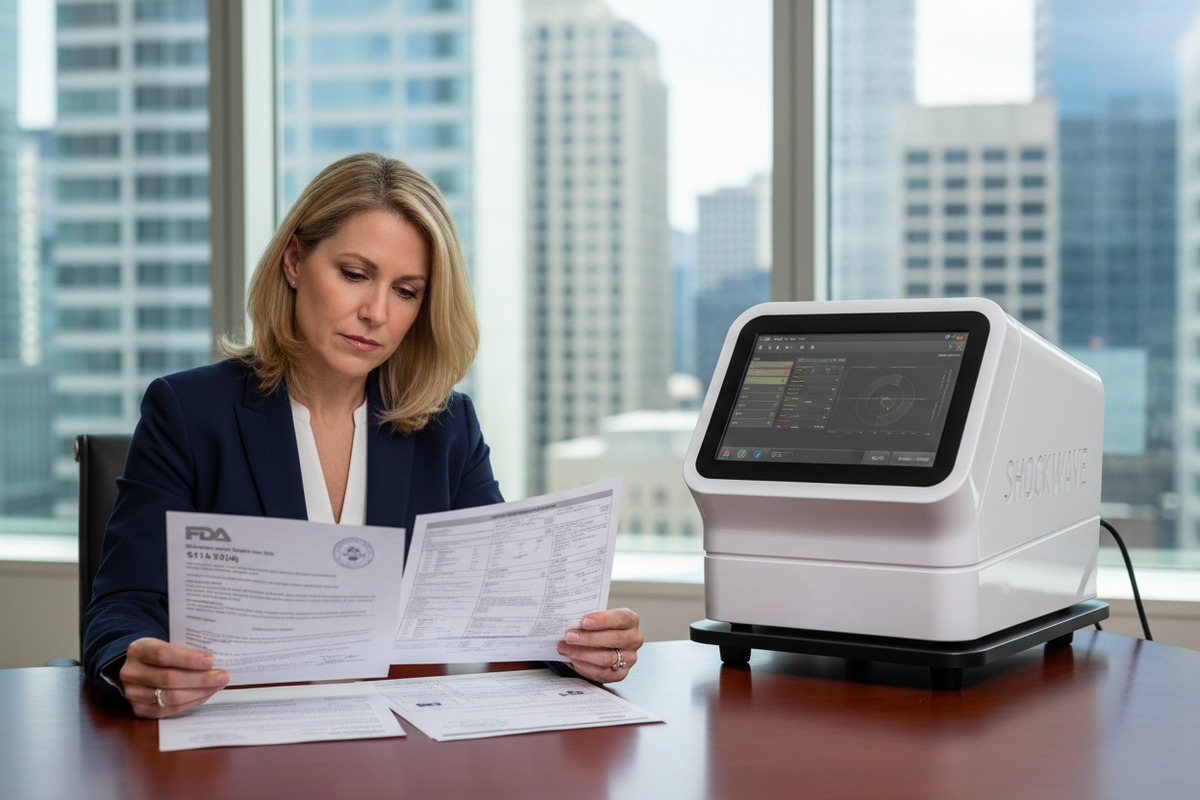
Every week, our sales team receives inquiries from US distributors who got burned by suppliers making bold claims IEC 60601 standards 1. They bought machines marketed as “FDA approved” for aesthetic use, only to discover the clearance was for orthopedic conditions only. The frustration is real, and the financial losses are significant.
To evaluate shockwave therapy machine supplier marketing for US aesthetic standards, verify FDA 510(k) clearance for specific aesthetic indications, scrutinize clinical evidence supporting claims, assess device technical specifications against IEC 60601 standards, and confirm the supplier provides compliant labeling with proper disclaimers and contraindications.
Let me walk you through exactly what our engineering and compliance teams look for when preparing machines for the US market. These insights will help you separate legitimate suppliers from those making empty promises.
How do I evaluate if a supplier's shockwave machine design will appeal to my high-end US salon customers?
Our design team spends considerable time researching US salon aesthetics before finalizing any product. We have seen too many machines with impressive specs fail in the market because they looked cheap or outdated next to competitor equipment.
Evaluate a supplier's shockwave machine design by examining chassis material quality, color palette sophistication, interface intuitiveness, ergonomic handpiece design, noise levels during operation, and overall footprint compatibility with upscale salon environments where space and ambiance matter greatly.
Visual Design Elements That Matter
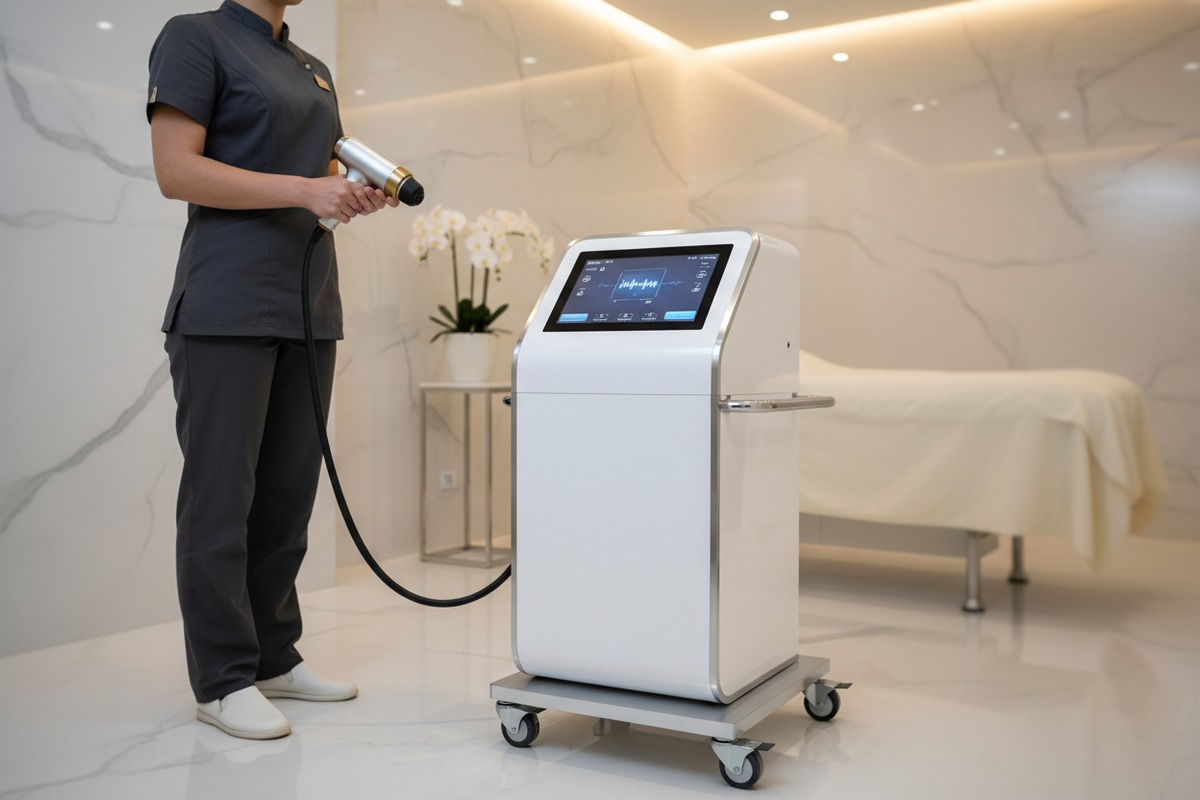
High-end US salons expect equipment that complements their interior design. When we develop machines for this market, we focus on several key visual elements.
The chassis finish 2 tells customers about build quality instantly. High-gloss white finishes with angular designs signal modernity. Rounded edges suggest safety and approachability. Both work, but consistency matters. A machine mixing cheap plastic buttons with premium housing looks assembled rather than engineered.
Screen quality impacts daily user experience. Our production team sources IPS displays 3 with wide viewing angles because technicians work from various positions. Resistive touchscreens feel dated compared to capacitive options 4 your staff uses on their phones.
Functional Design Considerations
Beyond aesthetics, functional design determines whether staff will use the machine correctly.
| Design Element | High-End Indicator | Budget Indicator |
|---|---|---|
| Chassis Material | Medical-grade ABS, aluminum accents | Thin ABS, visible seams |
| Display | 10"+ capacitive touchscreen | Small resistive screen |
| Handpiece Storage | Integrated magnetic holders | Dangling cables, no holders |
| Ventilation | Silent internal fans | Loud external vents |
| Mobility | Lockable medical casters | Fixed legs or cheap wheels |
Handpiece Ergonomics
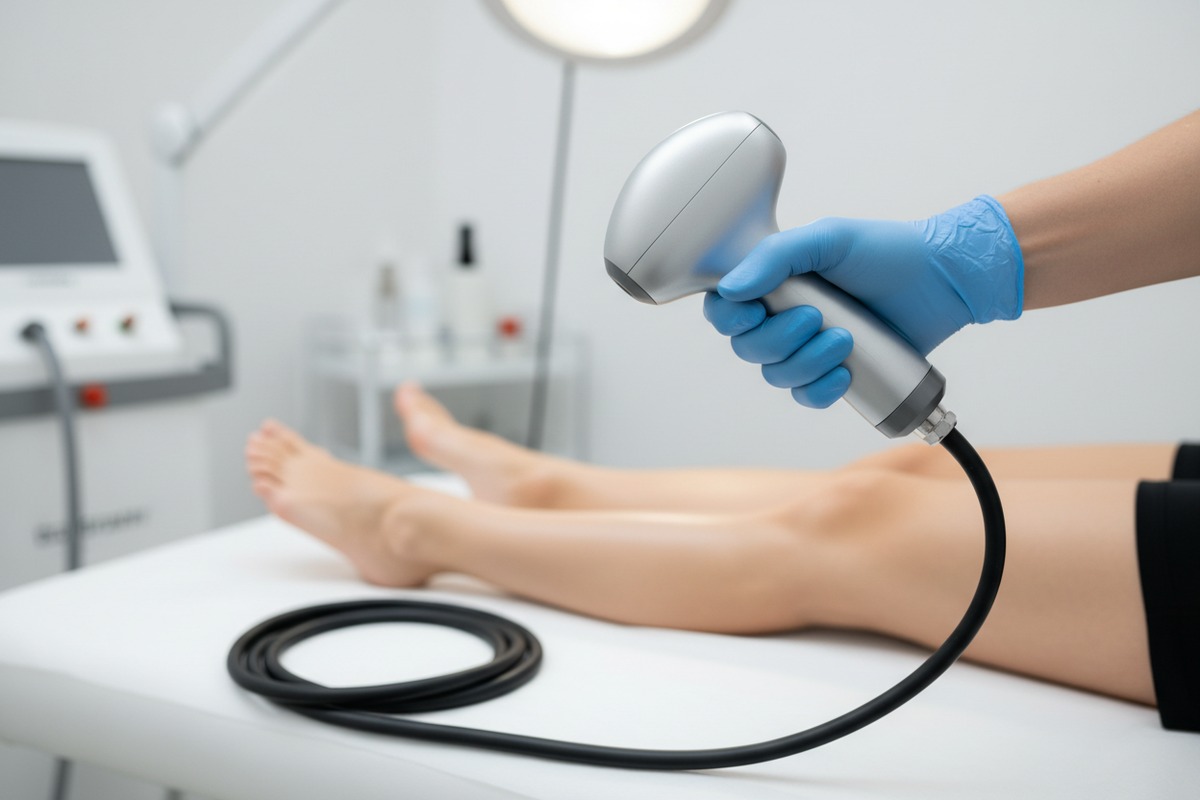
Your technicians hold handpieces for hours daily. When we test prototypes, our engineers simulate full treatment days to identify fatigue points.
Weight distribution matters more than total weight. A 300g handpiece with balanced weight feels lighter than a 250g handpiece that is head-heavy. Grip diameter should accommodate various hand sizes without causing strain.
Cable length and flexibility affect treatment flow. Stiff cables pull the handpiece during treatments. Our standard cable length is 2 meters, which allows technicians to move freely around treatment beds without repositioning the main unit.
Noise and Vibration Standards
US salons create relaxing environments. A machine producing 70dB during operation disrupts that atmosphere completely.
We test our units in anechoic chambers 5 and target under 55dB at one meter distance. This allows conversation during treatments. Vibration isolation in the handpiece prevents technician fatigue and ensures consistent energy delivery to treatment areas.
What should I look for in a manufacturer's portfolio to ensure my private-label branding looks professional?
When clients visit our showroom, they always ask about private-label capabilities. The quality gap between suppliers becomes obvious when you examine actual branded units rather than generic samples.
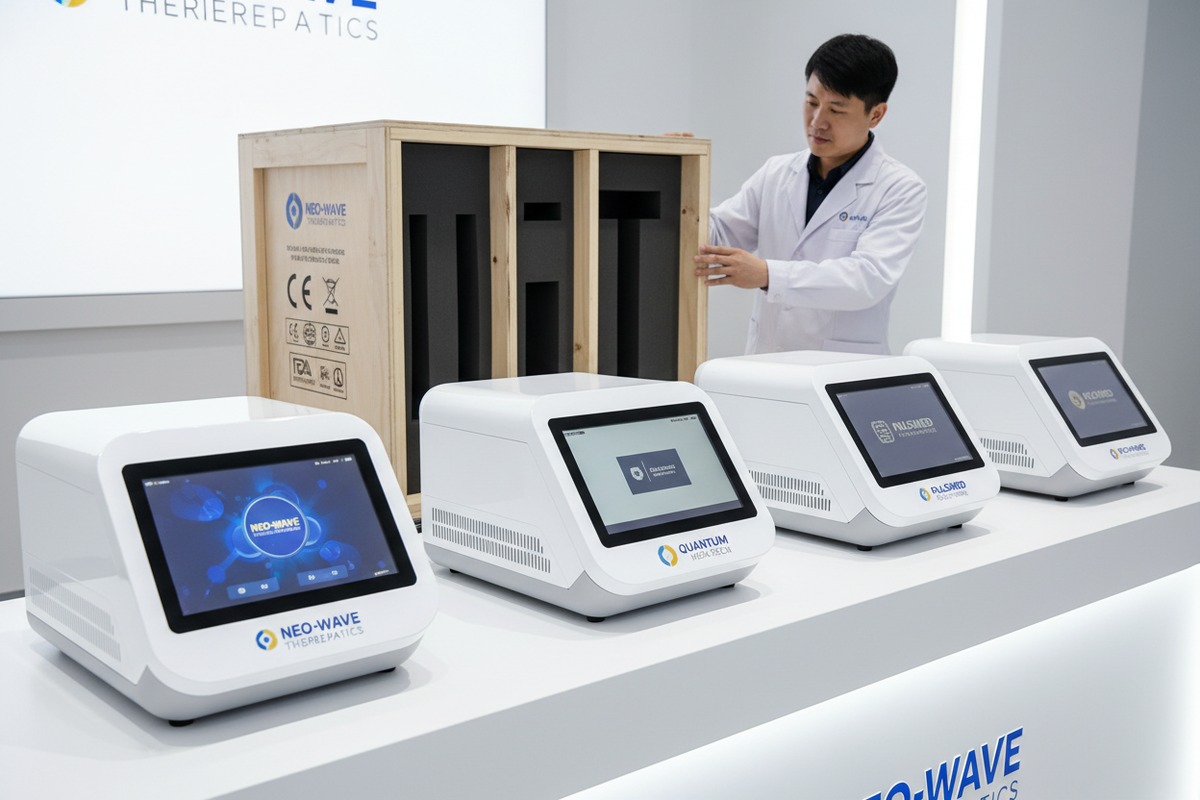
Look for portfolio examples showing consistent branding execution across multiple products, high-resolution logo application methods, custom color matching capabilities, professional packaging design with regulatory-compliant labeling, and branded user interface screens that maintain design coherence throughout the customer experience.
Logo Application Methods
Not all logo applications are equal. The method determines how your brand appears after months of use.
Laser engraving creates permanent marks that never peel or fade. We use this for metal surfaces and premium positioning. Screen printing works for larger logos on flat surfaces but requires proper curing to prevent peeling. Pad printing handles curved surfaces well.
Cheap suppliers use vinyl stickers. These peel within months, especially in humid salon environments. If a supplier shows portfolio images with sticker logos, expect the same treatment for your brand.
| Logo Application Method | Durability | Best Surface | Cost Level |
|---|---|---|---|
| Laser Engraving | 10+ years | Metal, hard plastic | High |
| Pad Printing | 5-7 years | Curved plastic | Medium |
| Screen Printing | 3-5 years | Flat surfaces | Medium |
| UV Printing | 3-5 years | Various | Medium |
| Vinyl Stickers | 6-12 months | Any | Low |
Custom Color Matching
Your brand likely has specific Pantone colors 6. Ask suppliers how they match colors and request samples before production.
Our painting facility uses Pantone matching systems with spectrophotometer verification 7. We provide color samples for approval before production runs. This prevents situations where your signature blue arrives looking purple.
Custom housing colors require minimum order quantities because paint mixing has setup costs. Expect MOQs between 50-200 units for custom colors versus 10-20 units for standard white or black.
User Interface Branding
The software interface is where your brand lives during every treatment. Generic interfaces with your logo slapped on top look exactly that way.
Professional private-label suppliers offer UI customization including:
- Boot screen with your logo animation
- Color scheme matching your brand palette
- Custom icons and button styles
- Your company name in headers and footers
- Removal of manufacturer branding
We provide UI mockups for approval before programming changes. This prevents costly revision cycles after production.
Packaging and Documentation
Your customer's first impression comes from packaging. Unboxing experience matters for salon owners who share equipment arrivals on social media.
Quality private-label packaging includes:
- Custom-printed corrugated boxes with your branding
- Foam inserts cut specifically for your unit configuration
- Branded user manuals with your contact information
- Branded accessory bags and cable organizers
- QC certificates with your logo
Ask suppliers for packaging samples. Weight the box, check foam density, and examine print quality. Thin cardboard with offset colors signals cost-cutting that extends to the product itself.
How can I confirm that a supplier's quality control standards match the durability requirements of the US market?
During factory audits, I always spend the most time in QC areas. Equipment that works perfectly in a controlled factory may fail quickly in demanding salon environments with continuous daily use.
Confirm supplier quality control standards by requesting documented QC procedures, third-party inspection reports, component traceability records, aging test protocols, failure mode analysis documentation, and warranty claim statistics that reveal actual field performance rather than controlled laboratory results.
Incoming Component Inspection
Quality starts before assembly begins. Ask suppliers about incoming quality control procedures.
Our QC team inspects every shipment of critical components. Capacitors, compressors, display panels, and handpiece elements all receive individual testing before entering inventory. We reject entire batches if sample failure rates exceed 2%.
Request component supplier information. Quality manufacturers source from established brands like Meanwell for power supplies or LG for display panels. Unknown component brands often indicate cost optimization that sacrifices reliability.
In-Process Quality Checkpoints
Assembly-line QC catches problems before they compound. Our production line has seven inspection points:
| Checkpoint | Tests Performed | Pass Criteria |
|---|---|---|
| PCB Assembly | Visual inspection, AOI | Zero solder defects |
| Power System | Voltage regulation, ripple | ±2% specified output |
| Compressor Install | Pressure test, leak detection | Zero leakage at 10 bar |
| Handpiece Assembly | Energy output calibration | ±5% specified joules |
| UI Integration | Software function test | All features operational |
| Full Assembly | 2-hour burn-in test | Zero errors, stable temps |
| Final QC | 47-point checklist | 100% compliance |
Aging and Stress Testing
Real-world durability requires accelerated testing. Our standard protocol includes:
Thermal cycling: Units operate in chambers cycling between 5°C and 40°C for 48 hours. This reveals solder joint weaknesses and component thermal mismatches.
Continuous operation: Units run at maximum output for 8 hours continuously. This simulates busy salon days and identifies components that overheat under sustained load.
Handpiece durability: Handpieces receive 50,000 simulated treatments using mechanical actuators. This equals approximately 2 years of heavy salon use.
Field Failure Analysis
Ask suppliers for warranty claim data. This reveals actual field performance better than any factory test.
Quality suppliers track failure modes systematically. We categorize every warranty claim by:
- Component that failed
- Hours of operation before failure
- Environmental conditions
- Serial number batch correlation
This data drives continuous improvement. When we identified a capacitor batch causing failures at 18 months, we traced affected units and offered proactive replacements before customers experienced problems.
Third-Party Verification
Independent inspection adds accountability. We work with SGS and Bureau Veritas for pre-shipment inspections on request.
Standard inspection includes:
- Visual examination against approved samples
- Functional testing per agreed protocols
- Quantity verification
- Packaging condition assessment
- Documentation completeness check
Inspection reports provide evidence for customs clearance and liability protection if disputes arise.
How do I assess if a supplier's technical documentation and marketing materials meet my professional standards?
Our documentation team rewrites materials for every market because what works in one country creates problems in another. US regulatory requirements for medical device marketing are particularly strict.
Assess supplier documentation by verifying FDA 510(k) clearance numbers match claimed indications, confirming clinical study citations are peer-reviewed and relevant, checking that contraindications and warnings meet US labeling requirements, and ensuring marketing claims stay within cleared indications without implying off-label benefits.

FDA Compliance in Marketing Materials
US marketing materials must align precisely with FDA clearances. This creates significant restrictions compared to markets with looser regulations.
Verify 510(k) numbers through FDA's public database. Search the supplier's claimed clearance number and compare approved indications with marketing claims. Many suppliers hold orthopedic clearances but market aesthetic benefits without corresponding approvals.
| Document Type | Required FDA Compliance Elements |
|---|---|
| Product Brochures | Cleared indications only, no off-label claims |
| User Manuals | Contraindications, warnings, precautions |
| Training Materials | Proper use limitations, operator qualifications |
| Website Content | Balanced risk-benefit presentation |
| Social Media | Same standards as traditional marketing |
Clinical Evidence Standards
Marketing claims require substantiation. Ask suppliers for the clinical evidence supporting each claim they make.
Legitimate evidence includes:
- Peer-reviewed published studies
- Controlled clinical trials
- Meta-analyses of multiple studies
Red flags include:
- Unpublished internal studies
- Anecdotal testimonials only
- Studies in unrelated populations
- Cherry-picked positive results
When suppliers cite studies, verify the research actually supports their specific claims. A study showing shockwave efficacy for plantar fasciitis does not support marketing claims about cellulite reduction.
Technical Documentation Quality
Professional technical documentation demonstrates engineering rigor. Our technical writing team produces documentation including:
User manuals covering:
- Device specifications and theory of operation
- Installation and setup procedures
- Treatment protocols by indication
- Maintenance schedules and procedures
- Troubleshooting guides
- Spare parts lists with ordering information
Service manuals providing:
- Electrical schematics
- Component location diagrams
- Calibration procedures
- Diagnostic test sequences
- Firmware update instructions
Training materials including:
- Treatment technique videos
- Safety protocol presentations
- Certification exam materials
Regulatory Documentation Package
US import requires specific documentation. Quality suppliers prepare complete regulatory packages including:
- FDA 510(k) clearance 8 letter and summary
- Declaration of Conformity
- IEC 60601-1 test reports
- IEC 60601-2-36 compliance evidence (for focused shockwave)
- Risk management files per ISO 14971 9
- Biocompatibility testing for patient-contact components
Request sample documentation before ordering. Review organization, completeness, and professional presentation. Poorly organized regulatory files suggest the supplier lacks experience with US market requirements.
Marketing Material Customization
Professional private-label suppliers provide customizable marketing materials. Our standard package includes:
- Editable brochure templates with your branding
- High-resolution product photography
- Treatment protocol documents
- Staff training presentations
- Patient education handouts
- Social media content templates
All materials come with source files so your marketing team can customize messaging while maintaining compliant claims. We review customizations to flag potential regulatory issues before you publish.
Conclusion
Evaluating shockwave therapy machine suppliers for US aesthetic standards requires examining design quality, private-label capabilities, quality control rigor, and regulatory compliance documentation. Partner with manufacturers who understand FDA requirements and provide verifiable evidence for every claim they make.
Footnotes
1. Explains the series of international technical standards for medical electrical equipment safety. ↩︎
2. Discusses material selection and finishes as important design considerations for chassis durability. ↩︎
3. Details the technology of In-Plane Switching (IPS) used in liquid-crystal displays. ↩︎
4. Explains how capacitive touchscreens work and their advantages over resistive types. ↩︎
5. Describes anechoic chambers as rooms designed to eliminate sound reflections for testing. ↩︎
6. Official source explaining the Pantone Matching System for consistent color reproduction. ↩︎
7. Defines spectrophotometers and their use in capturing and evaluating color data. ↩︎
8. Provides official FDA information on the 510(k) clearance process for medical devices. ↩︎
9. Official ISO page for the international standard on risk management for medical devices. ↩︎

 English
  Español de México
  Deutsch
  Français
  العربية
  Русский