

Last year, our production team received a panic call from a U.S. distributor. Their previous supplier’s system had lost three months of order specifications, leaving them with 50 machines nobody could trace. This nightmare happens more often than you think.
To evaluate a shockwave therapy machine supplier’s CRM for tracking requirements, verify that the system logs custom specifications accurately, provides real-time quality control visibility, prevents interdepartmental communication gaps, and offers end-to-end logistics tracking. Request live demos and audit trails before committing.
The following sections break down each critical evaluation area. You will learn exactly what questions to ask and what red flags to avoid.
How can I verify that the supplier's CRM accurately logs my custom shockwave machine specifications?
When our engineering team finalizes a custom shockwave unit, every detail matters. A wrong energy flux density 1 setting or incorrect applicator configuration can derail an entire order. This is where CRM accuracy becomes non-negotiable.
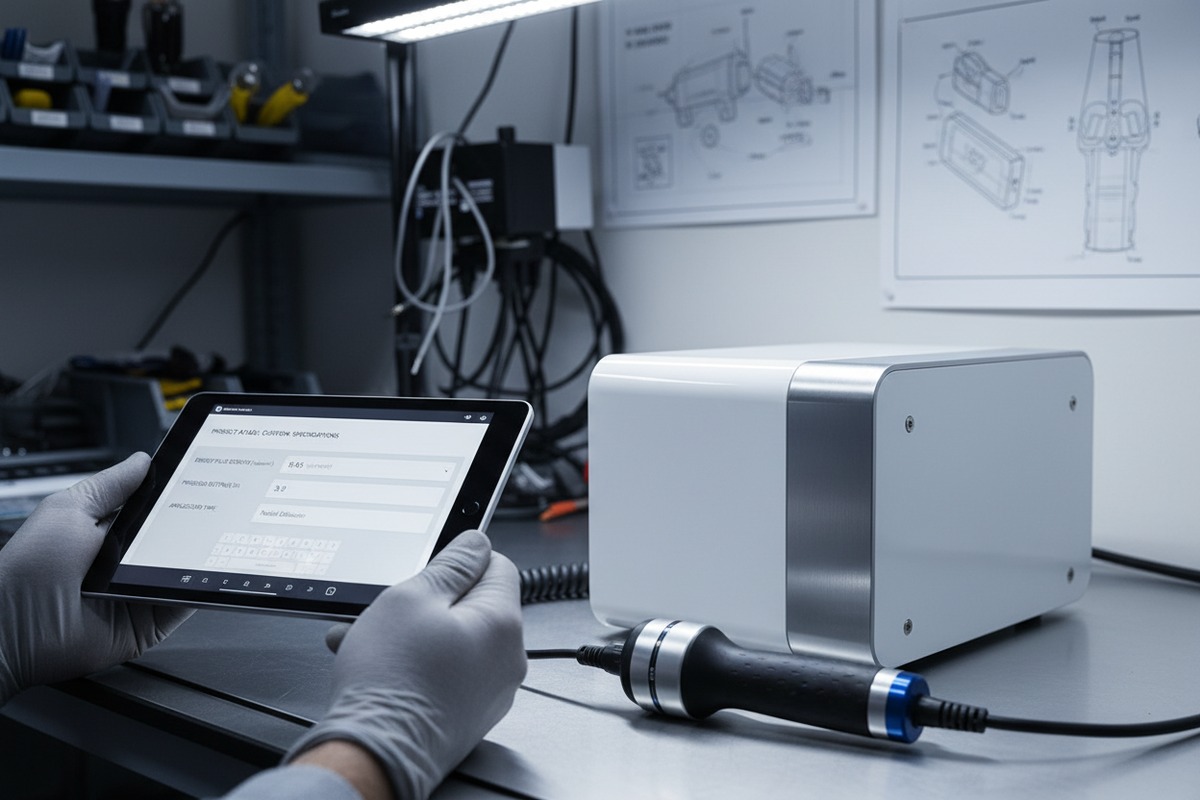
Verify CRM accuracy by requesting a live demo where your custom specifications are entered and retrieved. Check for fields covering energy levels, pressure settings, applicator types, and branding details. Confirm the system uses non-volatile memory and generates exportable logs in CSV or XML formats.
Why Specification Logging Matters
A single shockwave therapy machine can have dozens of customizable parameters. Energy flux density ranges from below 0.3 mJ/mm² to above 0.3 mJ/mm². Pressure settings vary between 1 and 5 bars. Applicator heads come in radial and focused types. applicator types 2 Your branding requirements add another layer.
If the supplier's CRM cannot capture all these details, errors compound. Machines arrive with wrong settings. Rebranding gets missed. Packaging fails to match your requirements.
Key Fields to Audit
Ask the supplier to show you these specific CRM fields:
| Specification Type | What the CRM Should Log | Why It Matters |
|---|---|---|
| Energy Parameters | Flux density, frequency, pulse count | Ensures treatment efficacy matches your market claims |
| Physical Components | Applicator type, handpiece model, cable length | Prevents assembly errors and returns |
| Branding Elements | Logo placement, packaging artwork, label text | Protects your brand consistency |
| Regulatory Markers | Serial numbers, lot codes, certification references | Supports FDA and EU MDR compliance 3 FDA compliance 4 |
| Warranty Terms | Coverage period, service conditions, parts included | Clarifies post-sale obligations |
Test the System Yourself
Do not accept screenshots or PDFs. Request a live screen-share session. Ask the supplier to enter a hypothetical order with your real specifications. Then ask them to retrieve it. Check if every field populates correctly.
Our quality assurance protocol requires suppliers to demonstrate this before any contract signing. We have seen systems that look comprehensive on paper but fail to save nested data like multi-applicator configurations.
Non-Volatile Memory and Data Retention
Power outages and system crashes happen. The CRM must use non-volatile memory to prevent data loss. Ask directly: "What happens to my order data if your server goes down?"
A reliable system maintains full records even during outages. It should also generate automatic backups. Request documentation on their backup frequency and recovery protocols.
Does the supplier's CRM give me real-time visibility into my order's quality control status?
Our clients often tell us their biggest frustration: they only discover quality issues after machines arrive at their warehouse. By then, the damage is done. Returns cost money. Delays lose customers.
A supplier's CRM should provide real-time QC visibility through status dashboards showing inspection checkpoints, pass/fail rates, and defect logs. Demand access to live updates at each production stage, from component inspection through final testing and packaging verification.

What Real-Time QC Visibility Looks Like
Real-time means you see updates as they happen. Not daily summaries. Not weekly reports. Immediate status changes when an inspector logs results.
At our facility, the QC team updates the system at six checkpoints:
- Incoming component inspection
- Subassembly testing
- Final assembly verification
- Electrical safety testing
- Performance calibration
- Packaging inspection
Each checkpoint generates a timestamped entry. The CRM should let you filter by checkpoint, date range, or specific order number.
Essential QC Data Points
The CRM must capture quantitative and qualitative data:
| QC Stage | Data Captured | Acceptable Thresholds |
|---|---|---|
| Component Inspection | Supplier certificates, visual defects, dimensional accuracy | 100% certificate verification, zero visual defects |
| Electrical Safety | Dielectric strength, ground continuity, leakage current | Per IEC 60601-1 standards 5 |
| Performance Testing | Energy output accuracy, pressure consistency, pulse timing | Within ±5% of specified values |
| Calibration | Flux density measurement, frequency verification | Matches labeled specifications |
| Packaging | Box integrity, cushioning adequacy, label accuracy | No damage potential, correct branding |
Access Levels and Permissions
Ask whether you can access the QC module directly or only through supplier-generated reports. Direct access means transparency. Report-only access means you depend on their interpretation.
We provide our OEM partners with read-only dashboard access. They see exactly what our QC team sees. No filters. No delays.
Audit Trails for Compliance
ISO 13485 6 and FDA regulations require documented QC records. The CRM should generate audit trails showing who performed each inspection, when, and what they found.
If the supplier cannot demonstrate audit trail functionality, their QC tracking may not meet regulatory standards. This creates liability for both parties.
Defect Trend Analysis
A sophisticated CRM does more than log individual inspections. It identifies patterns. If a particular component fails repeatedly, the system should flag it. If a specific operator's pass rates drop, management should know.
Ask to see historical defect reports. A supplier with mature QC processes will have this data readily available.
How does the CRM prevent communication gaps regarding my technical requirements between departments?
We once traced a costly error to a simple miscommunication. The sales team recorded "radial applicator" but the production team received "focused applicator." The CRM allowed free-text entry instead of standardized selections. Fifty machines needed rework.
The CRM prevents communication gaps through standardized data fields, mandatory specification checklists, automatic notifications across departments, and version-controlled requirement documents. All teams should access identical information from a single source of truth.
Single Source of Truth Architecture
Every department—sales, engineering, production, QC, logistics—must pull data from the same system. Single Source of Truth 7 No separate spreadsheets. No email chains with conflicting information.
When our sales team enters an order, the engineering team sees it immediately. When engineering adds technical notes, production sees them before manufacturing starts. No handoffs. No translation errors.
Standardized Fields vs. Free Text
Free-text fields invite errors. Standardized dropdown menus enforce accuracy.
| Field Type | Risk Level | Best Practice |
|---|---|---|
| Free-text product name | High | Use SKU codes with dropdown selection |
| Free-text energy setting | High | Predefined options matching machine capabilities |
| Free-text shipping address | Medium | Address validation with autocomplete |
| Checkbox for accessories | Low | Acceptable for binary yes/no requirements |
| File upload for artwork | Low | Acceptable with file type restrictions |
Ask the supplier to show you how technical specifications are entered. If you see free-text fields for critical parameters, request they implement standardized options.
Automatic Notifications
The CRM should send alerts when relevant updates occur. Production should know when engineering approves final specifications. QC should know when production completes assembly. Logistics should know when QC passes the order.
Manual notification systems fail. People forget. Emails get buried. Automated triggers ensure no department misses critical updates.
Version Control for Requirement Changes
Orders often change mid-production. Your client revises energy settings. Your marketing team updates logo artwork. These changes must flow through the system cleanly.
The CRM should track every version of your requirements. It should show who made changes, when, and what specifically changed. This prevents disputes and clarifies accountability.
Training and Adoption
A perfect CRM means nothing if staff do not use it properly. Ask about the supplier's training program. Do all departments receive CRM training? How often do they refresh skills?
During our supplier evaluations, we ask for training documentation. A supplier who invests in CRM training invests in accuracy.
Can I use the supplier's system to track my shipment's door-to-door logistics progress?
Our logistics coordinator fields the same question daily: "Where is my shipment?" Without integrated tracking, answering requires manual carrier lookups, forwarding emails, and piecing together fragmented updates. This wastes everyone's time.
Yes, you can track shipment progress if the supplier's CRM integrates with logistics carriers and freight forwarders. Look for systems offering milestone tracking from factory departure through customs clearance to final delivery, with automated status updates and estimated arrival times.

What Door-to-Door Tracking Includes
Door-to-door logistics for shockwave therapy machines involves multiple handoffs:
- Factory pickup
- Domestic transportation to port or airport
- Export customs clearance
- International freight (sea or air)
- Destination customs clearance
- Last-mile delivery to your warehouse
Each stage involves different parties. The CRM should consolidate updates from all of them into a single view.
Integration with Carriers and Forwarders
Ask whether the CRM pulls data automatically or requires manual entry. Automatic integration with carriers like DHL, FedEx, and major freight forwarders 8 provides real-time accuracy. Manual entry introduces delays and potential errors.
| Integration Type | Update Speed | Accuracy Level | Effort Required |
|---|---|---|---|
| API integration with carriers | Real-time | High | None from buyer |
| Manual entry by supplier staff | 1-2 day delay | Medium | None from buyer |
| Forwarded carrier links | Real-time | High | Buyer must check separately |
| No tracking provided | N/A | N/A | Buyer manages independently |
Customs Documentation Access
International shipments require extensive documentation. Commercial invoices. Packing lists. Certificates of origin. FDA documentation for U.S. imports.
The CRM should store these documents and make them accessible to you. When customs agents request paperwork, you should not need to email the supplier and wait for responses.
Exception Handling and Alerts
Shipments encounter problems. Customs holds. Weather delays. Carrier capacity issues. The system should alert you immediately when exceptions occur.
We configure our logistics module to send automatic alerts for:
- Customs examination notices
- Delivery date changes exceeding 24 hours
- Damage reports from carriers
- Delivery attempt failures
Historical Shipment Data
Over time, logistics data becomes valuable for planning. Which routes deliver fastest? Which carriers cause fewest issues? What seasons create delays?
A mature CRM stores historical shipment data and allows analysis. This helps you forecast lead times and set accurate customer expectations.
Proof of Delivery Documentation
The final milestone matters most. The CRM should capture proof of delivery, including recipient signature, delivery timestamp, and photo documentation if available.
This closes the loop on each order and provides evidence if disputes arise about delivery completion.
Conclusion
Evaluating a shockwave therapy machine supplier's CRM protects your investment. Verify specification logging, demand real-time QC access, ensure interdepartmental consistency, and confirm logistics integration before committing.
Footnotes
1. Explains the definition and categorization of energy flux density in shockwave therapy. ↩︎
2. Compares and explains the differences between radial and focused shockwave applicator types. ↩︎
3. Replaced with the official EU Medical Device Regulation (MDR) text from EUR-Lex, an authoritative source. ↩︎
4. Provides official information and guidance on medical device quality and compliance from the FDA. ↩︎
5. Explains the international standard for basic safety and essential performance of medical electrical equipment. ↩︎
6. Replaced with an overview of ISO 13485 from BSI, a reputable standards body. ↩︎
7. Replaced with the Wikipedia definition of Single Source of Truth, a generally authoritative source for definitions. ↩︎
8. Explains what freight forwarders are and how they operate in international shipping. ↩︎

 English
  Español de México
  Deutsch
  Français
  العربية
  Русский