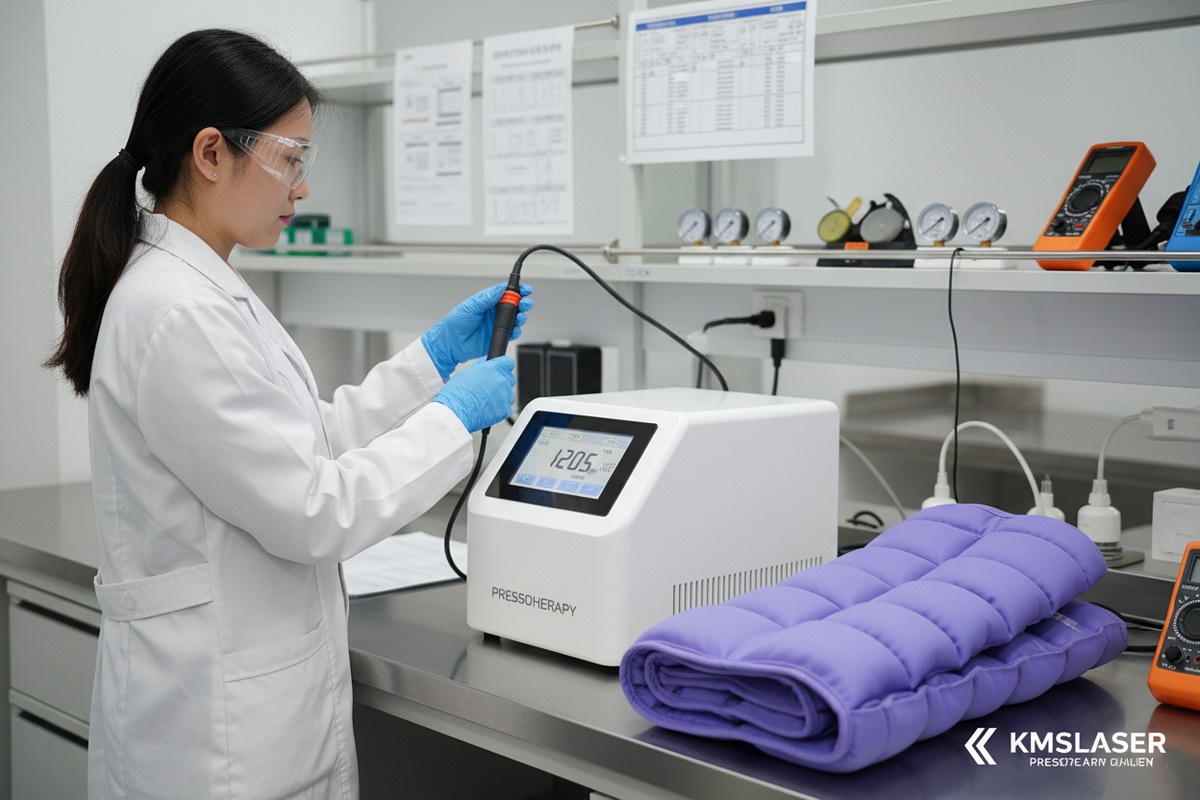
When we analyze the production costs on our assembly lines in Guangzhou, the price gap between our high-end units and those from Valencia or California often surprises new partners maximum pressure stability 1. We understand the hesitation you might feel when seeing a quote that is significantly lower than what you are used to paying for Western labels. You worry about compromising your salon’s reputation for a better margin, but the reality of modern manufacturing tells a different story.
To evaluate value effectively, you must look beyond the brand logo and focus on three core technical metrics: maximum pressure stability (typically 0.25 bar), the number of independent air chambers (16 to 24), and the durability of the air pump compressor. High-quality Chinese manufacturing can match these specifications at 40% to 60% lower acquisition costs.
Let’s examine the technical realities that determine true equipment value.
Our engineering team spends countless hours benchmarking our air pressure sensors against industry leaders to ensure precise modulation independent air chambers 2. We know that for a distributor like you, technical parity is non-negotiable because your downstream salon clients cannot afford treatment failures.
You should compare performance by verifying the continuous duty cycle of the compressor and the precise sequencing of the airbags. Premium Chinese machines now utilize Japanese-engineered pumps and medical-grade TPU suits that offer the same overlapping compression modes and lymphatic drainage efficacy as top-tier European models.
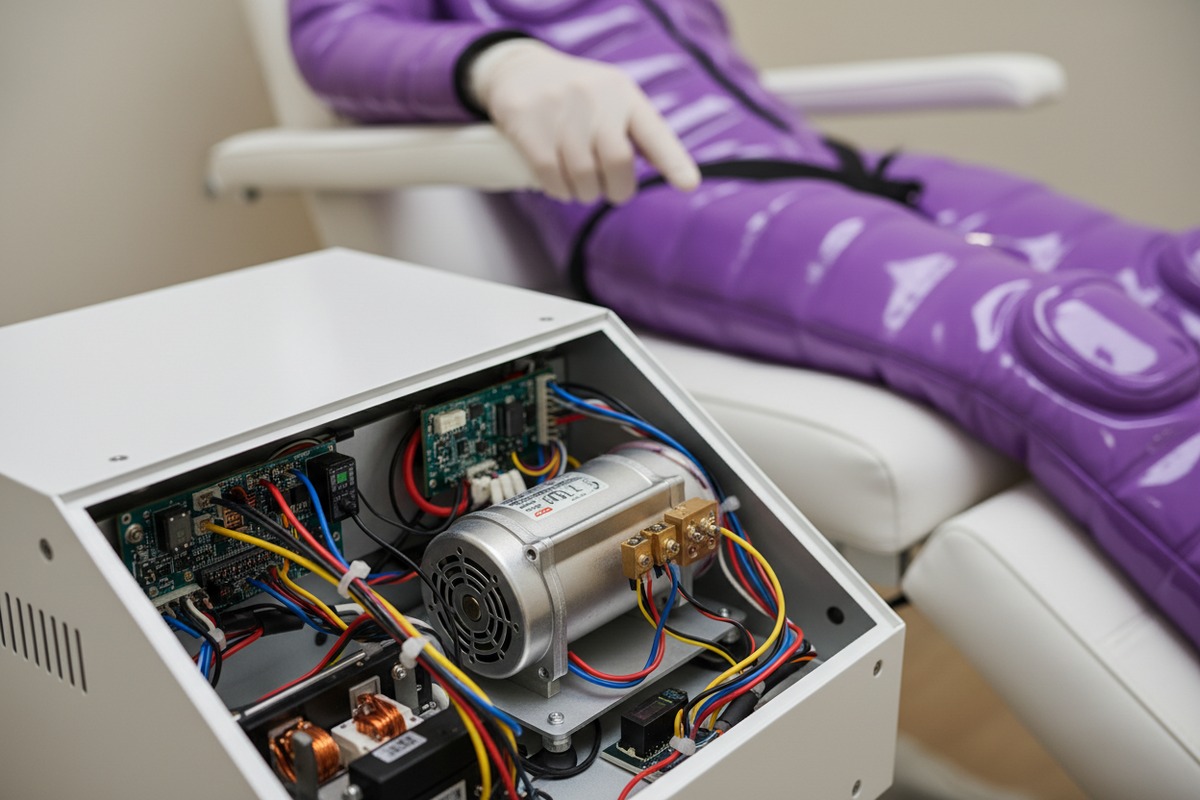
To accurately judge performance, you need to strip away the marketing language and look at the engineering data lymphatic drainage efficacy 3. In the professional salon sector, the "feeling" of the massage comes down to how air is delivered and held within the suit.
The Critical Metric: Chamber Count and Overlap
The most significant indicator of a machine's sophistication is the number of air chambers (channels) and how they overlap Return on Investment (ROI) 4.
- Entry-level systems often have 4 to 8 chambers. These create gaps in pressure, leading to fluid backflow 5, which defeats the purpose of lymphatic drainage.
- High-end systems (European and Top-tier Chinese) feature 16, 20, or even 24 chambers.
When we design our circuits, we implement "overlapping technology." This means Chamber 2 starts inflating slightly before Chamber 1 deflates. This ensures a continuous, wave-like motion that effectively pushes lymph fluid toward the nodes without creating a tourniquet effect. Many distributors assume only Western brands master this, but it is standard in our premium lines.
Compressor Durability and Pressure
The heart of the machine is the air pump. A salon machine must run for 8-10 hours a day.
- Pressure Range: Standard medical efficacy requires a range of 20 mmHg to roughly 200 mmHg (approx 0.26 bar).
- Stability: The machine must maintain the set pressure without fluctuation.
We often see Western brands marketing "proprietary pressure tech," but the physics remains the same. The key difference is often the sourcing of the pump. We use high-durability pumps that are rated for thousands of hours of operation, comparable to those found in German-engineered devices.
Comparison of Technical Specifications
The following table breaks down what you typically get at different market tiers.
| Feature | Average European Brand | Premium Chinese OEM (Our Level) | Budget Chinese Model |
|---|---|---|---|
| Air Chambers | 16 – 24 | 16 – 24 | 4 – 8 |
| Suit Material | High-density TPU | High-density TPU | PVC (stiff, prone to cracks) |
| Pressure Max | ~250 mmHg | ~240-250 mmHg | ~180 mmHg (often unstable) |
| Control Interface | Touchscreen with Client Data | Touchscreen with Custom UI | Simple Knobs/Buttons |
| Pump Noise | < 45 dB | < 50 dB | > 60 dB (Noisy) |
| Certifications | CE (Medical), FDA | CE (LVD/EMC), FDA (Optional) | None or Fake CE |
If you select the middle column—a premium Chinese OEM—you are effectively buying the same internal architecture as the left column, but you are not paying for the European headquarters' overhead or marketing budget.
Can I get the same level of OEM customization from a Chinese manufacturer that I expect from European labels?
We frequently host video conferences with brand owners who are frustrated by the rigidity of their current Western suppliers. In our design center, we prioritize agility, allowing us to modify software interfaces or mold designs in weeks rather than the months it typically takes larger conglomerates.
Chinese manufacturers generally offer superior flexibility in OEM customization compared to European counterparts. We can rapidly prototype custom housing designs, modify software user interfaces with your logo, and alter suit colors to match your brand identity, often with much lower Minimum Order Quantities (MOQs).

The short answer is: not only can you get the same level, you often get more deep customization with us. European manufacturers often operate on a "private label" basis where you can only place a sticker on a finished product. Because they likely have rigid production lines or are outsourcing parts of their own production, making structural changes is expensive and slow.
Deep Customization: Beyond the Logo
For a brand manager like you, differentiation is vital. You don't want your machine to look like the generic unit sold on Amazon.
- Chassis Design: We can open new injection molds to create a unique shape for the machine casing. This prevents price comparisons because your product looks unique.
- Software UI: We can rewrite the firmware. When your client turns on the machine, they see your boot-up screen. We can rename modes (e.g., "Slimming Mode" to "Elizabeth’s Signature Contour") to fit your marketing language.
Suit Material and Color
The suit is what the end-user interacts with.
- Standard: Blue or Grey.
- Custom: We can manufacture suits in your brand colors (e.g., Purple, Matte Black, or Cream).
- Connectors: We can even customize the connector types to ensure proprietary compatibility, meaning clients must buy replacement suits from you.
Speed and Cost of Customization
Time is money. Here is how the development timelines compare.
| Customization Type | European Manufacturer Timeline | Chinese OEM Timeline |
|---|---|---|
| Logo Placement | 2-4 Weeks | 3-7 Days |
| Custom UI/Software | 3-6 Months (High Cost) | 2-4 Weeks (Low Cost) |
| New Chassis Mold | 6-12 Months (Very High Cost) | 30-45 Days (Moderate Cost) |
| Custom Suit Color | High MOQ required (1000+) | Low MOQ (50-100 sets) |
In a market driven by trends, waiting a year for a new design is not an option. Our supply chain density in Guangzhou allows us to source custom screens, plastics, and valves within days, drastically shortening your time-to-market.
How will the lower acquisition cost of these machines affect my brand's long-term ROI and salon reputation?
When we calculate the landed cost for our US partners, we see the immediate financial advantage, but we also track the long-term success of their deployments. We understand that saving money upfront is meaningless if the machines fail, so we focus on balancing cost efficiency with component reliability.
Lower acquisition costs significantly accelerate your Return on Investment (ROI), often reducing the break-even period from 12 months to 3 months. As long as you select a premium Chinese model with stable pressure output, your salon reputation remains secure because the clinical results are indistinguishable from expensive alternatives.

The math is simple, but the implications are profound. In the beauty industry, equipment is a depreciating asset. Tying up $10,000 in a single European unit restricts your cash flow. Investing $3,000 in a comparable high-end Chinese unit frees up $7,000 for marketing, staff training, or interior design—factors that actually drive foot traffic.
The ROI Calculation
Let's look at a realistic scenario for a salon offering lymphatic drainage sessions.
- Session Price: $80 per 45-minute treatment.
- Operational Cost: Minimal (electricity + disposable suit liner).
| Metric | European Machine Scenario | Chinese Premium Machine Scenario |
|---|---|---|
| Machine Cost | $6,500 | $2,200 |
| Shipping & Import | $500 | $600 |
| Total Investment | $7,000 | $2,800 |
| Sessions to Break Even | ~88 Sessions | ~35 Sessions |
| Time to Profit (at 5/week) | ~4.5 Months | ~1.5 Months |
| First Year Profit | $13,800 | $18,000 |
By month two, the salon using the Chinese machine is pure profit. The salon using the European machine is still paying off the debt.
Protecting Your Reputation
The fear is that "cheap" equals "bad results." This is a valid concern with low-end budget machines ($500 range). However, with mid-to-high-end Chinese manufacturing:
- Results are Physical: Pressotherapy is mechanical. If the pressure is accurate (0.25 bar) and the sequence is correct, the biological effect on the lymph system is identical. The body does not know where the compressor was made.
- Perceived Value: Clients judge value by the look of the machine and the comfort of the suit. A sleek, custom-designed white matte casing (like View 1) looks just as premium as a European device.
- Reliability: If the machine runs for 5 years without breaking (which our premium lines do), your reputation for reliability is safe.
What quality control processes should I look for to ensure my imported equipment meets US durability standards?
Our quality assurance team operates with the mindset that every defective unit shipped is a lost client, so we implement strict checkpoints before any crate leaves the dock. We encourage you to be demanding and ask for specific testing reports rather than just accepting a generic “passed” stamp.
To ensure US-standard durability, you must demand proof of specific stress tests: a 48-to-72-hour continuous aging test for the compressor, air leakage detection for the suits, and calibration reports for pressure sensors. Additionally, verify that the manufacturer uses modular internal wiring to facilitate easy repairs.

Durability is the main hesitation for buyers like Elizabeth. You need to know that the machine won't die in the middle of a treatment. To ensure this, you must audit your supplier's Quality Control (QC) process 6. Do not just ask "Do you have QC?" Ask "What are your QC steps?"
Essential QC Steps for Pressotherapy
When evaluating a supplier, look for these specific procedures:
1. The Aging Test (Burn-in)
Electronics often fail within the first 48 hours if there is a defect. Aging Test (Burn-in) 7
- Standard: Turning the machine on for 1 hour. (Insufficient)
- Required: Running the machine continuously for 48 to 72 hours under load. We do this to stress-test the power supply and the cooling system of the air pump. If it survives this, it will likely last for years.
2. Air Leakage Testing
The suit is the most vulnerable part.
- We inflate the suit to maximum pressure (e.g., 200 mmHg) and seal it.
- We monitor it for 30 minutes. If the pressure drops by more than a tiny margin (e.g., >5 mmHg), the suit is rejected. This prevents the "hissing" sound of leaking air in a quiet spa.
3. Modular Internal Design
This is crucial for after-sales support in the US.
- Bad Design: Everything is glued together. If a valve fails, the whole machine is trash.
- Good Design: Modular components with plug-and-play connectors.
- Why it matters: If a valve block fails in New York, we can ship a replacement part from China. Your local technician can swap it in 10 minutes without soldering.
QC Checklist for Buyers
| QC Component | What to Ask For | Why it Matters |
|---|---|---|
| Power Supply | Voltage Stability Test Report | Ensures US 110V compatibility without fluctuations. |
| Air Pump | Noise Level Test (<50dB) | Ensures the machine is quiet enough for a relaxing spa. |
| Suit Weld | High-Frequency Welding Check | Prevents suit seams from bursting under high pressure. |
| Packaging | Drop Test (ISTA Standard) 8 | Ensures the machine survives the FedEx/UPS journey to your salon. |
Conclusion
Evaluating pressotherapy value is about decoupling technical capability from brand heritage. By focusing on critical specifications—chamber count, pressure stability, and compressor duty cycles—and enforcing strict QC protocols like aging tests, you can secure equipment that performs on par with European legacy brands. This approach not only protects your salon's reputation but also radically improves your ROI, allowing you to build a unique brand identity through deep customization without the premium price tag.
Footnotes
1. This page discusses the importance of accurate and precise calibration of pressure units to ensure stability and reliability in medical device production. ↩︎
2. Describes how air chambers in pressotherapy devices function for lymphatic and venous circulation. ↩︎
3. Provides a scientific review on the effectiveness of intermittent pneumatic compression for lymphedema. ↩︎
4. Offers a comprehensive definition and explanation of the Return on Investment metric. ↩︎
5. Explains how lymphatic valves prevent fluid backflow, ensuring unidirectional lymph movement. ↩︎
6. Details quality control procedures and standards specifically for medical device manufacturing. ↩︎
7. Explains burn-in testing to detect early failures (“infant mortality”) in electronic components. ↩︎
8. Outlines ISTA standards for packaging, including drop testing, for medical devices during transit. ↩︎

 English
  Español de México
  Deutsch
  Français
  العربية
  Русский