

In our years of exporting pressotherapy machines to the European market, we’ve seen countless buyers face unexpected customs rejections, product recalls, and legal challenges—all because their supplier’s EMC certificates didn’t hold up to scrutiny CE marking authenticity 1. The pain is real: you invest thousands in inventory only to discover your equipment can’t legally be sold.
To evaluate pressotherapy machine suppliers for European EMC compliance, you must verify CE marking authenticity, confirm Notified Body legitimacy through the NANDO database, request complete technical documentation per EU MDR Annex II and III, and assess ISO 13485 certification status. Additionally, demand test reports for EN 60601-1-2 EMC standards covering both emissions and immunity testing.
This guide walks you through the exact steps our quality team uses to ensure every machine we produce meets European standards EU MDR Annex II and III 2. Let’s break down each critical verification step.
How can I verify that my Chinese supplier's EMC certificates for pressotherapy machines are actually valid?
When we ship equipment to distributors in Germany or France, one of their first questions is always about certificate authenticity risk management files 3. Fake or expired EMC certificates from Chinese suppliers have become disturbingly common, and the consequences of accepting them can devastate your business.
To verify EMC certificate validity, cross-reference the certificate number with the issuing Notified Body, check the NANDO database to confirm the Notified Body's designation status, verify the certificate scope matches your exact device model, and confirm the certificate hasn't expired. Direct contact with the certifying body provides final confirmation of authenticity.

Understanding the NANDO Database
NANDO, which stands for New Approach Notified and Designated Organisations, is a central and official database maintained by the European Commission EU Authorized Representative 4. It plays an important role in providing public access to information about organizations designated and notified under the New Approach Directives and Regulations in the European Union.
For manufacturers seeking to work with a Notified Body, NANDO serves as a verification tool. Manufacturers can confirm whether a specific Notified Body is officially designated and whether its designation covers the type of products they manufacture.
Step-by-Step Certificate Verification Process
| Step | Action | What to Check |
|---|---|---|
| 1 | Obtain certificate copy | Complete document with all pages |
| 2 | Identify Notified Body number | Four-digit number on certificate |
| 3 | Search NANDO database 5 | Body designation status and scope |
| 4 | Verify scope coverage | Medical device classification match |
| 5 | Contact Notified Body | Direct confirmation of certificate |
Common Certificate Red Flags
In our experience, several warning signs indicate a certificate may be fraudulent or misrepresented:
- Certificate dates that extend beyond the Notified Body's designation period
- Scope descriptions that don't match the specific pressotherapy device
- Missing or incomplete Notified Body identification numbers
- Certificates issued under the old MDD instead of current MDR
The database can be used to verify the status (valid/withdrawn/expired/suspended) of a notified body related to a particular European Directive or Regulation as well as the associated designated scope of tasks related to conformity assessment procedures set out in that Directive or Regulation.
Why Direct Contact Matters
Even when certificates appear legitimate, we always recommend direct verification. It enables manufacturers, importers, and consultants to verify whether a body is authorised and active to carry out CE certification processes. This extra step takes only a few days but can save months of delays and significant financial losses.
What specific technical documentation should I request to prove my custom beauty machines meet European standards?
Our engineering team spends considerable time compiling technical files for each pressotherapy system we develop. When buyers ask for documentation, many don't know exactly what to request—and incomplete documentation can halt your entire import operation.
For EU MDR compliance, request the complete technical documentation as specified in Annex II and III, including device description, risk management files per ISO 14971, clinical evaluation report, GSPR checklist, EN 60601-1 safety test reports, EN 60601-1-2 EMC test reports, Declaration of Conformity, and post-market surveillance plan. All documents must be available and current.

MDR Technical Documentation Structure
The main purpose of technical documentation is to demonstrate that a medical device meets the general safety and performance requirements (GSPR) set forth in MDR Annex I, providing evidence that the medical device is MDR-compliant. Regardless of the class, technical documentation is mandatory for all medical devices and must always be available.
The main purpose of technical documentation in the EU Medical Device Regulation (MDR) is to prove that a medical device meets the general safety and performance requirements. Regardless of the class, technical documentation is mandatory for all medical devices.
Complete Documentation Checklist
| Document Category | Required Elements | Purpose |
|---|---|---|
| Device Description | Technical specifications, variants, accessories, UDI-DI | Product identification |
| Design Information | Engineering drawings, materials list, software documentation | Design verification |
| Manufacturing Info | Production processes, quality controls, supplier details | Production consistency |
| GSPR Checklist | Compliance evidence for each applicable requirement | Safety demonstration |
| Risk Management | ISO 14971 documentation, risk analysis, mitigation measures | Hazard control |
| Clinical Evaluation | CER, literature review, clinical data analysis | Performance evidence |
| Testing Reports | EN 60601-1, EN 60601-1-2, biocompatibility if applicable | Standard conformity |
| Post-Market | PMS plan, PMCF plan, vigilance procedures | Ongoing surveillance |
EMC-Specific Testing Documentation
For pressotherapy machines, the EMC documentation must be comprehensive. The European Medical Device and In-Vitro Regulations (MDR and IVDR) require manufacturers to prepare detailed Technical Documentation to obtain and maintain CE Marking of medical devices. In most cases, this documentation will be reviewed by your European Notified Body and contains a wide array of information about your device: specifications, manufacturing process, design controls, test reports, risk assessments, clinical data, and much more.
Keeping Documentation Current
It must be kept up to date throughout the entire product life cycle. The technical documentation is the basis for the conformity assessment and thus for the CE marking of a product.
The MDR requires this documentation to be updated regularly, and for it to be made available to regulatory authorities upon request.
This means your supplier should have a system for maintaining and updating documentation as the product evolves.
How do I evaluate if a manufacturer's quality control process is rigorous enough for long-term EMC stability?
At our facility, we've invested heavily in quality management systems because we understand that EMC compliance isn't just about passing initial tests. It's about every single unit maintaining those standards over years of production. Your supplier's quality system directly impacts your liability exposure.
Evaluate manufacturer quality control by verifying ISO 13485 certification, reviewing documented procedures for incoming component inspection, in-process EMC testing protocols, final product verification, and calibration management. Request evidence of periodic EMC re-testing, supplier qualification records, and traceability systems. A robust quality system ensures every unit meets the same standards as the originally certified device.
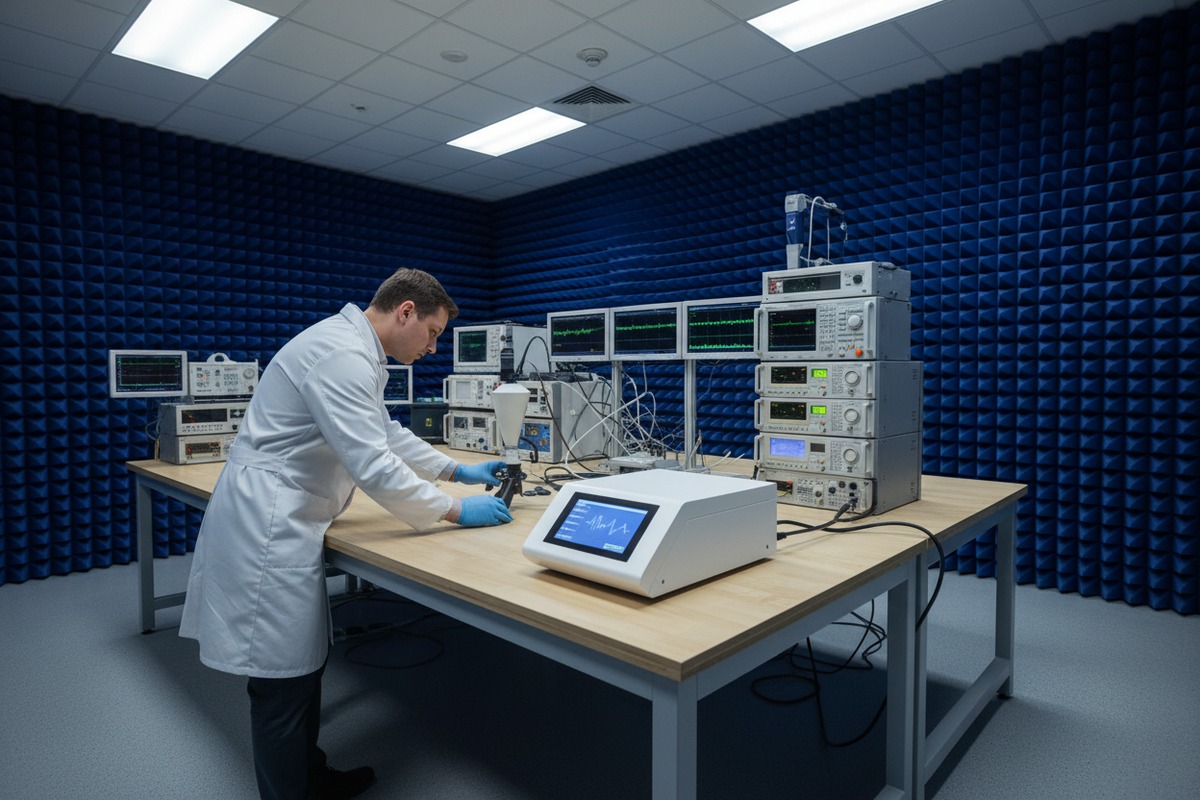
The Importance of ISO 13485 Certification
ISO 13485 is the internationally recognized standard for quality management systems in the design and manufacture of medical devices. It outlines specific requirements that help organizations ensure their medical devices meet both customer and regulatory demands for safety and efficacy.
Compliance with ISO 13485 is often seen as the first step in achieving compliance with European regulatory requirements.
Quality System Evaluation Criteria
| Quality Element | What to Assess | Why It Matters for EMC |
|---|---|---|
| Design Control | Change management procedures | Prevents uncontrolled modifications affecting EMC |
| Supplier Management | Component qualification records | Ensures consistent electromagnetic properties |
| Production Control | In-process testing protocols | Catches EMC issues before final assembly |
| Calibration | Equipment calibration certificates | Guarantees accurate EMC measurements |
| Traceability | Batch and serial tracking systems | Enables issue investigation and recall management |
| CAPA System | Corrective action procedures | Addresses EMC failures systematically |
Key Quality Indicators for EMC Stability
It ensures a robust QMS that enhances product quality and patient safety throughout the lifecycle of medical devices. Compliance with ISO 13485 helps companies meet global regulatory requirements, facilitating market access.
When evaluating suppliers, look for these specific indicators:
Documentation and Record Requirements
By standardizing QMS practices, ISO 13485 helps manufacturers reduce quality variation, enhance process control, and minimize risks throughout the entire product lifecycle. ISO 13485 supports consistent and compliant performance of medical devices by requiring documented procedures, traceability, control and monitoring of manufacturing processes, and effective change control throughout the product lifecycle.
Practical Assessment Questions
During supplier audits, we ask specific questions:
- How often do you re-test production units for EMC compliance?
- What happens when a component supplier changes their specifications?
- Can you show traceability from any finished unit back to component batches?
- How do you validate that production changes don't affect EMC performance?
Compliance with ISO 13485 helps companies meet global regulatory requirements, facilitating market access. It improves process efficiency, reduces risks, and minimizes the likelihood of defects or recalls.
What steps can I take to ensure my private-label equipment won't face legal or customs issues in the European market?
We've helped many brand owners navigate the complex requirements for bringing private-label pressotherapy equipment into Europe. The regulatory landscape has shifted significantly under the MDR, and what worked five years ago may now result in your shipments being stopped at the border.
To prevent legal and customs issues with private-label equipment, ensure your manufacturer holds valid MDR certification, appoint an EU Authorized Representative, designate an EU Importer, register in EUDAMED when mandatory, verify all labeling includes required economic operator information, maintain complete traceability documentation, and ensure customs tariff classification is correct. Private-label sellers may assume manufacturer obligations under certain conditions.

Understanding Your Role as Private-Label Seller
An importer or distributor will acquire the obligations of manufacturers if it: makes available on the market a device under its name, registered trade name or registered trademark.
This is critical for private-label operations. When you put your brand on a pressotherapy machine, you may become legally responsible as the manufacturer under EU law.
EU Import Requirements Checklist
| Requirement | Responsible Party | Action Required |
|---|---|---|
| CE Marking Verification | Importer | Confirm valid CE certificate before import |
| Authorized Representative | Manufacturer (non-EU) | Must be appointed and identified on labeling |
| EU Importer Designation | Brand Owner | Required for all non-EU manufactured devices |
| EUDAMED Registration 7 | All economic operators | Register when system becomes mandatory |
| Labeling Compliance | Manufacturer/Importer | Include all required operator details |
| Declaration of Conformity 8 | Manufacturer | Must be available and current |
| Technical Documentation | Manufacturer | Must be accessible to authorities |
Importer Obligations Under MDR
Specifically, Articles 13 and 14 of the EU MDR reinforce (and add specificity to) the need for supply chain economic operators to do the following: Verify that the medical device has CE Marking by getting a copy of the device's CE certificate and/or the Declaration of Conformity. (This applies to importers and distributors.) Ensure that the manufacturer has appointed an Authorized Representative (AR) in accordance with MDR Article 11.
Check EUDAMED registration of all economic operators. Verify that devices placed on the EU market include CE Marking. Verify that EU declaration of conformity and technical documentation exists.
Customs Clearance Considerations
For this reason, the CE marking and EU Declaration of Conformity—as proof of compliance with the essential safety and performance requirements—and the complete technical documentation are among the mandatory import documents.
For the actual import process, manufacturers and importers must, in addition to MDR & requirements for import, also comply with customs regulations to ensure a successful market entry. This is because both when importing into the European market and exporting to foreign markets, the correct tariff classification of the product is essential.
Maintaining Long-Term Compliance
Importers and distributors need to be able to identify (1) any economic operator to whom they have directly supplied a device, (2) any economic operator who has directly supplied them with a device, and (3) any health institution or healthcare professional to which they have directly supplied a device to the competent authority, for a period of at least 10 years, or, in the case of implantable devices, for a period of at least 15 years after the last device covered by the EU declaration of conformity has been placed on the market.
Practical Steps for Private-Label Success
Based on our experience supporting brand owners, follow these practical steps:
- Establish clear contracts specifying regulatory responsibilities
- Maintain independent verification of your supplier's compliance status
- Create backup documentation systems independent of your supplier
- Build relationships with your appointed Authorized Representative and Importer
- Monitor regulatory updates through official EU channels
Conclusion
Evaluating pressotherapy machine suppliers for European EMC compliance 9 requires systematic verification across multiple dimensions. Focus on certificate authenticity through NANDO database checks, demand complete technical documentation per EU MDR requirements, assess quality management systems beyond basic ISO 13485 certification, and understand your own legal obligations as a private-label seller or importer to protect your business.
Footnotes
1. Official EU guidance on the meaning and verification of CE marking. ↩︎
2. Official consolidated text of Regulation (EU) 2017/745 (EU MDR) on EUR-Lex, containing Annex II and III. ↩︎
3. Explains the international standard for risk management for medical devices. ↩︎
4. Official EU information on the role of Authorized Representatives under MDR. ↩︎
5. Direct link to the official European Commission NANDO database. ↩︎
6. Official ISO standard for quality management systems in medical devices. ↩︎
7. Official EU portal and information for the European Database on Medical Devices. ↩︎
8. Official European Commission page on CE marking, which includes information on the Declaration of Conformity. ↩︎
9. Official EU information on the Electromagnetic Compatibility Directive. ↩︎

 English
  Español de México
  Deutsch
  Français
  العربية
  Русский