

When we first started exporting pressotherapy machines 2 to regions with unstable grids, our support team received numerous calls about machines shutting down mid-treatment. Spa owners lost revenue. Clients lost trust. The problem was clear: voltage fluctuations 3 were destroying equipment and ruining businesses. This is not a rare issue—it affects thousands of beauty salons worldwide.
To evaluate pressotherapy machine stability under voltage fluctuations, check the rated voltage range on the specification plate (look for 100-240V auto-switching), verify CE or UL certifications, request manufacturer surge test documentation, and confirm the presence of internal voltage regulation and 36V safety output for garments.
This guide will walk you through the exact steps to assess voltage stability before purchasing. You will learn what to ask manufacturers, how to interpret technical specs, and what red flags to avoid. Let us dive in.
How can I verify that my pressotherapy machine's power supply is built for voltage stability?
Our engineers spend considerable time testing power supply units before they leave the production line. Many buyers overlook this critical component. They focus on airbag quality or screen resolution. But the power supply determines whether your machine survives the first power surge or dies within months.
Verify voltage stability by checking the machine’s input voltage range (ideal: 100-240V 50/60Hz auto-switching), confirming medical-grade power supply components, looking for 36V safety voltage output to garments, and requesting documentation of internal surge protection and voltage regulation circuitry.
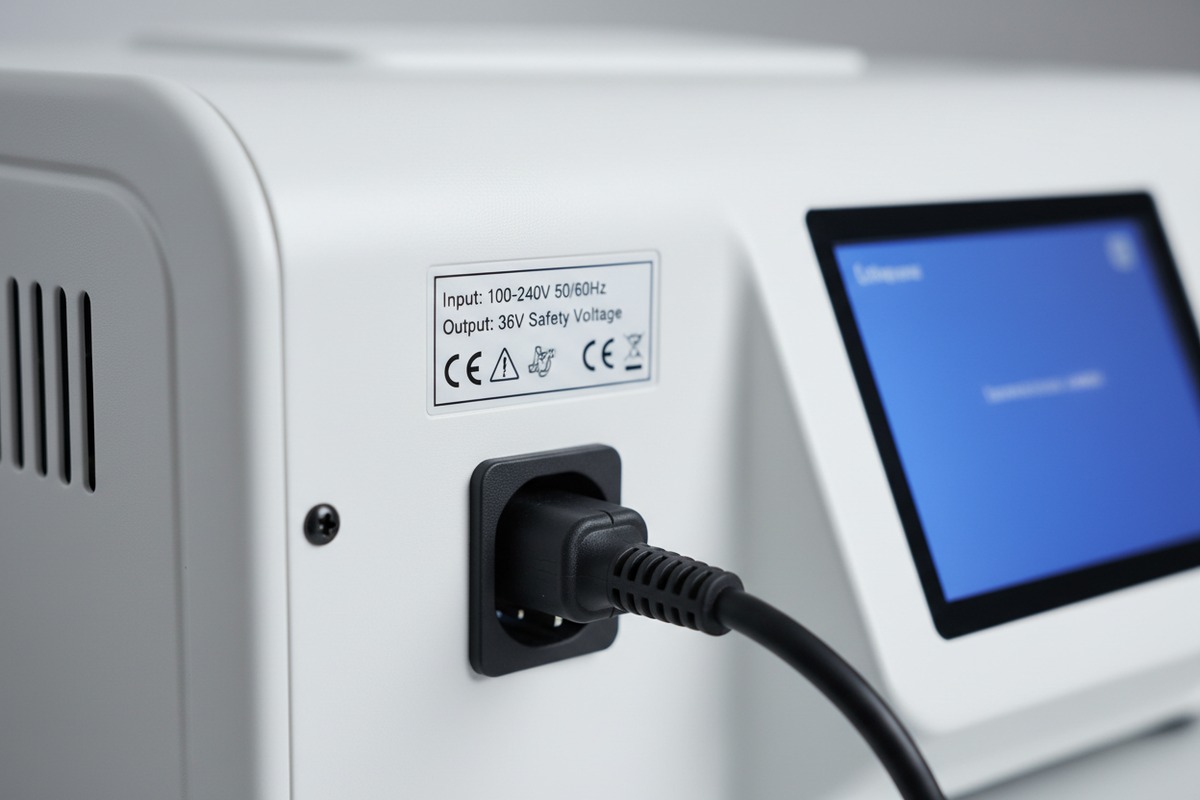
Understanding Voltage Input Specifications
The first step is simple. Look at the rating plate on the machine. A well-designed pressotherapy machine should show a wide input voltage range. Output voltage specifications like AC 110V±10%/60Hz or AC 220V±10%/50Hz indicate the machine's voltage tolerance. The ±10% tolerance means the machine can handle minor fluctuations without issues.
Better machines feature universal voltage input. Quality pressotherapy machines operate on AC110V/220V, 50-60Hz voltage, making them suitable for global markets. This dual-voltage capability signals robust internal regulation.
Key Power Supply Features to Verify
| Feature | What It Means | Why It Matters |
|---|---|---|
| Wide input range (100-240V) | Auto-switching power supply | Works in any country without external converters |
| 36V safety output | Internal voltage step-down | The massage machine operates on a 36V safety voltage, providing users with a reassuring environment. |
| Surge protection 4 | Built-in MOV or TVS diodes | Blocks sudden voltage spikes from reaching circuits |
| Medical-grade PSU | Meets IEC 60601 5 standards | Higher isolation and lower leakage current |
Checking for Internal Voltage Regulation
Medical devices should tolerate voltage fluctuations within a certain range, as voltage may vary briefly due to various reasons during actual operation. Devices need to have stable voltage regulation capabilities to maintain normal operation and prevent functional failures caused by voltage fluctuations.
Ask your supplier these questions:
- Does the machine use active power factor correction 6 (PFC)?
- Is there built-in voltage regulation circuitry?
- What is the maximum transient voltage the power supply can withstand?
If the supplier cannot answer these questions, that is a red flag.
Certification Marks That Indicate Quality
IEC 60601 is a widely accepted series of standards for the basic safety and essential performance of medical electrical equipment and systems. It is an important standard, and noncompliant equipment can pose a significant risk to patients.
Look for these marks:
- CE Mark: The CE certification is a symbol that a manufacturer marks to a product so that it can be sold in Europe. The CE mark 7 means that the manufacturer takes full responsibility for the compliance of a product with all applicable European health, safety, performance, and environmental requirements.
- UL Certification: UL certification 8 indicates that a product has been tested and meets the stringent safety standards set by UL. This certification is widely recognized in North America.
What specific stress tests should my manufacturer perform to ensure performance during power surges?
In our production facility, we conduct multi-stage voltage stress tests on every pressotherapy unit. Many competitors skip these tests to save time and money. The result? Machines that fail within the first year. When we test, we simulate real-world conditions—not just laboratory ideals.
Manufacturers should perform high-voltage insulation tests, surge immunity tests (per IEC 61000-4-5), voltage dip and interruption tests, burn-in testing at elevated temperatures, and continuous operation tests under simulated voltage fluctuations ranging from 80V to 260V.

Essential Pre-Shipment Tests
Making the units rugged through careful design and controlled overstress testing is a very important part of making the product reliable.
Here are the tests you should request documentation for:
| Test Type | Purpose | Standard Reference |
|---|---|---|
| Hi-Pot (High Voltage) Test | Checks insulation integrity | IEC 60601-1 |
| Surge Immunity Test | Simulates lightning and switching surges | IEC 61000-4-5 |
| Voltage Dip Test | Tests behavior during brief voltage drops | IEC 61000-4-11 |
| Burn-In Test 10 | Detects early failures (infant mortality) | Internal QC |
| Continuous Run Test | Validates long-term stability | Internal QC |
The Burn-In Process Explained
In region "A" of the failure curve, poor workmanship and substandard components cause failures. This period is usually a few hundred hours and a "burn in" is sometimes employed to stop these failures occurring in the field. Note that this does not stop the failures occurring, it just ensures that they happen in-house and not on the customer's premises.
A proper burn-in test runs the machine continuously for 24-72 hours under controlled conditions. During this time, voltage is varied intentionally to stress internal components. Any weak parts fail during burn-in—not after you have shipped the machine to your customer.
How to Request Test Documentation
When evaluating suppliers, ask for:
- Test reports: Formal documentation of voltage stress tests performed
- Video evidence: Some manufacturers can provide video of actual testing
- Calibration certificates: Proof that testing equipment is properly calibrated
- Failure rate data: Historical data on how many units fail specific tests
Simulating Real-World Voltage Conditions
Voltage fluctuations at the terminals of an induction motor affect the output torque and slip and consequently affect the production process. In the worst case, this may lead to excessive vibration, which reduces mechanical strength and shortening the motor service life.
The air compressor pump in a pressotherapy machine is essentially a small motor. It is sensitive to voltage variations. A good manufacturer tests with variable transformers (variacs) to simulate:
- Undervoltage conditions (down to 80V)
- Overvoltage conditions (up to 260V)
- Rapid voltage fluctuations
- Complete power loss and restoration
Questions to Ask About Testing Protocols
- Do you perform 100% testing or sample-based testing?
- What is your failure rate during burn-in?
- Can you provide test reports for my specific order?
- What equipment do you use for surge testing?
- How do you verify pressure accuracy under voltage stress?
How will frequent voltage fluctuations impact the long-term failure rate of my imported equipment?
We have tracked warranty claims across thousands of machines shipped to different regions. The data is clear: machines operating in areas with unstable power grids fail 2-3 times more often than those in stable environments. The damage is cumulative and often invisible until catastrophic failure occurs.
Frequent voltage fluctuations accelerate component aging, increase capacitor degradation, stress motor windings, corrupt control board firmware, and can reduce equipment lifespan by 40-60%. Without proper protection, expect significantly higher maintenance costs and unexpected downtime.

The Science Behind Voltage Damage
Failures can be caused by excess temperature, excess current or voltage, ionizing radiation, mechanical shock, stress or impact, and many other causes.
When voltage fluctuates, several things happen inside your pressotherapy machine:
- Capacitors overheat: Power dissipation by high ripple currents and internal resistances cause an increase of the capacitor's internal temperature beyond specifications, accelerating the deterioration rate.
- Motors work harder: Compressor pumps draw more current to compensate for low voltage
- Control boards stress: Microprocessors may reset or corrupt data
- Insulation degrades: Repeated voltage spikes weaken wire insulation over time
Failure Rate Impact Data
| Condition | Expected Lifespan | Failure Rate Increase |
|---|---|---|
| Stable voltage (±5%) | 7-10 years | Baseline |
| Moderate fluctuations (±10%) | 5-7 years | 30-50% higher |
| Severe fluctuations (±15%+) | 3-5 years | 100-200% higher |
| Frequent surges (>500V) | 1-3 years | 300%+ higher |
Components Most Vulnerable to Voltage Stress
Reduced Equipment Lifespan: Fluctuations in voltage can stress electronic components, shortening the lifespan of expensive medical equipment. This leads to higher operational costs due to more frequent repairs and replacements, and increases downtime, affecting patient care.
The most vulnerable parts in a pressotherapy machine include:
- Electrolytic capacitors: First to fail from heat stress
- Air compressor motor: Overheats and wears bearings faster
- Power supply MOSFETs: Can fail from repeated surge stress
- LCD display: May show artifacts or fail completely
- Solenoid valves: May stick or fail to actuate properly
Real-World Failure Scenarios
Rapid changes in voltage levels can lead to overheating, component failure, and even permanent damage, rendering the equipment inoperable and requiring costly repairs or replacements.
Common failure patterns we see include:
- Pump noise without inflation: Control board damage preventing proper airbag sequencing
- Inconsistent pressure: Solenoid valve degradation from voltage spikes
- Random shutdowns: Power supply protection circuits triggering repeatedly
- Display failures: LCD driver damage from voltage transients
Calculating the True Cost
Consider this scenario: You import 10 pressotherapy machines at $2,000 each. Without voltage protection:
- 3 machines may need board replacements ($300 each) = $900
- 2 machines may need motor replacements ($200 each) = $400
- 1 machine may fail completely = $2,000 loss
- Shipping costs for parts and repairs = $500
- Lost revenue during downtime = Incalculable
Total additional cost: $3,800+ (19% of initial investment)
Mitigation Strategies
The solution of Voltage Fluctuations in your facility Is a voltage stabilizer which is one of widely used solutions and it has proven to be an effective system that able to prevent potentially dangerous situations created by the unstable input voltage.
Protect your investment with:
- External voltage stabilizers: For regions with known grid issues
- UPS systems: Provide clean, stable power
- Surge protectors: Basic protection against spikes
- Regular maintenance: Check connections and internal components
Can I customize the internal voltage protection components to meet my local market's electrical standards?
When we develop machines for specific markets, our engineering team works closely with clients to customize voltage protection. A machine destined for Germany needs different specifications than one going to Nigeria. This is not just about plug shapes—it is about survival in different electrical environments.
Yes, reputable manufacturers can customize internal voltage protection by selecting appropriate surge protection ratings, adjusting voltage regulation range, adding external stabilizer compatibility, upgrading to medical-grade power supplies, and configuring protection circuits for specific regional grid characteristics.

What Can Be Customized
| Component | Customization Options | Best For |
|---|---|---|
| Power Supply Unit | Different voltage ranges, higher surge ratings | Regions with extreme fluctuations |
| Surge Protection | MOV ratings, TVS diode selection | Areas prone to lightning |
| Input Filter | EMI/RFI filtering level | Electrically noisy environments |
| Voltage Regulator | Adjustment range, response time | Regions with chronic instability |
| Safety Circuits | Cut-off thresholds, recovery behavior | Critical applications |
Understanding Regional Requirements
Different markets have different electrical characteristics:
- North America: 120V 60Hz, generally stable, occasional brown-outs
- Europe: 230V 50Hz, highly stable in Western Europe, variable in Eastern regions
- Asia: Mix of 220V and 100V systems, stability varies widely
- Africa/Middle East: Significant voltage instability in many regions
- South America: 220V/127V mixed systems, frequent fluctuations
Medical-Grade vs. Standard Power Supplies
Medical devices must incorporate at least one means of protection (MOP) to ensure that both the operator and the patient, if connected via an AP, are protected from the risks of electric shock, even under fault conditions. A MOP can be achieved through safety insulation, protective earth, a defined creepage distance, an air gap, other protective impedances, or by implementing a combination of these techniques.
For professional spa environments, consider upgrading to medical-grade power supplies that offer:
- Higher isolation voltage (4000V+ vs. 1500V standard)
- Lower leakage current (<100µA vs. <500µA)
- Better EMC performance
- Longer lifespan under stress
Certification Considerations
UL certification is voluntary, and manufacturers can choose to seek it to demonstrate product safety, whereas CE certification is mandatory for products intended to be sold in the EEA.
When customizing for specific markets, consider these certifications:
| Market | Required/Recommended Certification |
|---|---|
| EU/EEA | CE marking (mandatory) |
| USA | UL or ETL (often required by retailers) |
| Canada | CSA or cUL |
| Australia | RCM marking |
| Global | CB Scheme certification |
How to Request Customization
When working with your manufacturer, provide:
- Target market details: Which countries will receive the machines
- Voltage environment data: Known issues in your region
- End-user type: Home use vs. professional spa
- Budget constraints: Medical-grade components cost more
- Certification requirements: What marks do your clients require
OEM/ODM Customization Process
At our facility, customization follows this process:
- Consultation: Discuss your market requirements
- Engineering review: Our team assesses feasibility
- Component selection: Choose appropriate protection components
- Prototype: Build and test customized unit
- Validation: Stress testing under simulated conditions
- Production: Roll out customized specifications
- Documentation: Provide updated technical specifications
Cost Considerations
Customization typically adds 5-15% to unit cost, depending on:
- Component upgrades required
- Certification testing needed
- Minimum order quantity
- Engineering time required
However, this investment pays off through:
- Reduced warranty claims
- Higher customer satisfaction
- Lower total cost of ownership
- Better market reputation
Conclusion
Evaluating pressotherapy machine voltage stability requires checking input voltage ranges, verifying certifications, requesting stress test documentation, and understanding regional electrical conditions. Protect your investment by choosing manufacturers who prioritize power quality engineering and offer customization for your market. The small upfront investment in proper voltage protection saves significant costs in repairs, downtime, and customer complaints over the equipment's lifetime.
## Footnotes

<span id="footnote-1">
1. Detailed features and requirements for medical-grade power supplies. <a href="#ref-1" class="footnote-backref">↩︎</a>
</span>

<span id="footnote-2">
2. Comprehensive overview of pressotherapy from an authoritative health source. <a href="#ref-2" class="footnote-backref">↩︎</a>
</span>

<span id="footnote-3">
3. Details the causes and detrimental effects of voltage fluctuations on electrical systems and devices. <a href="#ref-3" class="footnote-backref">↩︎</a>
</span>

<span id="footnote-4">
4. Explains how surge protectors work by diverting excess voltage to protect electronic devices. <a href="#ref-4" class="footnote-backref">↩︎</a>
</span>

<span id="footnote-5">
5. Describes IEC 60601 as a globally recognized standard for medical electrical equipment safety and effectiveness. <a href="#ref-5" class="footnote-backref">↩︎</a>
</span>

<span id="footnote-6">
6. Explains active power factor correction (PFC) as a method to optimize power factor in AC systems. <a href="#ref-6" class="footnote-backref">↩︎</a>
</span>

<span id="footnote-7">
7. Official European Union page explaining the meaning and requirements of the CE marking. <a href="#ref-7" class="footnote-backref">↩︎</a>
</span>

<span id="footnote-8">
8. Explains UL certification's significance, process, and importance for product safety and market access. <a href="#ref-8" class="footnote-backref">↩︎</a>
</span>

<span id="footnote-9">
9. Technical explanation of voltage regulators and their internal workings. <a href="#ref-9" class="footnote-backref">↩︎</a>
</span>

<span id="footnote-10">
10. Explains burn-in testing as a critical reliability method to identify and eliminate early-life failures in components. <a href="#ref-10" class="footnote-backref">↩︎</a>
</span>

 English
  Español de México
  Deutsch
  Français
  العربية
  Русский