
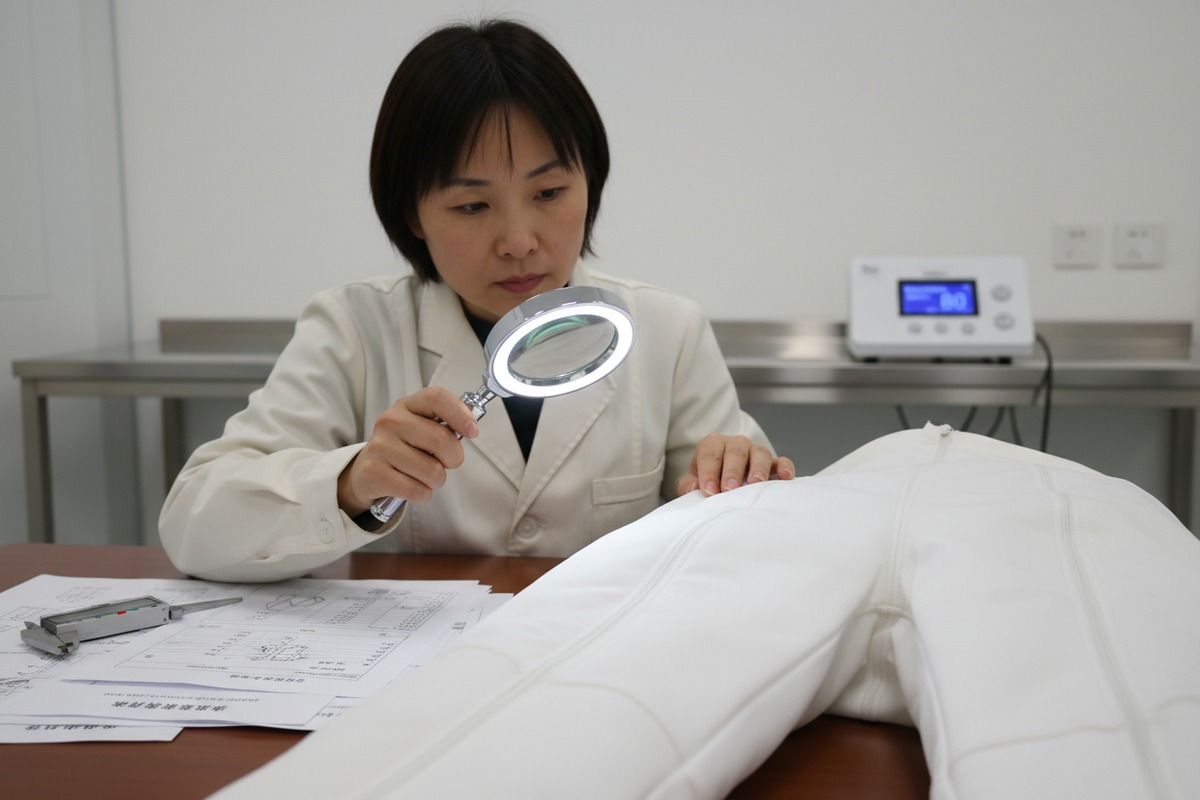
When our production team first started manufacturing pressotherapy systems 1 five years ago, we quickly learned a painful lesson. A batch of garments with substandard stitching failed after just 20 treatment sessions quality control inspection 2. The air chambers leaked. Seams ripped. Clients were furious. That experience taught us that stitching quality is not optional—it is the backbone of pressotherapy garment durability.
To evaluate pressotherapy garment stitching for durability and tear resistance, focus on four key areas: verify thread quality through tensile strength specifications (minimum 9-10 grams per denier), inspect for reinforced seam techniques like flatlock and double-stitching at high-stress zones, conduct tear resistance tests per ASTM D5587 or D1424 standards, and confirm stitch density customization capabilities with your supplier.
This guide walks you through exactly how to assess each factor during the sourcing process. We cover thread quality verification, reinforced seam identification, pre-shipment inspection protocols, and supplier customization discussions. Let’s break it down step by step.
How can I verify that the stitching thread quality meets my durability requirements for high-pressure treatments?
Thread quality is something our quality control team checks before any production batch begins. We have seen too many garments fail because the thread itself could not handle repeated inflation cycles. The wrong thread breaks under tension, frays during laundering, and ultimately compromises the entire garment.
To verify thread quality, request technical data sheets from your supplier specifying thread material (polyester or bonded nylon), tenacity (minimum 9.0-10.0 grams per denier), tensile strength, and UV/abrasion resistance ratings. Conduct sample testing with at least 50 wash cycles and 200 inflation-deflation cycles before approving bulk orders.

Understanding Thread Material Options
Your thread choice directly impacts garment lifespan. For pressotherapy garments used indoors, two main options dominate the market.
Nylon thread offers higher tenacity—approximately 10.0 grams per denier compared to polyester's 9.0 gpd. This means nylon delivers more strength for its size. Nylon also has excellent stretch and recovery, which helps seams flex during inflation cycles without breaking.
Polyester thread, on the other hand, provides superior UV resistance and moisture stability. For garments that may be exposed to cleaning solutions or disinfectants, polyester maintains its integrity better over time.
Key Thread Specifications to Request
| Specification | Minimum Requirement | Why It Matters |
|---|---|---|
| Tenacity | 9.0-10.0 gpd | Determines strength-to-weight ratio |
| Tensile Strength 3 | 14-15 lbs (Size 92) | Measures force before breakage |
| Elongation | 20-26% | Allows seams to stretch with fabric |
| Abrasion Resistance | Grade 4+ (AATCC scale 4) | Prevents thread degradation from friction |
| Chemical Resistance | Neutral pH range | Protects against cleaning solution damage |
Practical Testing Protocol
Before approving any supplier, request sample garments for your own testing. Run the following checks:
First, conduct a visual inspection of thread consistency. Look for uniform thickness and no visible weak points. Second, perform a wash durability test—50 wash cycles minimum at 40°C. Third, simulate inflation cycles. Connect the garment to your pressotherapy machine and run at least 200 full inflation-deflation cycles at maximum pressure. Check for any thread loosening, fraying, or seam separation.
Our engineers have found that garments passing all three tests show significantly lower field failure rates. The upfront testing investment saves thousands in warranty claims later.
What reinforced seam techniques should I look for to ensure my garments don't rip under heavy salon use?
During our factory audits of potential suppliers, seam construction is the first thing we examine. A garment may use premium thread, but if the seam technique is wrong, it will still fail. High-pressure treatments put enormous stress on specific garment zones—around air chamber connections, overlapping sections, and body contour areas.
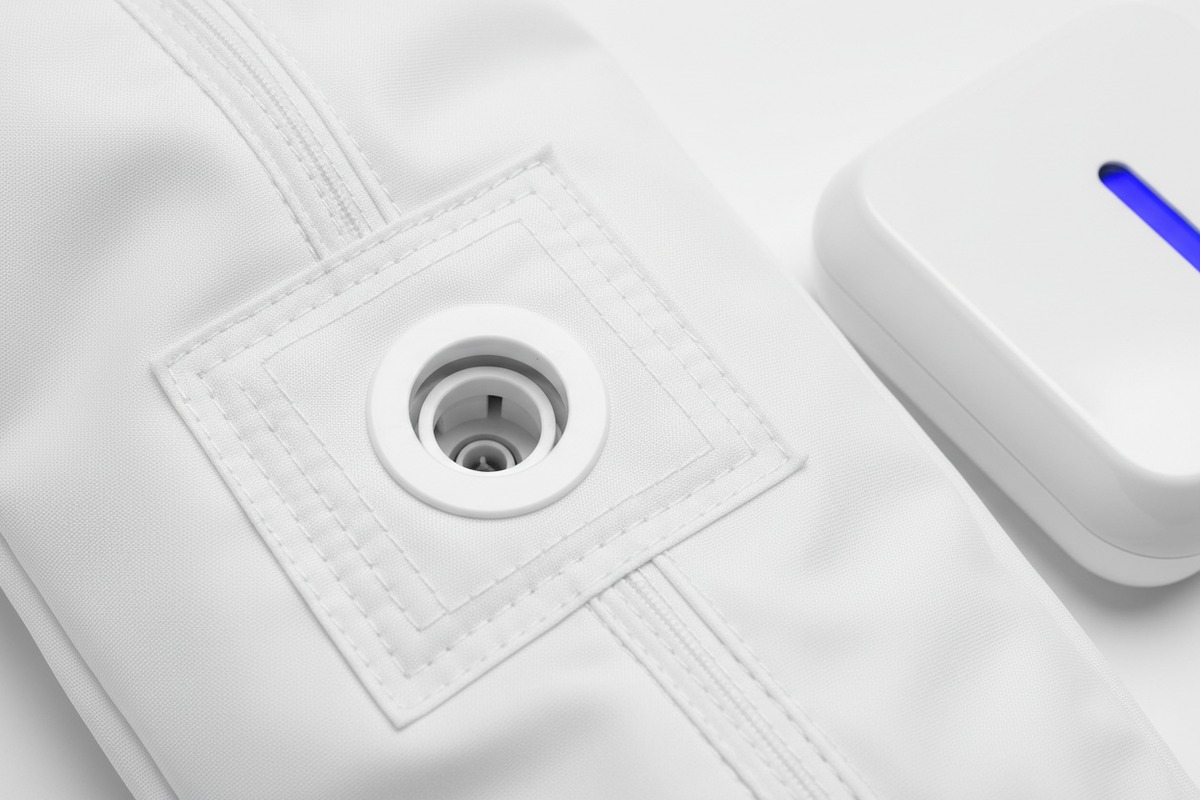
Look for flatlock stitching for flexibility and skin comfort, double-stitched reinforced seams at high-stress areas (shoulders, hips, inner thighs, connector ports), bar tack reinforcements at load-bearing points, and curved seams that follow body contours to distribute tension evenly.
Critical Seam Types for Pressotherapy Garments
Different seam techniques serve different purposes. Understanding each helps you evaluate supplier capabilities accurately.
Flatlock stitching 5 creates seams that lie completely flat against the skin. This technique uses interlocking loops rather than overlapping fabric layers. For pressotherapy garments worn directly on skin during treatment, flatlock seams prevent chafing and irritation while maintaining strength.
Double-stitched seams add a second row of stitching parallel to the first. This redundancy means if one row fails, the seam remains intact. Our production line uses double-stitching on all structural seams—around waistbands, leg openings, and arm sleeve joints.
Coverstitch methods provide both coverage and stretch. The visible loops on the underside allow the seam to expand and contract with fabric movement, critical for garments that inflate and deflate repeatedly.
High-Stress Zones Requiring Extra Reinforcement
| Garment Area | Stress Type | Recommended Reinforcement |
|---|---|---|
| Air chamber connectors | Constant pulling force | Bar tack + reinforced tape |
| Waistband | Stretching during wear | Double-stitched with elastic |
| Inner thigh seams | Friction + inflation pressure | Flatlock + seam tape |
| Shoulder joints | Lifting force | Triple-stitched with gussets |
| Overlap zones (chambers) | Inflation bursting force | Welded seams + double-stitch |
Evaluating Seam Quality During Supplier Visits
When visiting supplier factories, bring a checklist. Ask to see sample garments at various production stages. Check that seam allowances are consistent—typically 10-12mm for structural seams on pressotherapy garments. Verify that bar tacks appear at all designated stress points, usually 3-5 mm wide with at least 10 needle penetrations.
Pull gently on seams while watching for gapping or thread stress. Quality seams should show no visible gaps under moderate tension. If you see fabric layers separating or threads stretching, the seam construction is inadequate.
Also inspect seam placement. Curved seams that follow natural body contours distribute pressure better than straight seams cutting across muscle groups. This design principle reduces point stress and extends garment life.
How do I evaluate the tear resistance of garment samples during my pre-shipment quality control inspection?
Pre-shipment inspection is your last line of defense before goods leave the factory. At our facility, we never ship a batch without completing standardized tear resistance tests. The data we collect tells us whether the production batch matches the approved sample quality—or if problems emerged during mass production.
Evaluate tear resistance using standardized test methods: ASTM D5587 (trapezoid tear) for fabric panels and ASTM D1424 (Elmendorf pendulum) for overall tear strength. Set minimum thresholds of 300N+ for seam bursting strength. Document results for each production batch and compare against approved sample benchmarks.

Standardized Tear Resistance Test Methods
The textile industry uses several established standards for tear resistance testing. Understanding these helps you communicate requirements clearly with suppliers and third-party inspection agencies.
The ASTM D5587 6 trapezoid tear test evaluates how much force is needed to propagate a tear through fabric. A trapezoidal specimen is clamped and pulled until it tears. This test works well for assessing fabric panel strength in pressotherapy garment materials like PU-coated textiles.
The ASTM D1424 7 Elmendorf test uses a pendulum apparatus to measure tear resistance. A pre-cut specimen is held in clamps while a pendulum swings through, tearing the fabric. The energy absorbed during tearing indicates material strength. This test is widely accepted for textile quality control.
For seams specifically, ISO 13936 standards 8 measure the force required to break sewn seams. This test is critical because seam failure—not fabric tear—is the most common failure mode in pressotherapy garments.
Setting Quality Thresholds
| Test Parameter | Minimum Acceptable Value | Premium Quality Target |
|---|---|---|
| Fabric tear strength (warp) | 15 N | 25+ N |
| Fabric tear strength (weft) | 12 N | 20+ N |
| Seam bursting strength | 300 N | 500+ N |
| Seam slippage resistance | Grade 3 | Grade 4+ |
| Dimensional stability (post-wash) | ±5% | ±3% |
On-Site Inspection Checklist
When conducting pre-shipment QC, follow this sequence:
First, randomly select samples from the production batch—minimum 5% of total quantity or 10 units, whichever is greater. Second, perform visual inspection checking for consistent stitch density, no skipped stitches, proper seam alignment, and clean thread trimming. Third, conduct pull tests on seams using a handheld force gauge. Apply 50N force for 10 seconds and check for any separation or thread breakage.
For detailed lab testing, send samples to an accredited testing facility. Request tear strength reports per ASTM D5587 and seam strength reports per ISO 13936. Compare results against the pre-approved sample data. Any value falling below 90% of sample performance warrants investigation.
Document everything with photographs and test certificates. This documentation protects both you and your supplier if disputes arise later.
Inflation Cycle Stress Test
Beyond standard textile tests, pressotherapy garments require application-specific testing. Connect the garment to a calibrated pressure system. Run 100 inflation cycles at 200 mmHg (typical treatment pressure). After cycling, re-inspect all seams for any signs of stress, loosening, or air leakage.
This test catches problems that standard tear tests miss—specifically, the unique pneumatic stresses that pressotherapy garments experience during actual use.
Can my supplier customize the stitching density to match my brand's high-end performance standards?
Customization discussions are where good suppliers separate from great ones. When we work with OEM clients, we always ask about their specific performance requirements. A salon running 30 treatments daily needs different specifications than a home-use brand. The flexibility to adjust stitching density 9 is a key indicator of manufacturing capability.
Yes, reputable manufacturers can customize stitch density based on your requirements. Request density specifications between 0.3-0.5mm spacing for high-performance applications. Work with suppliers who offer pre-production sample runs with varying densities so you can test and approve the optimal configuration for your specific use case.

Understanding Stitch Density Parameters
Stitch density refers to the spacing between parallel stitches. It is typically measured in millimeters. A lower number means tighter, more dense stitching. A higher number means looser stitching with more space between stitch rows.
For standard embroidery and sewing, 0.4mm spacing is considered full density—where each thread line just touches its neighbor. For pressotherapy garments, you may want tighter density in high-stress areas and slightly looser density in flex zones.
The relationship between density and fabric weight matters. Heavier double-layer PU materials used in pressotherapy air chambers can handle higher density without puckering. Lighter materials require lower density to avoid distortion.
Density Customization Options
| Application Zone | Recommended Density | Rationale |
|---|---|---|
| Air chamber perimeters | 0.3-0.35mm (tight) | Maximum seam strength for pressure containment |
| Connector attachment points | 0.25-0.3mm (very tight) | Prevents pulling failure at stress concentration |
| General body panels | 0.4-0.45mm (standard) | Balances strength with fabric flexibility |
| Flex zones (joints) | 0.5mm (loose) | Allows movement without seam stress |
| Decorative stitching | 0.5-0.6mm | Visual appeal without compromising structure |
Questions to Ask Your Supplier
When discussing customization, ask these specific questions:
"What is your standard stitch density for pressotherapy garments?" Competent suppliers will cite specific values, not vague answers.
"Can you provide samples with three different density settings for testing?" This request reveals whether they have the equipment and expertise to adjust parameters precisely.
"What is your minimum order quantity for custom density specifications?" Some factories require large MOQs for customization. Others build it into their standard process.
"How do you verify density consistency across a production batch?" Look for answers mentioning calibration procedures, quality checkpoints, and measurement tools.
Balancing Density with Other Factors
Higher stitch density generally increases seam strength but also increases production time and thread consumption. It can cause fabric distortion if taken too far. The optimal density balances durability, cost, and garment flexibility.
Our R&D team typically recommends starting with 0.4mm density for most areas, then adjusting based on test results. Order small sample batches at 0.3mm, 0.4mm, and 0.5mm settings. Test all three under your specific pressure and cycling conditions. Choose the configuration that performs best for your application.
This iterative approach costs more upfront but prevents expensive mistakes in full production runs. A supplier willing to support this process demonstrates genuine commitment to quality partnership.
Conclusion
Evaluating pressotherapy garment stitching requires attention to thread quality, seam techniques, standardized testing, and supplier customization capabilities. By verifying specifications, inspecting reinforcement methods, conducting proper QC tests, and partnering with flexible manufacturers, you protect your brand reputation and reduce costly returns.
Footnotes
1. Explains what pressotherapy is, its benefits, and how it works. ↩︎
2. Explains what a quality inspection is and its role in ensuring product conformity. ↩︎
3. Provides a clear definition of tensile strength and its measurement. ↩︎
4. Links to the official AATCC test methods, including scales for abrasion resistance. ↩︎
5. Reference 4. ↩︎
6. Provides details on the ASTM D5587 standard for trapezoid tear testing of fabrics. ↩︎
7. Provides details on the ASTM D1424 standard for Elmendorf tear testing of fabrics. ↩︎
8. Describes the ISO 13936 standards for determining slippage resistance of yarns at a seam. ↩︎
9. Defines stitch density and explains its importance in embroidery and garment quality. ↩︎

 English
 Español de México
 Deutsch
 Français
 العربية
 Русский
