

When our production team first introduced modular pressotherapy designs to our European clients, the feedback was split dimensional weight calculations 2. Some praised the flexibility. Others missed the seamless pressure flow of one-piece systems. This dilemma faces every brand owner or distributor sourcing from China for the European market—which suit configuration truly delivers better ROI, compliance, and client satisfaction?
Evaluate one-piece versus split pressotherapy suits by comparing air chamber stability, material durability, EU MDR compliance readiness, logistics costs based on weight and dimensions, and after-sales maintenance requirements. One-piece suits offer uniform 360-degree pressure but limit flexibility, while split suits enable targeted treatments with modular versatility.
In this guide, I will break down each critical evaluation factor. You will learn what to look for in build quality, how to approach private labeling, why logistics costs differ significantly, and which design keeps your salon clients happy while reducing your support burden.
How do I evaluate the build quality and air chamber stability of one-piece versus split pressotherapy suits?
Our engineers spend weeks testing air chamber seams and pressure consistency before a new pressotherapy model leaves our facility. Poor chamber stability means uneven lymphatic drainage 3. It means client complaints. It means returns that eat into your margins.
Evaluate build quality by inspecting double-layered elastic fabrics, fixed versus removable air ducts, and chamber count. One-piece suits typically offer more uniform pressure distribution with fewer connection points. Split suits require inspection of each modular section’s stitching, seam integrity, and connector durability under repeated use.
Understanding Air Chamber Fundamentals
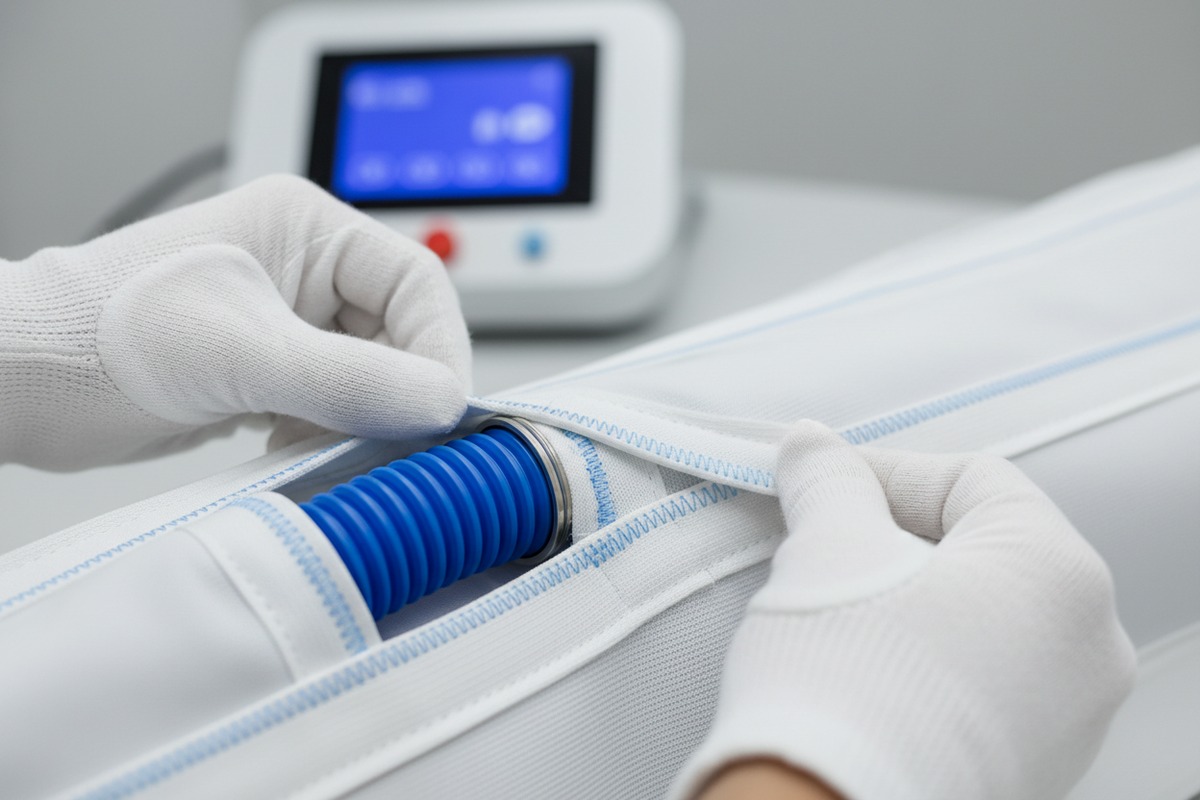
The air chambers are the heart of any pressotherapy system. They create the sequential compression that stimulates lymphatic drainage. A professional unit may have anywhere from 20 to 48 individual chambers.
When evaluating chamber quality, focus on three areas. First, check the material. Double-layered elastic fabrics 4 withstand constant inflation and deflation cycles far better than single-layer materials. Second, examine the pressure rating. Professional systems should handle pressures up to 200,000 Pa per chamber for effective treatment. Third, count the chambers and confirm even distribution across body zones.
One-Piece Suit Advantages
One-piece pressotherapy suits integrate all chambers into a single garment. This design eliminates connection points between body sections. Fewer connection points mean fewer potential failure points.
The key advantage is uniform pressure delivery. When chambers inflate sequentially from feet to torso, there are no gaps or pressure drops at connection zones. This creates optimal lymphatic flow direction 5.
However, one-piece suits have sizing limitations. A single garment must fit diverse body types. This can result in poor fit for clients at the extremes of the size range.
Split Suit Considerations
Split suits separate into distinct components—leg cuffs, arm sleeves, and abdominal wraps. Each piece connects independently to the compressor unit.
This modularity offers significant advantages. Salons can perform legs-only treatments for post-workout recovery. They can focus on arms for specific client needs. The flexibility reduces treatment time when full-body sessions are unnecessary.
But split suits introduce complexity. Each connection point is a potential failure zone. Connectors between suit sections and the main unit require regular inspection. Removable ducts, while convenient for cleaning, break down faster than fixed alternatives.
Build Quality Comparison Table
| Feature | One-Piece Suit | Split Suit |
|---|---|---|
| Connection Points | Minimal (1-2 main connectors) | Multiple (6-10 connectors typical) |
| Pressure Uniformity | Excellent—no section gaps | Good—depends on proper assembly |
| Failure Risk Points | Lower | Higher |
| Sizing Flexibility | Limited to garment size range | High—mix and match components |
| Material Wear Pattern | Even across garment | Uneven—high-use sections wear faster |
| Recommended Duct Type | Fixed ducts standard | Fixed ducts strongly recommended |
Testing Protocol Before Ordering
Before committing to a large order, request samples and perform basic quality checks. Run the system continuously for 60 minutes at maximum pressure. Check for any pressure drop indicators on the control unit. Inspect seams for stress marks after extended use.
What are my options for private labeling and custom branding when sourcing these different suit configurations from China?
When we discuss customization with European distributors, the first question is always about minimum quantities. The second is about what can actually be changed without engineering a new product from scratch. Understanding these boundaries saves months of back-and-forth.
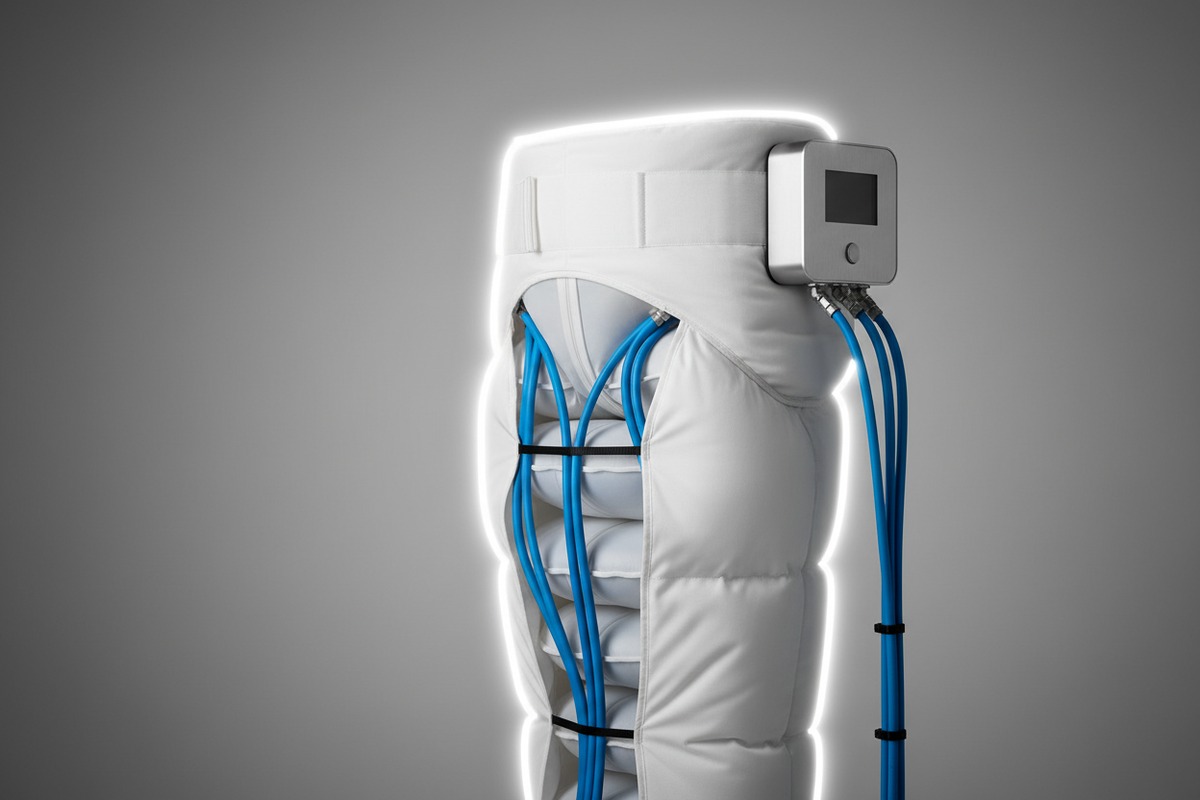
Private labeling options from Chinese manufacturers include logo placement on control units, custom packaging, branded user manuals, and suit color variations. ODM services allow deeper customization of software interfaces and treatment protocols. Expect minimum order quantities of 50-100 units for basic branding and 500+ units for custom engineering changes.
OEM vs ODM: Know the Difference
OEM (Original Equipment Manufacturing) means the factory builds to your specifications. You provide the design. They manufacture it. This requires significant upfront investment in tooling and engineering.
ODM (Original Design Manufacturing) means you select from the factory's existing product range and apply your branding. This is faster and requires lower investment. Most European distributors entering the pressotherapy market start with ODM arrangements.
Branding Elements You Can Customize
Most manufacturers offer these standard customization options without engineering changes:
- Logo printing or engraving on control unit housing
- Custom color schemes for the main unit exterior
- Branded startup screens on LCD displays
- Custom packaging boxes with your company branding
- User manuals translated into target market languages
- Warranty cards and registration materials
For suit customization specifically, options typically include fabric color changes, logo embroidery on suit panels, and custom storage bags.
Minimum Order Quantities for Different Customization Levels
| Customization Level | Typical MOQ | Lead Time | Cost Impact |
|---|---|---|---|
| Logo on existing product | 10-50 units | 2-3 weeks | Minimal |
| Custom packaging design | 50-100 units | 4-6 weeks | 5-10% increase |
| Suit color change | 100-200 units | 6-8 weeks | 10-15% increase |
| Custom software interface | 200-500 units | 8-12 weeks | 15-25% increase |
| Full ODM specification | 500+ units | 12-16 weeks | 25-40% increase |
| Complete OEM development | 1000+ units | 4-6 months | Project-based pricing |
Documentation and Compliance Support
When sourcing for Europe, your manufacturer should provide technical documentation that supports your EU MDR compliance efforts 6. Request these documents early in discussions:
- CE marking certificates (verify authenticity directly)
- Technical file structure information
- Risk analysis documentation
- Electrical safety test reports
- Material safety data sheets for suit fabrics
Reputable manufacturers maintain ISO 13485 certification 7 for medical device quality management. This certification streamlines your compliance documentation significantly.
Protecting Your Brand Investment
Work with manufacturers who offer confidentiality agreements. Your custom designs and brand identity deserve protection. Ensure contracts specify that your branding materials remain your intellectual property.
Request sample units before production. Test them thoroughly. Verify that branding quality matches expectations. It is far easier to correct issues before a container ships than after products sit in your warehouse.
How will the weight and dimensions of a one-piece suit impact my door-to-door logistics costs to Europe?
Our logistics team processes shipments to Rotterdam, Hamburg, and Antwerp every week. We have learned that small differences in packaging dimensions create substantial cost variations. A 5 cm increase in box height can push your shipment into a higher dimensional weight category.
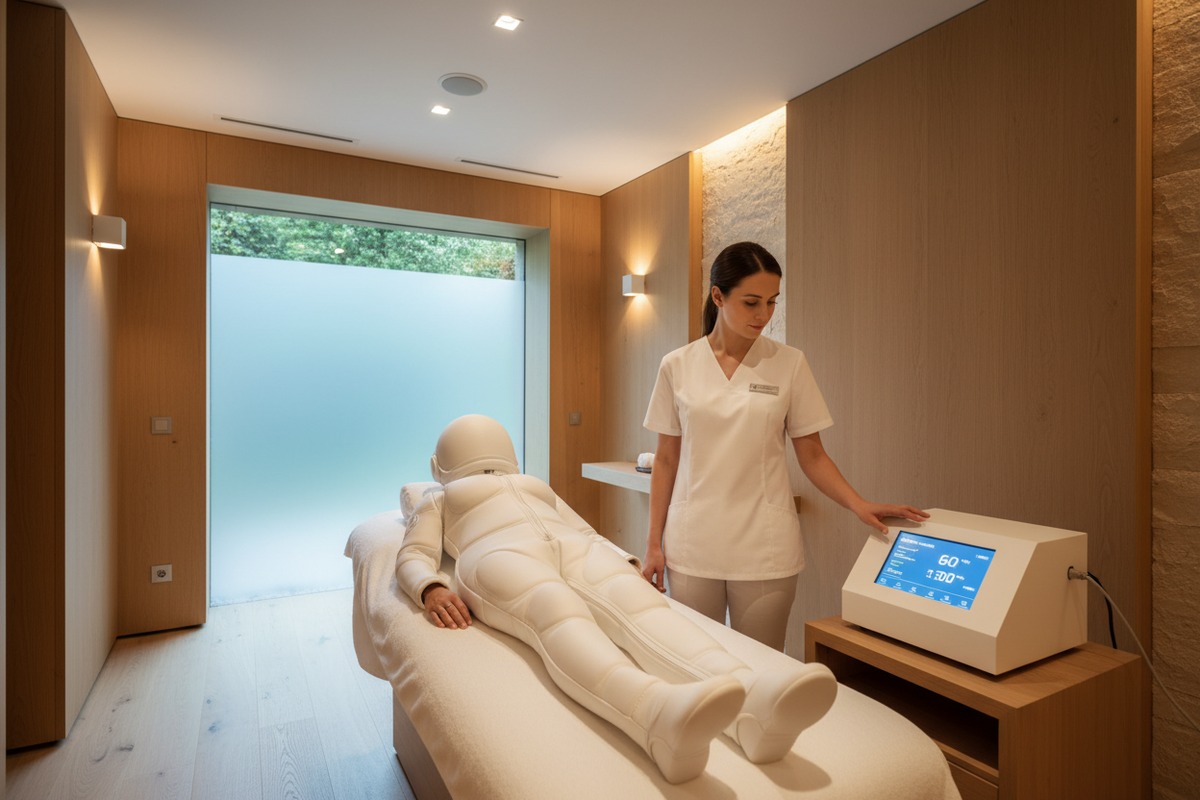
One-piece pressotherapy suits typically ship in larger single cartons, increasing dimensional weight calculations and storage costs. Split suits ship in modular packaging with better carton density. For door-to-door delivery to Europe, expect shipping costs between $150-400 per unit depending on shipping method, with one-piece configurations averaging 15-25% higher logistics costs.
Understanding Dimensional Weight Pricing
Courier and air freight companies price shipments using either actual weight or dimensional weight—whichever is higher. Dimensional weight is calculated as Length × Width × Height divided by a volumetric factor (typically 5000 for air freight).
One-piece suits require larger cartons because the suit cannot fold as compactly. The full-body garment maintains significant volume even when compressed. This inflates dimensional weight.
Split suits pack more efficiently. Leg sections nest together. Arm sleeves compress flat. Abdominal wraps roll tightly. The result is smaller cartons with better weight-to-volume ratios.
Shipping Method Comparison for European Delivery
| Shipping Method | Transit Time | Cost per Unit (Approx.) | Best For |
|---|---|---|---|
| Express Air (DHL/FedEx) | 3-7 days | $250-500 | Urgent single units, samples |
| Economy Air | 10-15 days | $150-300 | Small batch orders (5-20 units) |
| Sea Freight (LCL) | 35-45 days | $80-150 | Medium orders (20-100 units) |
| Sea Freight (FCL 20ft) | 35-45 days | $60-100 per unit | Large orders (100+ units) |
Note: These estimates assume standard pressotherapy machine dimensions and may vary based on current fuel costs and carrier rates.
Import Duties and VAT Considerations
When calculating landed cost for European destinations, factor in:
- Import duty 8: Typically 0-4% for medical/beauty equipment from China
- VAT: Country-specific (19% Germany, 21% Netherlands, 20% France)
- Customs clearance fees: €50-150 per shipment
- Potential inspection fees: Variable
One-piece and split suit configurations face the same duty rates. However, larger cartons may trigger more frequent physical inspections, adding clearance delays.
Optimizing Your Shipping Strategy
Work with your supplier to minimize packaging volume without compromising product protection. Request that suits ship compressed in vacuum-sealed bags where possible. Use reinforced cartons that allow tighter stacking.
For regular orders, consider sea freight with proper planning. The 4-6 week transit time requires accurate demand forecasting, but the cost savings compound significantly over a year of purchasing.
Warehouse Storage Impact
Beyond shipping, consider storage costs at your European distribution point. Larger cartons for one-piece suits consume more shelf space and pallet positions. This ongoing cost often exceeds the one-time shipping difference over the product lifecycle.
Which suit design will provide my salon clients with the best treatment experience while reducing my after-sales maintenance issues?
We track warranty claims and service requests from every market we serve. The data tells a clear story. The suits that fail most often are those with the most connection points and the lowest material quality. The clients who complain most are those whose treatments feel uneven or uncomfortable.
For optimal salon client experience and minimal maintenance, prioritize multi-chamber systems with at least 20 chambers, double-layered elastic fabrics, and fixed air ducts. One-piece suits typically generate fewer maintenance calls due to simpler construction, while split suits require more staff training but enable faster session turnover for targeted treatments.
Client Experience Factors
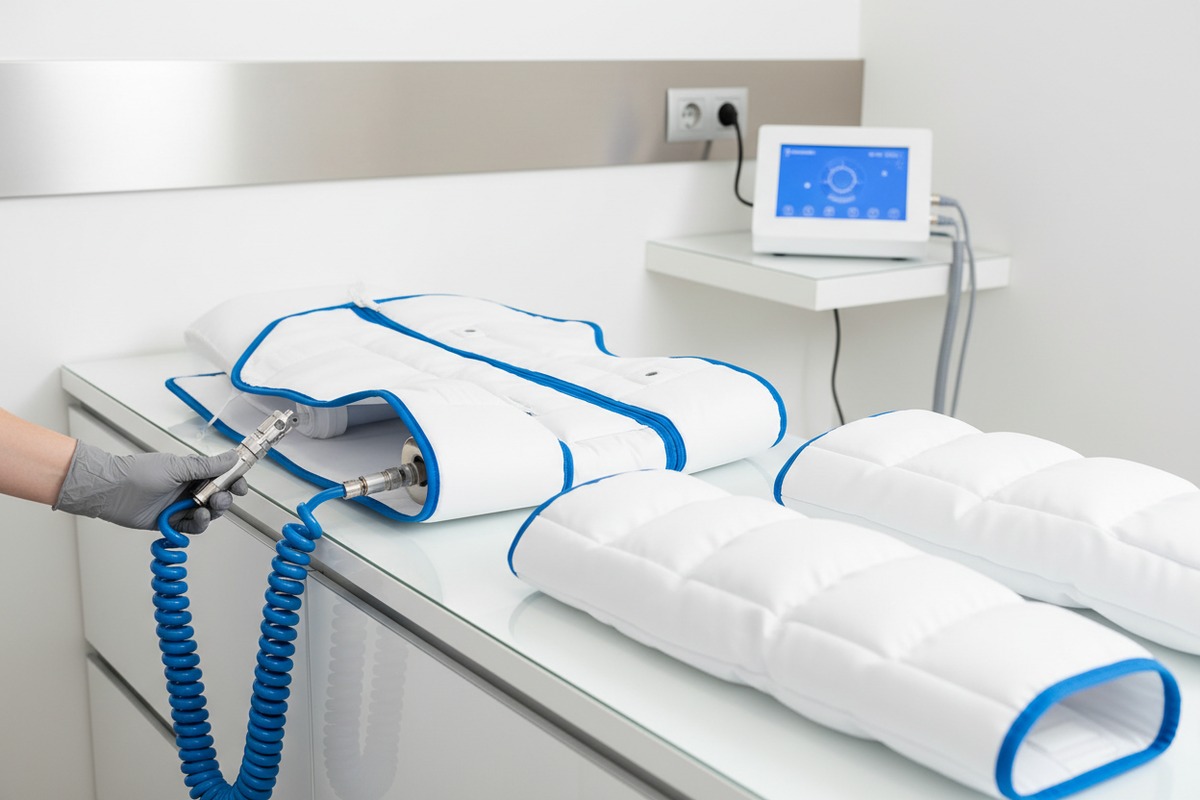
Treatment comfort depends on several factors working together. Pressure must distribute evenly across body zones. Sequential inflation should feel like a smooth wave, not abrupt pulses. The suit fabric should feel comfortable against skin, even over lightweight clothing.
One-piece suits excel at delivering this seamless experience. The continuous garment maintains consistent contact with the body. There are no gaps between sections where pressure intensity shifts suddenly.
Split suits require proper assembly to achieve similar results. When staff connect sections correctly and ensure proper overlap, the experience approaches one-piece quality. When assembly is rushed or incorrect, clients notice pressure gaps and inconsistent treatment zones.
Maintenance and Support Requirements
After-sales support consumes time and money. Every warranty claim, every troubleshooting call, every replacement part shipment erodes your profit margin.
The most common maintenance issues we see:
- Air duct disconnections – More frequent in split suits with removable ducts
- Seam failures – Occurs in both types but faster in single-layer materials
- Connector wear – Primarily affects split suit systems
- Compressor issues – Equal frequency across both suit types
- Control unit problems – Equal frequency across both suit types
Hygiene and Cleaning Considerations
European salon standards require strict hygiene protocols. Both suit types must accommodate regular cleaning or the use of disposable hygienic undergarments.
Split suits offer an advantage here. Individual sections can be cleaned independently. A soiled leg section doesn't require removing and cleaning the entire suit. Some salons prefer this modular approach for faster turnover between clients.
Hygienic client coveralls 9 represent an additional revenue opportunity. Rental at €2-3 per session or sale at €18-20 per garment creates a profit center while addressing hygiene requirements.
Treatment Protocol Flexibility
| Treatment Type | One-Piece Suit | Split Suit | Better Choice |
|---|---|---|---|
| Full-body lymphatic drainage | ✓ Optimal | ✓ Good with proper setup | One-piece |
| Post-workout leg recovery | ✗ Requires full suit use | ✓ Legs only available | Split |
| Arm-focused cellulite treatment | ✗ Requires full suit use | ✓ Arms only available | Split |
| Pre-surgery detox protocols | ✓ Optimal coverage | ✓ Good with full assembly | One-piece |
| Quick 20-minute sessions | ✗ Full suit required | ✓ Target area only | Split |
| Mixed treatment menu offerings | Limited flexibility | High flexibility | Split |
Staff Training Requirements
One-piece suits require minimal training. Staff help the client into the suit, connect the main air hoses, and start the program. The process is straightforward.
Split suits demand more comprehensive training. Staff must understand proper section assembly, correct connection sequences, and how to verify complete coverage before starting treatments. Poor training leads to inconsistent client experiences and increased complaints.
Factor training time and ongoing refresher needs into your total cost of ownership calculation.
Long-Term Durability Comparison
Based on our production data and warranty tracking, here is what to expect:
- One-piece suits: Average lifespan of 18-24 months with daily professional use
- Split suits: Average lifespan of 12-18 months with daily professional use (legs and arms may need replacement sooner)
- Control units: 3-5 years typical lifespan regardless of suit type
- Compressors: 4-6 years typical lifespan with proper maintenance
These figures assume quality construction with double-layered fabrics and fixed air ducts. Lower-quality products may fail significantly sooner.
Conclusion
Choosing between one-piece and split pressotherapy suits requires balancing multiple factors. Evaluate your salon clients' typical treatment needs, your staff training capacity, your logistics constraints, and your tolerance for after-sales support. Both designs serve valid purposes—match your choice to your specific business model and European market positioning.
## Footnotes

<span id="footnote-1">
1. Explains the purpose and importance of the UDI system for medical device traceability in the EU. <a href="#ref-1" class="footnote-backref">↩︎</a>
</span>

<span id="footnote-2">
2. Original domain, working URL for dimensional weight calculations. <a href="#ref-2" class="footnote-backref">↩︎</a>
</span>

<span id="footnote-3">
3. Explains the physiological process and function of the lymphatic system. <a href="#ref-3" class="footnote-backref">↩︎</a>
</span>

<span id="footnote-4">
4. Discusses the durability and benefits of double-covered elastane in medical compression textiles. <a href="#ref-4" class="footnote-backref">↩︎</a>
</span>

<span id="footnote-5">
5. Describes the natural, unidirectional flow of lymph towards the heart. <a href="#ref-5" class="footnote-backref">↩︎</a>
</span>

<span id="footnote-6">
6. Provides a comprehensive overview of the European Union Medical Device Regulation (EU MDR) requirements. <a href="#ref-6" class="footnote-backref">↩︎</a>
</span>

<span id="footnote-7">
7. Authoritative source (BSI) for ISO 13485 certification. <a href="#ref-7" class="footnote-backref">↩︎</a>
</span>

<span id="footnote-8">
8. Original domain, working URL defining customs duties. <a href="#ref-8" class="footnote-backref">↩︎</a>
</span>

<span id="footnote-9">
9. Discusses disposable protective wear for salons and spas, highlighting hygiene. <a href="#ref-9" class="footnote-backref">↩︎</a>
</span>

 English
  Español de México
  Deutsch
  Français
  العربية
  Русский