
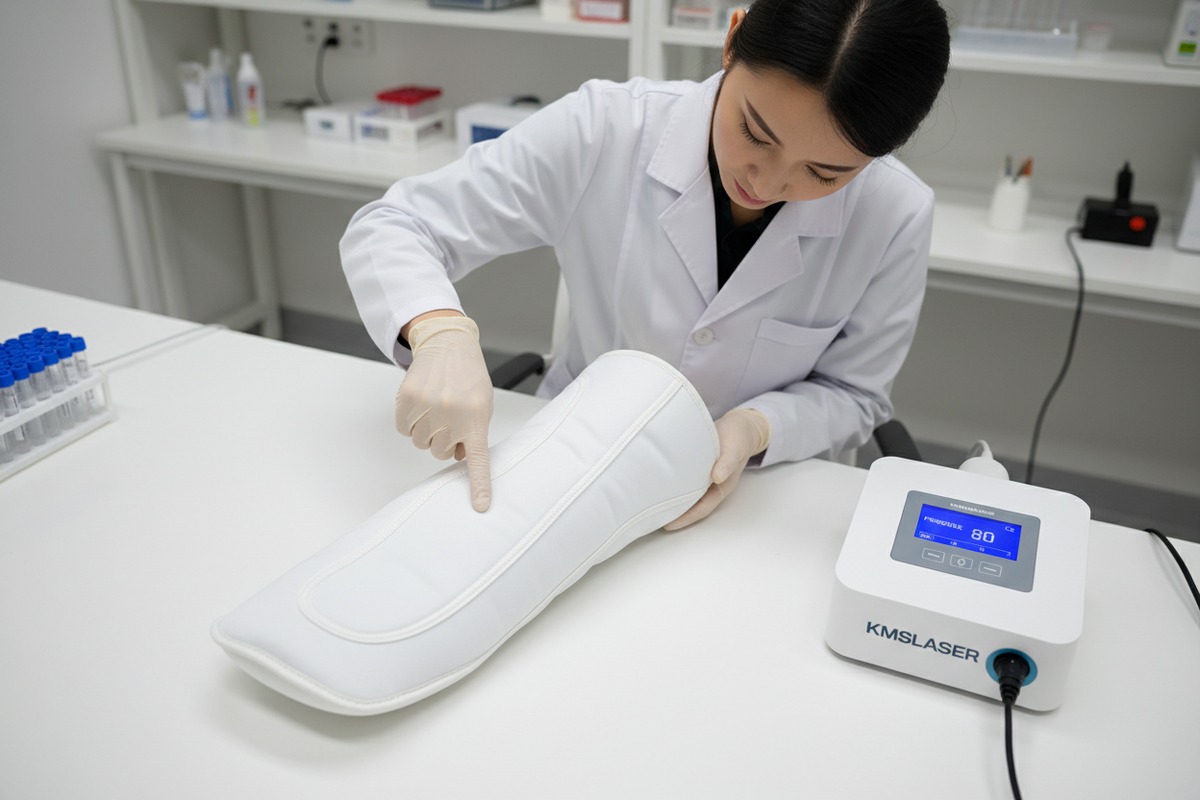
Working on our production line, we have seen many salon owners struggle with foot wrap failures. Poor ergonomic design 2 leads to client discomfort, air leaks, and lost revenue. Salons need pressotherapy foot wraps 3 that fit all sizes, hold pressure, and last through thousands of sessions. This is the hidden problem buyers overlook.
To evaluate ergonomic foot wrap designs, check the number of air chambers for targeted compression, inspect material quality for airtight seals, test adjustability for different foot sizes, and verify construction durability. Look for contoured shapes that fit the arch and heel. Demand TPU-coated fabrics and double-layer construction for professional-grade performance.
Below, we break down each key evaluation factor. You will learn how to test foot wraps before placing a bulk order. Let us help you avoid costly mistakes.
How do I ensure the foot wrap's ergonomic shape provides effective compression for different foot sizes?
Many distributors order foot wraps only to find they fit just 60% of their clients. Small feet slip inside loose chambers. Large feet feel pinched. Our engineering team has tested hundreds of prototypes to solve this exact problem.
Effective compression for all foot sizes requires multi-chamber design with at least 6 independent air cavities, adjustable velcro straps, and stretchable elastic fabric. The wrap must contour to the arch, heel, and dorsum. Test fit samples on various foot sizes before bulk orders. A good design balances snugness and comfort without pressure points.

Understanding Air Chamber Architecture
The number of air chambers 4 directly affects compression precision. The pressotherapy device, connected to special leggings consisting of air chambers, exerts a sequential massage 5 from the toes to the thighs. More chambers mean smoother pressure transitions. For foot wraps specifically, six chambers allow targeted compression across the sole, arch, ankle, and lower calf.
When we design foot wraps, we segment chambers to follow the foot's natural contours. Each chamber inflates independently. This prevents "dead zones" where compression fails to reach. Possibility to set individual pressure in each chamber, including its shutdown. This level of control matters for clients with sensitive areas or injuries.
Adjustability Features to Demand
Adjustable straps are not optional. They are essential. The best foot wraps use wide velcro closures at multiple points. This lets operators secure the wrap on feet ranging from size 5 to size 13.
| Adjustability Feature | Purpose | What to Check |
|---|---|---|
| Velcro strap width | Secure fit | Minimum 5 cm wide |
| Strap placement | Coverage | At ankle, midfoot, and calf |
| Elastic panel zones | Stretch accommodation | Sides and top of foot |
| Overlapping design | Size range | 30% overlap for extremes |
Testing Fit Before Bulk Orders
Request sample units before placing large orders. Test them on at least five different foot sizes. Check these points:
- Does the wrap reach full inflation without gaps?
- Can the client move toes slightly?
- Does the ankle area maintain contact during cycling?
- Is removal easy for elderly clients?
With an ergonomic and adaptable design, these pressotherapy boots are easily adjusted thanks to their velcro closure. This ease of adjustment speeds up treatment turnaround and reduces staff fatigue.
Contour Design for Heel and Arch
Its dual-therapy design allows for customizable temperature treatment, while the ergonomic shape ensures a snug fit around the heel and arch. The same principle applies to pressotherapy foot wraps. A flat wrap cannot deliver even compression to a curved foot. Look for pre-formed chambers that cup the heel and support the arch.
What specific material quality should I demand to prevent air leaks in my custom-branded foot wraps?
Air leaks destroy treatment efficacy. In our factory, we reject any fabric batch that fails pressure tests. Even a small leak means the pump works harder. Sessions take longer. Clients notice reduced results. Your brand reputation suffers.
Demand TPU-coated nylon or polyester fabric with minimum 210 denier thickness. The material must be RF-weldable or heat-sealable to create airtight seams. Request breathability test results below 0.01 cm³/m²·s·Pa. Double-layer construction at high-stress points prevents delamination. Avoid PVC—it cracks after repeated inflation cycles.

Why TPU Coating Matters
840D TPU-Coated Nylon Fabric 6 is a high-performance, airtight, and ultrasonically weldable textile designed for industrial, medical, and pressurized applications. This double-sided TPU-coated fabric offers superior strength, abrasion resistance, and flexibility, making it an excellent choice for inflatable devices, compression systems, and air containment solutions.
TPU (thermoplastic polyurethane) creates a complete seal. It bonds to the base fabric through heat lamination. This prevents air from escaping through the weave. Tek Air Medical Fabrics are soft, non-stretch, TPU-coated nylon fabrics that hold air, water, and gels and can be fabricated into products using RF welding and heat and sonic sealing technologies.
Seam Construction Standards
The seams fail before the fabric does. Poorly welded seams peel apart after 500-1000 cycles. Engineered for seam integrity under high-pressure conditions, this fabric withstands repeated inflation and deflation cycles without compromising its airtight seal.
| Seam Type | Durability | Best For |
|---|---|---|
| RF welded | 10,000+ cycles | Professional salon use |
| Heat sealed | 5,000-8,000 cycles | Mid-tier clinics |
| Sewn + sealed | 3,000-5,000 cycles | Budget options |
| Sewn only | <1,000 cycles | Avoid for commercial |
TPU fabrics can be RF welded and heat-sealed to create impervious seams which allow for the creation of air and fluid-holding parts and devices. Always ask your supplier which welding method they use.
Testing Parameters to Request
Before approving any foot wrap for your brand, request these test certificates:
The following are the main airtight technical parameters and test methods of this material: Breathability: This is an important indicator of the ability of a material to allow gas to pass through. For knitted fabric composite TPU fabrics, the breathability should usually be less than 0.01 cm³/m²·s·Pa to ensure its sealing effect in high pressure environments.
Ask for:
- Breathability test results
- Burst pressure rating
- Adhesion strength between layers
- Cycle fatigue test 7 (minimum 5,000 cycles)
Material Comparison for Foot Wraps
| Material | Air Retention | Comfort | Durability | Cost |
|---|---|---|---|---|
| TPU-coated nylon | Excellent | High | 10,000+ cycles | $$$ |
| TPU-coated polyester | Excellent | Medium-High | 8,000+ cycles | $$ |
| PU-coated nylon | Good | High | 3,000-5,000 cycles | $$ |
| PVC composite | Fair | Low | 1,000-2,000 cycles | $ |
| Basic cloth + liner | Poor | High | <500 cycles | $ |
The cushions are crafted from durable TPU material that is soft, comfortable, abrasion-resistant, odor-free, waterproof, and breathable for a comfortable massage experience. This combination of properties makes TPU the professional standard.
Can I request modifications to the foot wrap design to improve the user experience for my salon distributors?
Yes. And you should. Our OEM clients who customize foot wrap designs report 40% fewer complaints from their downstream salons. Standard designs work. Custom designs excel. But you need to know what to change—and what to leave alone.
Most manufacturers accept design modifications including strap placement, chamber layout, fabric colors, logo placement, and sizing ranges. Request changes that improve ease of use for operators and comfort for clients. Avoid modifying pressure pathways or chamber sequencing without engineering consultation. Always test modified prototypes before production approval.

Modifications That Improve User Experience
Salon operators put foot wraps on and off dozens of times daily. Small design changes create big efficiency gains. Here are the modifications we recommend to our clients:
Color-coded strapping: Different colors for left and right wraps speed up setup. Staff do not need to check labels.
Extended zipper access: A longer opening at the top makes it easier to insert and remove feet. Elderly clients with mobility issues benefit most.
Reinforced heel cup: Extra padding at the heel prevents wear and adds comfort during 30-minute sessions.
Quick-connect hose attachment: Magnetic or twist-lock connectors reduce fumbling. Once the accessories are connected to the hoses and the hoses to the machine body, you simply put them on and set the time and pressure values. Faster connections mean faster turnaround.
Modifications to Approach with Caution
Some changes affect therapeutic efficacy. Consult with your manufacturer's engineering team before changing:
- Chamber size or shape
- Number of air chambers
- Pressure pathway direction
- Hose internal diameter
Pressotherapy is a treatment based on the exertion of a certain amount of pressure on the patient's peripheral limbs, such as arms and legs and the abdominal area; applicators equipped with air chambers similar to leg braces, arm braces or abdominal straps are inflated sequentially, thus applying gradual pressure on the body. This compression is intermittent and starts from the extremities near the affected area to the area itself, inflating and deflating in a cyclic manner.
Changing chamber layout can disrupt this sequential pattern. The therapy loses effectiveness if fluid drainage direction 8 changes.
Sample Modification Request Process
When working with us, the process follows these steps:
- Submit your modification requests in writing
- Our engineers review for technical feasibility
- We provide a CAD rendering for approval
- Prototype production (2-3 weeks)
- Sample testing at your facility
- Revisions if needed
- Production approval
Cost Considerations for Customization
| Modification Type | Tooling Cost | MOQ Impact | Lead Time |
|---|---|---|---|
| Logo embroidery | None | None | +3 days |
| Custom fabric color | $200-500 | +20% | +2 weeks |
| Strap repositioning | $500-1,000 | +30% | +3 weeks |
| New chamber layout | $2,000-5,000 | +50% | +6 weeks |
| Complete redesign | $5,000-15,000 | +100% | +12 weeks |
Small modifications like logo placement and color changes have minimal impact. Major changes require new molds and higher minimum orders.
How do I verify that the foot wrap construction is durable enough to withstand daily professional use without losing its shape?
We test every foot wrap design for 10,000 cycles before approving production. Many competitors test only 1,000 cycles—or do not test at all. In a busy salon, a foot wrap sees 20-30 uses per day. That is 7,000-10,000 cycles per year. Cheap wraps fail within months. Quality wraps last 3-5 years.
Verify durability by requesting cycle fatigue test reports showing 10,000+ inflation cycles without air loss or delamination. Check for double-layer reinforcement at stress points: heel, ankle bend, and hose attachment. Inspect stitching density (minimum 8 stitches per cm). Test sample units for 30 days in your own facility before bulk orders. Quality TPU materials maintain shape; cheap PVC cracks and deforms.

Understanding Stress Points
Foot wraps fail at predictable locations. When we design for durability, we reinforce these areas:
Heel zone: This area bears body weight and sees friction with each application. Double-layer construction here is essential.
Ankle flex point: The wrap bends here repeatedly. Single-layer fabrics crack at the bend line within 2,000 cycles.
Hose connection: Tugging and twisting stress the attachment point. Reinforced grommet or welded collar prevents tearing.
Velcro edges: Hook-and-loop fasteners fray without edge binding. Quality wraps tape or seal all velcro borders.
Cycle Testing Standards
After actual testing, after 10,000 consecutive inflation and deflation cycles, no air leakage or damage was found, which fully meets the design expectations. This is the benchmark for professional-grade equipment.
Request these specific test results from your supplier:
| Test Type | Minimum Standard | Professional Grade |
|---|---|---|
| Inflation cycles | 5,000 | 10,000+ |
| Burst pressure | 0.3 bar | 0.5+ bar |
| Seam peel strength | 3 N/cm | 5+ N/cm |
| Abrasion resistance | 1,000 rubs | 3,000+ rubs |
| Temperature range | 15-35°C | 5-45°C |
Shape Retention Factors
Why do some wraps lose shape while others stay firm? The answer lies in material memory and construction method.
The garments are made of PU material, easy to clean, with a durable double-layer structure. Double-layer construction prevents stretching. The outer layer protects against abrasion. The inner layer maintains air seal. Together, they resist the pulling forces of daily use.
Quality indicators for shape retention:
- Fabric weight: Minimum 200 GSM for professional use
- Denier rating: 210D minimum, 420D preferred
- Recovery test: Should return to original shape within 30 seconds after compression
- Crease resistance: No permanent fold lines after 100 storage cycles
Pre-Production Testing Protocol
Before approving any foot wrap for your brand, conduct this 30-day test:
Week 1-2: Use the sample on 10 clients daily. Note any fit issues or discomfort reports.
Week 3: Inspect all seams and stress points under magnification. Look for micro-tears or delamination starting.
Week 4: Conduct pressure retention test. Inflate to maximum and measure air loss over 30 minutes. Loss should be under 5%.
After 30 days: Compare appearance to new sample. Significant fading, stretching, or deformation indicates poor durability.
You need to use medical devices 9 that are guaranteed and safe, and to be sure you have made the right choice, you need to check for CE marking. In addition, it is best to know the manufacturer and be sure that the pre and after sales support is reliable and of a high standard.
Warranty and Replacement Policy
Durable construction should come with confidence. Ask your supplier:
- What is the warranty period? (Industry standard: 12 months)
- What defects are covered?
- What is the replacement turnaround time?
- Are replacement parts available separately?
At our facility, we stock replacement components for all active products. Straps, hoses, and chamber segments can ship within 48 hours. Full wrap replacement takes 5-7 days.
Conclusion
Ergonomic foot wrap evaluation requires checking air chamber count, material airtightness, adjustability features, and construction durability. Demand TPU-coated fabrics with RF-welded seams. Test samples on multiple foot sizes. Request 10,000-cycle fatigue test reports. Your salon clients deserve equipment that fits well and lasts long.
## Footnotes

<span id="footnote-1">
1. Defines RF welding as a process for bonding materials using electromagnetic energy. <a href="#ref-1" class="footnote-backref">↩︎</a>
</span>

<span id="footnote-2">
2. Explains the definition and importance of ergonomic design in medical equipment. <a href="#ref-2" class="footnote-backref">↩︎</a>
</span>

<span id="footnote-3">
3. Provides information on medical compression wraps for legs and arms. <a href="#ref-3" class="footnote-backref">↩︎</a>
</span>

<span id="footnote-4">
4. Describes the mechanism of air chambers in compression therapy devices. <a href="#ref-4" class="footnote-backref">↩︎</a>
</span>

<span id="footnote-5">
5. Defines intermittent sequential pneumatic compression and its rhythmic pressure application. <a href="#ref-5" class="footnote-backref">↩︎</a>
</span>

<span id="footnote-6">
6. Provides a detailed description of 840D TPU-Coated Nylon Fabric properties and uses. <a href="#ref-6" class="footnote-backref">↩︎</a>
</span>

<span id="footnote-7">
7. Authoritative definition and explanation of fatigue testing, including cyclic loading. <a href="#ref-7" class="footnote-backref">↩︎</a>
</span>

<span id="footnote-8">
8. Explains how lymphatic drainage massage promotes the movement of lymph fluids. <a href="#ref-8" class="footnote-backref">↩︎</a>
</span>

<span id="footnote-9">
9. Explains the regulatory requirement for CE marking on medical devices in Europe. <a href="#ref-9" class="footnote-backref">↩︎</a>
</span>

 English
 Español de México
 Deutsch
 Français
 العربية
 Русский
