
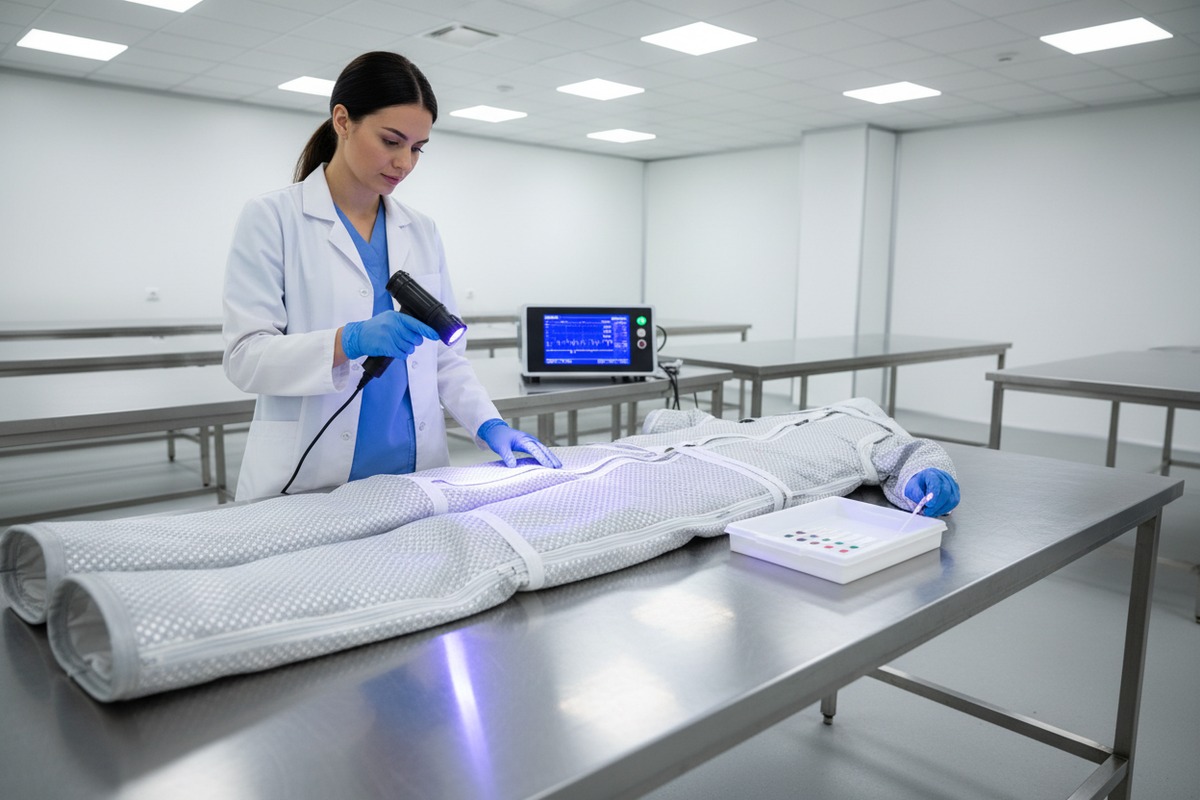
When our factory first started producing pressotherapy compression suits, I noticed a common problem. Some suits arrived from material suppliers with a strong plastic smell. Clients complained. Returns increased. Salons worried about client safety. This became a quality control priority. quality control in manufacturing 1
To detect odors and chemical residues in pressotherapy compression suits, perform a multi-step inspection: conduct initial sensory sniff tests, use pH test strips on damp fabric, apply UV-A blacklight for hidden residues, run airflow odor tests through the machine, and request OEKO-TEX or GC-MS test reports from manufacturers for verification.
The following sections will guide you through each detection method. You will learn how to spot chemical smells during quality inspection, test for hidden residues, prevent odors after salon use, and verify manufacturing standards for private-label suits.
How can I identify chemical smells during my initial quality inspection of the suits?
At our production facility, we check every batch of compression suits before shipment. Some chemical odors are easy to catch. Others hide until the suit heats up. The challenge is knowing what to smell for and when.
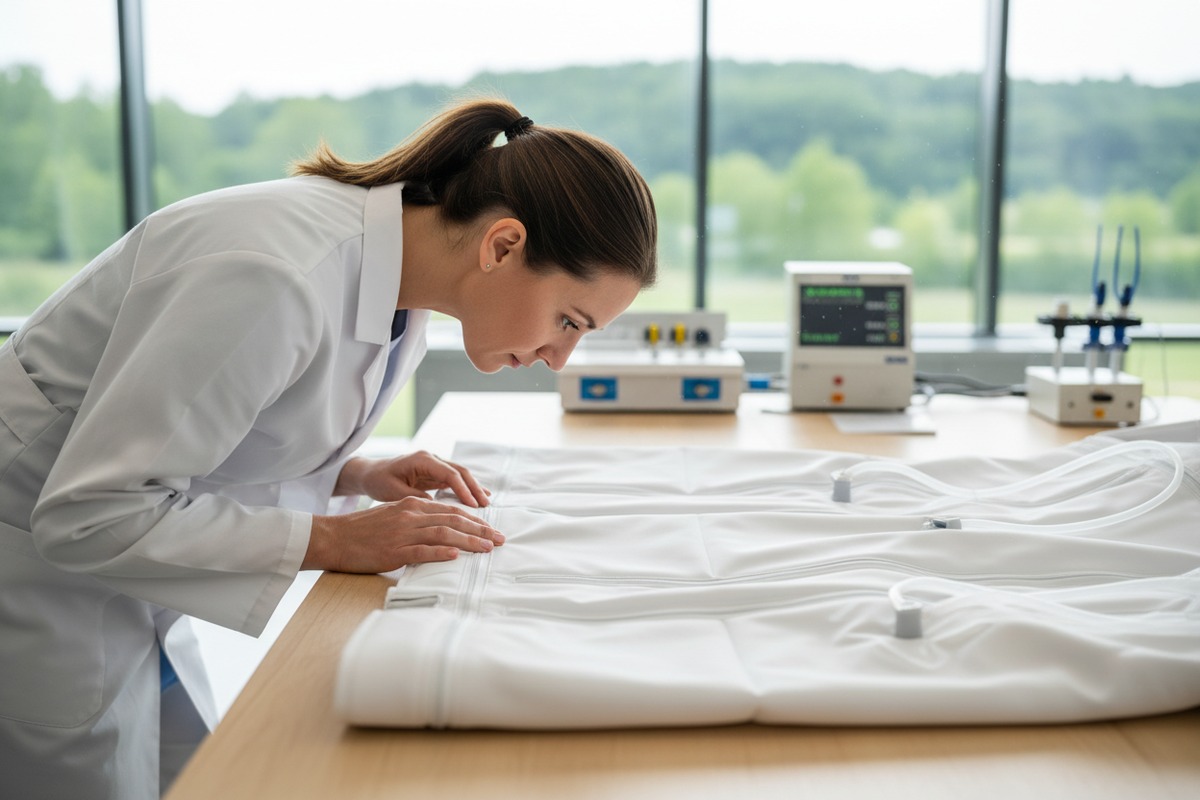
During initial quality inspection, identify chemical smells by unpacking suits in a well-ventilated area, allowing them to off-gas for 30 minutes, then performing direct sniff tests. Focus on seams, inner bladders, and welded joints. Strong plastic, solvent, or ammonia-like odors indicate VOC contamination that requires further testing.
Why VOCs Matter in Compression Suits
Volatile organic compounds 2 (VOCs) are the main source of chemical odors in new pressotherapy suits. These compounds come from plastics, adhesives, and fabric treatments used during manufacturing. As research confirms, "VOCs are emitted as gases from certain solids or liquids, typically characterised by high vapour pressure and low water solubility and are often organic chemicals used in or resulting from manufacturing processes."
Pressotherapy suits typically use PU (polyurethane) 3, fiber carbon, or similar synthetic materials. These materials can off-gas VOCs, especially when new. The air pressure systems operate at 40-187 mmHg, and some machines add infrared heat at 35-80°C. Heat accelerates off-gassing.
Step-by-Step Sensory Inspection Protocol
When we receive new suits at our warehouse, our QC team follows a consistent protocol:
| Step | Action | Purpose |
|---|---|---|
| 1 | Unpack in ventilated room | Allow initial off-gassing |
| 2 | Wait 30 minutes | Let concentrated VOCs disperse |
| 3 | Sniff external fabric | Detect surface-level odors |
| 4 | Inflate suit briefly | Check interior air chambers |
| 5 | Sniff seams and welded joints | These areas trap adhesive residues |
| 6 | Document findings | Create quality records |
Common Chemical Odors and Their Sources
Different chemical smells point to different manufacturing issues:
- Sharp plastic smell: New PU or PVC materials off-gassing
- Solvent odor: Adhesives not fully cured
- Ammonia-like smell: Certain fabric treatments or dyes
- Musty odor: Improper storage or moisture exposure
Our engineers have found that textiles commonly tested include "the chemical smell of dyes and finishes, the musty odor of storage, and residual smells resulting from exposure to the environment." Each requires different handling.
Human Panel vs. Instrumental Testing
There are two primary ways to evaluate odors in textiles. Sensory evaluation uses human panels. Instrumental analysis uses equipment like gas chromatography.
Human panels offer direct correlation to what customers will experience. However, they suffer from subjectivity. One person may detect strong odors that another misses. Professional odor panels use trained assessors who have been screened for odor acuity.
For initial factory inspections, we rely on trained staff. For disputed batches or customer complaints, we send samples to labs with GC-MS equipment. Gas chromatography-mass spectrometry 4 provides precise identification of which chemicals are present and at what concentrations.
In our experience exporting pressotherapy systems to the US and Europe, buyers often ask for proof that suits are safe. Sniff tests catch obvious problems. But hidden residues require better methods. Some chemicals have no smell. Others only release when wet or heated.
To test for hidden chemical residues, use pH test strips on damp fabric sections to detect cleaning agent remnants, apply UV-A blacklight to reveal fluorescent organic residues, perform airflow odor tests through the machine's air chambers, and consider sending samples for professional GC-MS analysis for definitive results.
pH Testing for Cleaning Agent Residues
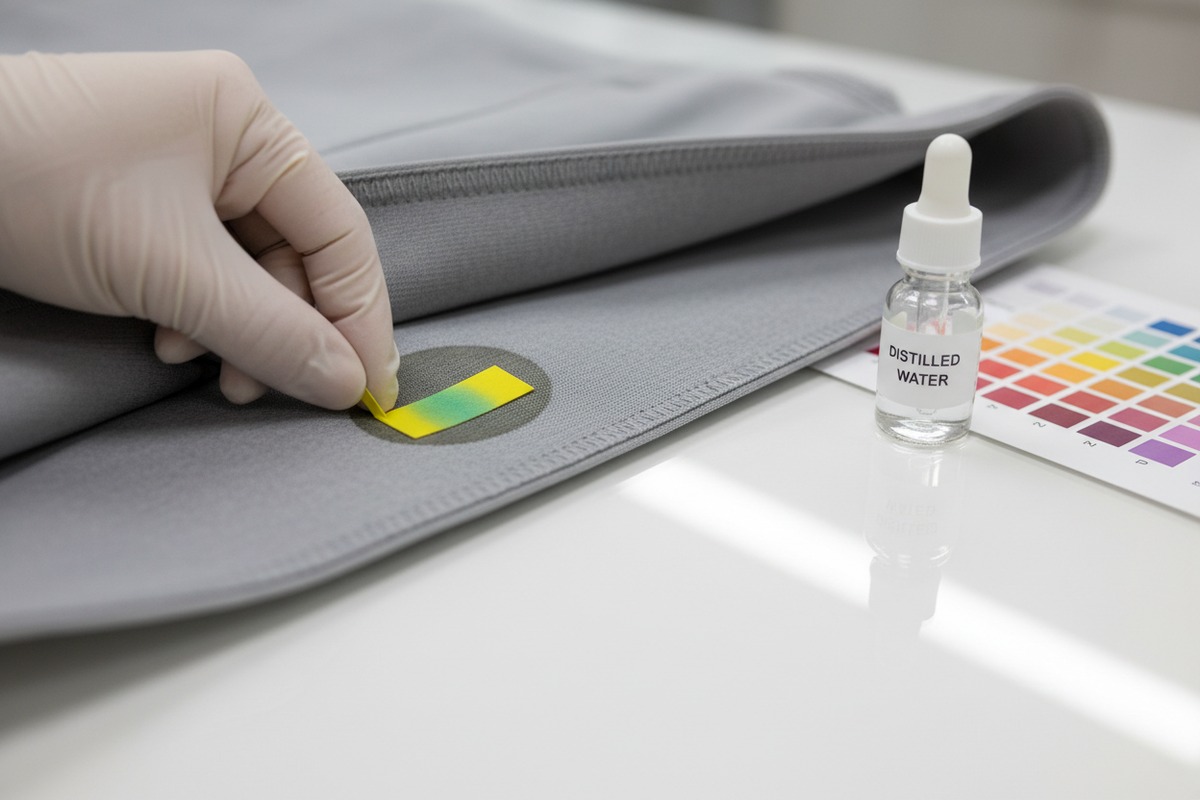
When compression suits are manufactured, they often go through cleaning or treatment processes. Residual chemicals can remain in the fabric. pH testing provides a quick, low-cost screening method.
The process is simple:
- Dampen a clean white cloth with distilled water
- Wipe the interior fabric surface
- Press a pH test strip against the damp area
- Compare the color to the reference chart
Normal textile pH should be close to neutral (6.5-7.5). Readings outside this range may indicate:
- Acidic residues (pH below 6): Possible cleaning agent remnants
- Alkaline residues (pH above 8): Possible detergent or treatment chemical remnants
This method is affordable and fast. However, it does not identify specific chemicals. It only signals that something unusual is present.
UV-A Blacklight Inspection
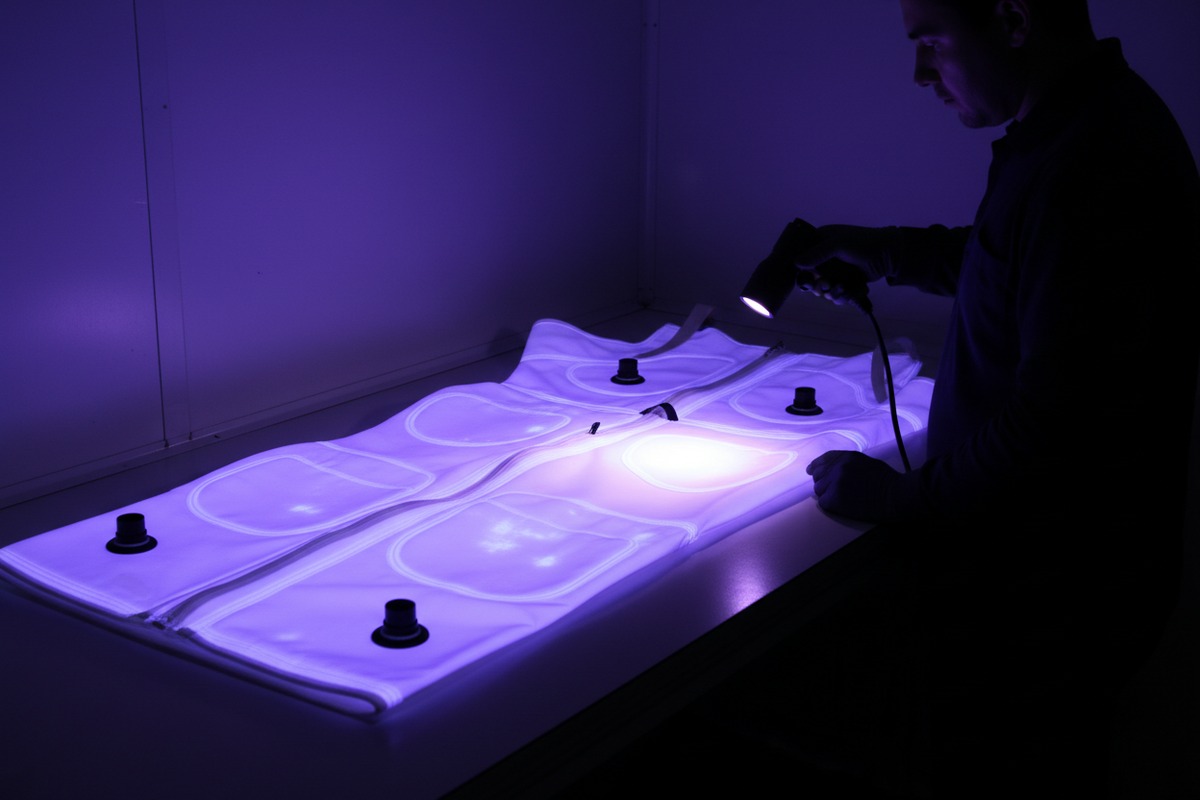
A UV-A blacklight 5 reveals what normal light cannot show. Many organic residues fluoresce under ultraviolet light. This includes body fluids, certain cleaning agents, and some manufacturing chemicals.
| Fluorescence Color | Possible Residue |
|---|---|
| Bright white/blue | Detergent residues |
| Yellow-green | Body fluids (sweat, oils) |
| Orange/pink | Certain dyes or finishes |
| No fluorescence | Generally clean |
Run the blacklight across the suit's interior surfaces, focusing on areas that contact skin during treatment. Check the tubing connections and air bladder surfaces. Document any glowing areas for follow-up cleaning or testing.
Airflow Odor Testing Through the Machine
This method catches residues inside the air chambers that you cannot see or touch directly. It simulates actual treatment conditions.
The procedure:
- Connect the suit to the pressotherapy machine
- Run the machine through a full pressure cycle
- Position your nose near the suit's air exhaust points
- Breathe normally and note any unusual odors
Odors detected during airflow testing may indicate:
- Manufacturing residues in internal bladders
- Condensation buildup causing bacterial growth 6
- Previous cleaning chemical remnants
We recommend performing this test both before first use and after each deep cleaning. It catches problems that static sniff tests miss.
Professional Laboratory Analysis
When basic tests raise concerns, or when you need documentation for regulatory compliance, professional lab analysis provides definitive answers. The gold standard for VOC identification is thermal desorption-gas chromatography-mass spectrometry 7 (TD-GC-MS).
For medical devices, "ISO 18562-3 — which focuses on the tests for VOC emissions — requires that samples are collected in sampling tubes and a subsequent analysis carried out using thermal desorption–gas chromatography–mass spectrometry." While pressotherapy suits may not be classified as medical devices everywhere, following these standards demonstrates due diligence.
Lab testing identifies specific compounds and their concentrations. This data allows comparison against safety thresholds. It also provides documentation for product liability protection.
Emerging Technology: Electronic Noses
Electronic nose technology 8 is advancing rapidly. These devices use sensor arrays and pattern recognition to detect and classify odors. As research describes, an electronic nose "is an electronic sensing device intended to detect odors or flavors" using "sensor arrays and pattern recognition systems."
Modern e-noses offer advantages:
- Portable for on-site testing
- More objective than human panels
- Can be calibrated to specific target chemicals
- Provide quantitative data
However, current limitations include sensitivity to humidity and the need for proper calibration. For most salon operators, they remain too expensive. For manufacturers doing high-volume QC, they may be worthwhile investments.
How do I ensure the compression suits won't develop persistent odors after multiple salon treatments?
Our technical support team hears this question often from salon owners who distribute our equipment. A suit smells fine when new. After twenty clients, it develops a smell that won't wash out. This damages client relationships and wastes money on premature replacements.
To prevent persistent odors in compression suits after multiple treatments, wash suits immediately after use with mild pH-neutral detergent, air dry away from direct heat, inspect and clean internal air bladders regularly, use diluted white vinegar pre-soaks for stubborn smells, and replace suits when they show loss of elasticity or compression.
Understanding Why Odors Build Up
Odors in used compression suits come from multiple sources:
- Sweat and body oils from clients
- Bacterial growth in moist environments
- Incomplete removal of soils during washing
- Cleaning chemical residues that build up over time
Research shows that "during use, textile items can develop unpleasant odors that arise from many different sources, both internal and external to the human body." Furthermore, "laundering is not always effective at removing odors, with odor potentially building up over time due to incomplete removal of soils and odorous compounds."
Synthetic fibers like polyester and polyurethane are particularly prone to odor retention. Studies found that "polyester and polyamide had the highest numbers of bacterial presence after 24-h challenge test with female sweat samples." The hydrophobic nature of these fibers allows odor-causing bacteria to thrive.
Proper Cleaning Protocol
| Step | Action | Details |
|---|---|---|
| 1 | Wash immediately | Don't let sweat dry on fabric |
| 2 | Use mild detergent | pH-neutral, no harsh chemicals |
| 3 | Cool water | Lukewarm maximum, never hot |
| 4 | Gentle cycle or hand wash | Protect elastic fibers |
| 5 | No fabric softener | Coats fibers, traps odors |
| 6 | No bleach | Degrades elastic components |
| 7 | Rinse thoroughly | Remove all detergent residue |
| 8 | Air dry flat | Away from direct heat/sunlight |
Tackling Stubborn Odors
When regular washing fails, try these methods:
Vinegar pre-soak: Mix one part white vinegar with four parts cold water. Soak the suit for 30 minutes before washing. Vinegar neutralizes many odor compounds without damaging fabric.
Baking soda treatment: Add half a cup of baking soda to the wash cycle. It helps lift odors and neutralize acids.
Steaming: High-temperature steam penetrates fibers and kills odor-causing bacteria. As research notes, "steaming a garment is an effective method for removing odors as the high temperature steam penetrates fibers in the fabric, breaking down odor-causing bacteria."
Airing out: Simple ventilation works. "When a garment is hung outside or in a well-ventilated space, the circulation of air helps to disperse and evaporate sweat, oils, and other odor-causing substances." UV exposure from sunlight provides additional antibacterial benefit.
Internal Component Maintenance
The suit's external fabric is only part of the story. Internal air bladders and tubing also need attention.
Regular inspection checklist:
- Disconnect tubing and check for visible moisture
- Look for discoloration or particulate matter
- Run the machine without the suit to dry internal components
- Replace any tubing that shows degradation
After each session, let the machine run briefly with empty suits attached. This helps dry out any moisture that accumulated during treatment. Moisture left inside promotes bacterial and mold growth.
Knowing When to Replace
Even with perfect maintenance, compression suits have limited lifespans. Signs that indicate replacement is needed:
- Visible stretching or loss of shape
- Small holes or thin spots in fabric
- Loss of compression effectiveness
- Persistent odors that don't respond to deep cleaning
- Degradation of welded seams or bladder connections
Regular replacement is not just about odor. A stretched suit delivers less effective compression therapy. Clients notice the difference. Maintaining a replacement schedule protects both treatment quality and salon reputation.
What manufacturing standards should I look for to guarantee my private-label suits are free from toxic residues?
When we develop private-label pressotherapy suits for brand partners, this question comes up in every negotiation. Buyers want proof, not promises. They need documentation that protects their liability and satisfies their customers.
To guarantee private-label pressotherapy suits are free from toxic residues, require OEKO-TEX Standard 100 certification for textiles with direct skin contact, request ISO 10993-18 test reports for chemical characterization, verify REACH compliance for EU markets, and demand batch-specific VOC emission test results from the manufacturer.
OEKO-TEX Standard 100: The Essential Certification
OEKO-TEX Standard 100 10 is the most widely recognized textile safety certification globally. It confirms that every component of a textile product has been tested for harmful substances.
Key facts about OEKO-TEX Standard 100:
- Tests for over 100 harmful substances
- Includes banned azo colorants, formaldehyde, heavy metals, phthalates
- "Every item bearing the OEKO-TEX® STANDARD 100 label is certified as having passed safety tests for the presence of harmful substances"
- Requirements exceed many national regulations
The certification uses product classes based on skin contact intensity:
| Product Class | Description | Stringency |
|---|---|---|
| Class I | Baby products | Most strict |
| Class II | Direct skin contact | Very strict |
| Class III | No direct skin contact | Strict |
| Class IV | Decoration materials | Standard |
For pressotherapy suits worn directly against skin, require Class II certification at minimum. Some clients serving sensitive populations may want Class I standards.
ISO Standards for Medical Device Materials
While pressotherapy equipment may not always classify as a medical device, following medical device material standards demonstrates serious commitment to safety.
ISO 10993-18 addresses chemical characterization of medical device materials. As testing laboratories explain, this standard helps "identify the chemical composition of the device and to generate data for estimating the associated risks." Testing "covers a wide variety of substances that may be released during clinical use, including VOCs."
ISO 18562-3 specifically addresses VOC emissions from devices in breathing gas pathways. Though pressotherapy suits don't involve breathing gas, the VOC testing methodology applies. Request that manufacturers conduct similar testing.
REACH Compliance for European Markets
If you sell in the European Union, REACH compliance is mandatory. This regulation controls registration, evaluation, and authorization of chemicals.
OEKO-TEX Standard 100 helps here. The certification ensures "compliance with Appendix XVII and appendix XIV of the EU Reach Regulation (EC) No 1907/2006." This simplifies your compliance documentation.
For comprehensive coverage, verify that your manufacturer's certification addresses:
- Substances of Very High Concern (SVHC)
- Restricted substances lists
- Current candidate list updates
What to Request from Manufacturers
When negotiating with pressotherapy suit manufacturers, request these documents:
| Document | Purpose | Frequency |
|---|---|---|
| OEKO-TEX Certificate | Proves third-party testing | Valid 12 months |
| Batch test reports | Confirms each production run | Per batch |
| Material safety data sheets | Chemical composition disclosure | Per material change |
| VOC emission test results | Quantifies off-gassing | Annual or per design |
| Process quality records | Manufacturing controls | Ongoing |
Don't accept certificates alone. Ask for the underlying test reports. Certificates can be outdated or applied incorrectly. Test reports show what was actually tested and when.
Verifying Certification Authenticity
Fake certificates exist. Verify authenticity:
- Check certificate numbers on the OEKO-TEX website label check
- Confirm the certificate covers the specific product you're buying
- Verify the certificate is current (they expire annually)
- Contact the testing institute directly if concerns arise
The OEKO-TEX system provides "a unique product ID that consumers can use to trace the production chain." Use this traceability feature for your private-label products.
Building Standards into Your Supply Contract
Include testing requirements in your manufacturing agreement:
- Specify which certifications are mandatory
- Require advance notice of material changes
- Reserve the right to independent third-party testing
- Define consequences for non-compliance
- Include annual certification renewal requirements
Our contracts with private-label partners include these provisions. They protect both parties and build long-term trust.
Conclusion
Detecting odors and chemical residues in pressotherapy compression suits requires multiple approaches. Start with sensory inspection, add simple tools like pH strips and blacklight, and back critical decisions with laboratory testing and proper certifications. Regular maintenance prevents problems from developing during salon use.
Footnotes
1. The article provides a comprehensive guide to quality control in manufacturing, including its definition, importance, and methods. ↩︎
2. Authoritative source defining VOCs and their impact on air quality. ↩︎
3. Wikipedia provides a comprehensive and authoritative overview of polyurethane, including its chemical composition and uses. ↩︎
4. Explains the analytical technique for identifying and quantifying chemicals. ↩︎
5. Describes blacklight and its applications in revealing fluorescence. ↩︎
6. Wikipedia provides a clear definition of bacterial growth and explains the process of proliferation through binary fission. ↩︎
7. Details the advanced analytical method for VOC emissions. ↩︎
8. Provides a comprehensive overview of electronic nose technology. ↩︎
9. Explains the function and use of pH indicator strips. ↩︎
10. Official source detailing the textile safety certification. ↩︎

 English
 Español de México
 Deutsch
 Français
 العربية
 Русский
