

When we design new equipment prototypes in our Guangzhou facility, we often discuss the unique challenges faced by educational institutions peristaltic motion 1. Unlike a quiet spa environment, a training room is high-energy and prone to equipment mishandling 2. We have seen firsthand how standard consumer-grade units fail under the stress of constant student rotation. You need equipment that withstands rookie mistakes while providing professional-grade results.
To define technical specs for beauty school pressotherapy machines, you must prioritize durable 16-24 chamber systems with adjustable pressure ranges of 20-200mmHg. Focus on reinforced air hoses, intuitive touchscreens with student-lock capabilities, and heavy-duty TPU suit materials that resist wear from frequent donning and doffing during daily practical classes.
Here is how you can break down these requirements to secure the best fleet for your students.
What core technical specifications should I prioritize to ensure my pressotherapy machines meet professional beauty school training standards?
Our engineering team frequently tests competitor models, and we often find that entry-level devices lack the precision required for educational anatomy lessons TPU (Thermoplastic Polyurethane) 3. When your students are learning lymphatic pathways 4, they need equipment that mimics exact manual drainage, not just generic squeezing.
Prioritize machines featuring at least 16 to 24 independent air chambers and a pressure range of 20 to 200mmHg. These specifications allow students to isolate specific body zones for precise lymphatic drainage training while ensuring the device is powerful enough to demonstrate deep tissue compression techniques effectively.
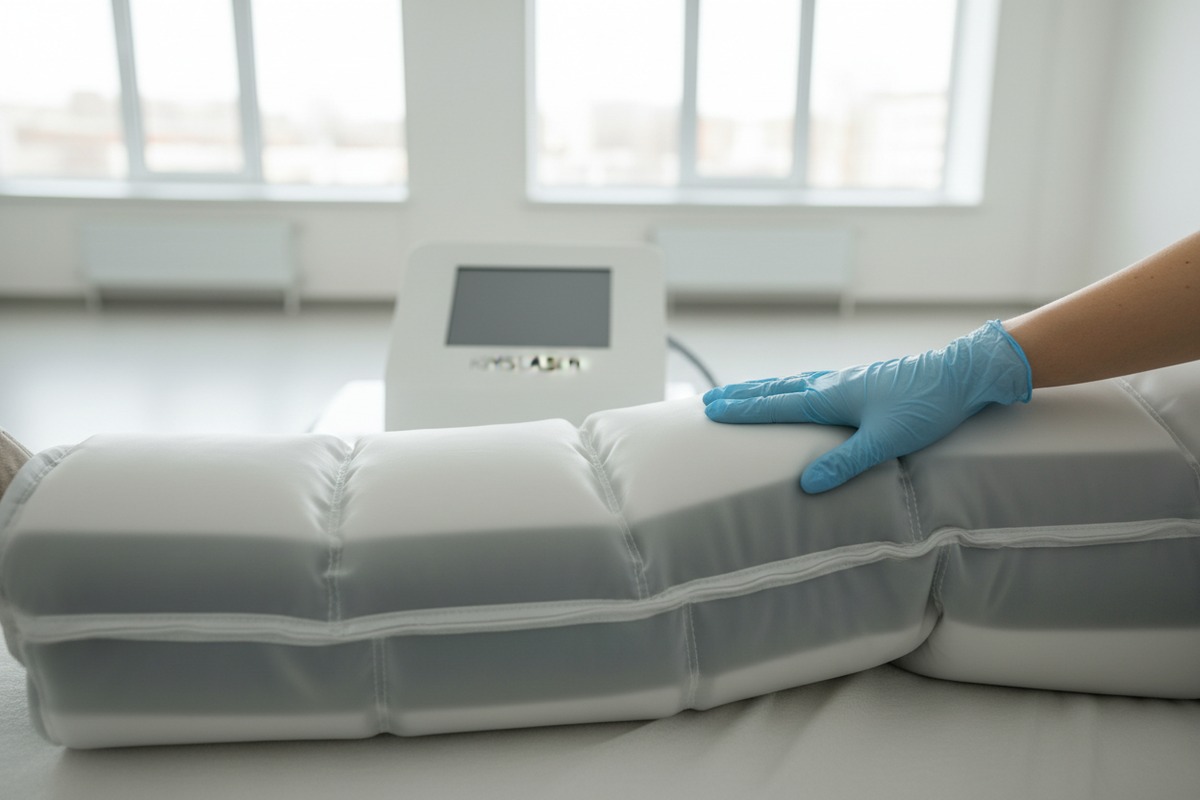
When equipping a classroom, the gap between a “home-use” device and a “training-grade” device becomes obvious very quickly Original Equipment Manufacturer (OEM) services 5. Students need to understand the physiological impact of pressure. Therefore, the core specifications must allow for versatility lymphatic drainage training 6. We recommend focusing on three critical technical pillars: Chamber Count, Pressure Precision, and Noise Control.
Chamber Count and Overlap
For educational purposes, a 4-chamber suit is insufficient. It compresses the entire leg in one go, which fails to teach the student about the progressive flow of lymph fluid. We recommend specifying 16 to 24 chambers. This high resolution allows the machine to create a smooth, wave-like gradient (peristaltic motion) that prevents backflow.
- Why it matters for schools: You can teach students how to treat specific blockages (e.g., knee or ankle edema) by activating only specific chambers.
- The Spec to Ask For: "Overlapping air chambers" (this prevents gaps in pressure between zones).
Pressure Range and Safety
Students often overestimate the pressure needed for results. A machine that caps at 120mmHg is too weak for body contouring demos, but a machine that starts at 80mmHg is too aggressive for sensitive lymphatic work.
- The Sweet Spot: Look for a range of 20mmHg to 200mmHg.
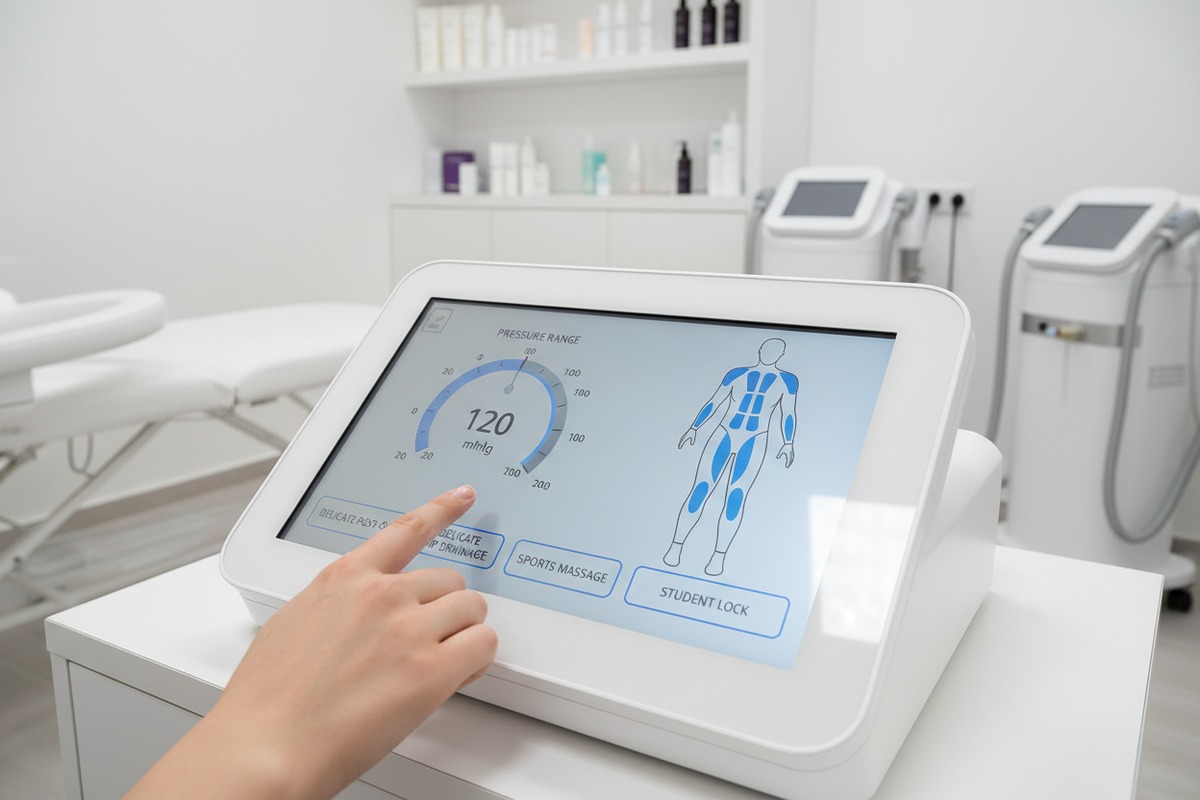
- Training Benefit: You can train students on delicate post-op drainage (low pressure) and sports massage (high pressure) using the same unit.
Noise Levels
In a classroom with 10 machines running simultaneously, noise becomes a major disruption. Standard compressors can reach 65dB.
- The Requirement: Specify "Silent Air Pump Technology" with a noise level below 50dB. This ensures the instructor can speak without shouting over the hum of compressors.
Technical Comparison Table
| Feature | Home Use Model | Standard Salon Model | Recommended School Training Model |
|---|---|---|---|
| Chambers | 4-8 Chambers | 12-16 Chambers | 16-24 Chambers (High Precision) |
| Pressure | Fixed or 3 Levels | 0-180mmHg | 20-200mmHg (Fully Adjustable) |
| Modes | 1-3 Basic Modes | 3-5 Modes | Pre-set + Custom "Student" Modes |
| Suit Material | Thin PVC | Standard Nylon | Heavy-duty TPU (Tear Resistant) |
| Noise | >60dB | ~55dB | <50dB (Classroom Friendly) |
How can I customize the machine interface and branding to match my school’s specific curriculum and aesthetic?
In our experience assisting large beauty academies with bulk orders, we realize that a generic interface often confuses beginners. We have developed software versions specifically for schools where the “Advanced” settings are hidden behind a passcode to prevent accidental injury during early learning stages.
You should request Original Equipment Manufacturer (OEM) services that allow you to upload your school’s logo to the boot screen and rename treatment programs to match your textbook terminology. This customization reinforces your brand identity and minimizes student confusion by aligning the machine’s software with your teaching materials.
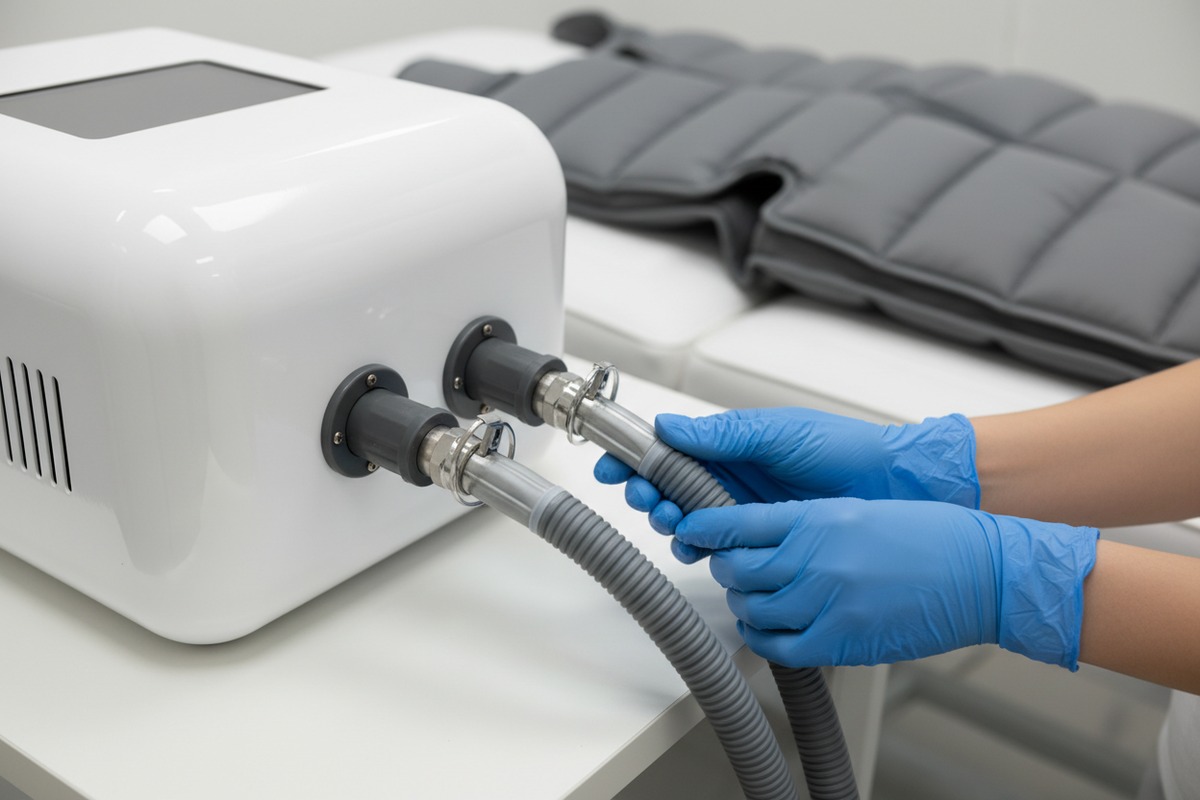
Customization goes beyond just slapping a sticker on the chassis. For a beauty school, the machine interface is a teaching tool. If your curriculum refers to a treatment as “Detox Drainage,” but the machine calls it “Mode B,” students will get confused. Customizing the digital interface bridges this gap.
Software Customization (GUI)
Modern pressotherapy machines, like our sleek white tabletop units, operate on touchscreen interfaces. This allows for significant flexibility.
- Terminology Alignment: We can reprogram the software so the mode names match your syllabus (e.g., "Introductory Flow," "Deep Tissue," "Cellulite Reduction").
- Startup Screen: Display your academy’s logo immediately upon powering on. This elevates the perceived value of the course and instills pride in students.
- Safety Locks: We can create a "Junior Mode" where pressure is capped at 60mmHg. As students pass exams, instructors can unlock "Pro Mode" with full capabilities. This prevents accidents during the first week of class.
Physical Branding & Aesthetics
Your training floor is a showroom for future professionals. The equipment should look cohesive.
- Chassis Color: While white is standard for a clinical look, we can mold the casing in your school’s brand colors for larger orders.
- Suit Labeling: We can print your logo directly onto the compression suits. This is excellent for marketing photos taken by students for social media.
Collaborative Development
Don't settle for "off-the-shelf." When working with a manufacturer, ask for the source files of the user manual.
- Pro Tip: Request a digital copy of the interface map. You can then print this out and include it in student workbooks, allowing them to study the machine's operation at home without the device present.
What quality control measures should I look for to guarantee my equipment survives heavy daily use by students?
We monitor the repair data from our international distributors, and the pattern is clear: educational units suffer three times the wear and tear of salon units. Students often yank air hoses by the tube rather than the connector, or force zippers closed. We have adjusted our production standards to mitigate these specific behaviors.
Demand proof of specific stress tests, such as 48-hour continuous aging tests for the air pump and zipper fatigue testing for the suits. Ensure the suits are made from high-density TPU rather than PVC, and look for reinforced, military-grade air connectors that resist breakage from forceful handling.
Durability in a training environment is non-negotiable. If a machine breaks during a practical exam, it affects a student’s grade and your school’s reputation. When evaluating a supplier’s quality control (QC), you need to look past the “CE Certificate” and ask about their internal stress testing. quality control measures 7
The Weakest Link: The Suit and Connectors
The console rarely fails; the accessories do.
- Material: Reject PVC suits. They crack over time and are prone to sweating. Specify TPU (Thermoplastic Polyurethane). It is flexible, easy to clean, and resists tears even when students clumsily pull at it.
- Zipper Quality: Ask for "YKK-grade" or equivalent heavy-duty zippers. The zipper is the number one failure point in pressotherapy suits.
- Hose Roots: The point where the air hose creates a junction with the suit is critical. We use a reinforced molded plastic strain relief here. Without this, students pulling on the hose will snap the air connection within months.
The "Aging Test"
Before any machine leaves our factory, it undergoes an "Aging Test." For salon orders, this might be 12 hours. For school orders, we recommend a 48-hour continuous run test. This ensures the air pump solenoid valves do not overheat or stick after prolonged use—a common scenario on days when you have back-to-back classes.
QC Checklist for Purchasing Managers
Use this table to audit your potential supplier:
| Component | Standard QC Check | School-Grade QC Requirement |
|---|---|---|
| Air Pump | Power on/off check | 48-hour continuous active cycle test |
| Suit Seams | Visual inspection | High-pressure inflation test (hold max pressure for 10 mins) |
| Zippers | Manual slide check | Fatigue test (1000+ open/close cycles) |
| Hoses | Airflow check | Tensile strength test on connectors |
| Screen | Touch sensitivity | Impact resistance check (hard plastic cover) |
Can my supplier provide the door-to-door logistics and OEM support I need for a seamless international rollout?
Our export department handles shipments to the US and Europe daily, and we know that purchasing managers like you dread customs delays. We recently helped a client in California who needed 20 machines for a semester start; by managing the DDP (Delivered Duty Paid) 8 terms ourselves, we ensured the equipment arrived directly at their loading dock without them filing a single customs form.
Yes, a capable supplier should offer DDP shipping terms to handle all customs clearance and duties for you. Additionally, require a structured support agreement that includes “train-the-trainer” video manuals and a spare parts “first-aid kit” (extra hoses and cuffs) shipped with the main order to minimize downtime.
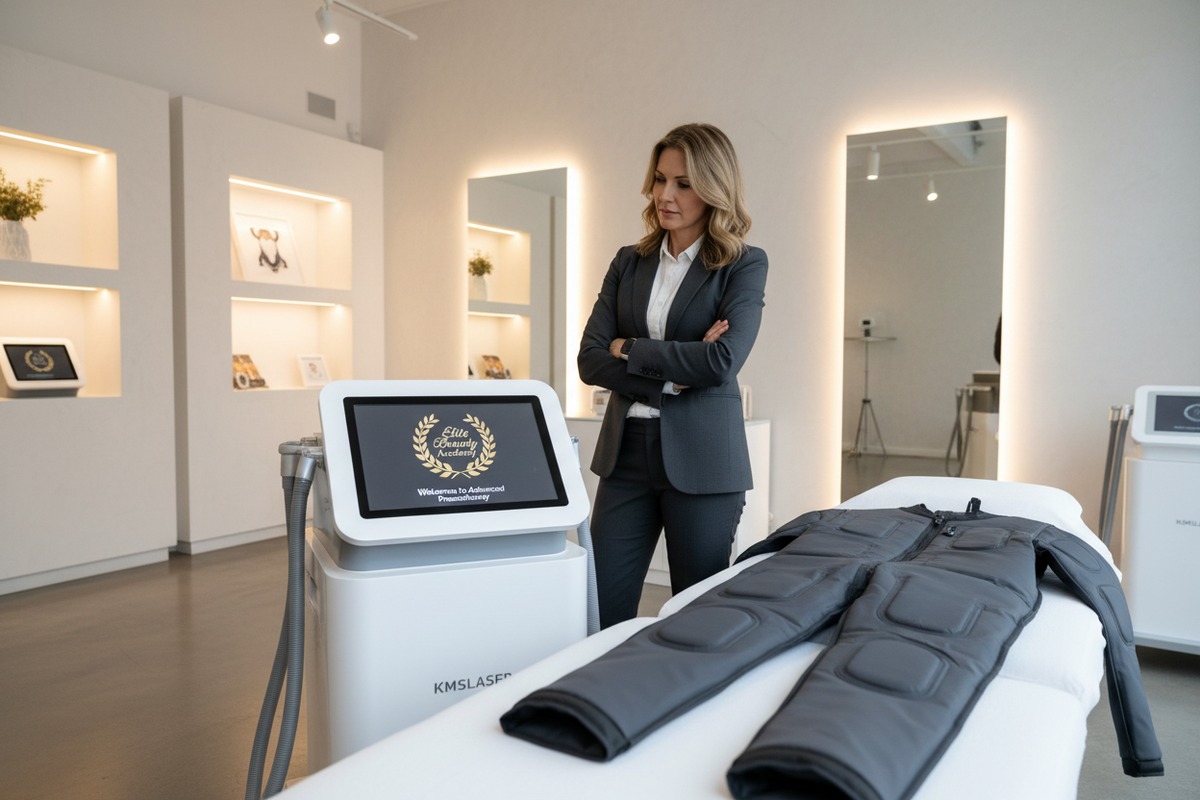
The best machine in the world is useless if it is stuck in Customs or if you cannot figure out how to assemble it. For a beauty school, logistics and after-sales support are just as important as the hardware specs.
Door-to-Door Logistics (DDP)
International trade jargon can be tricky. Many suppliers quote "FOB" or "EXW" prices, which look cheap but leave you responsible for shipping, insurance, and US Customs entry.
- The Solution: Insist on DDP (Delivered Duty Paid). This means the manufacturer takes full responsibility until the boxes are signed for at your school's reception. The price you pay is final, with no surprise tariffs or port fees.
The "First-Aid" Parts Kit
In a school, downtime is not an option. You cannot wait two weeks for a replacement hose to arrive from China.
- Our Strategy: We advise schools to purchase a "Maintenance Kit" with their initial order. This kit includes spare connector cables, two extra arm sleeves, and extra fuses.
- Modular Design: We design our machines so that parts can be swapped by a layperson. If a screen malfunctions, we can ship a new screen module that plugs in like a USB drive—no soldering required.
Training Support Materials
You need to train your instructors on how to use the machines before they can teach the students.
- Video Resources: A PDF manual is often ignored. We provide detailed video tutorials covering setup, basic maintenance, and troubleshooting.
- Direct Access: We offer WhatsApp support directly to your technical lead. If a machine acts up during a class, getting a real-time answer is invaluable.
Supplier Service Tier Table
| Service Aspect | Basic Supplier | Preferred Strategic Partner |
|---|---|---|
| Shipping | EXW/FOB (You handle customs) | DDP (Door-to-Door, Duties Included) |
| Spare Parts | Ordered as needed (slow) | Spare Parts Kit included with order |
| Support | Email (24-48hr response) | Instant Messenger / Video Call Support |
| Manuals | Generic English PDF | Custom Branded Video & Print Manuals |
Conclusion
Defining the technical specifications for pressotherapy machines in a beauty school setting requires a balance of durability, educational versatility, and smart branding. By prioritizing 16+ chambers for anatomical accuracy, insisting on TPU materials for longevity, and partnering with a manufacturer who understands the logistics of DDP shipping and OEM customization, you ensure your students train on the best equipment available. Investing in the right specs now prevents costly replacements and curriculum disruptions later.
Footnotes
1. Defines the wave-like muscle contractions relevant to lymph flow. ↩︎
2. Replaced with the main OSHA machine guarding overview page, an authoritative source that addresses safety concerns related to equipment use and potential hazards. ↩︎
3. Describes the properties and applications of TPU material. ↩︎
4. Replaced with a definition and overview of the lymphatic system from the National Cancer Institute, a highly authoritative .gov source. ↩︎
5. Replaced with the Wikipedia entry for Original Equipment Manufacturer, providing a comprehensive and accessible definition. ↩︎
6. Describes manual lymphatic drainage, a key concept for pressotherapy training. ↩︎
7. Explains the importance and methods of quality control in manufacturing. ↩︎
8. Defines DDP Incoterms and its implications for international shipping. ↩︎

 English
 Español de México
 Deutsch
 Français
 العربية
 Русский
